A workforce scheduling SaaS has 300 blog posts and 80,000 organic visits a month. Organic search brings it six demo requests a month. A smaller competitor with a tenth of the traffic gets around ten times the demos. The difference is in the page list: the competitor has 40 pages built for buyers who are already choosing, such as “[market leader] alternatives”, “shift scheduling software for clinics”, “pricing” and “integrates with [payroll tool]”. The first company writes for people learning about the topic. The second writes for people ready to buy.
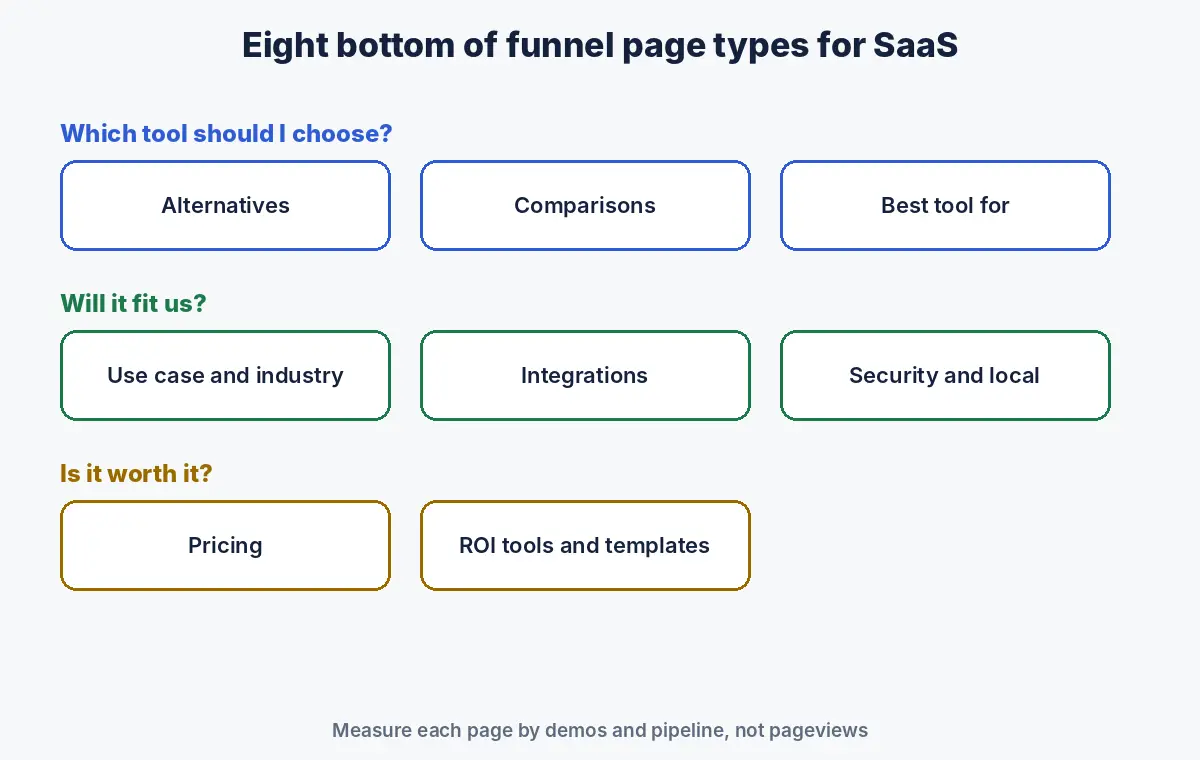
The short answer: bottom of funnel (BOFU) content for SaaS is the set of pages that answer buyers who are already evaluating a solution: alternatives and comparison pages, “best tool for [use case]” pages, pricing, use case and industry pages, integration pages, ROI and security pages. Build them from sales call language and your revenue keywords, make each one honest and specific, design every page around a demo or trial, and measure demos and pipeline per page instead of pageviews.
This guide is part of our series on search coverage, the SEO metric that ties rankings to revenue. It covers eight bottom of funnel page types, a page template, conversion elements and a measurement setup. Brand names in the examples are imaginary.
Why SaaS buyers need bottom of funnel content
Buyers want to self serve
A Gartner survey of 632 B2B buyers found that 61% prefer an overall rep free buying experience, and that 69% report inconsistencies between a supplier’s website and what its sellers tell them. Buyers are evaluating vendors on your website and in search results before they ever speak to sales. If your site only has awareness content, they evaluate you on someone else’s comparison page.
Funnel stages and what each should be measured on
| Stage | Buyer question | Example search | Measure by |
|---|---|---|---|
| Top of funnel | What is this problem? | how to reduce staff overtime | Reach, newsletter sign ups, assisted conversions |
| Middle of funnel | How do people solve it? | shift scheduling methods for hospitals | Engaged visits, return visits, assisted conversions |
| Bottom of funnel | Which tool should I choose? | [leader] alternatives for clinics | Demos, trials, pipeline, revenue |
Eight types of bottom of funnel SaaS content
1. Alternatives pages
Query pattern: “[competitor] alternatives”, “tools like [competitor]”. These searchers already know the category and are unhappy with, or unsure about, a specific product. Include why people look for alternatives (from real reviews and lost deal notes), a short list of genuine options including yours, who each suits, and pricing where public.
2. Comparison pages
Query pattern: “[you] vs [competitor]”, “[competitor A] vs [competitor B]”. Use a feature table, but lead with the difference that matters most for a specific buyer: “Choose [competitor] if you need X; choose [you] if you need Y.” Honest comparisons convert better and are cited more often by AI assistants than one sided ones.
3. “Best tool for” pages
Query pattern: “best [category] for [audience or use case]”, such as “best scheduling software for dental clinics”. Explain the selection criteria, review real options including competitors, and say where yours fits. A list that only praises your own product will not rank or be trusted.
4. Pricing page and pricing explainers
Query pattern: “[you] pricing”, “[category] cost”, “how much does [category] cost”. Show prices or ranges, explain what drives cost, and answer the questions sales hears most: contract length, setup fees, user limits. If you cannot publish prices, explain how pricing works and give typical ranges.
5. Use case and industry pages
Query pattern: “[category] for [industry]”, “[job to be done] software”. Each page should show the workflow for that audience with real screenshots, the problems specific to them, relevant integrations and proof from similar customers.
6. Integration pages
Query pattern: “[category] that integrates with [tool]”, “[tool] integration”. These searches signal a buyer checking fit with their stack. Explain what syncs, in which direction, how setup works and any limits.
7. ROI calculators and templates
Query pattern: “[category] ROI calculator”, “[process] template”. Tools and templates attract buyers building a business case. Tie them to the product: the calculator’s result should lead naturally to “see how [product] does this automatically”.
8. Security, compliance and local pages
Query pattern: “[category] data residency UAE”, “[you] security”, “[category] Arabic support”. Late stage buyers and their IT or legal teams search these. In the UAE and wider Gulf, data residency, Arabic language support and local payment and payroll rules are common deal breakers worth a page each.
Finding bottom of funnel topics
Start with sales and customer data
- Sales call recordings and notes: which competitors come up, which features decide deals, which objections stall them.
- Lost deal reasons: each common reason is a page, such as “we went with [competitor] because of X”.
- Onboarding questions: integrations and setup concerns buyers raise before signing.
- Review sites: what users praise and complain about for you and your competitors.
- Search and AI prompts: the comparison and “best for” questions buyers ask in search and in AI assistants.
Prioritise by revenue, not volume
Bottom of funnel keywords often have tiny search volumes: 30, 50 or 90 searches a month. That is normal. Score them by expected revenue, as described in our guide to building a revenue keyword set, and start with competitors and use cases that come up most often in sales conversations.
A template for an alternatives page
H1: [Competitor] alternatives for [audience] in [year if relevant]

Intro (3 sentences): who this page is for, why people look
for alternatives, and how options were chosen.

Quick comparison table: product, best for, starting price,
key strength, key limitation.

Why teams look for [Competitor] alternatives
  * Reason 1 (from reviews or lost deal notes)
  * Reason 2
  * Reason 3

The alternatives
  H3: [Your product]: best for [specific buyer]
      What it does well, honest limitations, pricing, screenshot
  H3: [Option 2]: best for [different buyer]
  H3: [Option 3]: best for [different buyer]

How to choose: 4 to 5 questions the buyer should ask

Switching from [Competitor]: migration steps, timeline, support

FAQs from sales calls

Call to action: see [product] with your own data (demo)
Designing bottom of funnel pages to convert
- One primary action: demo or trial, placed after the opening section and again at the end.
- Specific calls to action: “See shift scheduling for clinics in a 20 minute demo” converts better than “Contact us”.
- Short forms: ask only what sales needs to qualify the lead.
- Proof next to claims: customer logos you have permission to use, short quotes, numbers with dates.
- Real product screenshots for the exact workflow the page describes.
- Consistent facts: pricing and features must match what sales says, given how many buyers notice inconsistencies.
Bottom of funnel content and AI search
Buyers increasingly ask AI assistants the same bottom of funnel questions: “What are the best alternatives to [tool] for a 50 person clinic?” The answers draw on comparison pages, review sites and community threads. Clear, honest comparison and use case pages on your own site give AI tools accurate material to cite, and our guide to citation source mapping shows how to find the third party pages that also shape those answers.
Measuring demos from bottom of funnel content
What to track
| Metric | How to get it |
|---|---|
| Demo and trial requests by landing page | Analytics key events by landing page, organic traffic only |
| Pages viewed before converting | Analytics path exploration or your marketing automation tool |
| Pipeline and revenue by first and last page | Pass the landing page into your CRM with every lead |
| Self reported source | A “How did you hear about us?” field with options for Google, ChatGPT and other AI tools, review sites and referrals |
| Revenue keyword coverage | Top 3 rankings for bottom of funnel keywords |
Illustrative example: a monthly BOFU report
| Page | Organic visits | Demos | Visit to demo rate | Pipeline (AED) |
|---|---|---|---|---|
| [Leader] alternatives | 620 | 19 | 3.1% | 380,000 |
| Scheduling software for clinics | 410 | 14 | 3.4% | 290,000 |
| Pricing | 900 | 22 | 2.4% | 410,000 |
| Payroll integration | 180 | 6 | 3.3% | 120,000 |
| Blog total (300 posts) | 78,000 | 6 | 0.01% | 95,000 |
The figures are imaginary, but the pattern is one I see in almost every SaaS audit: a handful of bottom of funnel pages outperform the entire blog on demos.
Common mistakes with bottom of funnel content
- Attacking competitors. Buyers and AI tools both discount one sided pages.
- Generic use case pages that swap the industry name and change nothing else.
- Gating everything. Buyers want to evaluate before talking to sales.
- Outdated comparisons. Review competitor features and pricing every quarter.
- Judging by traffic. A page with 200 visits and 8 demos is a success.
- Keeping a blog full of unrelated posts that dilute focus; see our guide to content pruning with conversion data.
How Crawl To Click builds bottom of funnel content
Crawl To Click is the SEO and AI visibility practice of Indu Priya, with more than 15 years of experience across the US, MENA and India. For SaaS and B2B clients, bottom of funnel content is where we start, because it is the fastest route from search to pipeline. We sit in on or review sales calls to collect competitor names, objections and use cases, score each topic by revenue potential, and write high intent content briefs that cover the buyer’s decision criteria, honest comparisons and the product workflow. Every page gets a specific demo or trial call to action, and we track demos, qualified leads and pipeline by landing page in custom dashboards, alongside AI mentions for the same comparison queries.
This is the approach behind one of our clearest results. For a B2B marketing software platform built from scratch, bottom of funnel content aimed at qualified leads was central to 10x growth in demos, and the platform now receives hundreds of demos a month from SEO and ChatGPT. Visitors arriving from AI assistants converted to demos at 14%, up from 8%. For a technical B2B product in a hard to crack category, the same focus produced recurring monthly demos from both Google and ChatGPT. Read more about us.
FAQs on bottom of funnel content for SaaS
What is bottom of funnel content in SaaS?
Content for buyers already choosing a solution: alternatives and comparison pages, best tool for a use case pages, pricing, use case and industry pages, integration pages, ROI tools and security or compliance pages.
Should SaaS companies write competitor comparison pages?
Yes, if they are honest and specific. Buyers search for comparisons when choosing, and balanced pages that explain who each product suits convert better and are more likely to be cited by AI assistants.
How many bottom of funnel pages does a SaaS site need?
It depends on your competitors, use cases and integrations. Many SaaS companies need 20 to 50 pages to cover their main competitors, industries and integrations, built in order of revenue potential.
Why do bottom of funnel keywords have low search volume?
Because they are specific. Fewer people search for a particular alternative or integration, but those who do are close to buying, so a small number of visits can produce many demos.
How do I measure demos from SEO content?
Track demo and trial requests by organic landing page in analytics, pass the landing page to your CRM with each lead, and add a self reported source field that includes Google and AI assistants.
Need bottom of funnel content that books demos?
Plenty of blog traffic but a thin demo pipeline? Book a strategy call and we will map the bottom of funnel pages your SaaS is missing, ranked by revenue potential.
Disclaimer: The scheduling software, competitors and all example figures are imaginary and for illustration only. Survey findings are summarised from the linked source. Client results come from work led by our founder and depend on market, product and execution.