Updated: October 2026. Prices checked this month and linked to their sources.
“AI SEO tool” now covers two very different kinds of software. Some tools use AI to do SEO work faster: researching keywords, writing briefs, optimising drafts and auditing sites. Others measure how your brand appears inside AI answers from ChatGPT, Gemini, Perplexity and Google’s AI features. Most teams need tools from the first group and one from the second, and buying the wrong kind is the most common mistake I see in audits.
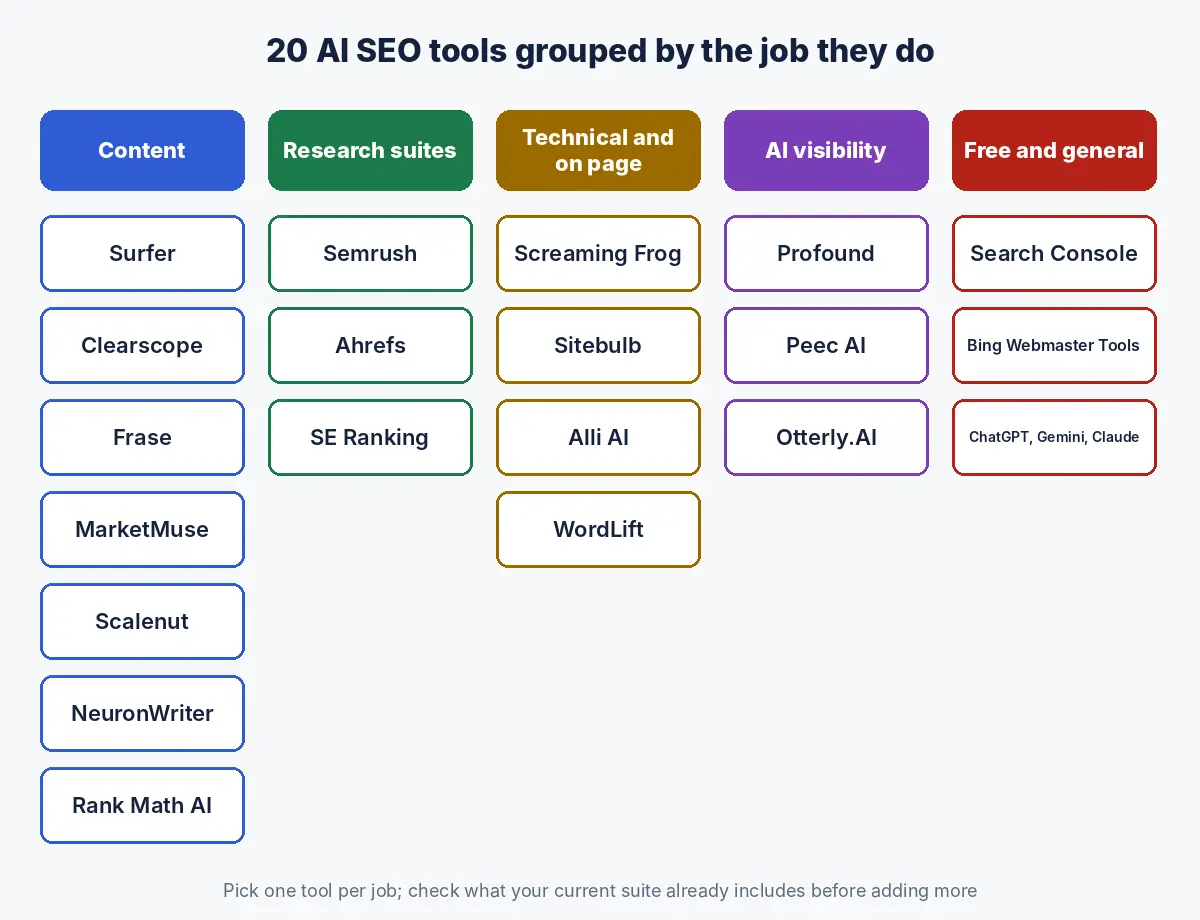
The short answer: the best AI SEO tools in 2026 are Surfer, Clearscope, Frase, MarketMuse, Scalenut, NeuronWriter and Rank Math Content AI for content; Semrush, Ahrefs and SE Ranking as all in one research suites; Screaming Frog, Sitebulb, Alli AI and WordLift for technical, on page and entity work; Profound, Peec AI and Otterly.AI for tracking AI search visibility; and Google Search Console, Bing Webmaster Tools and general assistants such as ChatGPT, Gemini and Claude as free or low cost essentials. Pick one tool per job rather than several that overlap.
What are the best AI SEO tools in 2026?
The best AI SEO tools in 2026 are the 20 below, grouped by the job they do. Starting prices were checked in October 2026 and are linked in each tool’s section.
| # | Tool | Job | Best for | Starting price |
|---|---|---|---|---|
| 1 | Surfer | Content | Optimising drafts against ranking pages | See vendor |
| 2 | Clearscope | Content | Simple content grading | $129 a month |
| 3 | Frase | Content | Briefs on a budget | $49 a month |
| 4 | MarketMuse | Content | Topic planning across a site | $99 a month per feature |
| 5 | Scalenut | Content | Content plus AI tracking in one | $59 a month |
| 6 | NeuronWriter | Content | Affordable content scoring | €19 a month |
| 7 | Rank Math Content AI | Content | AI help inside WordPress | Limited free uses; paid plans annual |
| 8 | Semrush | Research suite | All round SEO with an AI toolkit | $139.95 a month |
| 9 | Ahrefs | Research suite | Organic and backlink research | $129 a month |
| 10 | SE Ranking | Research suite | Value suite with AI search tracking | $103.20 a month, billed annually |
| 11 | Screaming Frog | Technical | Crawls with AI integrations | £199 a year |
| 12 | Sitebulb | Technical | Prioritised, explainable audits | $18 a month |
| 13 | Alli AI | On page automation | Applying on page changes at scale | $249 a month |
| 14 | WordLift | Entities and schema | Knowledge graphs and structured data | See vendor |
| 15 | Profound | AI visibility | Deep AI answer tracking | $99 a month |
| 16 | Peec AI | AI visibility | Tracking many prompts | $95 a month |
| 17 | Otterly.AI | AI visibility | Low cost AI tracking | $29 a month |
| 18 | Google Search Console | Free | AI Overviews and AI Mode impressions | Free |
| 19 | Bing Webmaster Tools | Free | Copilot citation data | Free |
| 20 | ChatGPT, Gemini and Claude | General assistants | Analysis, drafting and scripts | Free and paid plans |
What is the difference between AI SEO tools and AI visibility tools?
AI SEO tools use artificial intelligence to help you do search engine optimisation work; AI visibility tools measure how often and how accurately AI assistants mention and cite your brand. The first improves your pages; the second measures a new channel.
| AI SEO tools | AI visibility tools | |
|---|---|---|
| Main question answered | How do I research, write and fix pages faster? | Does ChatGPT, Gemini or Google’s AI mention us? |
| Typical outputs | Keyword clusters, briefs, content scores, audit findings | Mention rate, citations, sentiment, competitor share |
| Examples | Surfer, Frase, Semrush, Screaming Frog | Profound, Peec AI, Otterly.AI |
| Who uses them daily | SEO executives, writers, developers | SEO leads and marketing heads reporting on AI search |
Both matter because buyers now research in both places: ChatGPT reached 1 billion weekly users in 2026 (Yahoo Tech), and Google says AI Overviews passed 2.5 billion monthly users (Google). For a dedicated comparison of trackers, see our guide to AI visibility tracking tools.
How did we choose these AI SEO tools?
We chose these AI SEO tools on five criteria: a clear job to do, output you can verify, coverage of AI search, transparent pricing and fit for different team sizes.
- A real job: each tool solves a specific SEO or AI visibility task, not just “uses AI”.
- Verifiable output: recommendations backed by data you can check, such as rankings, crawl results or citations.
- AI search coverage: extra weight for tools that track or improve visibility in AI answers.
- Transparent pricing: published prices, or a clear route to a quote.
- Range of team sizes: options from freelancers to enterprises.
Prices come from vendor pages, Capterra and CostBench, as linked. AI tool pricing changes often, so confirm with the vendor before buying.
What are the best AI SEO tools for content writing and optimisation?
The best AI SEO tools for content are Surfer for optimising drafts, Clearscope for simple grading, Frase for briefs on a budget, MarketMuse for site wide topic planning, Scalenut for content plus AI tracking, NeuronWriter for affordable scoring and Rank Math Content AI for WordPress users.
1. Surfer: best for optimising drafts against ranking pages
Surfer scores drafts against the pages that rank for a keyword and suggests terms, structure and internal links. It works inside Google Docs and WordPress, which keeps writers in their usual editor.
- AI features: Content scoring, AI drafting, term and structure suggestions.
- Watch out for: Scores reward matching what already ranks; add original insight or the page will read like the others.
- Starting price: see Surfer pricing
2. Clearscope: best for simple content grading
Clearscope grades content for relevance and readability with a simple letter score that writers understand quickly, and includes tracked prompts for AI search.
- AI features: Content grading, term recommendations, AI search prompt tracking.
- Watch out for: Fewer extras than broader platforms; pricing suits teams publishing regularly.
- Starting price: $129 a month for Essentials, according to CostBench
3. Frase: best for briefs on a budget
Frase builds research briefs from the top results, pulling headings and questions into one view, then helps write and optimise the draft.
- AI features: Brief generation, AI writing, optimisation scoring.
- Watch out for: Briefs summarise what exists; you still need to decide what to add that competitors lack.
- Starting price: $49 a month, according to Capterra
4. MarketMuse: best for topic planning across a whole site
MarketMuse models topics across your site to show gaps, cannibalisation and update priorities, which makes it more of a planning tool than a writing tool.
- AI features: Topic modelling, content gap analysis, briefs.
- Watch out for: Most valuable for sites with large content libraries.
- Starting price: $99 a month per feature, according to Capterra
5. Scalenut: best for content creation plus AI tracking in one
Scalenut combines article creation and optimisation with prompt tracking in AI search, so small teams can cover both in one subscription. Compare it with similar tools in our guide to Scalenut alternatives.
- AI features: Long form drafting, optimisation, AI search prompt tracking.
- Watch out for: AI drafts need editing and fact checking before publishing.
- Starting price: $59 a month for Starter, according to Capterra
6. NeuronWriter: best for affordable content scoring
NeuronWriter offers term suggestions, competitor analysis and content scoring at a lower price than most content optimisers, which suits freelancers and small sites.
- AI features: Content scoring, term and question suggestions, AI writing.
- Watch out for: Interface and support are simpler than premium tools.
- Starting price: €19 a month for Basic, with Silver at €37 and Gold at €57, according to Capterra
7. Rank Math Content AI: best for AI help inside WordPress
Rank Math’s Content AI adds more than 40 AI tools inside the WordPress editor, including fixing failed SEO tests, keyword research, meta descriptions and image alt text, in over 30 languages.
- AI features: SEO test fixes, meta and alt text generation, keyword research, long form drafting.
- Watch out for: Monthly use limits depend on the plan, and unused uses do not roll over.
- Starting price: free plugin users get limited uses; paid plans are annual, according to Rank Math
What are the best AI SEO tools for keyword research and competitor analysis?
The best AI SEO tools for keyword research and competitor analysis are the all in one suites: Semrush for the broadest feature set, Ahrefs for organic and backlink research, and SE Ranking for value.
8. Semrush: best for all round SEO with an AI toolkit
Semrush combines keyword and competitor research, site audits, rank tracking and content tools, and its AI Toolkit tracks how AI tools describe brands.
- AI features: AI keyword insights, content tools, AI Toolkit for brand perception in AI answers.
- Watch out for: Check which AI features your plan includes; some are sold separately.
- Starting price: $139.95 a month for Pro, on the Semrush pricing page
9. Ahrefs: best for organic and backlink research
Ahrefs is strongest on backlinks, keyword research and competitor analysis, and adds Brand Radar for monitoring brand visibility in AI answers.
- AI features: AI content helper, keyword clustering, Brand Radar for AI visibility.
- Watch out for: Check which AI features your plan includes before relying on them.
- Starting price: $129 a month for Lite, $249 for Standard and $499 for Advanced, according to Capterra
10. SE Ranking: best for a value suite with AI search tracking
SE Ranking offers rank tracking, keyword research, a site audit, a content editor and AI search tracking at a lower price than the largest suites.
- AI features: AI search visibility tracking, AI writing in the content editor.
- Watch out for: Smaller databases than the largest suites in some markets.
- Starting price: $103.20 a month billed annually for Core, according to Capterra
What are the best AI SEO tools for technical audits and on page fixes?
The best AI SEO tools for technical work are Screaming Frog for crawling with AI integrations, Sitebulb for explainable audits, Alli AI for applying on page changes at scale and WordLift for entities and schema.
11. Screaming Frog: best for crawling with AI integrations
Screaming Frog’s version 23 connects to OpenAI, Gemini and Anthropic models during a crawl and uses embeddings for semantic similarity, which helps with redirect mapping, internal linking and spotting near duplicate pages. See our list of Screaming Frog alternatives for other crawlers.
- AI features: Custom AI prompts per URL, embeddings, semantic similarity.
- Watch out for: API costs for the AI models are separate from the licence.
- Starting price: £199 a year, on Screaming Frog pricing
12. Sitebulb: best for prioritised, explainable audits
Sitebulb explains every issue it finds and prioritises them, which makes technical findings easier to hand to developers and non specialists.
- AI features: Prioritised hints and explanations; cloud crawling on higher plans.
- Watch out for: Desktop plans suit single users; teams may need cloud plans.
- Starting price: $18 a month for Lite, according to Capterra
13. Alli AI: best for applying on page changes across many pages
Alli AI applies code and content changes across a site from one dashboard and works with any CMS, which helps teams that cannot get developer time for routine on page fixes.
- AI features: Bulk on page optimisation, automated changes, rank tracking.
- Watch out for: Changes made through a layer on top of your CMS should be documented so they are not lost in a migration.
- Starting price: $249 a month, according to Capterra
14. WordLift: best for entities and structured data
WordLift builds a knowledge graph of the entities on your site and outputs schema markup, helping search engines and AI systems understand who you are and what you cover.
- AI features: Entity extraction, knowledge graph, automated schema.
- Watch out for: Best value on content heavy sites; check schema matches visible content.
- Starting price: see WordLift
What are the best AI SEO tools for tracking AI search visibility?
The best tools for tracking AI search visibility are Profound for depth, Peec AI for tracking many prompts and Otterly.AI as a low cost starting point. Each runs a set of prompts across AI assistants and reports how often you are mentioned and cited.
15. Profound: best for deep AI answer tracking for larger brands
Profound tracks brand mentions, citations and sentiment across answer engines, with enterprise features for large brands and agencies.
- AI features: Mention and citation tracking, sentiment, multi engine coverage on higher plans.
- Watch out for: Starter covers one engine; multi engine tracking needs a higher plan.
- Starting price: $99 a month for Starter with 50 prompts on ChatGPT, $399 for Growth, according to Capterra (Capterra listing; a competing tool reported these self serve plans were withdrawn in September 2026, so confirm with Profound)
16. Peec AI: best for tracking many prompts
Peec AI tracks visibility, citations and competitor share across AI assistants, with source analysis showing which domains feed the answers.
- AI features: Prompt tracking, citation source analysis, competitor benchmarking.
- Watch out for: Prompt limits rise steeply by plan; plan your prompt set first.
- Starting price: $95 a month for 50 prompts, $245 for 150 and $495 for 350, according to Capterra
17. Otterly.AI: best for a low cost start in AI tracking
Otterly.AI monitors mentions and citations in ChatGPT, Google AI Overviews, Perplexity and Copilot, with Google AI Mode and Gemini available as add ons.
- AI features: Mention and citation monitoring, link citation reports.
- Watch out for: Entry plan prompt limits are small; useful for testing before committing.
- Starting price: $29 a month for 15 prompts, $189 for 100 and $489 for 400, according to Capterra
Whichever tracker you choose, sample enough prompts and runs: research by SparkToro and Gumshoe found AI tools returned the same list of brand recommendations twice less than 1 time in 100 (Search Engine Land). Our guide to LLM mentions per 100 queries explains how much sampling is enough.
Which free AI SEO tools are worth using?
The free AI SEO tools worth using first are Google Search Console, Bing Webmaster Tools and the free tiers of general AI assistants, because they give you first party data and analysis at no cost.
18. Google Search Console: best for seeing your visibility in Google’s AI features
Search Console is Google’s free reporting tool for your site. In June 2026 Google launched generative AI performance reports that show impressions in AI Overviews and AI Mode by page, country and device, rolling out to a subset of sites first (Google Search Central).
- AI features: Generative AI performance reports; AI feature data also included in overall Performance totals.
- Watch out for: Clicks were not yet listed in the AI reports at launch, and not every site has access.
- Starting price: free
19. Bing Webmaster Tools: best for Copilot citation data
Bing Webmaster Tools includes an AI Performance report showing how often your site is cited in Microsoft Copilot and Bing’s AI summaries, which pages are cited and sample grounding queries (Search Engine Land).
- AI features: Total citations, cited pages, grounding queries, trends over time.
- Watch out for: Covers Microsoft surfaces only, launched as a public preview.
- Starting price: free
20. ChatGPT, Gemini and Claude: best for analysis, drafting and scripts
General AI assistants are useful for clustering keywords, summarising Search Console exports, writing regex and Python scripts, drafting briefs and reviewing content against a checklist. Our list of ChatGPT prompts for SEO has 100 ready to use examples.
- AI features: Analysis of data you paste in, drafting, code.
- Watch out for: They have no live ranking or traffic data unless you provide it, and can state wrong figures confidently.
- Starting price: free and paid plans
How much do AI SEO tools cost?
AI SEO tools cost from free to several hundred dollars a month: entry plans start around $18 to $59, full research suites around $103 to $140, and specialist automation or enterprise tracking from about $249 upwards.
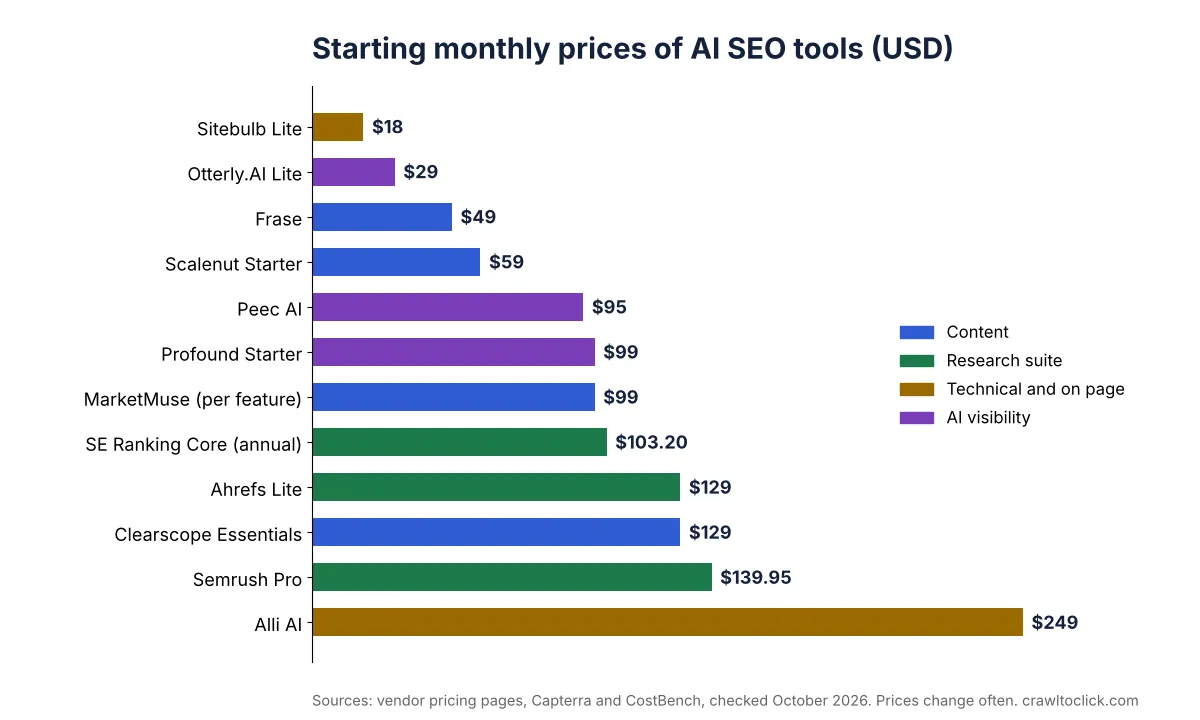
| Budget | What it buys | Example stack |
|---|---|---|
| Free | First party data and analysis | Search Console, Bing Webmaster Tools, a free AI assistant |
| Under $100 a month | One paid tool plus free tools | NeuronWriter or Frase, Otterly.AI Lite, Sitebulb Lite |
| $100 to $300 a month | A suite plus one specialist | SE Ranking or Ahrefs Lite, plus Peec AI or Frase |
| $300 to $800 a month | Suite, content tool and AI tracking | Semrush or Ahrefs, Surfer or Clearscope, Peec AI |
| Above $800 a month | Enterprise suites and tracking | Full suite, Profound at scale, MarketMuse, WordLift |
Which AI SEO stack fits your team?
The right AI SEO stack depends on team size: freelancers need one suite and free tools, small teams add a content tool and AI tracking, and agencies and enterprises add technical and entity tools at scale.
| Team | Suggested stack | Why |
|---|---|---|
| Founder or freelancer | SE Ranking or Ahrefs Lite, Otterly.AI Lite, Screaming Frog, Search Console, one AI assistant | Covers research, audits and a first look at AI visibility for little cost |
| Small marketing team | Semrush or Ahrefs, Frase or Surfer, Peec AI, Sitebulb | Adds content production and regular AI tracking |
| Agency | Semrush or Ahrefs, Surfer or Clearscope, Peec AI or Profound, Screaming Frog and Sitebulb | Multi client reporting and repeatable workflows |
| Enterprise | A full suite, Profound or Peec AI at scale, MarketMuse, an enterprise crawler, WordLift | Scale, governance and entity management |
What can AI SEO tools not do?
AI SEO tools cannot create expertise, guarantee rankings or AI mentions, or be trusted without checking. They speed up the work; they do not replace judgement.
- They cannot create expertise. Google’s guidance on helpful content rewards original information, research and first hand experience (Google Search Central), which no tool generates for you.
- They can produce content that breaks Google’s policies. Google says appropriate use of AI is fine (Google Search Central), but generating many pages without adding value counts as scaled content abuse (Google spam policies).
- They cannot guarantee AI mentions. Trackers measure visibility; consistent brand facts, useful pages and mentions on trusted sources change it.
- They can be confidently wrong. Check figures, facts and recommendations before acting.
- They overlap. Many suites now include content and AI tracking features, so audit what you already pay for before adding a tool.
How should you test an AI SEO tool before buying?
Test an AI SEO tool on a real task from your own site during the free trial, and compare its output with what you would have done manually.
- Pick one real task, such as a brief for a page you plan to write, an audit of one section or tracking 20 buying questions.
- Check the data against Search Console or your own analytics where possible.
- Time it. Did the tool save time once you include checking its output?
- Check overlap with tools you already pay for.
- Read the plan limits: prompts, credits, seats, projects and add ons.
Copy these prompts to test any AI assistant on SEO analysis:
1. Group these 200 keywords into clusters by search intent.
   Return a table: cluster name, intent, keywords, suggested page type.

2. Here is a Search Console export (query, page, clicks, impressions,
   position). List queries in positions 4 to 15 with over 500
   impressions, grouped by page.

3. Review this page against the brief below. List missing sections,
   unsupported claims and any facts that need a source.
How Crawl To Click uses AI SEO tools
Crawl To Click is an SEO and AI visibility consultancy, and we use AI tools throughout our work while keeping strategy in human hands. We use AI visibility trackers and Search Console’s AI reports to see where clients appear in AI answers, AI assistants and Python to process Search Console, analytics and crawl data at scale, and embedding based crawl analysis for internal linking and redirect mapping. What we do not automate is deciding which revenue keywords matter, what expertise each page needs and which sources to earn mentions from. We work in whatever stack a client already pays for, whether that is a software company, a healthcare provider, a property developer or an ecommerce brand, and we recommend new tools only when they fill a real gap. Learn more about our approach.
FAQs on AI SEO tools
What is the best AI SEO tool in 2026?
There is no single best AI SEO tool; it depends on the job. Semrush and Ahrefs are the strongest all round suites, Surfer and Clearscope lead for content optimisation, Screaming Frog for technical audits, and Profound, Peec AI and Otterly.AI for tracking AI search visibility.
What is the difference between AI SEO tools and AI visibility tools?
AI SEO tools use AI to help with search engine optimisation tasks such as research, writing and audits. AI visibility tools measure how often and how accurately AI assistants such as ChatGPT, Gemini and Google’s AI features mention and cite your brand.
Are there free AI SEO tools?
Yes. Google Search Console now includes generative AI performance reports for AI Overviews and AI Mode on eligible sites, Bing Webmaster Tools includes an AI Performance report for Copilot citations, and free tiers of ChatGPT, Gemini and Claude can analyse data you provide.
How much do AI SEO tools cost?
AI SEO tools range from free to several hundred dollars a month. Entry plans start around $18 to $59 a month, all in one suites around $103 to $140, and specialist automation or enterprise AI tracking from about $249 a month.
Can AI SEO tools write content that ranks?
AI tools can draft and optimise content, but pages rank and get cited when they add original information and experience. Google allows appropriate use of AI, but mass producing pages without added value counts as scaled content abuse.
Which AI SEO tool is best for small businesses?
Small businesses usually get most value from free tools such as Search Console and Bing Webmaster Tools, plus one affordable paid tool such as SE Ranking, NeuronWriter or Frase, and a low cost AI tracker such as Otterly.AI if AI visibility matters to their buyers.
Need help choosing your AI SEO stack?
Not sure which of these tools you actually need, or whether you are paying for overlap? Get a second pair of eyes on your stack and a recommendation based on your goals and budget.
Disclaimer: Prices and features were checked in October 2026 from the linked vendor pages and pricing trackers and may change. Always confirm current pricing and plan limits with the vendor.