The short answer: B2B SEO is the work of getting a business to business company found, shortlisted and contacted by the people who buy what it sells, through Google and, increasingly, AI assistants such as ChatGPT and Gemini. It differs from consumer SEO because search volumes are small, several people decide each purchase, sales cycles run for months, and success is measured in qualified pipeline rather than traffic.
It matters because buyers now decide early. In a 6sense study of more than 4,000 B2B buyers, 94% of buying groups had ranked their preferred vendors before first contacting a seller, and 77% went on to buy from that favourite (6sense). If you are not visible while buyers research, you are often not in the deal at all. This hub explains how B2B SEO works, what a strategy should contain, the pages and content that win, how AI search changes the work, what is different in the UAE, and how to measure it, with examples throughout.
What is B2B SEO?
B2B SEO is search engine optimisation for companies that sell to other businesses: making sure the website ranks and gets cited for the problems, solutions, categories and vendor comparisons that buying teams search for, and that those visits turn into demos, enquiries and sales conversations.
It covers the same foundations as any SEO, including technical health, content and authority, but the targeting is different. A B2B site rarely needs thousands of visitors; it needs the right fifty companies to find it, trust it and get in touch.
How is B2B SEO different from B2C SEO?
B2B SEO targets fewer, higher value searches made by several people over a long buying cycle, so it relies more on intent, proof and conversion paths than on traffic volume.
| Factor | B2C SEO | B2B SEO |
|---|---|---|
| Search volume | Often high | Often tens or hundreds a month per keyword |
| Who decides | One person | A buying group: user, manager, finance, IT, procurement |
| Buying cycle | Minutes to days | Weeks to many months |
| Main goal | Sales and revenue online | Qualified leads, demos and pipeline |
| Content that wins | Product pages, reviews, guides | Solution pages, comparisons, case studies, pricing, proof |
| Measurement | Ecommerce revenue in analytics | CRM pipeline and closed revenue from organic |
| Value of one conversion | Low to medium | Often very high |
How do B2B buyers research vendors today?
B2B buyers research mostly on their own, use several sources, and increasingly start with AI. A Gartner survey of 645 B2B buyers found that 45% used generative AI in their purchases, mainly to research vendors and products, that buyers used an average of seven information sources per purchase, and that 69% turned to sales reps to validate what AI told them (Gartner).
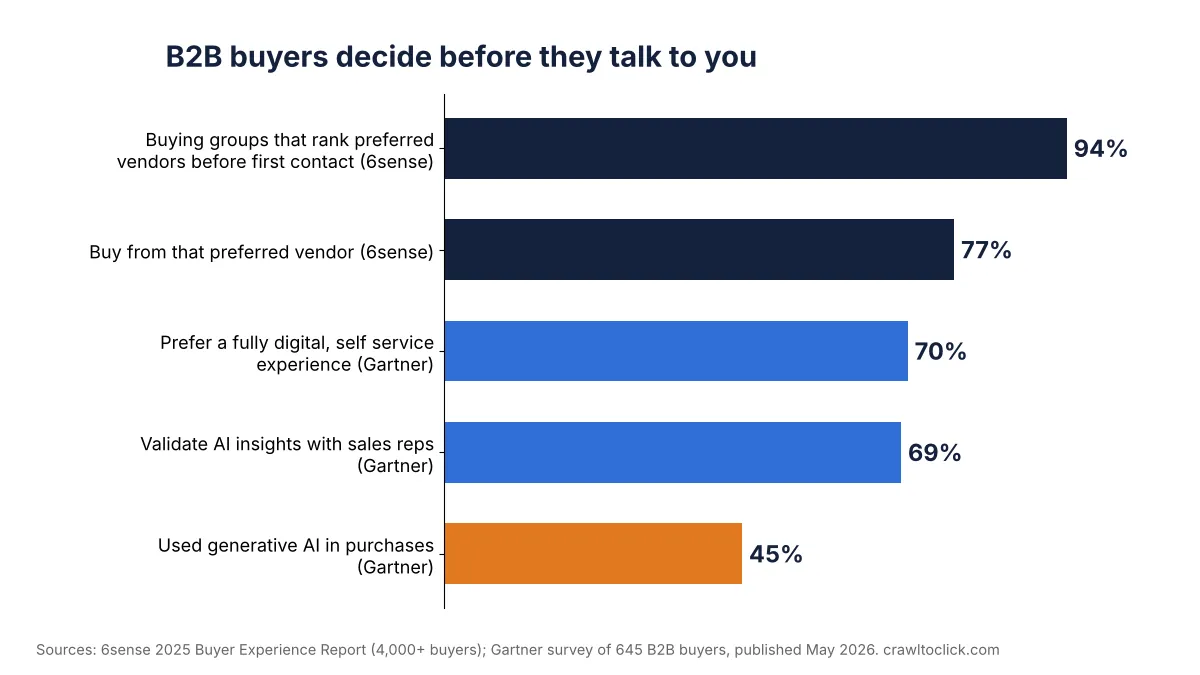
The same Gartner survey found 70% of buyers prefer a fully digital, self service experience (Gartner). For SEO this means three things: your site must answer buyer questions without forcing a sales call, your company needs to appear in the AI answers buyers start with, and the facts AI repeats about you need to be accurate, because buyers will check them with your team.
What results can B2B SEO realistically deliver?
B2B SEO delivers qualified enquiries from buyers already looking for what you sell, usually starting with a few high intent pages within months and compounding over a year or more; it rarely delivers large traffic, and it should not be judged on traffic.
A simple illustrative calculation shows why small numbers matter. The figures below are made up for a fictional Dubai software company, not a real client:
| Step | Illustrative figure |
|---|---|
| Monthly organic visits to solution, comparison and pricing pages | 1,200 |
| Visit to enquiry rate | 1.5%, so 18 enquiries |
| Enquiries that become qualified opportunities | 40%, so about 7 |
| Opportunities won | 20%, so about 1.4 deals a month |
| Average annual contract value | AED 60,000 |
| Revenue from one month of organic opportunities | About AED 84,000 a year |
Run the same calculation with your own conversion rates and deal values before committing a budget. Once the work starts, track the real figures; our guide to measuring B2B SEO shows the GA4 and CRM setup.
How do you build a B2B SEO strategy?
Build a B2B SEO strategy in six steps: define who buys, find the searches that lead to revenue, map them to the right page types, create proof led content for each stage, make the site technically sound and visible to AI, and measure pipeline in your CRM.
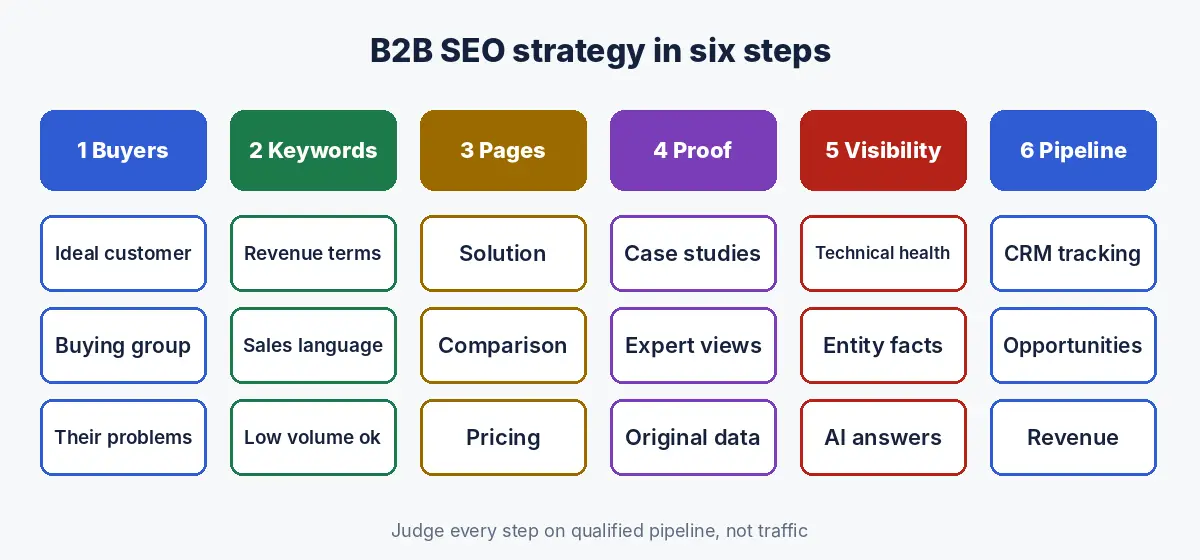
- Define buyers and the buying group. List your ideal customer profile, the roles involved in a purchase, and the problems each role searches for.
- Build a revenue keyword set. Start from what buyers search when they are close to buying, not from the biggest volumes; see our guide to building a revenue keyword set.
- Map keywords to page types. Solution, industry, use case, comparison, pricing and integration pages each serve a different search.
- Create proof led content. Case studies, data, process explanations and expert views that a generic competitor cannot copy.
- Fix technical health and AI visibility. Crawlable, fast pages, clear entity information and content AI assistants can quote.
- Measure pipeline. Connect organic landing pages to CRM opportunities and revenue, not just form fills.
This is the core of our Search Market Fit approach: publish for the searches that can convert, and stop publishing for volume. Tracking search coverage, the share of that revenue demand you actually own, shows whether it is working.
What pages should a B2B website have for SEO?
A B2B website needs pages for each way buyers search: by solution, by industry, by use case, by comparison, by price and by integration, plus proof pages that support all of them. Our guide to B2B solution and service pages gives a template for the most important of these.
| Page type | Example search | Buyer stage | What the page must include |
|---|---|---|---|
| Solution or service page | warehouse management software UAE | Ready to compare | What it does, who it is for, proof, pricing approach, clear next step |
| Industry page | logistics software for freight forwarders | Solution aware | Industry problems, examples, relevant case studies |
| Use case page | track shipments across Jebel Ali and Khalifa Port | Problem aware | The problem, how you solve it, results |
| Comparison page | [your brand] vs [competitor] | Final shortlist | Honest comparison table, who each suits |
| Alternatives page | [competitor] alternatives | Switching | Why buyers switch, migration process |
| Pricing page | [category] pricing UAE | Budget check | Price ranges or model, what affects cost |
| Integration page | [your product] SAP integration | Technical check | What connects, how, limits |
| Case study | [industry] case study | Validation | Situation, approach, measurable results |
Most B2B sites have the solution page and a blog, and miss the comparison, pricing and integration pages buyers search just before contacting a vendor. Our guide to comparison and alternatives pages covers the highest intent of these, with templates and examples.
How do you do keyword research for B2B SEO?
Do B2B keyword research by buyer stage rather than volume: list problem, solution, category, comparison and pricing searches for each role in the buying group, check them against Search Console and sales conversations, and accept that the most valuable keywords often show low or zero volume in tools.
| Keyword type | Example (illustrative) | Typical volume | Value |
|---|---|---|---|
| Problem | how to reduce container detention charges | Low | Early demand, good for guides |
| Solution | freight management software | Medium | High, core solution page |
| Category plus location | freight management software Dubai | Low | Very high, local buyers |
| Comparison | [tool A] vs [tool B] | Low | Very high, shortlist stage |
| Pricing | freight software pricing | Low | Very high, budget stage |
| Role specific | freight software for finance teams | Very low | High, supports the buying group |
The best source of B2B keywords is often the sales team: the exact phrases prospects use on calls, in emails and in RFPs. A keyword showing zero volume in a tool can still bring the one enquiry that pays for a year of SEO. Our guide to B2B keyword research shows how to turn sales conversations into a keyword map.
What content works for B2B SEO across a long sales cycle?
Content works when it answers the question each member of the buying group has at each stage, and when it carries proof a buyer can forward internally.
| Buying group role | What they search | Content that helps |
|---|---|---|
| User | How do I solve this problem? | Use case pages, how to guides, product walkthroughs |
| Manager or champion | Which options exist and which fits us? | Solution pages, comparisons, case studies |
| Finance | What does it cost and what is the return? | Pricing pages, ROI explanations, cost guides |
| IT and security | Will it integrate and is it secure? | Integration pages, security and compliance pages |
| Procurement | Is this vendor reliable? | About page, client logos where permitted, certifications, contract terms |
Google’s guidance asks whether content shows first hand expertise and adds original value compared with other pages (Google Search Central). In B2B that means named experts, real process detail and results, not generic definitions that any competitor could publish.
How do B2B companies get shortlisted by AI assistants?
B2B companies get shortlisted by AI assistants when the facts about them are consistent, specific and repeated on trusted sites: what they do, for whom, where, at what price level and with what proof, so an assistant can confidently name them for a buyer’s question.
- Publish clear facts: category, industries served, locations, integrations, pricing model and certifications on your own pages.
- Answer comparison questions yourself: honest comparison and alternatives pages are often what assistants summarise.
- Earn third party mentions: industry media, review platforms, partner directories, analyst lists and community discussions.
- Keep entity information consistent: the same name, description and facts on your site, LinkedIn, directories and profiles.
- Test regularly: ask ChatGPT and Gemini the questions your buyers ask and record who gets named.
Entity SEO shapes how assistants decide which brands to recommend, and our guide to B2B AEO shows how to get shortlisted by ChatGPT and Gemini step by step.
What is different about B2B SEO in the UAE?
B2B SEO in the UAE has to serve a multinational buyer base, location specific searches across emirates and free zones, buyers who may search in English or Arabic, and sectors where trust signals such as licences and certifications decide shortlists.
| UAE factor | What it means for SEO | Example |
|---|---|---|
| Location searches | Buyers add emirate, city or zone names | logistics software Jebel Ali, accounting firm Abu Dhabi |
| Free zone and mainland buyers | Content for both setups where your service differs | Separate sections for free zone and mainland clients |
| Arabic searches | Arabic pages for sectors and buyers who search in Arabic, such as government related work | Arabic service pages reviewed by native editors |
| Regulated sectors | Licences and certifications are trust signals | Show licence numbers and certifications on service pages |
| Events | Major trade events drive seasonal searches and press coverage | Pages and press around major Dubai trade events in your sector |
| GCC expansion | Buyers compare vendors across the region | Country pages only where your offer differs by country |
Our guide to B2B SEO in the UAE covers each of these local factors in detail, with examples of location pages, Arabic priorities and trust signals.
How do you measure B2B SEO?
Measure B2B SEO in your CRM, not only in analytics: track organic visits to commercial pages, enquiries and demos from organic, qualified opportunities, pipeline value and closed revenue, and add AI visibility for your key buyer questions.
| Metric | Where it comes from | Why it matters |
|---|---|---|
| Rankings and clicks for revenue keywords | Search Console | Shows visibility where buying happens |
| Organic visits to commercial pages | Analytics | Traffic that can convert |
| Organic enquiries and demo requests | Analytics and forms | First business outcome |
| Qualified opportunities from organic | CRM | Filters out poor fit leads |
| Pipeline value and won revenue from organic | CRM | The number leadership cares about |
| AI mentions for buyer questions | Regular prompt testing | Shortlisting in AI assistants |
Add a “How did you hear about us?” field to forms and ask on first calls. Buyers who researched in AI assistants often arrive as direct or branded search visits, and self reported attribution catches what analytics misses.
What does a 90 day B2B SEO plan look like?
The plan below is illustrative, for a fictional Dubai logistics software company, not a real client. It shows the order of work: fix and measure first, then commercial pages, then proof and authority.
| Period | Focus | Deliverables |
|---|---|---|
| Days 1 to 30 | Foundations | Technical audit and fixes; CRM tracking for organic leads; revenue keyword set of 100 terms; AI visibility baseline for 25 buyer questions |
| Days 31 to 60 | Commercial pages | Rewrite 5 solution pages; add pricing page; 2 comparison pages; 3 industry pages for freight, warehousing and ecommerce logistics |
| Days 61 to 90 | Proof and authority | 3 case studies with results; integration pages; pitches to regional logistics media; Arabic versions of top 3 solution pages |
What are the most common B2B SEO mistakes?
| Mistake | Fix |
|---|---|
| Chasing high volume, top of funnel keywords | Start with revenue keywords and commercial pages |
| One solution page for every audience | Add industry, use case and role specific pages |
| No comparison or pricing pages | Answer the questions buyers ask before calling |
| Generic blog content written for volume | Publish proof led content with real expertise |
| Reporting traffic instead of pipeline | Connect organic leads to CRM opportunities |
| Ignoring AI assistants | Test buyer questions and fix the facts AI repeats |
Community channels such as Reddit and LinkedIn can also feed B2B SEO and AI visibility when handled carefully.
How Crawl To Click approaches B2B SEO
Crawl To Click is an SEO and AI visibility consultancy, and our B2B work starts with revenue rather than traffic. We map the buying group and the searches that precede a sales conversation, build a revenue keyword set, then fix or create the solution, industry, comparison, pricing and proof pages buyers need. We connect organic leads to the CRM so every recommendation is judged on pipeline, and we test what ChatGPT and Gemini say about the company for the questions buyers ask.
We apply this to B2B software companies, logistics and supply chain businesses, healthcare technology firms, professional services, manufacturing and industrial suppliers, and education technology companies in the UAE and India.
FAQs on B2B SEO
What is B2B SEO?
B2B SEO is search engine optimisation for companies that sell to other businesses. It focuses on ranking and being cited for the problem, solution, comparison and pricing searches buying teams make, and on turning those visits into qualified leads and pipeline.
How is B2B SEO different from B2C SEO?
B2B SEO targets fewer, higher value searches made by several decision makers over a long buying cycle. It relies more on solution, comparison, pricing and proof pages, and it is measured by qualified pipeline and revenue rather than traffic or online sales.
How long does B2B SEO take to show results?
High intent pages such as solution, comparison and pricing pages can start bringing enquiries within a few months, while broader authority and content results usually build over six to twelve months or more, depending on competition and the site’s starting point.
Is SEO worth it for B2B companies with low search volume?
Yes, when deal values are high. A keyword with a few searches a month can bring a buyer worth a large contract, so B2B SEO should be judged on the value of enquiries and pipeline, not on search volume.
What pages should a B2B website have for SEO?
A B2B website should have solution or service pages, industry pages, use case pages, comparison and alternatives pages, a pricing page, integration pages where relevant, and case studies that prove results.
How do B2B buyers use AI in research?
A Gartner survey published in May 2026 found that 45% of B2B buyers used generative AI in their purchases, mainly to research vendors and products, and that 69% turned to sales reps to validate what AI told them.
How do you measure B2B SEO success?
Measure B2B SEO by organic enquiries, qualified opportunities, pipeline value and won revenue in the CRM, alongside rankings for revenue keywords and visibility in AI assistants for key buyer questions.
Need help with B2B SEO?
Want SEO judged on pipeline, not traffic? Book a B2B SEO strategy call and get a clear view of which searches and pages can bring qualified buyers.
Disclaimer: Survey figures are from the studies cited. Examples, figures in the illustrative calculation and the 90 day plan are illustrative and do not describe a real business. Results depend on the market, competition and implementation.