The short answer: B2B comparison and alternatives pages are pages on your own site that compare your product or service with named competitors, or list alternatives to a competitor, for buyers who are already shortlisting. They work when they are honest: a clear answer on who each option suits, a fair comparison table, where the competitor is the better choice, pricing models, switching effort and proof. Built that way, they rank for high intent searches and give AI assistants accurate facts to repeat.
They matter because the shortlist is where B2B deals are won. In a 6sense study, 94% of buying groups ranked preferred vendors before contacting a seller (6sense), and in G2’s March 2026 survey, AI chatbots were the top source influencing B2B software shortlists (G2). This guide covers which comparison pages to build, how to choose competitors, a page template, an example, honesty and accuracy rules, and how these pages get cited by AI. It is part of our B2B SEO guide.
What are B2B comparison and alternatives pages?
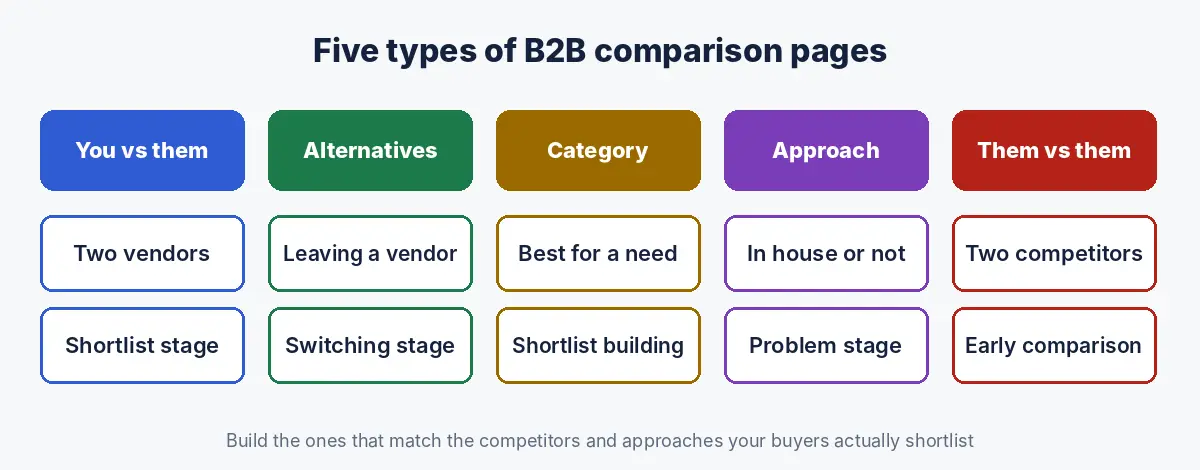
B2B comparison pages compare your company with one or more named competitors, and alternatives pages list options for buyers who are leaving or questioning a competitor; both target searches made at the shortlist and switching stages, when buyers are closest to a decision.
| Page type | Example search | Buyer situation |
|---|---|---|
| Brand vs competitor | [your brand] vs [competitor] | Comparing two shortlisted vendors |
| Competitor alternatives | [competitor] alternatives | Unhappy with or questioning a current or shortlisted vendor |
| Category comparison | best [category] for [company type] | Building a shortlist |
| Approach comparison | outsourced vs in house [service] | Deciding how to solve the problem |
| Competitor vs competitor | [competitor A] vs [competitor B] | Comparing two vendors you compete with |
Why do comparison pages matter for B2B SEO and AI search?
Comparison pages matter because they target buyers at the decision stage and because AI assistants use comparisons to build shortlists. G2 found 69% of B2B software buyers had chosen a different vendor than planned because of a chatbot recommendation (G2), so the comparisons AI reads, including yours, shape who gets picked.
Search volume is usually small, often a few dozen searches a month for a “vs” query, but the people searching are close to a decision. Our guide to bottom of funnel content explains why these pages often produce more pipeline than a blog many times their traffic. If you do not publish a comparison, buyers and AI assistants rely on your competitors’ versions or on third party lists you do not control.
How do you choose which competitors to compare against?
Choose competitors from your own deal data first, the vendors you meet most often in sales and lose to most often, then confirm demand with Search Console queries, keyword tools and AI prompt tests.
| Source | What to look for |
|---|---|
| CRM competitor field and lost deal reasons | Vendors that appear most often on shortlists and win against you |
| Sales team | Competitors prospects mention on calls and in RFPs |
| Search Console | Queries containing competitor names or “vs” that already show your pages |
| Keyword tools | Search demand for “vs” and “alternatives” queries in your category |
| AI assistants | Which competitors ChatGPT and Gemini name alongside you |
Start with three to five competitors. A comparison page for a vendor your buyers never consider wastes effort, however much search volume it has.
What should a B2B comparison page include?
A B2B comparison page should open with a direct answer on who each option suits, then give a fair comparison table, the main differences explained, where the competitor is the better fit, pricing models, switching effort, proof and FAQs, with a date showing when the comparison was last checked.
B2B COMPARISON PAGE TEMPLATE
H1: [Your brand] vs [Competitor]: [category] compared for [buyer type]

1. Direct answer (2 to 3 sentences)
   Choose [your brand] if ... Choose [competitor] if ...
   Last checked: [month year]

2. Comparison table
   Best for | Pricing model | Key features | Integrations |
   Implementation time | Support | Local presence | Languages

3. Main differences (one short section per difference)

4. Where [competitor] is the better choice (be specific)

5. Pricing compared (models and ranges from public sources)

6. Switching from [competitor] (effort, data migration, timeline)

7. Proof: case study or review quotes from customers who compared both

8. FAQs: questions buyers ask when comparing the two

9. Sources: links to the public pages the comparison relies on
This follows Google’s guidance for review and comparison content: discuss benefits and drawbacks based on your own research, explain what sets something apart, share quantitative measurements and cover which option suits which circumstances (Google Search Central).
What does a good B2B comparison table look like?
A good comparison table uses the criteria buyers actually decide on, states facts rather than ticks, and admits where the competitor is stronger. The example below compares two fictional freight software companies.
| Criteria | CargoLine (fictional) | FreightPro (fictional) |
|---|---|---|
| Best for | Mid size forwarders in the UAE and Saudi Arabia | Large global forwarders with complex multi country operations |
| Pricing model | Per user per month plus implementation fee | Annual enterprise licence |
| Implementation | 4 to 6 weeks for teams under 50 users | 3 to 6 months |
| Customs documents | UAE and Saudi customs formats built in | Global formats; regional formats through partners |
| Languages | English and Arabic interface | English, with more European languages |
| Local support | Dubai team, Gulf working hours | Regional partner network |
| Where FreightPro is stronger | Ocean carrier integrations and multi entity accounting at large scale |
The last row is the most important one. A comparison that admits the competitor’s strengths is more credible to buyers, more useful for AI assistants that cross check facts, and more defensible if the competitor objects.
How do you write a B2B alternatives page?
Write an alternatives page for buyers leaving or questioning a specific competitor: open with why buyers look for alternatives, list several genuine options including yours with who each suits, and explain switching, without pretending your product suits everyone.
EXAMPLE OPENING (fictional)
Looking for FreightPro alternatives?

Mid size forwarders usually look for FreightPro alternatives
for three reasons: long implementation times, annual contracts
that do not suit growing teams, and limited Gulf customs
formats. This page compares four alternatives, including
CargoLine, by who each suits, pricing model and switching
effort. Last checked: [month year].
Include real alternatives, not only your own product. Pages that list several genuine options are more useful to buyers and more likely to be trusted and cited than a page that is an advert in disguise.
How honest should B2B comparison pages be?
Comparison pages should be accurate, current and fair enough that a competitor’s customer would recognise the description. Base every claim on public sources or your own testing, link those sources, date the page, and avoid disparaging language; buyers check, with TrustRadius finding 94% of buyers who use AI check its answers at least some of the time (TrustRadius via HG Insights).
| Do | Avoid |
|---|---|
| Cite competitor pricing and features from their public pages | Claims you cannot support |
| Say where the competitor is better | Pretending you win on every criterion |
| Show the date the comparison was last checked | Leaving outdated pricing or features online |
| Describe differences neutrally | Disparaging language about the competitor |
| Have legal review competitor name use if you are unsure | Using competitor logos or trademarks in misleading ways |
Rules on comparative advertising and trademark use differ by country, so check with your legal adviser before publishing comparisons, especially in regulated sectors.
How do comparison pages get cited by AI assistants?
Comparison pages get cited by AI assistants when they answer the comparison directly, put differences in tables, state who each option suits, and match the facts found elsewhere about both companies. Assistants cross check, so a fair comparison that agrees with reviews and the competitor’s own site is more likely to be used than a one sided one.
- Lead with the answer: “Choose CargoLine if you are a mid size Gulf forwarder; choose FreightPro if you run complex global operations.”
- Use plain criteria names: pricing model, implementation time, integrations, languages, support location.
- Keep your own facts consistent with your pricing, product and about pages and your review profiles.
- Show a last checked date so assistants and buyers can judge freshness.
Our guide to B2B AEO covers the wider steps for getting shortlisted by ChatGPT and Gemini.
Where should comparison pages sit on a B2B website?
Give comparison and alternatives pages their own folders, link to them from solution and pricing pages, and add a comparison hub that lists them all, so buyers and search engines can find every comparison from the pages where shortlisting happens. Our guide to B2B solution and service pages shows where these links fit on each page.
example.com/compare/                         Comparison hub (lists all comparisons)
example.com/compare/cargoline-vs-freightpro/  Brand vs competitor
example.com/alternatives/freightpro/          Competitor alternatives
example.com/compare/in-house-vs-software/     Approach comparison
Linked from: solution pages, pricing page, relevant case studies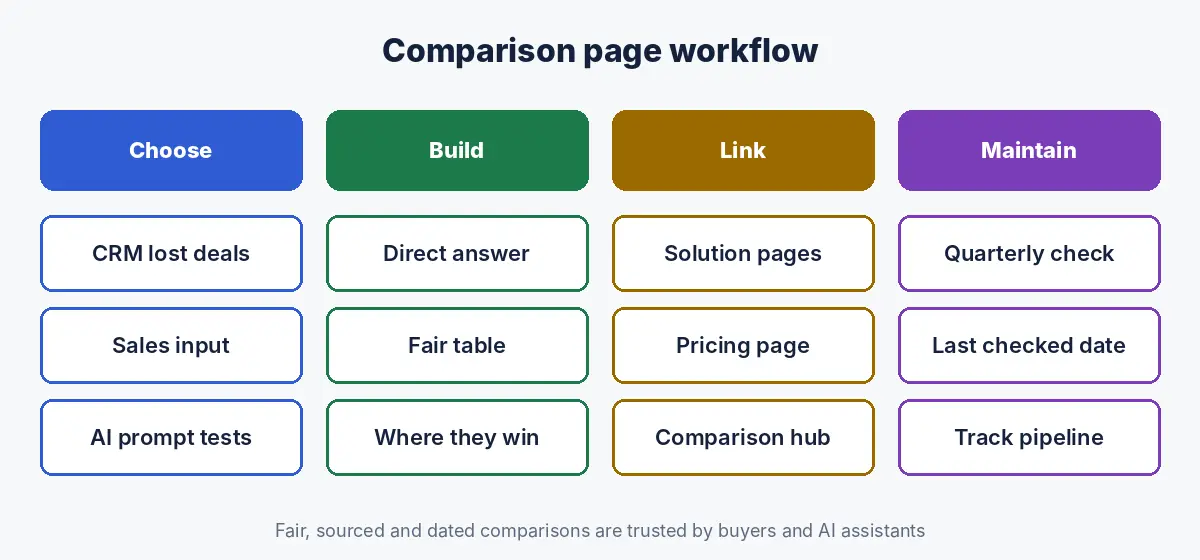
How do you keep comparison pages accurate?
Review every comparison page at least quarterly and whenever a competitor changes pricing, packaging or major features, and update the last checked date each time; outdated comparisons damage trust with buyers, competitors and AI assistants.
- Keep a source list for each page with the competitor URLs used.
- Set a quarterly reminder to recheck pricing and features.
- Ask sales to flag any comparison point a prospect challenges.
- Update the page and the last checked date, and note significant changes.
How do you measure comparison page performance?
Measure comparison pages by the leads, opportunities and pipeline they start, not by traffic. Tag them as their own page group in GA4 and your CRM so you can compare pipeline per visit with solution pages and the blog; our guide to measuring B2B SEO shows the setup.
What does a sample comparison content plan look like?
The plan below is illustrative, for the fictional CargoLine, not a real client. It starts with the competitors met most often in deals.
| Priority | Page | Why | Source of evidence |
|---|---|---|---|
| 1 | CargoLine vs FreightPro | Most common competitor in lost deals | CRM lost reasons, sales calls |
| 2 | FreightPro alternatives | Buyers leaving FreightPro mention long implementations | Sales calls, review sites |
| 3 | CargoLine vs ShipDesk (fictional) | Second most common shortlist competitor | CRM competitor field |
| 4 | Freight software vs spreadsheets | Smaller forwarders still use spreadsheets | Search Console queries, sales |
| 5 | Comparison hub | Links all comparisons from one page | Site architecture |
What are the common mistakes with B2B comparison pages?
| Mistake | Fix |
|---|---|
| Claiming to win on every criterion | Include where the competitor is the better choice |
| Ticks and crosses with no detail | State facts, numbers and conditions |
| Outdated competitor pricing | Quarterly checks and a last checked date |
| Comparing against vendors buyers never consider | Choose competitors from deal data |
| Pages hidden from navigation | Link from solution and pricing pages and a comparison hub |
| Alternatives pages that only promote you | List several genuine alternatives |
How Crawl To Click builds B2B comparison pages
Crawl To Click is an SEO and AI visibility consultancy, and we build comparison programmes from the client’s own deal data: which competitors appear on shortlists, why deals are lost, and what buyers and AI assistants say about each vendor. We then write fair, sourced comparison and alternatives pages with clear answers and tables, link them from solution and pricing pages, track their pipeline separately and keep them accurate with scheduled reviews.
We do this for B2B software companies, logistics and supply chain businesses, professional services firms, healthcare technology providers, industrial suppliers and education technology companies in the UAE and India.
FAQs on B2B comparison and alternatives pages
Should B2B companies create comparison pages against competitors?
Yes, for the competitors buyers actually shortlist against you. Fair, sourced comparison pages rank for high intent searches, help buyers decide and give AI assistants accurate facts, while leaving the comparison to competitors or third parties means you do not control it.
Is it legal to name competitors on comparison pages?
Comparative content is common, but rules on comparative advertising and trademark use differ by country. Keep every claim accurate and sourced, avoid disparaging language and misleading use of logos, and check with a legal adviser before publishing, especially in regulated sectors.
What should a B2B comparison page include?
A B2B comparison page should include a direct answer on who each option suits, a fair comparison table, the main differences, where the competitor is the better choice, pricing models, switching effort, customer proof, FAQs, sources and a last checked date.
What is the difference between a comparison page and an alternatives page?
A comparison page compares your company with a named competitor for buyers choosing between the two, while an alternatives page lists several options for buyers leaving or questioning a specific competitor.
Do comparison pages help with AI search?
Yes. AI assistants use comparisons to build vendor shortlists, and fair comparison pages that state who each option suits and match facts found elsewhere are more likely to be used in answers than one sided pages.
How often should comparison pages be updated?
Review comparison pages at least every quarter and whenever a competitor changes pricing, packaging or major features, and update the last checked date each time.
How many comparison pages should a B2B company create?
Start with three to five competitors chosen from your own deal data, the vendors you meet and lose to most often, plus an alternatives page for the most common one, then expand based on pipeline results.
Need help building comparison pages that win shortlists?
Losing deals to the same competitors and not sure how to compare yourself fairly? Book a strategy call and get a comparison page plan built from your deal data.
Disclaimer: This article is general guidance, not legal advice; check comparative advertising and trademark rules with a legal adviser. Survey figures are from the studies cited. Companies, products and plans in the examples are fictional.