The short answer: B2B AEO is the work of getting your company named when buyers ask AI assistants such as ChatGPT, Gemini, Perplexity and Copilot which vendors to consider. Assistants build shortlists from what the web says about you: your own pages, customer evidence, reviews and third party mentions, so B2B AEO means making those facts clear, consistent and easy to quote, then checking what assistants actually say.
It now shapes shortlists directly. In G2’s survey of 1,076 B2B software buyers in March 2026, AI chatbots were the top source influencing vendor shortlists, ahead of review sites, analyst firms and vendor websites, and 69% said they had chosen a different vendor than planned because it appeared in a chatbot’s recommendation (G2). This guide explains how assistants build B2B shortlists, the questions buyers ask, how to measure your visibility and a seven step playbook with examples. For the wider strategy, see our B2B SEO guide.
What is B2B AEO?
B2B AEO, or answer engine optimisation for business to business companies, is optimising your website and wider presence so AI assistants mention, describe and recommend your company accurately when buyers research a problem, a category or a vendor comparison.
It overlaps with B2B SEO, because assistants often search the web before answering, but the goal is different: instead of ranking a page, you want your company named in the answer, described correctly and linked as a source.
| B2B SEO | B2B AEO | |
|---|---|---|
| Goal | Rank pages for buyer searches | Be named and cited in AI answers |
| Where buyers see you | Search results | ChatGPT, Gemini, Perplexity, Copilot, Google AI Mode |
| Main inputs | Your pages, links, technical health | Your pages plus reviews, mentions, case studies and consistent facts |
| Measurement | Rankings, clicks, leads | Share of answers that name you, accuracy, cited sources, leads |
| Typical gap | Missing commercial pages | Missing or inconsistent facts and third party proof |
For the general method beyond B2B, see our guide to what AEO is.
Why does B2B AEO matter now?
B2B AEO matters because buyers increasingly start and shortlist in AI assistants. G2 found 51% of B2B software buyers now start research in an AI chatbot more often than in Google, up from 29% the year before, and 85% think more highly of a vendor when AI includes it in an answer (G2).
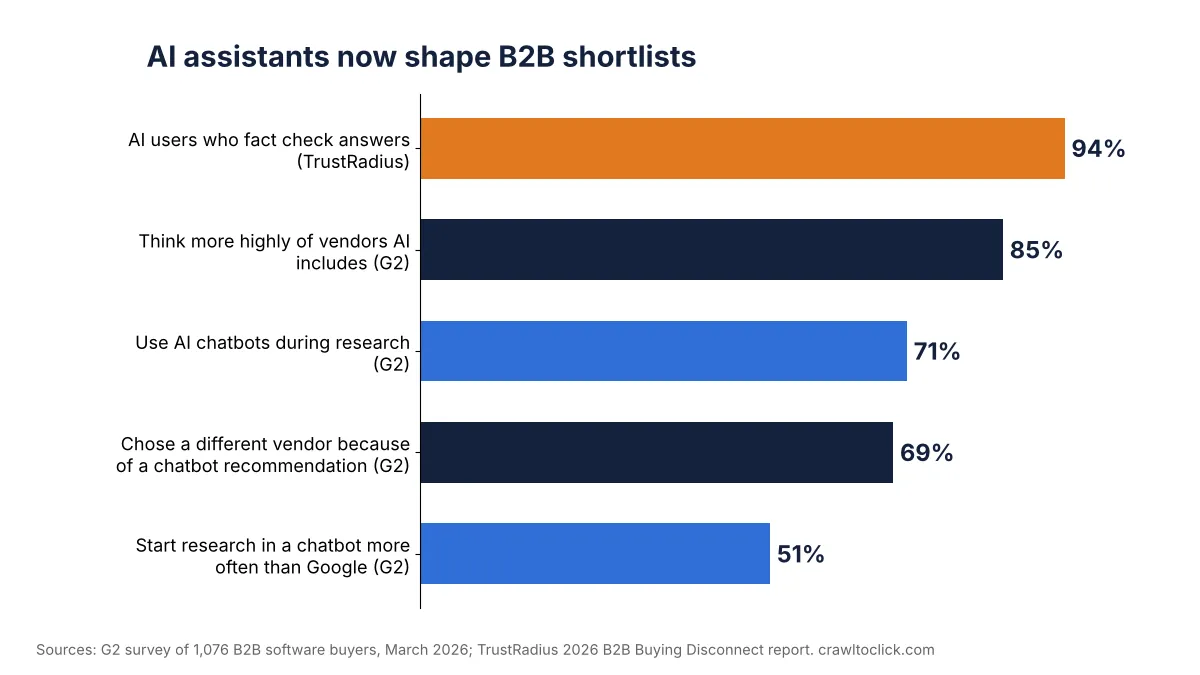
Buyers do not trust AI blindly. TrustRadius found 63% of tech buyers used AI during their purchase journey and 94% of them check its answers at least some of the time (TrustRadius via HG Insights), and Gartner found 69% of B2B buyers turn to sales reps to validate what AI told them (Gartner). So you need to be in the answer, and the answer needs to be right, because buyers will test it against your site and your sales team.
How do AI assistants build a B2B vendor shortlist?
AI assistants build a B2B shortlist by interpreting the buyer’s request, searching the web for relevant pages, reading vendor sites, comparison articles, review platforms and discussions, then naming the companies that appear repeatedly with consistent, specific facts that match the request.
- Interpret: the assistant turns “best freight software for a mid size forwarder in Dubai” into sub questions about category, size, location and features.
- Search: it looks for pages that answer those sub questions, often lists, comparisons, reviews and vendor pages.
- Cross check: it favours companies mentioned in several independent sources with matching facts.
- Answer: it names a few vendors with a reason for each and, depending on the assistant, links its sources.
Forrester’s advice reflects this: answer engines cross reference stories, mentions and data, favour original, expert and customer driven material, and reward consistent messaging, so vendors should refresh case studies, testimonials and reviews for AI discovery (Forrester).
What questions do B2B buyers ask AI assistants?
B2B buyers ask AI assistants problem, category, shortlist, comparison, pricing and validation questions, and you should know which of these your company appears in. The examples below are for a fictional freight software company in Dubai.
| Stage | Example prompt | What gets you named |
|---|---|---|
| Problem | How can a freight forwarder reduce manual data entry for shipments? | Guides that explain the problem and name your approach |
| Category | What software do freight forwarders in the UAE use? | Consistent category description and third party lists |
| Shortlist | Best freight management software for a mid size forwarder in Dubai | Comparison pages, reviews, regional mentions |
| Comparison | [your brand] vs [competitor] for freight forwarders | Your own honest comparison page and review data |
| Pricing | How much does freight management software cost in the UAE? | A pricing page with ranges or a clear model |
| Validation | Is [your brand] reliable? Who uses it? | Case studies, reviews, named clients where permitted |
Copy this prompt set and adapt it to your category. Run each prompt in ChatGPT, Gemini and Perplexity, and in Arabic where your buyers use it:
B2B AI VISIBILITY PROMPT SET (adapt the bracketed parts)
1. What is the best [category] for [company type] in [UAE / Dubai]?
2. Which [category] vendors work with [industry] companies in the GCC?
3. Compare [your brand], [competitor A] and [competitor B] for [use case].
4. What are alternatives to [competitor A] for [company size]?
5. How much does [category] cost for a [size] company in the UAE?
6. What do customers say about [your brand]?
7. Does [your brand] integrate with [system buyers use]?
8. Which [category] providers have an office in [Dubai / Abu Dhabi]?
9. [Problem question your buyers ask before they know the category]
10. Arabic version of prompts 1, 5 and 8 where buyers research in Arabic
How do you measure B2B AI visibility?
Measure B2B AI visibility by running a fixed set of buyer prompts in each assistant on a regular schedule, several times each because answers vary, and recording how often you are named, whether the description is accurate, which competitors appear and which sources are cited.
| Metric | How to calculate | Why it matters |
|---|---|---|
| Mention rate | Share of runs that name your company | Your presence on AI shortlists |
| Accuracy | Share of mentions with correct category, location, pricing and features | Wrong facts lose deals at validation |
| Competitor share | How often each competitor is named for the same prompts | Who you are losing shortlists to |
| Cited sources | Domains the assistant links or relies on | Where to earn mentions next |
| AI influenced leads | Leads who say they found you through an AI assistant | Business outcome |
Our AI visibility audit guide covers this method step by step, including how many runs to use so the numbers are reliable.
How do you get your B2B company shortlisted by AI assistants?
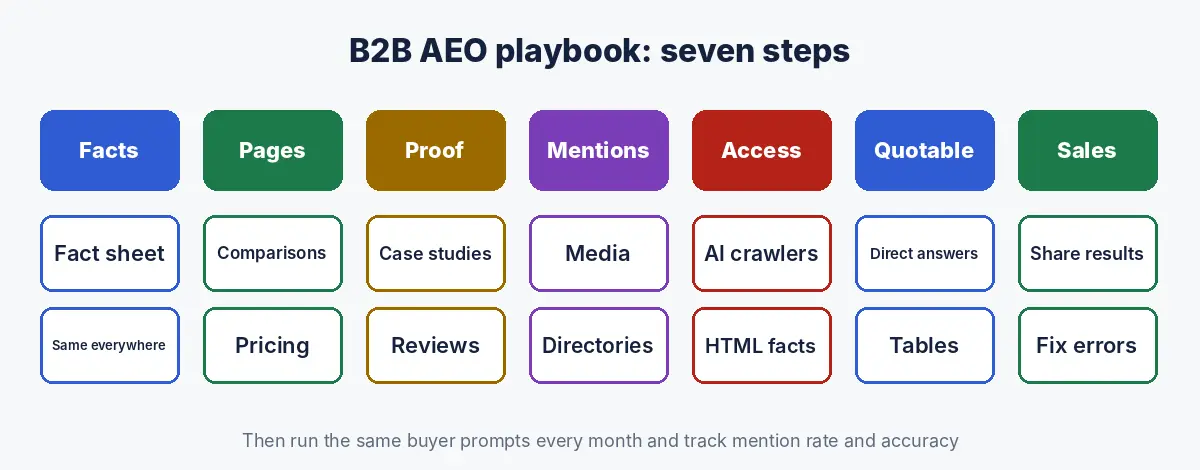
Follow seven steps: fix your facts, publish pages that answer shortlist questions, turn customer evidence into public proof, earn third party mentions, let AI crawlers in, make content easy to quote, and align sales with what AI says.
Step 1: Fix the facts AI repeats about your company
Write one fact sheet with your category, what you do, who you serve, industries, locations, integrations, pricing model, certifications and founding details, then make your website, LinkedIn page, directories and review profiles match it. Inconsistent facts are the most common reason assistants describe a B2B company wrongly.
BRAND FACT SHEET (example, fictional company)
Name: CargoLine
Category: Freight management software for freight forwarders
Serves: Mid size forwarders and NVOCCs in the UAE and Saudi Arabia
Locations: Office in Dubai; team in Riyadh
Core features: Shipment tracking, customs documents, invoicing
Integrations: Major accounting platforms and carrier APIs
Pricing model: Per user per month; implementation fee
Certifications: ISO 27001
Languages: English and Arabic interface
Our guide to entity SEO for AI search explains how to make these facts consistent across the web.
Step 2: Publish pages that answer shortlist questions
Assistants answer shortlist prompts from pages that compare options. Publish honest comparison pages, alternatives pages, a pricing page, integration pages and industry pages, each opening with a short, direct answer. Our guide to bottom of funnel content covers these page types.
| Before | After |
|---|---|
| CargoLine is an innovative, end to end platform transforming logistics for the modern enterprise. | CargoLine is freight management software for mid size freight forwarders in the UAE and Saudi Arabia. It handles shipment tracking, customs documents and invoicing in English and Arabic, integrates with major accounting platforms and is priced per user per month. Best for forwarders with 10 to 200 staff; not built for shipping lines. |
The after version gives an assistant facts it can match to a buyer’s request, including who the product is not for, which makes recommendations more accurate.
Step 3: Turn customer evidence into public proof
Publish case studies with the client’s industry, problem, approach and measurable results, collect reviews on the platforms your buyers use, and let customers describe outcomes in their own words. Forrester recommends refreshing existing testimonials and case studies for AI discovery rather than starting from scratch (Forrester). TrustRadius found 74% of tech buyers use reviews to inform decisions (TrustRadius via HG Insights).
Step 4: Earn third party mentions
Assistants trust what others say about you. Aim for mentions in industry media, regional business publications, analyst and partner directories, association member lists, conference speaker pages, podcasts and relevant community discussions. Each mention should use the same name and category as your fact sheet.
Community platforms can help when handled carefully; our Reddit SOP for B2B SaaS covers what to post and what to avoid.
Step 5: Let AI crawlers reach your pages
Check robots.txt allows the search crawlers AI assistants use, such as OpenAI’s OAI SearchBot, which OpenAI recommends allowing so your site can appear in ChatGPT search answers (OpenAI), and Bingbot, which feeds Microsoft’s search. Make sure key facts are in the page HTML, not hidden in PDFs, images or scripts that load later.
Step 6: Make content easy to quote
Open each section with a direct answer, use specific numbers and named examples, put comparisons in tables, and keep definitions short. An assistant can quote “implementation takes four to six weeks for teams under 50 users” but not “we deliver rapid, seamless onboarding”.
Step 7: Align sales with what AI says
Because 69% of B2B buyers validate AI insights with sales reps (Gartner), share your AI visibility results with the sales team: which competitors AI names, what it says about your pricing and features, and which facts are wrong. Add “AI assistant” as an option in your “How did you hear about us?” field so you can count AI influenced leads.
What does a sample B2B AI visibility report look like?
A B2B AI visibility report shows, for each prompt group, how often you are named, how accurately, who else appears and what to fix. The example below is illustrative, for the fictional CargoLine, not a real client.
| Prompt group | Mention rate | Accuracy issue | Competitors named | Main sources cited | Action |
|---|---|---|---|---|---|
| Best freight software Dubai | 2 of 10 runs | None | Two global vendors, one regional | Global software lists | Pitch regional logistics media; add UAE detail to comparison page |
| Alternatives to [competitor A] | 0 of 10 | Not named | Three global vendors | Review platforms | Collect reviews; publish alternatives page |
| CargoLine pricing | 6 of 10 | Old pricing model quoted | n/a | Old press release | Update pricing page; correct directory listings |
| Arabic: freight software UAE | 0 of 10 | Not named | One regional vendor | Arabic business news | Arabic product pages and Arabic press release |
The company and results above are illustrative, not a real client. For the UAE specific side, including Arabic prompts and regional sources, see our guide to B2B SEO in the UAE.
What are the common B2B AEO mistakes?
| Mistake | Fix |
|---|---|
| Vague positioning copy | State category, audience, location and pricing model plainly |
| Different descriptions on site, LinkedIn and directories | One fact sheet, applied everywhere |
| No comparison, alternatives or pricing pages | Answer shortlist questions on your own site |
| Case studies hidden behind forms | Publish key results openly; gate the full report if needed |
| Checking AI visibility once | Run a fixed prompt set monthly, several runs per prompt |
| Blocking AI search crawlers | Allow search crawlers that power AI answers |
| Sales unaware of what AI says | Share results and correct wrong facts at the source |
How Crawl To Click approaches B2B AEO
Crawl To Click is an SEO and AI visibility consultancy, and our B2B AEO work starts with a baseline: we run the buyer prompts that matter for the category in ChatGPT, Gemini, Perplexity and Google’s AI features, in English and Arabic, and record mentions, accuracy, competitors and cited sources. We then fix the brand facts, build the comparison, pricing and proof pages assistants draw on, turn customer evidence into public material, and target the third party sources that shape answers in the category, tracking AI influenced leads alongside organic pipeline.
We apply this to B2B software companies, logistics and supply chain businesses, professional services firms, healthcare technology providers, industrial suppliers and education technology companies in the UAE and India.
FAQs on B2B AEO
What is B2B AEO?
B2B AEO is answer engine optimisation for business to business companies: making sure AI assistants such as ChatGPT, Gemini, Perplexity and Copilot mention, describe and recommend your company accurately when buyers research a problem, category or vendor comparison.
Do B2B buyers really use ChatGPT to choose vendors?
Yes. In G2’s survey of 1,076 B2B software buyers in March 2026, 71% used AI chatbots during research, AI chatbots were the top source influencing vendor shortlists, and 69% had chosen a different vendor than planned because of a chatbot recommendation.
How do AI assistants decide which B2B vendors to recommend?
AI assistants interpret the buyer’s request, search the web, read vendor pages, comparisons, reviews and discussions, and name the companies that appear repeatedly with consistent, specific facts matching the request, often citing their sources.
How is B2B AEO different from B2B SEO?
B2B SEO aims to rank pages in search results, while B2B AEO aims to get the company named and correctly described in AI answers. AEO relies more on consistent facts, customer evidence, reviews and third party mentions, and is measured by mention rate and accuracy as well as leads.
How do I check if ChatGPT recommends my B2B company?
Run a fixed set of buyer prompts covering category, shortlist, comparison, pricing and validation questions in ChatGPT, Gemini and Perplexity, several runs each, and record how often you are named, whether the facts are correct and which competitors and sources appear.
What content helps B2B companies get cited by AI?
Clear solution pages, honest comparison and alternatives pages, pricing and integration pages, case studies with measurable results, reviews on the platforms buyers use, and mentions in industry media and directories, all using the same facts about the company.
How long does B2B AEO take to work?
Fixing wrong facts and publishing missing comparison or pricing pages can change some AI answers within weeks, while earning third party mentions and reviews that shift shortlists usually takes several months of consistent work.
Need help getting your company onto AI shortlists?
Want to know whether ChatGPT and Gemini name your company when buyers ask for vendors in your category? Request a B2B AI visibility review.
Disclaimer: Survey figures are from the studies cited and are self reported by respondents. AI assistant behaviour changes often and answers vary between runs. The company, prompts and results in the examples are illustrative.