The short answer: measure B2B SEO by following organic visitors all the way into your CRM: mark lead actions as key events in GA4, capture the original source and first landing page on every form, add a “How did you hear about us?” field, then report organic leads, qualified opportunities, pipeline value and won revenue by landing page group. Rankings and traffic are early signals; pipeline is the result.
This matters because B2B buying is long and mostly invisible. In a 6sense study of more than 4,000 buyers, 94% of buying groups had ranked their preferred vendors before first contact (6sense), so much of SEO’s influence happens before anyone fills in a form. This guide shows the metrics to track, the GA4 and CRM setup, code you can copy, how to handle attribution and long sales cycles, and a sample report. It is part of our B2B SEO guide.
Why is traffic the wrong metric for B2B SEO?
Traffic is the wrong headline metric for B2B SEO because a few visits from the right companies are worth more than thousands from people who will never buy, and blog traffic in particular rarely correlates with pipeline.
| Scenario | Traffic | Pipeline |
|---|---|---|
| Generic “what is” article ranking well | High | Usually low |
| Comparison page for two vendors in your category | Low | Often high |
| Pricing page | Low | High |
| Industry page for your best customer sector | Low to medium | High |
Report traffic only for the pages that can convert, and always next to the leads and pipeline those pages produce. Our guide to search coverage explains how to track visibility for the searches that matter commercially rather than overall traffic.
Which B2B SEO metrics matter at each stage?
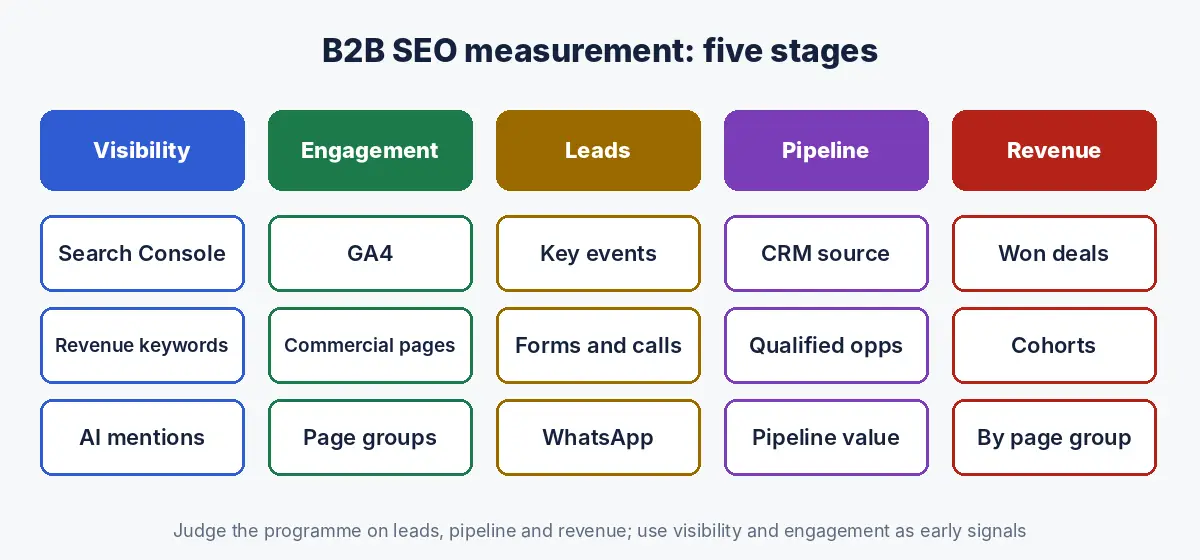
Track B2B SEO in five stages, from visibility to revenue, and judge the programme on the last three; the first two tell you whether the work is heading in the right direction.
| Stage | Metric | Source |
|---|---|---|
| Visibility | Rankings and impressions for revenue keywords; mentions in AI answers | Search Console; prompt testing |
| Engagement | Organic visits to solution, comparison, pricing and industry pages | GA4 |
| Leads | Organic form fills, demo requests, calls and WhatsApp clicks | GA4 key events and CRM |
| Pipeline | Qualified opportunities and pipeline value from organic | CRM |
| Revenue | Won deals and revenue from organic | CRM |
How do you set up GA4 to measure B2B SEO leads?
Mark every lead action as a key event in GA4, which Google defines as an event that measures an action particularly important to the success of your business (Google Analytics Help), and name them consistently so you can compare organic with other channels.
| Lead action | Suggested event name | Mark as key event? |
|---|---|---|
| Demo or consultation request form | demo_request | Yes |
| Contact or enquiry form | generate_lead | Yes |
| Pricing or proposal request | quote_request | Yes |
| Phone number click | phone_click | Yes |
| WhatsApp click (common in the UAE) | whatsapp_click | Yes |
| Brochure or case study download | file_download | Optional, as a soft lead |
| Newsletter sign up | sign_up | No, track separately |
If your forms do not send events automatically, push one to the data layer when the form submits successfully and fire a GA4 event tag from Google Tag Manager. A minimal example:
<script>
  // Fire after a successful form submission (not on button click)
  window.dataLayer = window.dataLayer || [];
  window.dataLayer.push({
    event: 'demo_request',
    form_name: 'Demo request',
    page_type: 'solution_page'   // solution_page, comparison, pricing, blog, industry
  });
</script>
The page_type value lets you report leads by page group later, which is how you show that comparison and pricing pages produce more pipeline per visit than the blog.
How do you pass the organic source into your CRM?
Capture the source on the form itself, because GA4 cannot follow a lead through to a closed deal. CRMs such as HubSpot record an Original Traffic Source for each contact, the first known web source through which they interacted with the business, with organic search as one value (HubSpot Knowledge Base). For other CRMs, store the first visit details in the browser and send them with the form in hidden fields.
This snippet stores the first landing page, referrer and UTM parameters on the first visit and fills hidden form fields with matching names. Adapt the field names to your form tool:
<script>
(function () {
  var KEY = 'first_touch';
  try {
    if (!localStorage.getItem(KEY)) {
      var p = new URLSearchParams(location.search);
      localStorage.setItem(KEY, JSON.stringify({
        landing_page: location.pathname,
        referrer: document.referrer || '(direct)',
        utm_source: p.get('utm_source') || '',
        utm_medium: p.get('utm_medium') || '',
        utm_campaign: p.get('utm_campaign') || '',
        first_visit: new Date().toISOString().slice(0, 10)
      }));
    }
    var data = JSON.parse(localStorage.getItem(KEY));
    document.addEventListener('DOMContentLoaded', function () {
      Object.keys(data).forEach(function (k) {
        document.querySelectorAll('input[name="' + k + '"]').forEach(function (el) {
          el.value = data[k];
        });
      });
    });
  } catch (e) {}
})();
</script>
A referrer from a search engine with no UTM parameters is organic search. A referrer from chatgpt.com, perplexity.ai, gemini.google.com or copilot.microsoft.com is an AI assistant visit, worth tracking as its own source. Check your cookie consent setup before storing visitor data, and keep the stored fields to what you need.
Why should B2B companies add self reported attribution?
Add a “How did you hear about us?” field because much of B2B research leaves no trackable click: buyers ask AI assistants, read LinkedIn posts, hear from peers and then type your name into Google, which analytics records as branded search or direct. In G2’s March 2026 survey, 69% of B2B software buyers said they had chosen a different vendor than planned because of a chatbot recommendation (G2), and many of those visits never show an AI referrer.
How did you hear about us? (single choice, required)
- Google or another search engine
- ChatGPT, Gemini, Perplexity or another AI assistant
- LinkedIn
- Referral from a colleague or partner
- Event or conference
- Industry article, podcast or directory
- Other (please specify)
Compare the answers with the tracked source. When many “direct” or “branded search” leads say they found you through an AI assistant or search, that is SEO and AEO influence your analytics was missing.
How do you connect organic landing pages to pipeline?
Join CRM opportunities to the first landing page and source captured on the lead, then group landing pages by type, so you can report organic pipeline by page group rather than for the website as a whole.
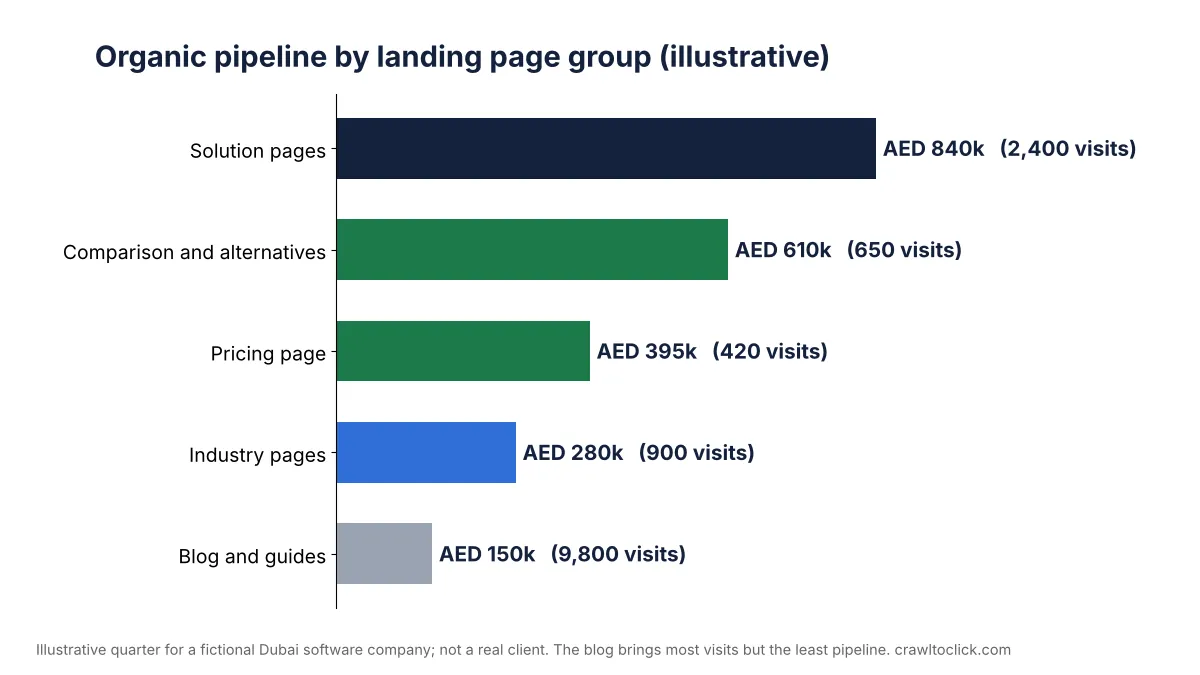
The illustrative example below is for a fictional Dubai software company, not a real client:
| Landing page group | Organic visits (quarter) | Organic leads | Qualified opportunities | Pipeline value (AED) |
|---|---|---|---|---|
| Solution pages | 2,400 | 38 | 14 | 840,000 |
| Comparison and alternatives | 650 | 21 | 10 | 610,000 |
| Pricing page | 420 | 17 | 7 | 395,000 |
| Industry pages | 900 | 12 | 5 | 280,000 |
| Blog and guides | 9,800 | 26 | 3 | 150,000 |
In this example the blog brings most of the traffic but the least pipeline, while comparison pages produce the most pipeline per visit. That is the evidence a B2B SEO plan should be built on.
How do you track revenue keywords in Search Console?
Group your revenue keywords in Search Console with a regular expression filter on queries, then track clicks, impressions and average position for that group each month instead of for the whole site. Build the list from the searches closest to buying; our guide to building a revenue keyword set shows how.
Search Console > Performance > Search results
Add filter > Query > Custom (regex) > Matches regex:

(pricing|price|cost|vs|alternative|alternatives|software|provider|company|agency|consultant|dubai|abu dhabi|uae)

Then add a Page filter for commercial URLs, for example:
(/solutions/|/pricing|/compare/|/industries/)
Adjust the terms to your category and language, and add Arabic terms if you have Arabic pages. Compare the filtered group month on month and year on year; a rising share of clicks on commercial queries is the clearest early sign that SEO will reach pipeline.
How do you track phone and WhatsApp leads from organic search?
Track phone and WhatsApp clicks as GA4 key events, and record the source on the conversation itself, because in the UAE many B2B buyers contact suppliers by phone or WhatsApp instead of filling in a form, and those leads disappear from SEO reports otherwise.
- Click events: fire phone_click and whatsapp_click events with the page type, so you know which pages start conversations.
- Prefilled WhatsApp messages: use a different prefilled message per page group, such as “Hi, I saw your pricing page”, so the team can log the source when the chat starts.
- Call logging: ask “How did you find us?” on first calls and record the answer in the CRM.
- Call tracking numbers: where call volume justifies it, show a dedicated number to organic visitors and report calls by source.
Which attribution model should B2B SEO use?
Use first touch to show how SEO brings new buyers in, last touch to see what converts them, and self reported attribution to catch influence analytics misses; for most B2B companies, reporting all three side by side is more honest than one multi touch model built on incomplete tracking.
| Model | What it credits | Strength | Weakness |
|---|---|---|---|
| First touch | The first known source | Shows SEO’s role in creating demand | Ignores later touches |
| Last touch | The source just before the lead | Shows what converts | Undervalues research content and SEO |
| Multi touch | Several touches by rule | Fuller picture where tracking is complete | Misleading when AI, LinkedIn and offline touches are invisible |
| Self reported | What the buyer says | Catches untracked influence | Depends on honest, accurate answers |
How do you report B2B SEO with long sales cycles?
Report B2B SEO in cohorts: group leads by the month they were created and track how much pipeline and revenue each month’s organic leads produce over the following three, six and twelve months, so long sales cycles do not make recent work look worthless.
| Lead cohort | Organic leads | Pipeline after 3 months | Pipeline after 6 months | Won after 12 months |
|---|---|---|---|---|
| January (illustrative) | 24 | AED 310,000 | AED 520,000 | AED 180,000 |
| February (illustrative) | 28 | AED 360,000 | AED 590,000 | Pending |
| March (illustrative) | 31 | AED 400,000 | Pending | Pending |
Pair cohorts with a forecast so leadership knows what to expect; our guide to SEO forecasting that finance teams accept shows how.
What should a monthly B2B SEO report include?
A monthly B2B SEO report should open with pipeline and revenue, then explain what drove them, then list the next actions, so leadership can read the first section and stop.
MONTHLY B2B SEO REPORT (template)
1. Outcomes
   Organic leads | Qualified opportunities | Pipeline value | Won revenue
   Same figures for last month and same month last year
2. Where it came from
   Pipeline by landing page group
   Leads by self reported source (search, AI assistant, LinkedIn, referral)
3. Visibility
   Revenue keyword rankings and clicks (Search Console)
   AI mention rate for priority buyer prompts
4. What we did
   Pages published or improved, technical fixes, mentions earned
5. Next month
   Three priorities and the result each should move
For a ready made layout, see our SEO report template, and for tracking mentions in AI answers, our AI visibility audit guide.
What are the common B2B SEO measurement mistakes?
| Mistake | Fix |
|---|---|
| Reporting traffic and rankings as the result | Lead with pipeline and revenue from organic |
| Form fills tracked, but source not passed to the CRM | Hidden fields or CRM source properties on every form |
| Counting all form fills as leads | Separate qualified opportunities from raw leads |
| Ignoring phone and WhatsApp enquiries | Track click events and log source on calls |
| Judging this month’s work on this month’s revenue | Cohort reporting over three, six and twelve months |
| No way to see AI influence | Self reported attribution plus AI referrer tracking |
| Whole site reporting | Report by landing page group |
How Crawl To Click measures B2B SEO
Crawl To Click is an SEO and AI visibility consultancy, and every B2B engagement starts by fixing measurement before changing content: GA4 key events for each lead action, source and landing page passed into the CRM, a self reported attribution field and AI referral tracking. Reports then lead with organic opportunities and pipeline by page group, so decisions on what to build next are based on what produces revenue, not traffic.
We set this up for B2B software companies, logistics and supply chain businesses, professional services firms, healthcare technology providers, industrial suppliers and education technology companies in the UAE and India, working with the CRM and form tools they already use.
FAQs on measuring B2B SEO
How do you measure B2B SEO success?
Measure B2B SEO by organic leads, qualified opportunities, pipeline value and won revenue in the CRM, reported by landing page group, alongside rankings and AI visibility for revenue keywords as early signals.
How do I track organic leads in my CRM?
Capture the source on the form: use your CRM’s original source property where it exists, or store the first landing page, referrer and UTM parameters in the browser and send them in hidden form fields, so every lead and opportunity carries its organic source.
What GA4 events should a B2B website track?
A B2B website should track demo requests, contact and quote forms, phone clicks and WhatsApp clicks as key events, with downloads as optional soft leads, using consistent event names and a page type parameter to report by page group.
Which attribution model is best for B2B SEO?
Most B2B companies get a more honest picture by reporting first touch, last touch and self reported attribution side by side than by relying on one multi touch model, because much B2B research happens in AI assistants, LinkedIn and conversations that analytics cannot track.
How do you measure SEO when the B2B sales cycle is long?
Use cohort reporting: group organic leads by the month they were created and track the pipeline and revenue each cohort produces over three, six and twelve months, so recent work is judged fairly.
How do you track leads that come from ChatGPT or other AI assistants?
Track visits with referrers such as chatgpt.com, perplexity.ai, gemini.google.com and copilot.microsoft.com as a separate source, and add an AI assistant option to a required “How did you hear about us?” field, because many AI influenced buyers arrive later as direct or branded search visits.
What should a B2B SEO report include?
A B2B SEO report should start with organic leads, opportunities, pipeline and revenue, then show pipeline by landing page group and self reported source, then visibility metrics, work completed and next month’s priorities.
Need help measuring what SEO brings to your pipeline?
Not sure how many deals organic search actually produces? Request a B2B SEO measurement review and get tracking your leadership can trust.
Disclaimer: Tool features described here reflect Google Analytics and HubSpot documentation as of November 2026. Check data protection and cookie consent requirements before storing visitor data. Figures in the examples are illustrative and do not describe a real business.