The short answer: a bilingual website SEO audit checks whether the English and Arabic versions of a site can each be found, indexed and chosen by the right searchers. It covers the URL and language setup, hreflang annotations and their return links, whether Arabic pages are indexable rather than canonicalised to English, content parity and translation quality, Arabic keyword targeting, right to left layout and rendering, Arabic metadata and structured data, and how the brand appears in Arabic in local and AI search. The most common finding is not a missing Arabic site but an Arabic site that search engines cannot see or that says different things from the English one.
Google handles over 93% of searches in the UAE (StatCounter) and its AI Mode is available in Arabic, with the UAE among the countries in the October 2025 expansion (Search Engine Roundtable). Yet many bilingual sites in the Gulf were translated once, wired up quickly and never checked again. This guide explains each area of a bilingual audit, what Google’s own documentation requires, which problems come up most on English and Arabic sites, and includes a sample audit report.
What is a bilingual website SEO audit?
A bilingual website SEO audit reviews the language setup of a site with two language versions, here English and Arabic, checking that each version is technically sound on its own and correctly connected to the other, so Google shows the right language to the right searcher.
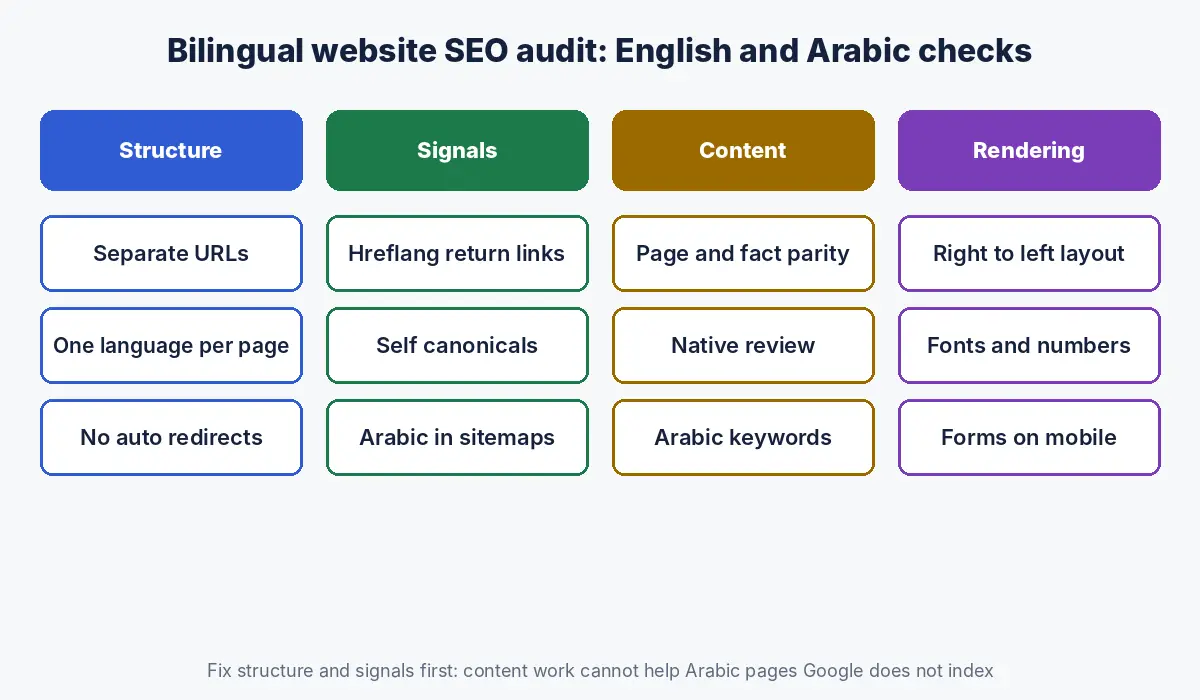
| Layer | What the audit checks |
|---|---|
| Structure | Separate URLs for each language, one language per page, no automatic redirects |
| Signals | Hreflang annotations with return links; self referencing canonicals |
| Indexing | Arabic pages indexable, in sitemaps and visible in Search Console |
| Content | Parity of pages, facts and calls to action; translation quality |
| Keywords | Arabic terms researched separately, including dialect and transliteration |
| Rendering | Right to left layout, fonts, forms and numbers on mobile |
| Visibility | Arabic presence in local results, Business Profile and AI answers |
A bilingual audit is one part of a full review; our guide to SEO audits in Dubai explains how it fits with the technical and content audit.
How do you audit the URL structure and language setup?
Check that every language version has its own URL, that each page uses one language for content and navigation, and that visitors are not automatically redirected by language; Google recommends different URLs for each language and advises against automatic redirection between language versions (Google Search Central).
| Setup | Example | Audit notes |
|---|---|---|
| Subfolders | example.com/en/ and example.com/ar/ | Most common and easiest to manage; authority shared across languages |
| Subdomains | en.example.com and ar.example.com | Works; check both are verified in Search Console |
| Separate domains | example.ae and example.com | Strongest separation; most effort |
| Parameters or cookies | example.com/?lang=ar | Risky: often a single URL serving both languages |
Google determines a page’s language from its visible content and does not use code level language information such as the lang attribute (Google Search Central). Pages that mix languages, such as English body text with Arabic navigation, confuse both users and search engines. Translating only the boilerplate while leaving the main content in English is a common shortcut Google specifically warns against (Google Search Central).
How do you audit hreflang on an English and Arabic site?
Audit hreflang by confirming that every English page lists itself and its Arabic equivalent, that every Arabic page links back, that language codes are valid, and that every URL in the annotations returns a 200 status, is indexable and is canonical; if page X links to page Y, page Y must link back to page X or the annotations may be ignored (Google Search Central).
<!-- On BOTH the English and the Arabic page -->
<link rel="alternate" hreflang="en" href="https://example.com/en/services/" />
<link rel="alternate" hreflang="ar" href="https://example.com/ar/services/" />
<link rel="alternate" hreflang="x-default" href="https://example.com/en/services/" />

<!-- Optional regional versions, if content differs by country -->
<link rel="alternate" hreflang="ar-AE" href="https://example.com/ae-ar/services/" />
<link rel="alternate" hreflang="ar-SA" href="https://example.com/sa-ar/services/" />
Language codes follow ISO 639 1, with an optional region in ISO 3166 1 Alpha 2 format; a region on its own is invalid, and URLs must be fully qualified including the protocol (Google Search Central). Annotations can sit in the HTML head, in HTTP headers or in the XML sitemap; pick one method and use it consistently.
| Common hreflang error | How to spot it | Fix |
|---|---|---|
| No return link from the Arabic page | Crawl both versions and compare annotations | Add the reciprocal annotation |
| Hreflang points to redirected or 404 URLs | Status codes of every annotated URL | Point to the final, live URL |
| Hreflang URL differs from the canonical | Compare canonical and hreflang targets | Use canonical URLs only |
| Region code used alone | Codes without a language | Use a language code, optionally with a region |
| Homepage only, inner pages missing | Coverage by template | Add annotations on every paired template |
How do you check that Arabic pages are indexed?
Check indexing by filtering Search Console’s page indexing and performance reports to the Arabic folder or subdomain, confirming Arabic pages carry self referencing canonicals, are not noindexed, appear in the XML sitemap and are linked from the Arabic navigation.
- Filter Search Console to the Arabic URLs and compare indexed pages with the number of live Arabic pages.
- Inspect a sample with the URL inspection tool: is the Google selected canonical the Arabic URL or the English one?
- Check the canonical tag on each Arabic template; canonicalising Arabic pages to English is the single most damaging bilingual error.
- Confirm Arabic URLs are in a sitemap and linked internally from Arabic pages, not only through a language switcher.
- Compare impressions for Arabic queries over time; near zero usually means an indexing or canonical problem rather than low demand.
How do you audit content parity and translation quality?
Build a parity matrix that pairs every English page with its Arabic equivalent, then check that both exist, carry the same facts, prices and calls to action, and that the Arabic text reads as written for Arabic speakers rather than as raw machine translation.
| Parity check | What to compare |
|---|---|
| Page coverage | Every important English page has an Arabic version, and vice versa |
| Facts | Prices, services, locations, team, hours and credentials identical |
| Calls to action | Same forms, WhatsApp, call and booking options |
| Updates | Arabic pages updated when English pages change |
| Quality | Native review of headings, key paragraphs and terminology |
Machine translation without review is a quality risk and, at scale, a policy risk: Google’s spam policies list scraping content and applying automated transformations such as translating, with little added value, as an example of scaled content abuse (Google Search Central). Use translation tools to draft, and native speakers to edit, especially for commercial and regulated pages.
How do you audit Arabic keyword targeting?
Audit Arabic keyword targeting by checking whether Arabic pages target terms Arabic speakers actually search, researched separately rather than translated from English, including Gulf dialect terms, Modern Standard Arabic and common transliterations where they carry demand.
- Translated keywords often miss how people search: a literal translation of an English service name may have little or no search demand.
- Some searches in the UAE are typed in Arabic, some in English, and some in Latin script transliteration; each needs checking.
- Dialect matters for some categories and tone; see our comparison of Gulf Arabic and Modern Standard Arabic for SEO content.
- Titles, H1s and meta descriptions on Arabic pages should use the researched Arabic terms, not translations of the English title.
How do you audit right to left layout and rendering?
Audit right to left rendering on mobile and desktop for every key template: the page direction set correctly, navigation and icons mirrored where they should be, forms and checkout working, numbers and prices displaying correctly, Arabic fonts loading quickly, and no overlapping or clipped text.
| RTL check | Common problem |
|---|---|
| Page direction | Arabic pages rendered left to right because the direction attribute is missing |
| Navigation and icons | Arrows and breadcrumbs pointing the wrong way |
| Forms | Fields, validation messages and phone inputs misaligned or broken |
| Mixed text | English brand names and numbers jumbling Arabic sentences |
| Fonts | Heavy Arabic web fonts slowing pages; fallback fonts looking broken |
| Tables and sliders | Columns or slides in the wrong order |
For fixes in detail, see our step by step guide to fixing RTL website SEO issues.
How do you audit Arabic metadata, URLs and structured data?
Check that Arabic pages have their own Arabic titles, meta descriptions and headings, that URL slugs follow a consistent policy, and that structured data on Arabic pages uses Arabic values matching the visible content.
- Titles and descriptions: written in Arabic for Arabic pages, not left in English or copied from the English page.
- URL slugs: Arabic script slugs are valid but appear percent encoded when copied; Latin slugs are easier to share. Either works if applied consistently.
- Structured data: names, descriptions, addresses and FAQs in Arabic on Arabic pages, matching what users see.
- Images: alt text in Arabic on Arabic pages; text inside images translated or avoided.
How do you audit Arabic visibility in local and AI search?
Check how the business appears to Arabic searchers in Maps, the Business Profile and AI assistants: whether one profile per location shows correct Arabic details, whether Arabic reviews receive replies, and whether assistants answer Arabic questions about the business correctly.
- Google allows one Business Profile per location (Google); separate English and Arabic profiles for the same branch split reviews and signals.
- Reply to Arabic reviews in Arabic.
- Run part of your AI visibility question set in Arabic; our AI visibility audit explains how. Arabic answers often draw on outdated Arabic pages and directories.
- Check Arabic spelling of the brand name across directories so assistants and maps connect them to the same business.
What does a sample bilingual website SEO audit report look like?
A sample bilingual audit report summarises how visible each language is, lists language specific findings with evidence and fixes, and sequences them so that indexing and hreflang problems are fixed before content and keyword work.
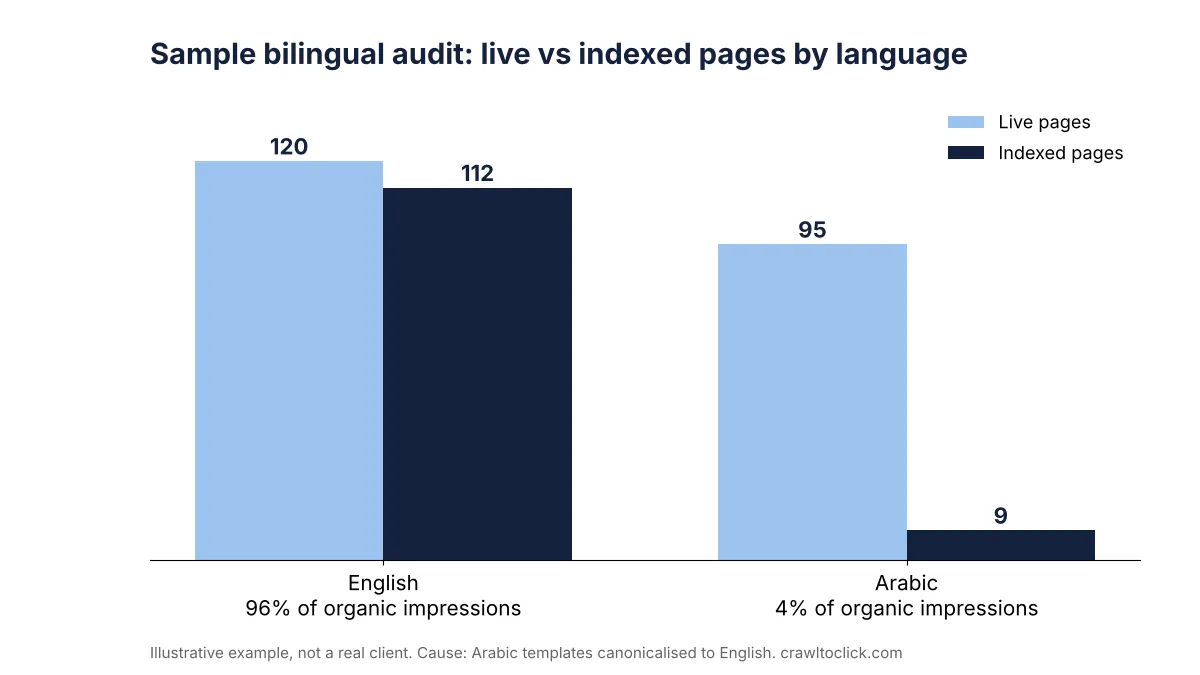
Sample summary (illustrative): “A Dubai education consultancy with 120 English pages and 95 Arabic pages. Arabic pages receive 4% of organic impressions although Arabic speaking families are a core audience. Arabic templates canonicalise to English, hreflang return links are missing on inner pages, 25 English service pages have no Arabic version, and Arabic titles are machine translated from English. Fees on 18 Arabic pages are a year out of date.”
| Measure | English | Arabic |
|---|---|---|
| Live pages | 120 | 95 |
| Indexed pages | 112 | 9 |
| Share of organic impressions | 96% | 4% |
| Pages with current fees | 100% | 81% |
| # | Finding | Evidence | Impact | Fix | Owner | Priority |
|---|---|---|---|---|---|---|
| 1 | Arabic templates canonicalise to English | Canonical tag; URL inspection shows English selected | Arabic pages not indexed | Self referencing canonicals on Arabic templates | Developer | High, quick win |
| 2 | Hreflang missing return links on inner pages | Crawl of both versions | Wrong language shown | Reciprocal hreflang on all paired templates | Developer | High, quick win |
| 3 | Outdated fees on 18 Arabic pages | Parity matrix | Wrong facts shown to Arabic speaking parents and repeated by AI answers | Update fees; make one fact sheet drive both languages | Content | High |
| 4 | Arabic titles machine translated | Native review of 40 titles | Weak relevance for Arabic searches | Arabic keyword research; rewrite titles and H1s | Content, SEO | Medium |
| 5 | 25 English service pages without Arabic versions | Parity matrix | Arabic demand unserved | Translate and adapt by priority | Content | Medium |
| 6 | Arabic enquiry form fails on iOS | Manual test | Lost Arabic enquiries | Fix right to left form handling | Developer | High, quick win |
| Phase | Actions |
|---|---|
| Days 1 to 30 | Canonicals (1), hreflang (2), form (6), fee updates (3) |
| Days 31 to 60 | Arabic keyword research and titles (4) |
| Days 61 to 90 | Missing Arabic pages (5); compare Arabic impressions and enquiries with baseline |
The consultancy and figures above are illustrative, not a real client.
What are the most common bilingual SEO mistakes on UAE websites?
| Mistake | Why it hurts |
|---|---|
| Arabic pages canonicalised to English | Arabic pages are not indexed at all |
| Hreflang on the homepage only | Inner pages show the wrong language |
| Automatic redirect by browser language | Google and users cannot reach the other version reliably |
| Machine translated content with no review | Low quality, wrong terms, possible scaled content risk |
| Arabic pages not updated with English changes | Conflicting facts in search and AI answers |
| English and Arabic Business Profiles for one branch | Duplicate listings split reviews |
| Language switcher as the only link to Arabic pages | Arabic pages poorly linked and crawled |
For a wider list of Arabic content pitfalls, see our guide to Arabic SEO mistakes to avoid.
How Crawl To Click runs bilingual SEO audits
Crawl To Click is an SEO and AI visibility consultancy, and our bilingual audits treat English and Arabic as one system: we crawl both versions, validate every hreflang pair and canonical, filter Search Console by language, build a parity matrix of pages and facts, review Arabic titles and key pages with native speakers, test right to left templates on mobile, and check Arabic visibility in Maps and AI answers. We audit bilingual sites for clinics, schools, property firms, government suppliers, retailers and professional services firms across the UAE and wider Gulf.
FAQs on bilingual website SEO audits
What is a bilingual website SEO audit?
A bilingual website SEO audit checks whether both language versions of a site, such as English and Arabic, are technically sound, correctly connected through hreflang and canonicals, indexed, consistent in content and facts, targeted at the right keywords and displayed correctly, including right to left layout for Arabic.
Why are my Arabic pages not showing in Google?
Arabic pages most often fail to show because their canonical tags point to the English versions, they are noindexed, they are missing from sitemaps, or hreflang annotations are incomplete. Check the canonical selected by Google with the URL inspection tool in Search Console.
Does Google use the lang attribute to detect Arabic pages?
No. Google says it determines a page’s language from its visible content and does not use code level language information such as the lang attribute. Hreflang annotations tell Google about alternate language versions.
Should I redirect Arabic speaking visitors automatically to the Arabic site?
No. Google advises against automatically redirecting users from one language version to another based on perceived language. Offer a visible language switcher and use hreflang so Google shows the right version in search.
Is machine translated Arabic content bad for SEO?
Unreviewed machine translation often uses terms people do not search and reads poorly, and Google’s spam policies list automated transformations such as translating content with little added value as an example of scaled content abuse. Use tools to draft and native speakers to edit.
Should Arabic and English use separate keyword research?
Yes. Arabic speakers often search with different terms, dialect words or transliterations than a direct translation of English keywords, so Arabic pages should target terms researched in Arabic.
Is your Arabic site invisible in search?
If Arabic pages bring a fraction of your traffic, the cause is usually technical and fixable within weeks. Request a bilingual SEO audit.
Disclaimer: This article reflects Google documentation as of the dates stated. The sample report is illustrative and does not describe a real business. Code examples should be adapted and tested on your site.