A Dubai business pays AED 8,000 for an SEO audit and receives a 140 page PDF. It lists 2,300 “issues”, gives the site a health score of 61, and flags hundreds of titles as “too long”. Three months later, almost nothing has been fixed, because nobody could tell which of the 2,300 issues actually mattered.
The short answer: a useful SEO audit gives you a short, prioritised list of problems that are costing you traffic or leads, the evidence for each, the exact fix, who should do it, and the expected impact. Everything should trace back to the pages and searches that make you money. Tool exports, health scores and long lists of low impact warnings are padding.
Below is what a proper SEO audit in Dubai should contain, the padding to push back on, a scoring sheet for any audit you receive, and how we run audits at Crawl To Click.
What an SEO audit in Dubai should include
| Section | What you should receive | Why it matters |
|---|---|---|
| Business context | Your priority services, revenue pages and the searches that bring leads | Without this, every finding is ranked by the tool, not by business impact |
| Search coverage | For your top revenue keywords, how many you rank for on page one and where you are missing | Shows the size of the opportunity in a number leadership understands |
| Crawling and indexing | Pages that should be indexed but are not, and pages that are indexed but should not be, from Search Console | Pages Google cannot index cannot rank |
| Technical health | Core Web Vitals on key templates against Google’s recommended thresholds (LCP within 2.5 seconds, INP under 200 milliseconds, CLS under 0.1), rendering, redirects, canonicals, internal links, hreflang for Arabic pages | Fixes at template level affect many pages at once |
| Content quality | Thin, duplicated or outdated pages; content gaps against what searchers and competitors cover | Most ranking gains after the basics come from better pages |
| Authority | Link and mention profile compared with the competitors who outrank you | Explains why good pages still sit on page two |
| Local visibility | Google Business Profile setup per emirate and consistency of business details | Often the fastest win for UAE service businesses |
| AI search visibility | How your brand appears in AI answers for priority prompts, and what those answers cite | A growing share of buyers shortlist in AI tools first |
| Prioritised action plan | Every fix ranked by impact and effort, with an owner and estimated time | This is the part you will actually use |
For the full technical checklist, see our technical SEO audit checklist for the UAE. If AI search is a priority, the AEO audit checklist covers what that part of the audit should contain.
SEO audit padding: what to push back on
These items make an audit look thorough without helping you rank. When I review audits that businesses have already paid for, these take up most of the pages:
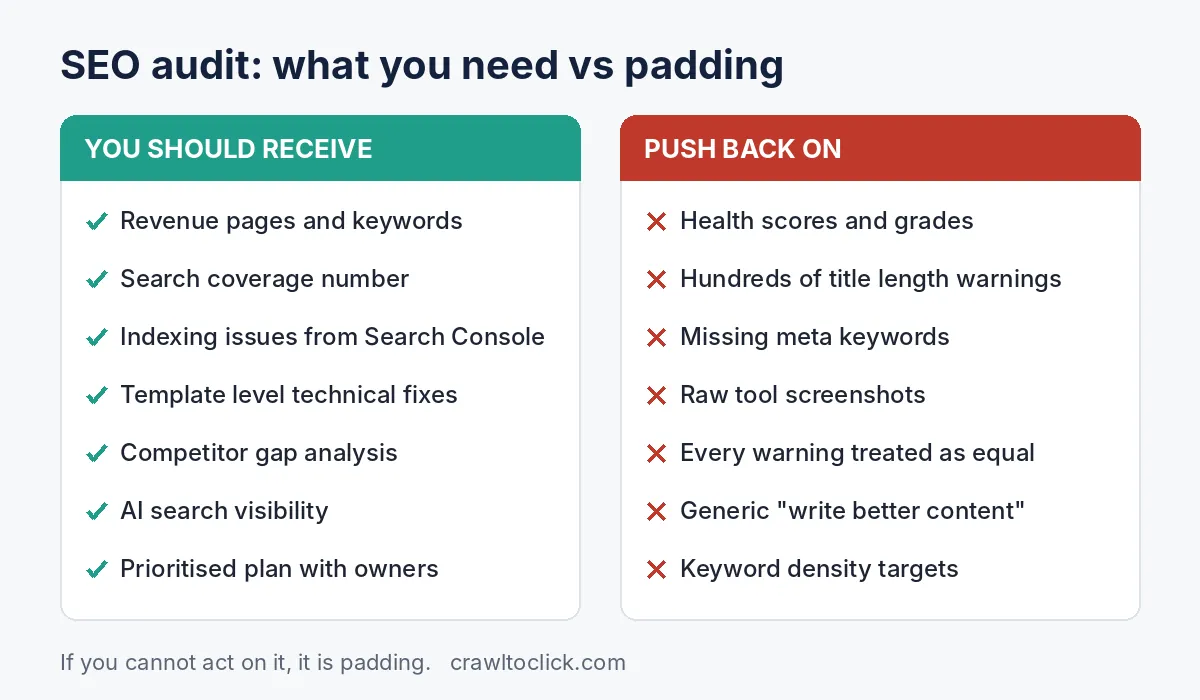
- Health scores and grades. A score out of 100 from a crawler is not a Google metric. It moves when you fix warnings that do not affect rankings.
- “Title too long” warnings by the hundred. Google says there is no limit on how long a title element can be; it is truncated in results to fit the screen. Titles are worth improving for clicks, not for a character count.
- Missing meta keywords. Google states the meta keywords tag is not used by Google Search and has no effect on indexing or ranking.
- Raw tool exports. Pages of screenshots from crawlers and SEO tools with no interpretation.
- Every warning treated as equal. A missing image alt text on a blog post from 2019 sits next to a noindex tag on your main service page.
- Generic recommendations. “Create high quality content” and “build authoritative backlinks” without saying which pages, which topics or which sites.
- Keyword density targets. Repeating a keyword a set number of times is not how pages earn rankings.
How to score an SEO audit you have received
Score each question 0 (no), 1 (partly) or 2 (yes). Under 12 out of 20 means the audit is probably more padding than plan.
| # | Question |
|---|---|
| 1 | Does it start from your business goals and revenue pages? |
| 2 | Does it use your own Search Console and analytics data, not just a third party crawler? |
| 3 | Is there a prioritised list of fewer than 30 actions? |
| 4 | Does each finding include evidence: the URL, the data and a screenshot where helpful? |
| 5 | Does each action say exactly what to change and who should do it? |
| 6 | Is there an estimate of effort for each fix? |
| 7 | Does it compare you with the competitors who actually outrank you? |
| 8 | Does it cover UAE specifics: Arabic pages, local profiles, regulated content where relevant? |
| 9 | Does it cover AI search visibility? |
| 10 | Does it explain how progress will be measured after the fixes? |
How much an SEO audit costs in Dubai, and what affects it
Audit pricing depends on site size, the number of languages and markets, whether ecommerce or programmatic templates are involved, and whether AI visibility is included. In published pricing data, one off SEO projects most often fall around AED 9,180 to 18,360; our guide to SEO cost in Dubai shows the source and conversion. A cheap audit that nobody can act on costs more in the end than a focused one with a usable plan.
What should happen after an SEO audit
- Walkthrough call. The auditor explains the top ten findings to your marketing and development teams together.
- Ticketing. Each action goes into your team’s task tracker with an owner and a date.
- Fix the template level issues first. One change to a service page template can fix hundreds of pages.
- Verify. After fixes ship, check them live and request recrawls for key URLs in Search Console.
- Measure against the baseline. Compare search coverage, clicks and leads with the figures captured in the audit.
If the audit is the start of an ongoing engagement, see what a monthly SEO retainer should include. If you are commissioning an audit because you are changing provider, read switching SEO agencies without losing rankings first.
How we run SEO audits at Crawl To Click
Our audits follow the same three step approach we use in every engagement, built from more than 15 years of SEO work across the US, MENA and India. First, find what converts: before crawling anything, we map the high intent searches that lead to demos, enquiries or sales, and measure your search coverage across your top revenue keywords. Second, engineer the system: we audit crawlability, internal linking, structured data and page templates, because a fix at template level improves many pages at once, and we check whether key pages are structured so AI tools can quote them. Third, adapt and amplify: every audit ends with a prioritised plan and a measurement setup, so you can see whether the fixes work. Search coverage is the number we watch most closely. On one ecommerce project our founder led, coverage of the top 100 revenue keywords rose from 35% to 75% after technical fixes, a faster site and user focused content, and revenue grew sixfold over that period. You can read more about who we are and how we work.
FAQs on SEO audits in Dubai
What should an SEO audit include?
An SEO audit should include business context, search coverage for your revenue keywords, crawling and indexing issues, technical health, content quality, authority compared with competitors, local visibility, AI search visibility, and a prioritised action plan with owners and effort estimates.
How long does an SEO audit take?
For most small and mid sized UAE business websites, a focused audit takes two to four weeks, including data collection, analysis and a walkthrough. Large ecommerce or multilingual sites take longer.
Is a free SEO audit worth it?
A free automated audit can flag basic technical errors, but it cannot tell you which issues affect your revenue pages or how you compare with the competitors who outrank you. Use it as a starting point, not a plan.
What is padding in an SEO audit?
Padding is content that makes an audit look thorough without helping you rank, such as health scores, hundreds of title length warnings, missing meta keywords, raw tool screenshots, generic advice and treating every warning as equally important.
How often should I get an SEO audit?
A full audit once a year is enough for most businesses, with a lighter technical review every quarter. Run a full audit before and after any site migration or redesign.
Need an SEO audit you can actually act on?
Already have an audit and not sure what matters in it? Request an independent audit review and get a short, prioritised plan tied to your revenue pages.
Disclaimer: Audit timelines and scoring guidance reflect the author’s practice and are general guidance. Pricing references come from the sources linked in our SEO cost guide. Project results described are from work led by our founder and depend on each business’s market and execution.