The short answer: a content audit is a page by page review of everything a website has published, scored on performance, quality, accuracy and business value, ending with a decision for every URL: keep, update, merge, redirect or remove. Build an inventory of all indexable content, add Search Console, analytics, conversion and backlink data, judge each page against its search intent and Google’s helpful content questions, and act on the decisions in order of impact. Removing pages is only one outcome; most audits find that updating and merging produce more gains than deleting.
Content audits matter more as sites grow. Blogs accumulate overlapping posts, service pages drift out of date, and old statistics get repeated by AI assistants long after they stop being true. Google is clear that removing content just to look fresh does not help: its guidance lists “removing a lot of older content primarily because you believe it will help” as a sign of search engine first content (Google Search Central). This guide explains how to build the inventory, which metrics to use, how to decide what happens to each page, how to merge, update and remove safely, and includes a sample content audit report.
What is a content audit, and how is it different from content pruning?
A content audit evaluates every page and decides what to do with each; content pruning is one possible outcome, removing or consolidating pages that add nothing, and a technical SEO audit is a separate review of how the site is crawled and indexed.
| Content audit | Content pruning | Technical SEO audit | |
|---|---|---|---|
| Question | Is each page useful, accurate and earning its place? | Which pages should be removed or merged? | Can search engines crawl, index and render the site? |
| Outcomes | Keep, update, merge, redirect, remove, create | Remove, merge, noindex | Technical fixes |
| Data | Performance, conversions, quality, accuracy, links | Mainly performance and conversions | Crawl data, logs, Search Console |
| Typical gain | Higher rankings for updated and merged pages | Cleaner site, less dilution | Pages found and indexed correctly |
For the removal side in depth, see our guide to content pruning with conversion data; for the technical side, our guide to SEO audits in Dubai.
When should you run a content audit?
Run a content audit once a year for sites that publish regularly, before a redesign or migration, after a traffic drop that coincides with a core update, when several pages compete for the same searches, and before planning the next year’s content.
| Trigger | What the audit answers |
|---|---|
| Annual review | Which pages to refresh, merge or retire before planning new content |
| Redesign or migration | Which content moves, which merges and which is retired, so redirects are planned |
| Traffic drop after a core update | Whether quality, accuracy or overlap is the likely cause |
| Keyword cannibalisation | Which page should own each search |
| Pricing, regulation or product changes | Which pages now state wrong facts |
How do you build a content inventory?
Build the inventory by listing every indexable URL from a crawl and the sitemap, then adding the page type, primary topic, target keyword, publish and update dates, word count, and performance and link data for each page in one spreadsheet.
url | page_type | topic | target_keyword | language | published | last_updated
| word_count | clicks_12m | impressions_12m | avg_position | conversions_12m
| referring_domains | internal_inlinks | top_query | intent_match (y/n)
| facts_current (y/n) | decision | owner | notes
Pull clicks, impressions, positions and top queries from Search Console for the last 12 months, conversions from analytics, and referring domains from a backlink tool. Our guide to analysing Search Console data with Claude shows how to join these exports quickly for large sites.
Which metrics should a content audit use?
Use a mix of demand, performance, business value, authority and quality metrics, because a page with little traffic can still convert or attract links, and a page with high traffic can bring no business.
| Metric | Source | What it tells you |
|---|---|---|
| Impressions and average position | Search Console | Whether Google shows the page and for what |
| Clicks and click through rate | Search Console | Whether searchers choose it |
| Conversions or assisted conversions | Analytics | Whether it contributes to business |
| Referring domains | Backlink tool | Whether it carries authority worth keeping |
| Internal inlinks | Crawl | How important the site treats it |
| Top query and intent match | Search Console plus review | Whether the page answers what people search |
| Accuracy and freshness | Manual review | Whether prices, rules, dates and facts are current |
| Overlap | Query overlap with other pages | Whether it competes with another page |
How do you decide whether to keep, update, merge, redirect or remove a page?
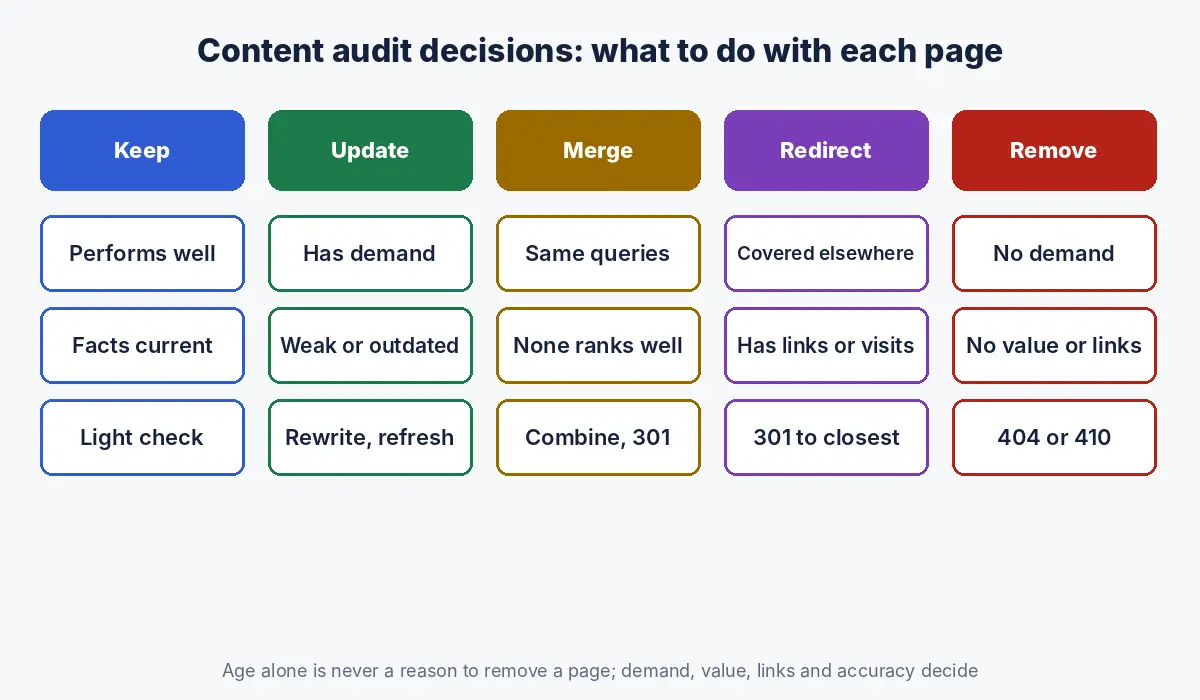
Decide with a simple rule set: keep pages that perform and are accurate, update pages with demand but weak or outdated content, merge pages that compete for the same intent, redirect pages whose topic is covered better elsewhere, and remove pages with no demand, no value and no links.
| Decision | When to choose it | What to do |
|---|---|---|
| Keep | Ranks well, converts or earns links, facts current | Light check; no change needed |
| Update | Has impressions or demand but weak position, thin answers or outdated facts | Rewrite to match intent, refresh facts and sources, improve structure |
| Merge | Two or more pages split the same queries and none ranks strongly | Combine the best content into the strongest URL; 301 the others |
| Redirect | Topic fully covered by a better page; the old URL has links or traffic | 301 to the closest relevant page |
| Remove | No impressions, no conversions, no links, no ongoing value to users | Return 404 or 410; remove from sitemap and internal links |
| Create | Audit reveals a demand gap no page covers | Add to the content plan |
When should you merge pages instead of updating them?
Merge pages when two or more URLs receive impressions for the same queries, target the same intent and none of them ranks in the top results; combining them gives one stronger page instead of several weak ones competing with each other.
- Confirm the overlap: the same top queries split between the pages in Search Console.
- Choose the target URL: usually the one with more links, better position or the cleaner address.
- Combine the best sections, examples and data into the target page; do not just paste one under the other.
- 301 redirect the other URLs to the target; Google recommends permanent server side redirects for pages that have moved (Google Search Central).
- Update internal links to point straight at the target page.
- Check rankings and impressions for the merged queries over the following weeks.
When should you remove content, and how should you remove it?
Remove content only when it has no search demand, no conversions, no meaningful links and no value to users; if a page still helps some visitors, keep it or merge it, because deleting old content to look fresh is not something Google rewards.
When a technology publisher deleted thousands of old articles in 2023, Google’s Search Liaison responded: “Are you deleting content from your site because you somehow believe Google doesn’t like ‘old’ content? That’s not a thing!” and added that older content can still be helpful (Search Engine Land).
| Situation | Method |
|---|---|
| Page has links or some traffic, and a relevant page exists | 301 redirect to the relevant page |
| Page has no links, no traffic and no relevant alternative | 404 or 410, removed from the sitemap and internal links |
| Page is useful to visitors but should not appear in search (for example, a policy archive) | Keep it and add noindex |
| Page is outdated but the topic still has demand | Update instead of removing |
How do you update content so it actually improves?
Update content by re checking the search intent, rewriting the opening to answer the main question directly, refreshing facts, figures and sources, filling gaps that ranking pages cover, and improving structure, then changing the date only when the content has substantially changed, as Google’s guidance warns against changing dates to seem fresh (Google Search Central).
| Update step | Check |
|---|---|
| Intent | Does the page match what the top query is really asking? |
| Opening | Do the first two sentences answer the question with a specific fact? |
| Facts and figures | Are prices, rules, dates and statistics current, with sources? |
| Coverage | What do better ranking pages answer that this one does not? |
| Structure | Question headings, short sections, tables for comparisons |
| Experience | Is there first hand detail, an example or data only you have? |
| Links | Internal links to and from related pages updated |
Google’s helpful content questions are a useful final check: does the page provide original information or analysis, and substantial value compared with other pages in the results (Google Search Central)?
How do you audit content for AI search?
Audit content for AI search by checking whether each important page answers its questions in self contained passages, states current facts that assistants can repeat correctly, and ranks well enough to be retrieved, since most AI citations come from pages that already rank.
- 76.10% of pages cited in Google AI Overviews rank in Google’s top 10 for the query (Ahrefs), so updating pages into the top results also raises their chance of being cited.
- Outdated pages are a risk: assistants repeat old prices and facts long after they change. Flag every page with figures, regulations or prices for accuracy review.
- Sections that depend on earlier paragraphs (“as mentioned above”) lose meaning when quoted alone; rewrite them to stand on their own.
- If content was produced with AI tools, Google asks publishers to fact check and review it before publishing (Google Search Central); the audit should check older AI assisted pages for errors.
How do you audit content in English and Arabic?
Audit both languages together: pair each English page with its Arabic equivalent, check that facts and coverage match, that hreflang links them, and that Arabic pages target the terms Arabic speakers search rather than direct translations.
- Pairs should be linked with hreflang as Google describes in its localised versions guidance.
- Updating an English page without updating the Arabic one creates conflicting facts, which assistants then repeat.
- Merges and redirects must be mirrored in both languages.
- Arabic pages with no English equivalent, and the reverse, should be reviewed as possible gaps.
What does a sample content audit report look like?
A sample content audit report summarises how much of the site performs, how much needs work, and which decisions matter most, then lists decisions by URL group with evidence, action, owner and priority.
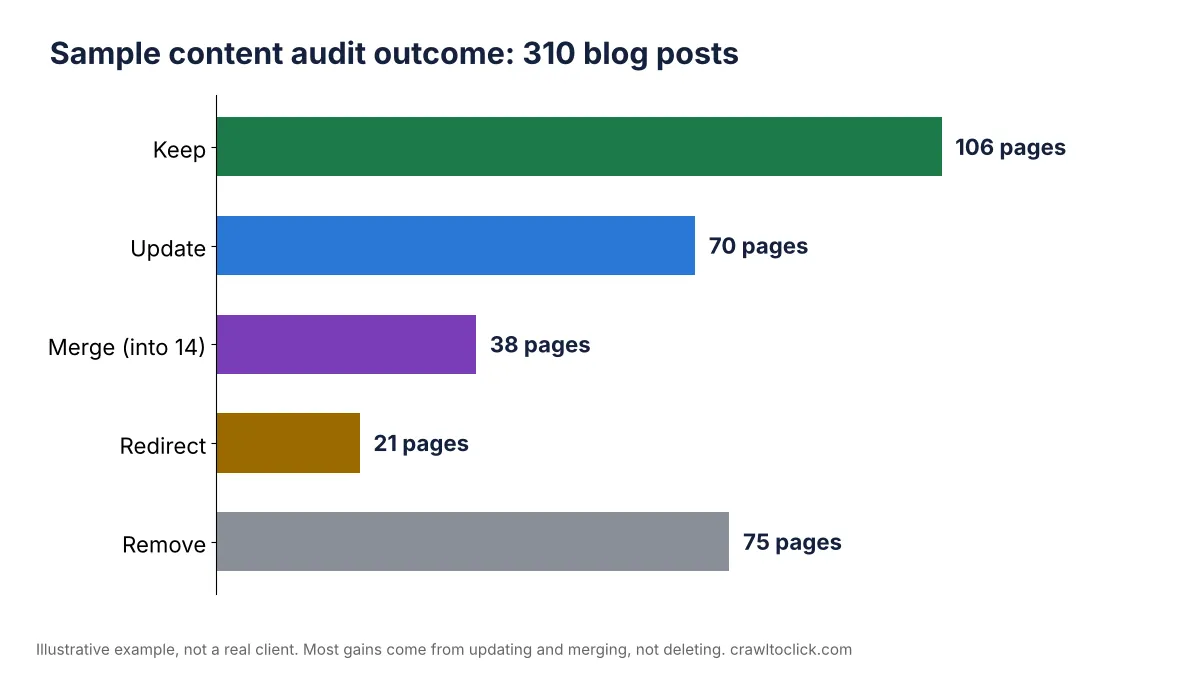
Sample summary (illustrative): “A UAE HR software company with 310 blog posts and 24 product pages. 41 posts bring 78% of organic clicks. 96 posts have no clicks in 12 months and no links; 38 posts form 14 overlapping pairs or groups; 52 posts cite labour law figures that changed in the last two years. Recommended: update 70, merge 38 into 14, redirect 21, remove 75, keep 106. Expected effect: stronger rankings for the 14 merged topics and fewer outdated answers repeated by AI assistants.”
| Decision | Pages | Example (illustrative) | Owner | Priority |
|---|---|---|---|---|
| Update: outdated legal facts | 52 | Posts on gratuity and leave rules citing old figures | Content, legal review | High |
| Merge: competing posts | 38 into 14 | Three posts on “WPS payroll” split the same queries | Content, SEO | High |
| Update: page two posts with demand | 18 | “HR software UAE” guide at position 11 | Content | High |
| Redirect: covered elsewhere | 21 | Old feature announcements to current product pages | SEO, developer | Medium |
| Remove: no demand, value or links | 75 | Event recaps from 2021 with no traffic | SEO | Low |
| Keep | 106 | Top performing guides and product pages | None | None |
| Phase | Actions |
|---|---|
| Days 1 to 30 | Legal fact updates (52), page two updates (18) |
| Days 31 to 60 | Merges and redirects (38 into 14, plus 21) |
| Days 61 to 90 | Removals (75), internal link clean up, measure against baseline |
The company and figures above are illustrative, not a real client. For how to judge any audit report, see our guide on how to read an SEO audit report.
How do you measure the results of a content audit?
Measure results for each decision group separately: clicks, impressions and positions for updated and merged pages, conversions from the pages that matter commercially, and the share of revenue keywords where the site ranks on page one, compared over equal periods once Google has recrawled the changes.
Sitewide traffic can hide the effect, because removed pages had little traffic to begin with. Track the merged and updated groups, and use your revenue keyword set to see whether the audit moved the searches that actually bring business.
What are the common content audit mistakes?
| Mistake | Better approach |
|---|---|
| Deleting pages because they are old | Judge on demand, value, links and accuracy, not age |
| Judging on traffic alone | Add conversions, links and business value |
| Merging by pasting pages together | Rewrite into one coherent page, then redirect |
| Redirecting everything to the homepage | Redirect to the closest relevant page |
| Changing dates without changing content | Update the date only after substantial changes |
| Updating English but not Arabic | Treat language pairs as one unit |
| No baseline before changes | Record metrics first so results can be measured |
How Crawl To Click runs content audits
Crawl To Click is an SEO and AI visibility consultancy, and our content audits combine a full inventory with 12 months of Search Console, analytics and link data, an intent and accuracy review of every important page, overlap analysis to find competing pages, and a decision for every URL with an owner and a sequence. We review English and Arabic content as pairs and flag every page whose facts AI assistants may be repeating. We run content audits for software companies, publishers, clinics, schools, property firms and ecommerce stores in the UAE and India.
FAQs on content audits
What is a content audit?
A content audit is a page by page review of a website’s content using performance, conversion, link and quality data, ending with a decision for each URL: keep, update, merge, redirect or remove, plus gaps where new content is needed.
How often should you do a content audit?
Most sites that publish regularly should run a full content audit once a year, plus targeted audits before a redesign or migration, after a traffic drop linked to a core update, or when several pages compete for the same searches.
Does deleting old content improve SEO?
Not by itself. Google’s Search Liaison has said that deleting content because Google supposedly dislikes old content is not a thing, and Google’s guidance lists removing lots of older content mainly for rankings as a search engine first practice. Remove pages only when they offer no value, demand or links.
When should I merge two pages?
Merge pages when they receive impressions for the same queries, serve the same intent and neither ranks strongly. Combine the best content into the stronger URL, 301 redirect the other and update internal links.
Should I change the published date when I update a page?
Change the date only when the content has substantially changed. Google’s guidance warns against changing dates to make pages seem fresh when the content has not meaningfully changed.
What tools do I need for a content audit?
A crawler to list URLs, Google Search Console for clicks, impressions and queries, an analytics tool for conversions, a backlink tool for referring domains, and a spreadsheet to record metrics and decisions for each page.
Need a content audit before your next content plan?
Find out which pages to update, merge or retire before you publish anything new. Request a content audit.
Disclaimer: This article reflects Google documentation and published sources as of the dates stated. The sample report is illustrative and does not describe a real business. Results depend on the site, competition and implementation.