An SEO manager asks ChatGPT for “keywords for my dental clinic” and gets a generic list of 20 terms she could have guessed. Her colleague pastes the clinic’s services, its three Dubai locations, a Search Console export and the questions patients ask at reception, and asks for clusters by intent with a suggested page for each. Same tool, very different result. With SEO prompts, the quality of the output depends almost entirely on the context and data you give it.
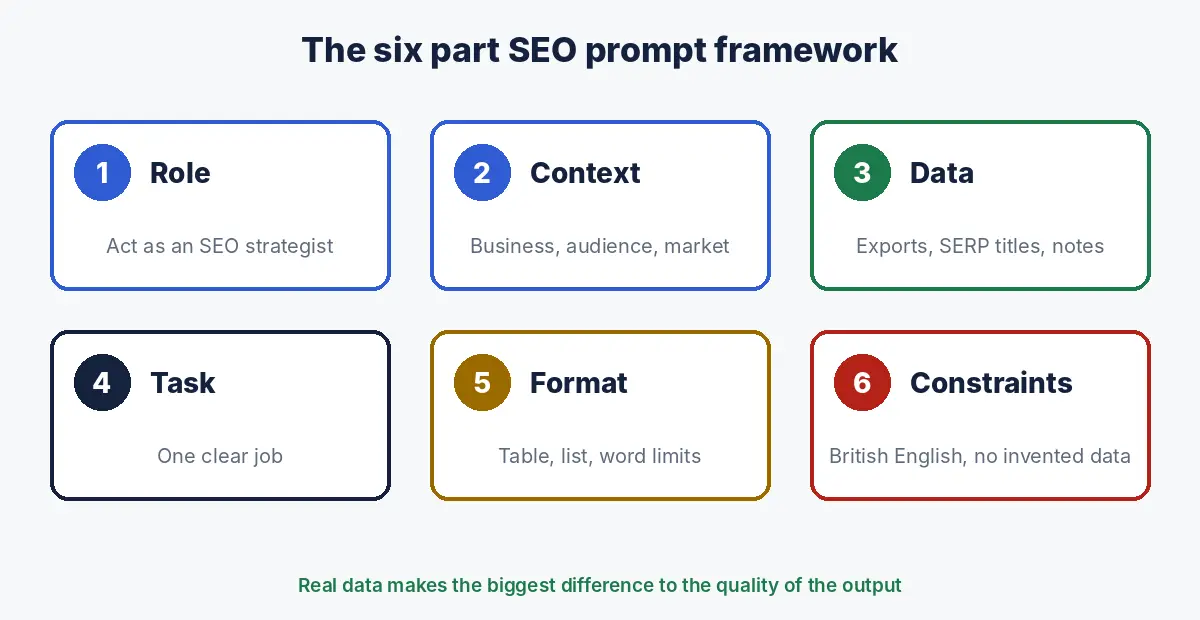
The short answer: the best ChatGPT prompts for SEO give the model a role, your business context, the real data to work from, a specific task, the output format you want and the constraints it must respect. Below are 100 copy ready prompts organised by task: keyword research, search intent, content briefs, writing, on page SEO, technical SEO, schema, data analysis, link building, and AI search and local SEO. Replace the text in square brackets, paste your own data, and check every output before you use it.
Want them all in one place? Download all 100 prompts as a spreadsheet. The same prompts work in Gemini, Claude and Copilot.
How to write ChatGPT prompts for SEO
The six part prompt framework
| Part | What to include | Example |
|---|---|---|
| Role | Who the model should act as | Act as a technical SEO consultant |
| Context | Your business, audience and market | A Dubai clinic group with three branches |
| Data | The real inputs to work from | A Search Console export or top 10 titles |
| Task | One clear job | Group these keywords by intent |
| Format | How you want the answer | A table with cluster, intent and page type |
| Constraints | Rules to respect | British English, no invented numbers |
Before and after: one prompt, improved
Weak prompt:
Give me keywords for my dental clinic.

Strong prompt:
Act as an SEO strategist. We run three dental clinics in Dubai
(Jumeirah, Marina, Deira) offering implants, aligners, whitening
and emergency care. Here is our Search Console export: [paste].
Here are questions patients ask at reception: [paste].
Group the queries into clusters by search intent. Return a table
with cluster, main keyword, intent, suggested page and whether a
page already exists. Use British English and do not invent volumes.
Rules to follow with any SEO prompt
- Give it real data. ChatGPT does not have your rankings, traffic or search volumes unless you paste them, so outputs without data are educated guesses.
- Check every fact and number. Google’s guidance on using generative AI content notes that AI output can contain errors and should be reviewed, including titles, meta descriptions and structured data.
- Do not mass produce pages. The same guidance warns that generating many pages without adding value for users may breach Google’s spam policy on scaled content abuse.
- Add what only you know. First hand experience, client examples and your own data are what make AI assisted content worth ranking.
- Protect confidential data. Check your workspace’s data settings before pasting client or customer information.
ChatGPT prompts for keyword research
Use these with a seed list or a keyword export. ChatGPT does not have search volume data, so paste volumes from your keyword tool when you want them used.
- Act as an SEO strategist. My business is [business], selling [product or service] to [audience] in [country]. List 40 search queries my buyers might type at each stage of the journey: problem aware, solution aware and ready to buy. Return a table with query, stage and intent.
- Here is a keyword export with volumes: [paste]. Remove keywords that are irrelevant to [business] or have no buying intent, and explain in one line why each removed keyword was cut.
- Group these keywords into clusters where one page could rank for the whole cluster: [paste keywords]. Return a table with cluster name, main keyword, secondary keywords and suggested page type.
- Suggest 30 long tail variations of [keyword] that include a location, an audience, a problem or a comparison. Mark which ones signal intent to buy.
- List 25 question keywords people ask about [topic], grouped by who, what, why, how, when and cost. Flag the ones likely to trigger a featured snippet or AI answer.
- My competitors are [competitor 1], [competitor 2] and [competitor 3]. Suggest the types of keywords each is likely to target based on their positioning, and where a gap may exist for [my business].
- Turn these customer questions from sales calls into search queries people would type: [paste questions]. Keep the customer's wording where possible.
- Here are my keywords with volume, current position and conversion rate: [paste]. Score each from 1 to 10 for business value and explain the top 10.
- Suggest Arabic search queries a UAE buyer might use for [product or service], with an English translation of each. Note any that differ in intent from the English version.
- Create 20 [product] plus [city] keyword combinations for [list of cities], and suggest which deserve their own page and which should share one.
ChatGPT prompts for search intent and SERP analysis
Paste the titles, snippets or headings from the current top results so the model works from real data rather than guesses.
- Here are the top 10 titles and snippets for [keyword]: [paste]. Classify the dominant search intent and the page type Google prefers, and say what format my page should use.
- Compare the headings of these three ranking pages: [paste]. List the subtopics all three cover, the subtopics only one covers, and what none of them answers.
- Based on these People Also Ask questions for [keyword]: [paste], write a short outline of sections that would answer each one in order of importance.
- Is [keyword] a commercial, informational or transactional query? Give your reasoning and the kind of page that would satisfy it.
- These two keywords might need one page or two: [keyword A] and [keyword B]. Here are the top results for each: [paste]. Should they share a page? Explain.
- Summarise what the top results for [keyword] promise in their titles. Suggest three title angles that would stand out without overpromising.
- Here is the AI Overview text for [keyword]: [paste]. Which questions does it answer, which sources does it lean on, and what could a page add that the overview does not?
- List the questions a sceptical buyer would still have after reading the top results for [keyword]: [paste summaries].
- For [keyword], what level of expertise do the top results show? Suggest the evidence, data or first hand experience my page should include to compete.
- Create a SERP feature checklist for [keyword]: which features appear (paste them), and what on page elements would help my page qualify for each.
ChatGPT prompts for content planning and briefs
Brief prompts work best when you add your own audience, offer and examples, so the output is specific to you.
- Create a content brief for [keyword] for [audience]. Include search intent, a 2 to 3 sentence direct answer, H2 and H3 outline, questions to answer, examples to include, internal link ideas and a call to action.
- Build a hub and spoke plan for [topic]: one pillar page and 8 to 12 supporting articles. For each, give a title, main keyword and the question it answers.
- Here is my list of existing posts: [paste titles and URLs]. Group them by topic, find duplicates competing for the same keyword, and suggest which to merge.
- Plan a 3 month content calendar for [business] that balances buying intent pages and educational articles. Prioritise topics likely to bring leads.
- Write 10 headline options for an article on [topic] aimed at [audience]. Avoid clickbait and keep each under 60 characters.
- List the original data, examples or expert input my article on [topic] needs so it says something the top results do not.
- Turn this webinar transcript into an article outline with H2 and H3 headings and a list of quotable points: [paste transcript].
- Suggest five comparison or alternatives articles for [product] based on these competitors: [list]. Give the angle and target reader for each.
- Create a persona summary for [audience] buying [product]: goals, objections, questions they search and words they use.
- Review this content plan for gaps against the buyer journey: [paste plan]. Which stages are missing content?
ChatGPT prompts for writing and content optimisation
Use these to edit drafts you or your writers created. Always check facts and add your own experience before publishing.
- Rewrite this introduction so it answers the question in the first two sentences, then gives context. Keep it under 80 words: [paste].
- Edit this section for clarity: shorter sentences, plain words, British English, and no change to the facts: [paste].
- Here is my draft and the brief: [paste both]. List every brief requirement the draft misses, and every claim that needs a source.
- Add a concrete example to each of these points for a [industry] business in [country]: [paste points].
- Turn this paragraph into a numbered step by step process with one action per step: [paste].
- Write a short FAQ section of five questions and answers about [topic], each answer 40 to 60 words, based only on this content: [paste].
- Identify filler, repetition and vague claims in this article and suggest tighter replacements: [paste].
- Create a comparison table from this text with clear columns and no invented data: [paste].
- Write a 2 to 3 sentence summary of this article that could be quoted as a direct answer: [paste].
- Rewrite this product description to explain who it is for, what problem it solves and why it is different, in under 120 words: [paste].
ChatGPT prompts for on page SEO
Paste the page content so titles and descriptions reflect what is actually on the page.
- Write five title tags for this page, each under 60 characters, with [keyword] near the start: [paste page summary].
- Write three meta descriptions for this page, 140 to 160 characters each, including [keyword] and a reason to click: [paste summary].
- Review this heading structure and suggest improvements so each H2 and H3 is descriptive and includes relevant keywords naturally: [paste headings].
- Suggest a short, readable URL slug for a page about [topic]. Avoid stop words and dates.
- Write descriptive alt text for these images based on their context in the article: [list image descriptions and surrounding text].
- Here are the titles of my 20 most important pages: [paste]. Find duplicates or near duplicates and suggest distinct versions.
- Suggest internal links for this new article: [paste article]. Choose from these existing pages: [paste titles and URLs]. Give anchor text for each.
- Check this page for keyword cannibalisation risk against these other pages: [paste titles and main keywords].
- Suggest Open Graph titles and descriptions for social sharing for these pages: [paste titles and summaries].
- Rewrite these thin category descriptions into 80 to 120 word introductions that help shoppers choose: [paste].
ChatGPT prompts for technical SEO
Paste real outputs such as crawl exports, robots.txt or server responses. Never let a model guess your site’s configuration.
- Explain these crawl errors in plain English, rank them by likely impact on search traffic, and suggest a fix for each: [paste crawl export summary].
- Review this robots.txt file. Flag anything that might block important pages or resources: [paste].
- Write redirect rules for these URL changes in [Apache or Nginx] format: [paste old and new URLs].
- Here is my hreflang setup for [languages and countries]: [paste]. Check for missing return links and incorrect language or region codes.
- Explain what these Core Web Vitals results mean and which fixes would improve them most: [paste PageSpeed Insights summary].
- Create a checklist for migrating [site] from [old platform] to [new platform] without losing search traffic.
- These pages show as Crawled but not indexed in Search Console: [paste URLs and short descriptions]. Suggest likely reasons and fixes.
- Suggest rules for which faceted navigation URLs on my ecommerce site should be indexable, based on these filters: [list filters].
- Write a short brief for developers explaining why [technical issue] matters for SEO and what done looks like.
- Review this XML sitemap sample for problems such as redirected, noindexed or non canonical URLs: [paste].
ChatGPT prompts for schema and structured data
Always test generated markup in Google’s Rich Results Test and make sure it matches what is visible on the page.
- Write Organization schema in JSON LD for [business] with name, URL, logo, description, founder and sameAs links to [profiles].
- Create Product schema in JSON LD for this product page, using only the information shown: [paste product details].
- Write LocalBusiness schema for [business type] in [city] with address, opening hours and contact details: [paste details].
- Create FAQPage schema from these questions and answers exactly as written on the page: [paste].
- Write Article schema for this blog post with author as a Person linked to [author page], and publisher as my Organization: [paste details].
- Review this JSON LD for errors, missing recommended properties and mismatches with the visible page: [paste markup and page text].
- Suggest which schema types fit these page templates on my site: [list templates].
- Write MedicalClinic and Physician schema for [clinic] with these doctors and specialties: [paste details].
- Convert this schema into one connected graph using consistent @id values: [paste separate snippets].
- Create BreadcrumbList schema for this URL path: [paste URL and page names].
ChatGPT prompts for data analysis, regex and scripts
Paste exports rather than describing them. Check every formula and script on a small sample before trusting the output.
- Here is a Search Console export (query, page, clicks, impressions, CTR, position): [paste]. List queries in positions 4 to 15 with high impressions, grouped by page.
- Find pages in this export where CTR is well below others at the same position, and suggest title changes: [paste].
- Write a regex for Search Console that matches question queries starting with who, what, why, how, when, where, can, does or is.
- Write a regex that matches branded queries containing [brand] or common misspellings: [list misspellings].
- Write a Google Sheets formula that labels each keyword in column A as branded or non branded, based on a list of brand terms in column F.
- Write a Python script that joins gsc.csv and ga4.csv on URL and outputs clicks, sessions and key events per page.
- Write a Python script that compares two crawl exports and lists URLs whose title, canonical or status code changed.
- Here are monthly organic sessions for two years: [paste]. Describe the trend, seasonality and any unusual drops, and list questions to investigate.
- Explain the difference between these two date ranges in Search Console and which pages drove the change: [paste comparison].
- Turn these SEO results into a five line summary for a chief executive, focused on revenue and next steps: [paste data].
ChatGPT prompts for link building and digital PR
Personalise every outreach message yourself. Models can draft, but relationships need a human.
- Suggest 15 types of websites that might link to a [type of resource] about [topic], and why each would find it useful.
- Write a short outreach email to [site] suggesting my [resource] as an addition to their article [title]. Keep it under 120 words and specific to their page.
- Suggest five data led story ideas [business] could publish to earn press coverage in [country].
- Turn this survey data into three newsworthy headlines and key findings for journalists: [paste data].
- Write a pitch to a [industry] journalist offering expert comment on [news topic] from [expert name and credentials].
- Suggest linkable assets for [business], such as tools, templates or studies, and the audience that would share each.
- Here is a list of unlinked brand mentions: [paste]. Draft a polite request to add a link to each, tailored to the context.
- Review these backlink prospects and rank them by relevance to [topic] and likely quality: [paste domains and descriptions].
- Write a guest post pitch for [site] with three topic ideas that fit their audience and do not overlap their existing articles: [paste their recent titles].
- Create a simple tracking sheet structure for a link building campaign, with columns and status definitions.
ChatGPT prompts for AI search visibility and local SEO
These prompts help you prepare for AI answers and local search. Test brand prompts in several assistants, and repeat them, since answers vary between runs.
- Write a brand fact sheet for [business] with one sentence per fact covering what we are, who we serve, founding, location, leaders, products, pricing and proof. Use only these facts: [paste].
- Rewrite this About page opening so an AI assistant could describe us accurately in one sentence: [paste].
- List 30 prompts a buyer might ask ChatGPT or Perplexity when choosing a [category] provider in [city or country].
- Here are AI answers for my category prompts: [paste answers]. Which competitors are mentioned, how are they described, and what sources are cited?
- Compare how these AI answers describe my brand with my fact sheet, and list every inaccuracy: [paste answers and fact sheet].
- Suggest answer first summaries of 40 to 60 words for each of these pages, written so they can be quoted directly: [paste page titles and content].
- Write a Google Business Profile description for [business] in [area], under 750 characters, with services and area served.
- Suggest 10 Google Business Profile post ideas for [business] for the next month, tied to local events or seasons in [city].
- Write short, polite replies to these Google reviews, positive and negative, without sounding templated: [paste reviews].
- Create a checklist to keep [business] name, address, phone number and description consistent across directories in [country].
Turning prompts into an SEO workflow
Prompts are most useful when they sit inside a repeatable process. A simple weekly loop: export Search Console data, run the data analysis prompts to find pages in positions 4 to 15, use the brief and writing prompts to improve those pages, and check AI answers for your main buying questions each month. Our guide to building a revenue keyword set shows which keywords to feed into that loop, and our guide to measuring LLM mentions explains how to track AI visibility reliably.
If you are choosing tools to run alongside ChatGPT, see our list of the best AI SEO tools. For schema prompts, our guide to schema layers for AI search explains how to connect the markup into one graph.
How Crawl To Click uses AI prompts in SEO work
Crawl To Click is the SEO and AI visibility practice of Indu Priya, with more than 15 years of experience and more than 30 clients across the US, MENA and India. We use prompts like these every day, but always on real data and under a practitioner’s review. Assistants help us cluster keyword exports, draft first versions of briefs, write regex and Python for Search Console and crawl analysis, and check drafts against briefs. Strategy, prioritisation and the expertise on each page stay with people, and every number, fact and piece of schema is checked before it reaches a client. Read more about us.
FAQs on ChatGPT prompts for SEO
Can ChatGPT do keyword research?
It can generate ideas, cluster keywords and classify intent, but it does not have search volume or ranking data. Paste data from your keyword tool or Search Console for reliable results.
Is content written with ChatGPT bad for SEO?
Google’s guidance focuses on whether content is helpful and accurate, not on how it was produced. AI generated pages produced at scale without added value can breach Google’s spam policies, so review, fact check and add your own expertise.
What makes a good SEO prompt?
A role, your business context, real data, one specific task, the output format and clear constraints. Adding your own data makes the biggest difference.
Do these prompts work in Gemini and Claude?
Yes. The prompts are written for any general AI assistant. Results vary slightly between tools, so test the ones you use most.
Can ChatGPT write schema markup?
Yes, it can draft JSON LD quickly. Always test it in Google’s Rich Results Test and make sure every value matches what is visible on the page.
Want help building an AI assisted SEO workflow?
Using ChatGPT for SEO but not sure the output is reliable? Book a strategy call and we will help you build prompts and checks around your own data.
Disclaimer: Prompts are starting points. Outputs from AI assistants can be inaccurate, so review every result before publishing or acting on it. Google guidance summarised here comes from the linked source and may change.