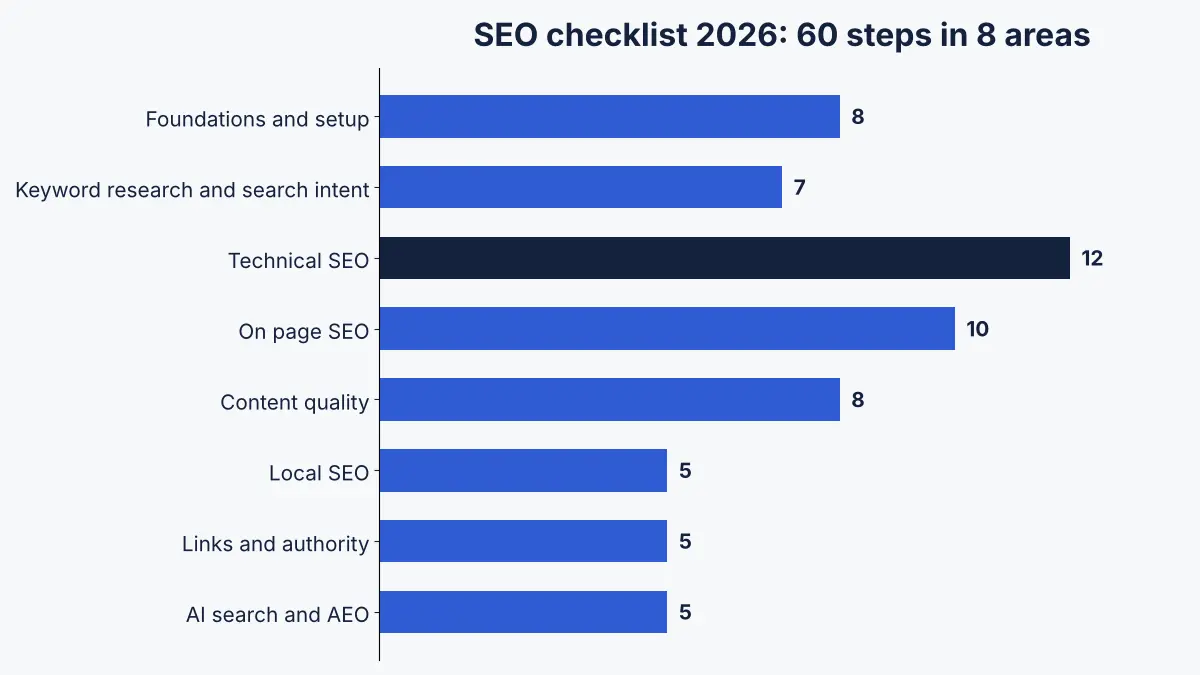
Most SEO checklists are either 10 obvious tips or 200 items nobody finishes. This one has 60 steps, grouped into eight areas and ordered the way we would tackle a site: measurement first, then keywords, technical health, on page work, content, local, links and AI search. Each step says what to do and why it matters.
The short answer: an SEO checklist for 2026 covers eight areas: foundations and measurement, keyword research and intent, technical SEO, on page SEO, content quality, local SEO, links and authority, and AI search visibility. Work through foundations and technical issues first, because they affect every page, then improve the pages tied to your revenue keywords, and add AI search checks so your brand is described and cited correctly. Download the spreadsheet version below to track progress.
The SEO checklist at a glance
| Area | Steps | Why it matters |
|---|---|---|
| Foundations and setup | 8 | Get measurement and access right first, or nothing else can be proven. |
| Keyword research and search intent | 7 | Choose what to rank for before deciding what to write. |
| Technical SEO | 12 | Make sure search engines can crawl, render and index the pages that matter. |
| On page SEO | 10 | Help search engines and readers understand each page quickly. |
| Content quality | 8 | Content that ranks and gets cited adds something the existing results do not. |
| Local SEO | 5 | For businesses that serve customers in specific areas. |
| Links and authority | 5 | Earn mentions and links from sources your buyers and search engines trust. |
| AI search and AEO | 5 | Make your brand easy for AI assistants to understand, cite and recommend. |
SEO checklist: foundations and setup
Get measurement and access right first, or nothing else can be proven.
- Verify the site in Google Search Console. Add a domain property so all subdomains and protocols are covered.
- Verify the site in Bing Webmaster Tools. Bing powers Copilot and other assistants, so its index matters for AI search too.
- Set up Google Analytics 4 with key events. Mark leads, sign ups, bookings and purchases as key events.
- Separate AI assistant traffic in analytics. Create a channel group for chatgpt.com, perplexity.ai, gemini.google.com and copilot.microsoft.com.
- Define your revenue keywords. List the searches that lead to sales or leads, with a target page for each. Our guide explains how.
- Record a baseline. Save current clicks, key events, rankings and AI mentions so progress can be measured.
- Check access and ownership. Make sure the business, not only an agency, owns the domain, analytics and Search Console.
- Agree targets and reporting. Set monthly targets and a simple report format before work starts.
SEO checklist: keyword research and search intent
Choose what to rank for before deciding what to write.
- Map keywords to buyer stages. Group searches by problem aware, solution aware and ready to buy.
- Check intent on the results page. Match the page type Google already ranks: guide, comparison, category or service page.
- Assign one main keyword per page. Avoid two pages competing for the same search.
- Find question keywords. Use People Also Ask, sales calls and support tickets.
- Include location and language variants. For example city names and Arabic keywords for UAE buyers.
- Prioritise by value and winnability. Start with valuable keywords where you already rank in positions 4 to 20.
- Plan hubs and supporting pages. Build a pillar page per topic and link supporting articles to it.
SEO checklist: technical SEO
Make sure search engines can crawl, render and index the pages that matter.
- Review robots.txt. Check nothing important is blocked, including CSS and JavaScript files. See Google’s documentation.
- Submit an XML sitemap. List only indexable, canonical URLs that return a 200 status. See Google’s documentation.
- Fix crawl errors and broken links. Resolve 404s on linked pages and server errors.
- Remove redirect chains. Point links straight to the final URL.
- Set canonical tags correctly. Each page should declare its preferred URL to consolidate duplicates. See Google’s documentation.
- Check indexing reports. Investigate pages that are crawled but not indexed, or excluded unexpectedly.
- Use HTTPS everywhere. Redirect all HTTP URLs and fix mixed content.
- Make the site mobile friendly. Content, links and structured data should match on mobile and desktop.
- Meet Core Web Vitals thresholds. Aim for LCP within 2.5 seconds, INP under 200 milliseconds and CLS below 0.1. See Google’s documentation.
- Check JavaScript rendering. Confirm important content and links appear in the rendered HTML.
- Handle faceted navigation. Control filter URLs with canonicals, noindex or parameter rules so they do not waste crawling.
- Set up hreflang for multiple languages or regions. Include return links and correct language and region codes. See Google’s documentation.
SEO checklist: on page SEO
Help search engines and readers understand each page quickly.
- Write unique title tags. Keep them descriptive, under about 60 characters, with the main keyword near the start. See Google’s documentation.
- Write meta descriptions that earn clicks. Summarise the page and give a reason to click in 140 to 160 characters.
- Use one clear H1. Match the H1 to the search intent of the main keyword.
- Structure headings logically. Use descriptive H2 and H3 headings that include related terms naturally.
- Answer the main question early. Put a direct two or three sentence answer in the first 100 words.
- Use short, readable URLs. Use words that describe the page; avoid dates and stop words where possible.
- Add descriptive alt text to images. Describe what the image shows in context.
- Compress and size images. Use modern formats such as WebP and set dimensions to avoid layout shifts.
- Add internal links with descriptive anchors. Link to related pages and from strong pages to important ones.
- Add relevant structured data. Use Organization, Article, Product, Service or LocalBusiness schema that matches visible content. See Google’s documentation.
SEO checklist: content quality
Content that ranks and gets cited adds something the existing results do not.
- Write from first hand experience. Include your data, examples, screenshots and expert input. See Google’s documentation.
- Cover the topic completely. Answer the related questions a searcher would ask next.
- Show who wrote it. Add author names, credentials and an about page.
- Source every statistic. Link each figure to its original source.
- Keep facts current. Review important pages every quarter and update dates, prices and examples.
- Merge or remove thin pages. Consolidate overlapping content and redirect to the stronger page.
- Match format to intent. Use tables, steps, checklists and comparisons where they help.
- Add a clear next step. Every commercial page should have a specific call to action.
SEO checklist: local SEO
For businesses that serve customers in specific areas.
- Claim and complete your Google Business Profile. Choose accurate categories, services, hours and photos.
- Keep name, address and phone consistent. Match your website, profile and directories exactly.
- Create location pages. One useful page per branch or service area, not thin copies.
- Earn and reply to reviews. Ask happy customers for reviews and reply to all of them.
- List in relevant directories. Prioritise trusted local and industry directories.
SEO checklist: links and authority
Earn mentions and links from sources your buyers and search engines trust.
- Audit your backlink profile. Understand which sites link to you and which pages earn links.
- Create linkable assets. Publish data, tools, templates or guides others want to reference.
- Pursue digital PR. Offer expert comment and original data to journalists in your industry.
- Reclaim unlinked mentions. Ask sites that mention your brand to add a link.
- Avoid paid or manipulative links. Follow Google’s spam policies to protect the whole site. See Google’s documentation.
SEO checklist: AI search and AEO
Make your brand easy for AI assistants to understand, cite and recommend.
- Publish a brand fact sheet. State what you are, who you serve, pricing and proof in clear sentences. Our guide explains how.
- Keep profiles consistent. Match facts across your site, social profiles, review sites and directories.
- Check what AI assistants say about you. Ask ChatGPT, Gemini, Perplexity and Copilot your main buying questions each month.
- Find the sources AI answers cite. Earn mentions on the pages that feed answers in your category.
- Track AI mentions per 100 queries. Measure frequency across many prompts and runs, not single answers.
How to use this SEO checklist
- New sites: work through all 60 steps in order before publishing at scale.
- Existing sites: start with foundations and technical SEO, then focus on pages that target your revenue keywords.
- Ongoing: repeat the technical, content and AI search sections every quarter, and use an SEO report template to track results.
- For new content: use a content brief template so every page meets the on page and content steps before it goes live.
For a deeper technical review, our technical SEO audit checklist goes into each area in more detail.
What changed in SEO for 2026
- AI answers sit above many results. Pages still need to rank, but brands also need clear facts and mentions on the sources AI tools cite.
- Clicks are worth more than traffic. Fewer searches end in a click, so pages tied to buying intent matter most.
- First hand content stands out. Google’s guidance on helpful content rewards original information, which is hard for mass produced pages to match.
- Measurement covers AI assistants. Track AI referral traffic and AI mentions alongside organic search.
How Crawl To Click works through an SEO checklist
At Crawl To Click, a checklist is the starting point, not the plan. We run it against the site, then rank every gap by its effect on revenue: technical issues on templates that carry revenue keywords come first, followed by pages in positions 4 to 20 for valuable keywords, then new pages for gaps. Editorial, technical and AI visibility work run together, so fixes to crawling, content and brand facts support each other. Progress is tracked in a custom dashboard against the targets agreed at the start, and the checklist is repeated each quarter and after core updates. Learn more about our approach.
FAQs on SEO checklists
What should be on an SEO checklist in 2026?
Foundations and measurement, keyword research and intent, technical SEO, on page SEO, content quality, local SEO, links and authority, and AI search visibility, including how AI assistants describe and cite your brand.
What should I do first in SEO?
Set up Search Console, Bing Webmaster Tools and analytics with key events, define your revenue keywords and fix technical issues that stop important pages being crawled or indexed.
How often should I run an SEO checklist?
Run the full checklist when launching or taking over a site, then repeat the technical, content and AI search sections every quarter and after major updates.
What are good Core Web Vitals scores?
Google recommends LCP within 2.5 seconds, INP under 200 milliseconds and CLS below 0.1.
Is this SEO checklist free?
Yes. Download the spreadsheet version to assign owners, track status and see progress by area.
Stuck on a step this checklist didn’t cover?
Get a second pair of eyes on your site and a prioritised list of what to fix first.
Disclaimer: This checklist is general guidance. Google documentation linked here may change; check the latest version before making major changes.