A property portal in Dubai generates 12,000 pages overnight, one for every combination of community, bedroom count and “for rent” or “for sale”. Three months later, Search Console shows 1,400 indexed and the rest stuck as crawled but not indexed. A competitor with 900 pages, each built from live listings, recent transaction prices and community facts, ranks for most of the same searches. The difference is not the number of pages. It is whether each page deserves to exist.
The short answer: programmatic SEO is the practice of generating many search focused pages from a structured dataset and a template, such as one page per location, integration or product combination. It still works in 2026, but only when every page offers unique, useful data for a real search demand. Google’s spam policies treat pages generated mainly to manipulate rankings, with little value for users, as scaled content abuse, whether they were made by templates, scraping or AI. Build programmatic pages from proprietary or well curated data, validate demand before publishing, roll out in batches, and prune pages that never earn their place.
What is programmatic SEO?
Programmatic SEO is a method of creating large numbers of pages from a database and a page template, each targeting a specific search pattern such as “[service] in [city]”, “[tool A] integration with [tool B]” or “[product] vs [product]”.
| Pattern | Example search | Data each page needs |
|---|---|---|
| Location | plumbers in Al Barsha | Local providers, prices, availability, reviews |
| Listing | 2 bedroom apartments for rent in Dubai Marina | Live listings, rent ranges, community facts |
| Integration | CRM integration with WhatsApp | Supported features, setup steps, limitations |
| Comparison | Tool A vs Tool B for small teams | Feature, pricing and fit differences |
| Data lookup | salary for data analyst in Bangalore | Current figures, ranges, sources |
| Conversion or calculation | AED to INR | Live rates, history, fees |
The template provides structure; the dataset provides what makes each page different. When the dataset is thin, the pages are thin, no matter how many there are.
Is programmatic SEO still allowed by Google in 2026?
Yes. Google does not ban pages because they were generated by templates or automation. It acts against pages created mainly to manipulate rankings without helping users, which its spam policies call scaled content abuse.
- Google defines scaled content abuse as generating many pages “for the primary purpose of manipulating search rankings and not helping users”. Its examples include pages generated with AI tools without adding value, scraped feeds or search results, content stitched together from other pages, and pages with keywords but little meaning for readers (Google spam policies).
- Google’s guidance on AI content states that appropriate use of AI or automation is not against its guidelines; what matters is whether content is helpful and not made primarily to manipulate rankings (Google Search Central).
- Google expected its March 2024 core update and related changes to reduce low quality, unoriginal content in search results by 40%, and introduced the scaled content abuse policy at the same time (Search Engine Journal; Google).
- Google confirmed core updates in March, June and December 2025 and in March and May 2026 (Google Search Status Dashboard), so programmatic sites face regular quality reassessment.
What is the difference between programmatic SEO and scaled content abuse?
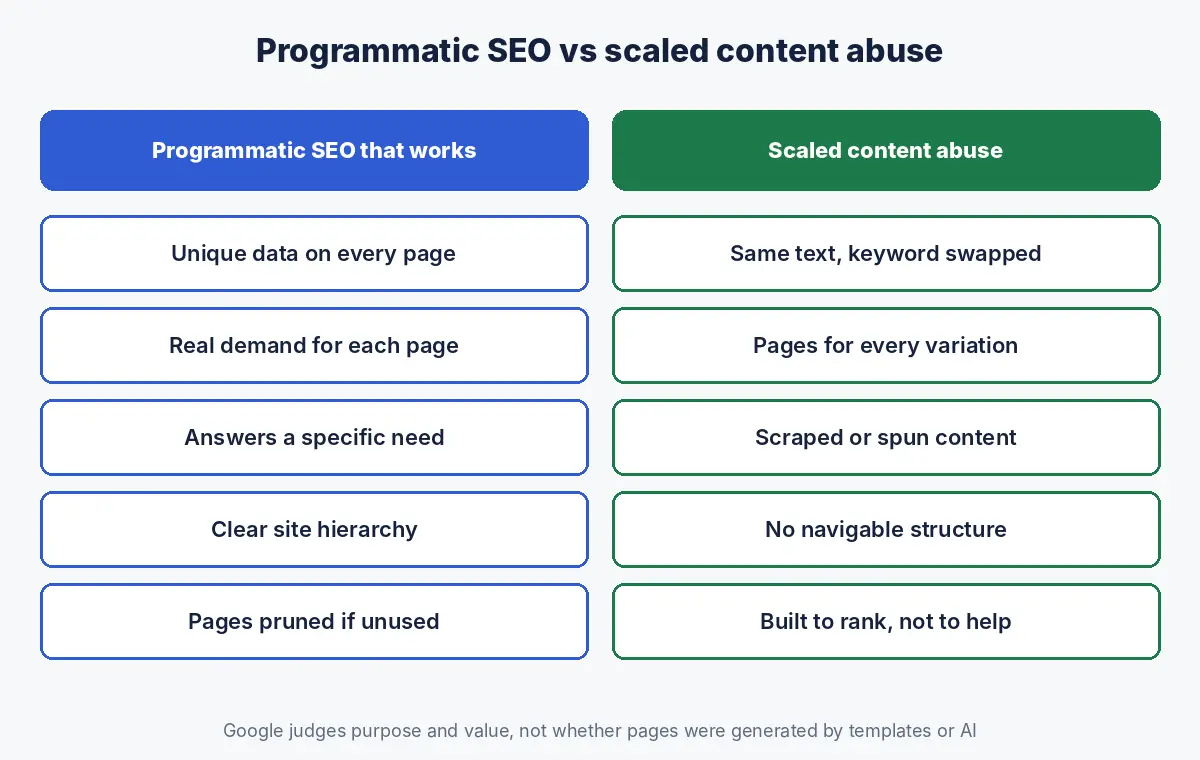
The difference is value per page. Programmatic SEO gives each page unique, useful information for a real search need; scaled content abuse produces near identical pages for every keyword variation with little for the reader.
| Question | Programmatic SEO that works | Scaled content abuse |
|---|---|---|
| What differs between pages? | Data, inventory, prices, reviews, recommendations | Only the keyword or place name |
| Why does the page exist? | Real people search for it and the site can answer | A keyword exists, regardless of whether the site can answer |
| Where does the content come from? | Proprietary, licensed or carefully combined data | Scraped, spun or stitched together text |
| How is it organised? | Clear hierarchy users can browse | Flat pages built to catch search traffic |
| What happens to weak pages? | Merged, noindexed or removed | Left live indefinitely |
Google’s doorway abuse policy is also relevant: it covers pages created to rank for specific similar queries that funnel users elsewhere, including multiple pages targeting regions or cities that lead users to the same content (Google spam policies). City pages with nothing local on them are the most common way programmatic projects cross that line.
Which businesses should use programmatic SEO?
Programmatic SEO suits businesses that hold structured data with genuine variation across many searchable combinations, such as marketplaces, listing sites, software with many integrations and data publishers.
| Business type | Good fit when | Poor fit when |
|---|---|---|
| Property, jobs and travel marketplaces | Live inventory exists for each location and filter | Most combinations have no listings |
| SaaS with many integrations or use cases | Each integration has real features and setup steps | Integration pages differ only in the partner’s name |
| Local service networks | Real providers, prices and reviews exist in each area | One office serves every city page |
| Data and comparison publishers | Data is proprietary, licensed or carefully compiled | Data is copied from the sources it competes with |
| Ecommerce | Filtered category pages match real search demand | Every filter combination becomes an indexable page |
If your answer to “what is unique on page 4,000?” is “the city name”, programmatic SEO is the wrong tool. Focus on fewer, deeper pages instead, chosen with a revenue keyword set.
What makes a programmatic page worth indexing?
A programmatic page is worth indexing when it answers its target query better than a generic page could, using information specific to that combination, and when someone actually searches for it.
- Specific data: numbers, listings, availability, prices or attributes that change from page to page.
- A direct answer: the page states the answer to its query in the first lines, such as the typical rent range in that community.
- Context that helps decide: comparisons with nearby options, trends, pros and cons drawn from the data.
- Evidence of experience: reviews, expert notes or editorial commentary where it adds value.
- A clear next step: listings to browse, a quote to request, a tool to try.
- Accuracy and freshness: a visible update date and data that is kept current.
Google’s guidance on helpful content asks whether content provides original information, reporting, research or analysis, and whether it adds substantial value compared with other pages in search results (Google Search Central). Every programmatic template should be tested against those questions, page type by page type.
How do you decide which programmatic pages should exist?
Decide which programmatic pages should exist by scoring each potential page on search demand, data coverage and business value, and publishing only combinations that pass all three.
| Test | Pass when | Typical fail |
|---|---|---|
| Search demand | Keyword data or Search Console shows people search this combination | Combinations no one searches, such as niche filters on small locations |
| Data coverage | Enough unique data exists to make the page useful | Zero or one listing, empty tables, placeholder text |
| Business value | Visitors can convert: enquire, book, sign up or buy | Pages that attract traffic you cannot serve |
Pages that fail the data test should not be indexable. Most pages never earn search traffic anyway: Ahrefs found that 96.55% of pages in its index get no traffic from Google, mainly because of no search demand, no backlinks or a mismatch with search intent (Ahrefs). Publishing thousands of pages without these tests mostly adds to that figure.
Where should the data for programmatic pages come from?
The strongest programmatic pages use proprietary data, such as your own listings, transactions, usage or reviews; licensed data is the next best; public data works only when you add analysis or combination others do not.
| Data source | Examples | Risk level |
|---|---|---|
| Proprietary | Your inventory, prices, customer reviews, product usage data, support data | Low: competitors cannot copy it |
| Licensed | Paid datasets, partner feeds, official APIs with permission | Medium: others may license the same data |
| Public | Government statistics, open datasets, public registries | High unless you add analysis, combination or tools |
| Scraped from competitors | Copied listings, reviews or descriptions | Very high: likely scaled content abuse and legal risk |
How do you build programmatic page templates that are not thin?
Build programmatic templates around data blocks that change per page, an answer first summary, and conditional sections that only appear when the data supports them, so no page shows empty or repeated filler. Our guide to programmatic page templates covers each block, conditional logic and testing in detail.
- Answer block: a one or two sentence summary generated from the data, such as “Two bedroom apartments in Dubai Marina listed for rent averaged [range] this month across [number] listings.”
- Data blocks: tables, charts and lists populated from the dataset.
- Conditional sections: show a section only when its data exists; hide it otherwise rather than printing placeholder text.
- Comparison links: link to nearby or related combinations, which also builds a crawlable hierarchy.
- Editorial layer: human written notes for the most valuable pages; AI can draft from data, but a person should check accuracy.
- Structured data: schema that matches the visible content, such as Product, LocalBusiness or ItemList; see our schema markup examples.
How do you get thousands of programmatic pages crawled and indexed?
Get programmatic pages crawled and indexed by publishing in batches, linking them through a clear hierarchy, listing only indexable URLs in sitemaps with accurate lastmod dates, and keeping low value combinations out of the crawl.
- Google’s crawl budget guidance is aimed at sites with roughly 1 million or more pages changing about weekly, 10,000 or more pages changing daily, or many URLs marked as discovered but not indexed (Google Search Central). Many programmatic sites fall into one of these groups.
- Google recommends consolidating duplicate content, blocking unimportant URLs with robots.txt rather than noindex, returning 404 or 410 for removed pages, fixing soft 404s and keeping sitemaps current with lastmod (Google Search Central).
- Link every programmatic page from at least one category or hub page, and link related pages to each other.
- Start with a pilot of a few hundred pages and check indexing and engagement before releasing the next batch.
How do you monitor and prune a programmatic site?
Monitor a programmatic site through Search Console’s page indexing report, crawl stats and performance data by template, and prune pages that stay unindexed or earn no clicks or conversions after a fair period.
| Signal | Where to find it | What it suggests |
|---|---|---|
| Many pages crawled but not indexed | Search Console page indexing report | Google sees little value; improve or remove the pattern |
| Many pages discovered but not indexed | Search Console page indexing report | Crawl capacity or demand problem; reduce low value URLs |
| Indexed pages with no impressions | Search Console performance report by URL pattern | No demand or poor relevance |
| Impressions but no clicks | Search Console | Titles, snippets or SERP features need work |
| Traffic but no conversions | Analytics key events | Wrong audience or weak next step |
Pruning is not failure; it is maintenance. Our guide to content pruning with conversion data explains how to decide between improving, merging, noindexing and removing.
How does programmatic SEO affect AI search visibility?
Programmatic pages built on specific, accurate data can be cited in AI answers, because AI search systems retrieve pages for many narrow related queries; thin templated pages rarely are.
Google says its AI features may issue multiple related searches across subtopics and data sources to build a response (Google Search Central). A page that clearly answers a narrow question, such as typical rents in one community or whether an integration supports a specific feature, is a natural candidate for one of those subtopic searches. Google also says there are no special requirements for its AI features beyond being indexed and eligible for a snippet, and that you do not need to break content into chunks or rewrite it specially for AI (Google Search Central). Good programmatic pages already have the clear structure these systems use.
What does a programmatic SEO rollout plan look like?
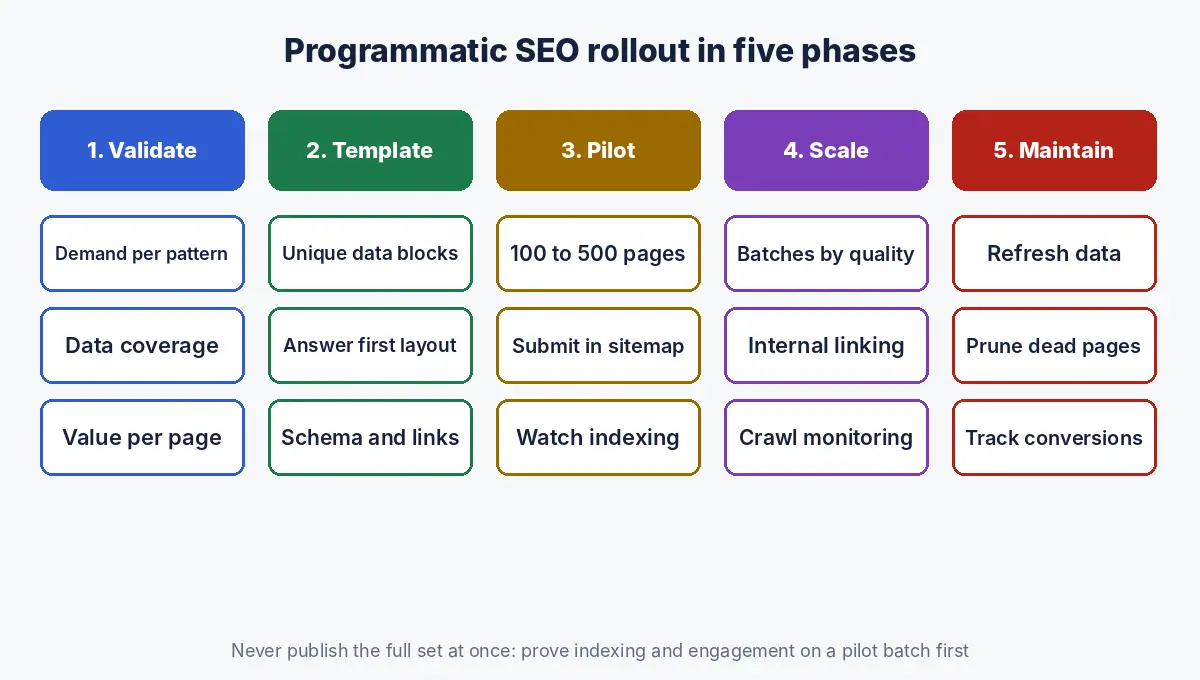
A programmatic SEO rollout plan moves through five phases, validate, template, pilot, scale and maintain, with a go or no go decision after the pilot.
| Phase | Duration | Key activities | Go or no go test |
|---|---|---|---|
| 1. Validate | 2 to 4 weeks | Map patterns, check demand, audit data coverage, estimate value | Enough combinations pass demand, data and value tests |
| 2. Template | 2 to 6 weeks | Design data blocks, answer block, conditional logic, schema, links | Sample pages reviewed against Google’s helpful content questions |
| 3. Pilot | 6 to 10 weeks | Publish 100 to 500 strongest pages, submit sitemap, monitor | Most pilot pages indexed and earning impressions |
| 4. Scale | Ongoing, in batches | Release further batches by quality tier; strengthen linking | Indexing rate and engagement hold steady per batch |
| 5. Maintain | Ongoing | Refresh data, prune weak pages, track conversions | Pages kept only if they earn their place |
Durations are typical planning ranges, not fixed rules. To forecast the likely return before committing engineering time, use the approach in our guide to SEO forecasting that finance teams accept.
How Crawl To Click approaches programmatic SEO
Crawl To Click is an SEO and AI visibility consultancy, and we treat programmatic SEO as a data and demand problem before it is a content problem. We start by mapping the search patterns that lead to revenue, testing each combination for demand, data coverage and business value, and deciding which pages deserve to exist. We then work with product and engineering teams on templates that show unique data first, indexation rules, sitemaps and internal linking, launch a pilot batch and scale only what Google indexes and users engage with. We have applied this to property and listing sites, software products with many integrations, education and healthcare directories, and ecommerce catalogues, always with a pruning plan from day one. Learn more about our approach.
FAQs on programmatic SEO
What is programmatic SEO?
Programmatic SEO is creating many search focused pages from a structured dataset and a template, such as one page for each location, integration or product combination, where each page targets a specific search pattern and shows data unique to that combination.
Is programmatic SEO against Google’s guidelines?
No. Google does not penalise pages for being generated from templates or with automation. It acts against scaled content abuse: many pages created mainly to manipulate rankings with little value for users, such as keyword swapped or scraped pages.
Does programmatic SEO still work in 2026?
Yes, when each page offers unique, useful data for a real search demand. Programmatic sites built on thin, near identical pages tend to see most pages left unindexed or lose visibility in core updates.
How many programmatic pages should I publish at once?
Start with a pilot of roughly 100 to 500 of your strongest pages, monitor indexing and engagement for several weeks, then release further batches by quality tier rather than publishing the full set at once.
Can I use AI to create programmatic SEO pages?
Yes, if the pages are helpful. Google says appropriate use of AI or automation is not against its guidelines, but generating many pages with AI without adding value is listed as scaled content abuse. Use AI to draft from real data and have people check accuracy.
Why are my programmatic pages not being indexed?
Programmatic pages usually stay unindexed because Google sees little unique value in them, because too many low value URLs dilute crawling, or because pages are poorly linked. Improve data per page, remove weak combinations and link pages from category hubs.
Planning a programmatic SEO project?
Before you generate thousands of pages, find out which ones deserve to exist. Book a free strategy call and get a straight answer on whether programmatic SEO fits your data and market.
Disclaimer: This article reflects Google documentation and published studies as of the dates stated. Google’s policies and ranking systems change over time. Examples are illustrative, and phase durations are planning guidance rather than guarantees.