Last updated: October 2026. Every statistic links to its source, with the date it refers to.
Most SEO statistics pages recycle the same figures from 2016. This one uses only current, sourced data, and for each group of SEO statistics it explains what the numbers mean for your budget and priorities in 2026.
The short answer: Google still dominates search, with 94.7% of mobile and 76.4% of desktop search share (September 2026), and its query growth is the fastest in five years. But clicks are harder to win: 58.5% of US Google searches end without a click, an AI Overview cuts the top result’s click through rate by about 58%, and 96.55% of pages get no Google traffic at all. Only 48% of websites pass Core Web Vitals on mobile. The opportunity is still there for pages that match intent, earn links and are worth citing in AI answers.
Key SEO statistics for 2026 at a glance
| SEO statistic | Figure | Source and date |
|---|---|---|
| Google share of mobile search | 94.7% | StatCounter, September 2026 |
| Google share of desktop search | 76.4% (Bing 14.1%) | StatCounter, September 2026 |
| Google searches per day | Just under 14 billion | Alphabet via TechCrunch, 2025 |
| Searches that are brand new each day | About 15% | Google, 2025 |
| US Google searches with zero clicks | 58.5% | SparkToro and Datos, 2024 |
| Drop in top result click through rate with an AI Overview | About 58% | Ahrefs, December 2025 data |
| Pages that get no traffic from Google | 96.55% | Ahrefs |
| Websites passing Core Web Vitals on mobile | 48% (56% on desktop) | Web Almanac 2025 |
| Mobile share of web traffic worldwide | 60.1% | StatCounter, September 2026 |
| Consumers who always read reviews for local businesses | 41%, up from 29% | BrightLocal, 2026 |
Search engine market share statistics
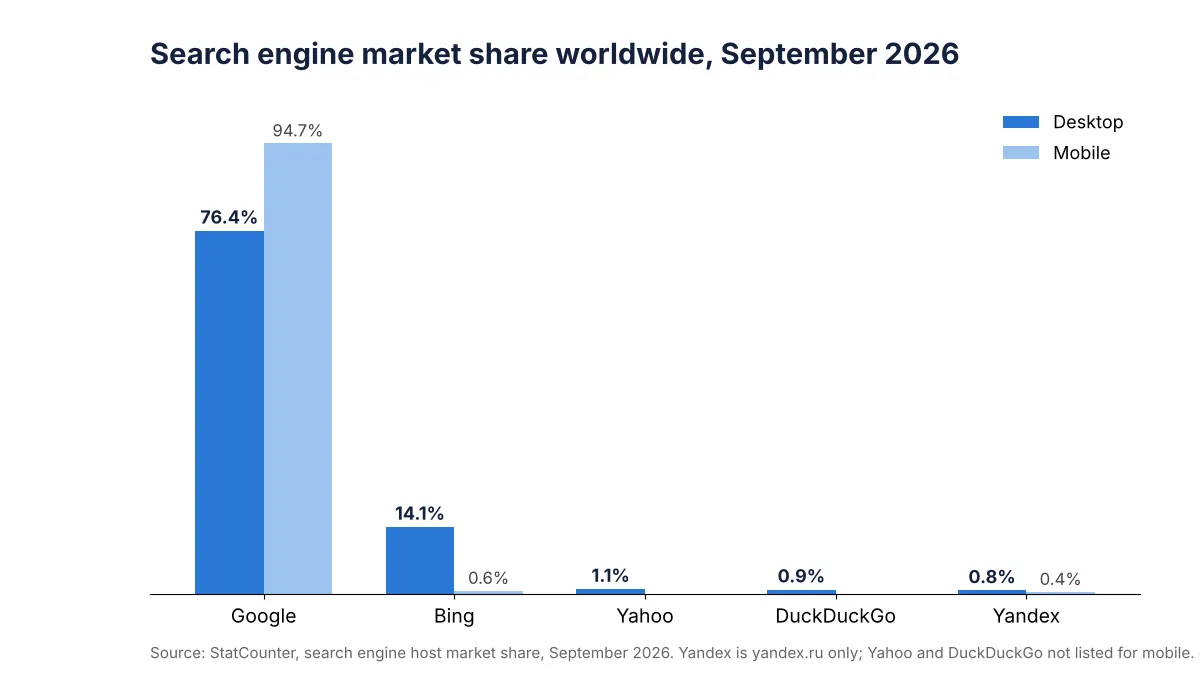
- Google held 94.7% of mobile search engine share worldwide in September 2026; Bing had 0.64% (StatCounter).
- On desktop, Google held 76.38% and Bing 14.12%, followed by Yahoo at 1.06% and DuckDuckGo at 0.94% (StatCounter).
- Takeaway: Google is still where most organic demand sits, but Bing matters on desktop, which is where much B2B research happens. Bing also feeds Microsoft Copilot, so verify your site in Bing Webmaster Tools.
Google search statistics: how much people search
- Alphabet has reported around 5 trillion searches a year, or just under 14 billion a day (TechCrunch).
- Google’s year over year query growth in Q3 2026 was the highest in five years, according to Sundar Pichai in Alphabet Q3 2026 earnings remarks. Search and other advertising revenue grew 12% year over year in the same quarter.
- About 15% of queries Google sees each day are new, a figure John Mueller of Google said has stayed steady even with AI tools, as reported by Search Engine Journal in 2025.
- Queries in Google’s AI Mode are on average three times longer than traditional searches, and Google handles over 50 billion visual searches a month (Alphabet).
So the much quoted prediction that search volume would fall 25% by 2026 (Gartner, 2024) has not played out in Google’s own numbers. Search demand is growing. What has changed is how many of those searches lead to a click.
Zero click search and organic CTR statistics
- 58.5% of US Google searches and 59.7% of EU searches ended without a click, and only 360 of every 1,000 US searches sent a click to the open web, in clickstream data from Datos analysed by SparkToro (Search Engine Land, data to May 2024).
- When a Google AI summary appeared, users clicked a traditional result in 8% of visits, against 15% without one (Pew Research Center, March 2025 data).
- An AI Overview reduces the click through rate of the top ranking page by about 58%, comparing December 2023 with December 2025 across 300,000 keywords (Ahrefs).
What zero click statistics mean for your SEO targets
If your forecast assumes 2019 click through rates, it will overpromise. In audits I run, the fix is to forecast clicks per keyword using the SERP features actually showing for it today, and to judge success by leads from organic search rather than raw sessions. Our guide to SEO forecasting walks through the method.
AI Overviews and AI search statistics
- Google AI Overviews reached over 2.5 billion monthly users, and AI Mode over 1 billion, according to Google at I/O 2026.
- AI Overviews appear in more than 43% of US searches, according to Similarweb.
- 76.10% of pages cited in AI Overviews also rank in Google’s top 10 for the query (Ahrefs, 1.9 million citations).
- At Ahrefs, AI search sent 0.5% of visitors but 12.1% of signups over 30 days (Ahrefs).
- More detail is in our AI search statistics and ChatGPT usage statistics roundups.
Organic traffic and content statistics
- 96.55% of pages in Ahrefs’ index get no traffic from Google, and a further 1.94% get 10 visits a month or fewer (Ahrefs).
- The main reasons Ahrefs gives: no search demand for the topic, no backlinks, and a mismatch with search intent (Ahrefs).
This is the statistic I quote most often to founders. Publishing more is not the plan. Picking topics with real demand and buying intent, then giving each page enough authority to rank, is the plan.
Technical SEO and Core Web Vitals statistics
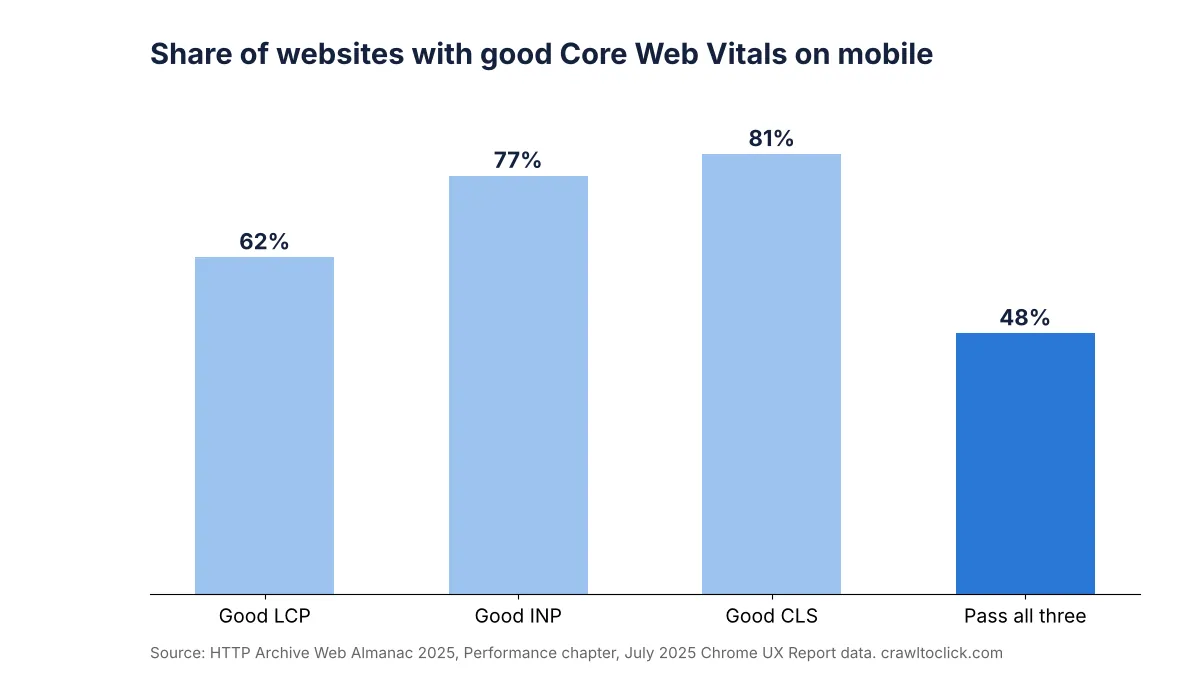
- Only 48% of websites pass all three Core Web Vitals on mobile, and 56% on desktop (HTTP Archive Web Almanac 2025, July 2025 data).
- On mobile, 62% have good Largest Contentful Paint, 77% good Interaction to Next Paint and 81% good Cumulative Layout Shift (Web Almanac 2025).
- Takeaway: loading speed (LCP) is the most common failure. Start with image size, server response time and render blocking resources.
Mobile SEO statistics
- Mobile devices produced 60.11% of web traffic worldwide in September 2026, against 39.89% for desktop (StatCounter).
- In India, mobile’s share was 77.76% (StatCounter, September 2026).
- Takeaway: Google indexes the mobile version of your pages, so check content, links and structured data on mobile first, especially for Indian audiences.
Local SEO statistics
- 41% of consumers always read reviews when choosing a local business, up from 29%, and 97% read them at least sometimes (BrightLocal Local Consumer Review Survey 2026).
- 74% look for reviews from the last three months, and 31% will only use a business rated 4.5 stars or higher, up from 17% (BrightLocal).
- 80% are more likely to use a business that responds to all its reviews (BrightLocal).
- Use of ChatGPT and other AI tools for local recommendations rose from 6% to 45%, making AI the third most popular source in the survey (BrightLocal).
Google algorithm update statistics
Google confirmed three core updates in 2025 (March, June and December) and two in 2026 so far (March and May), plus spam updates in March, June, August and September 2026, according to the Google Search Status Dashboard. Expect two to four broad ranking shifts a year, and annotate each one in your reporting so changes are not misread.
SEO statistics for the UAE and India
- The UAE had 11.3 million internet users, a penetration rate of 99%, at the end of 2025 (DataReportal Digital 2026).
- 70.1% of the UAE’s working age population used AI in Q1 2026, against 17.8% globally (Khaleej Times reporting the Microsoft AI Diffusion Report).
- In India, mobile accounts for 77.76% of web traffic (StatCounter).
- Takeaway: in the UAE nearly everyone is online and AI adoption is the highest in the world, so search and AI visibility should be planned together. In India, mobile performance is not optional.
How to use SEO statistics in a business case
Statistics persuade leadership only when they connect to a decision. Use this table to pair each figure with the action it supports:
| If you need to argue | Use this statistic | The decision it supports |
|---|---|---|
| Search is still worth investing in | Google query growth highest in five years | Keep organic search in the budget |
| Rankings alone are not enough | 58.5% zero click; about 58% lower CTR with AI Overviews | Measure leads and AI visibility, not only rankings |
| Volume publishing does not work | 96.55% of pages get no Google traffic | Fund fewer, better pages with demand and links |
| Technical fixes are overdue | Only 48% of sites pass Core Web Vitals on mobile | Prioritise LCP and mobile performance |
| AI search needs a plan | AI Overviews over 2.5 billion monthly users; 76% of citations rank top 10 | Run SEO and AEO as one programme |
| Local reputation matters | 74% want reviews from the last three months | Build a steady review and response routine |
A word of caution: if a statistic has no linked primary source and date, do not put it in front of a board. Many widely repeated SEO figures trace back to studies that are a decade old. To turn these benchmarks into an action list for your site, use our SEO checklist.
How to cite these SEO statistics
You are welcome to use these figures. Please cite the original source linked next to each one, and link to this page as the collection: “SEO Statistics 2026, Crawl To Click”. We update the page as new data is published.
How Crawl To Click turns SEO statistics into a plan
Crawl To Click is an SEO and AI visibility consultancy built around Search Market Fit: investing only in the searches that lead to revenue. Industry statistics like these set the context, but every plan we build starts with the site’s own data: which keywords already bring leads, where rankings sit just outside the top positions, how click through rates have changed as AI Overviews appeared, and which technical issues hold pages back. We then prioritise the work by expected business value, whether the site belongs to a software company, a healthcare provider, a property developer or an online retailer, and report progress in leads and revenue alongside rankings. Learn more about our approach.
FAQs on SEO statistics
What is Google’s search market share in 2026?
In September 2026, Google held 94.7% of mobile search engine share and 76.4% of desktop share worldwide, according to StatCounter. Bing had 14.1% of desktop share.
How many Google searches are there per day?
Just under 14 billion, based on the roughly 5 trillion searches a year Alphabet has reported. Google said in October 2026 that its query growth was the highest in five years.
What percentage of Google searches are zero click?
58.5% of US Google searches and 59.7% of EU searches ended without a click, in SparkToro’s 2024 analysis of Datos clickstream data.
Is SEO still worth it in 2026?
Yes, for pages that match real demand. Search volume is growing and AI Overviews mostly cite pages that already rank in the top 10, but 96.55% of pages get no Google traffic, so topic choice and authority matter more than volume.
How many websites pass Core Web Vitals?
48% of websites pass all three Core Web Vitals on mobile and 56% on desktop, according to the HTTP Archive Web Almanac 2025.
How many Google core updates happen each year?
Google confirmed three core updates in 2025 and two by October 2026, according to its Search Status Dashboard, alongside several spam updates.
Need an independent view of your SEO numbers?
Benchmarks tell you what is normal. Your own data tells you what to fix first. Request an SEO audit and get a prioritised plan tied to leads and revenue.
Disclaimer: Statistics are reported as published by the linked sources, for the dates stated, and may be revised. Studies use different methods, samples and regions, so compare figures with care.