A writer is handed a keyword, “corporate cards UAE”, and a word count. Two weeks later the article arrives: 2,000 words on what a corporate card is, written for nobody in particular, with no mention of the product, no comparison with banks and no call to action. The writer did what was asked. The brief was the problem.
The short answer: an SEO content brief tells a writer who the page is for, what search intent it serves, what the top results and AI answers already say, the direct answer to open with, the outline, the questions to answer, the first hand evidence to include, the facts to source, the internal links, the on page details and the action the reader should take. Our free template covers all of this in 12 sections, with notes on what to write in each.
Download the free SEO content brief template (DOCX, opens in Word and Google Docs)
Why SEO content briefs matter
Google’s guidance on creating helpful, reliable, people first content asks whether content provides original information, reporting or analysis, and whether it adds substantial value compared with other pages in search results. A writer can only deliver that if the brief says what the other pages cover, what they miss and what original material is available. A good brief turns those questions into instructions.
- Fewer rewrites: the writer knows the angle, depth and audience before starting.
- Pages that convert: every brief names the business goal and the call to action.
- Consistency at scale: several writers can produce work that fits one strategy.
- Better AI visibility: briefs that ask for a quotable direct answer and clear facts produce pages AI tools can cite.
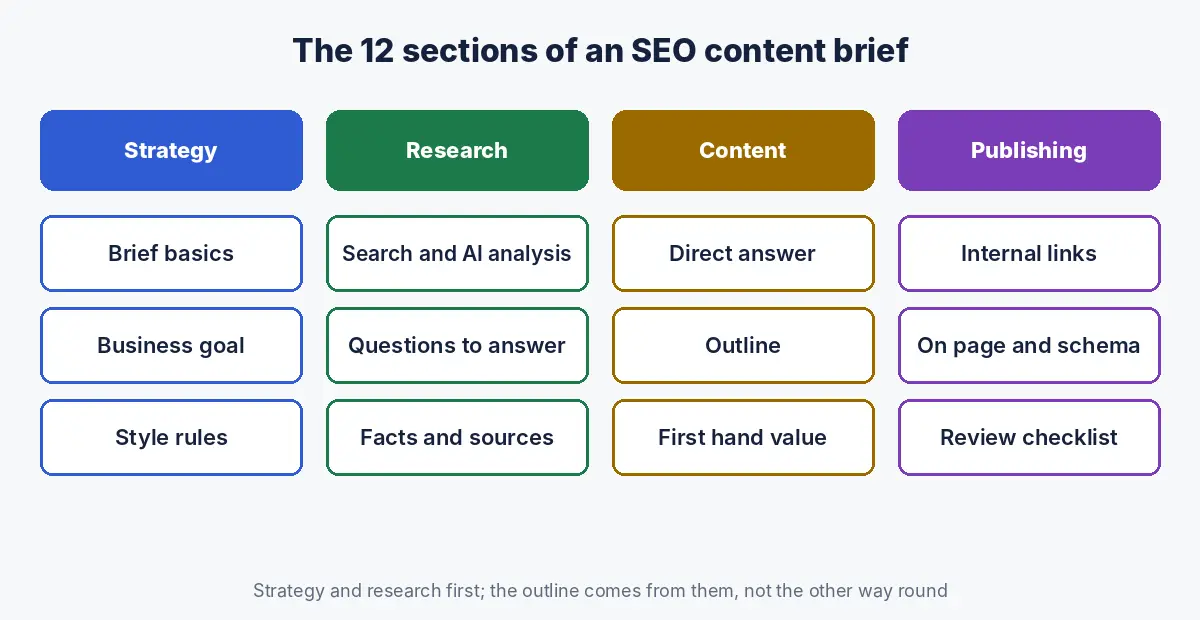
The 12 sections of an SEO content brief
| Section | What it contains |
|---|---|
| Brief basics | Working title, URL slug, Main keyword, Secondary keywords, Target reader, Funnel stage, Search intent, Page type, Length guide, Writer / reviewer / deadline |
| Business goal | Why this page exists, Primary call to action, Keyword value, How success is measured |
| Search and AI answer analysis | Top 5 results, What all of them cover, What none of them cover, SERP features, What AI assistants say |
| Direct answer | Answer in 2 to 3 sentences |
| Outline | H1, H2 / H3 sections |
| Questions to answer | From People Also Ask, From sales and support, Objections to address |
| First hand value | Our data or examples, Expert input, Visuals |
| Facts and sources | Statistics to include, Claims that need checking |
| Internal links | Link from this page to, Link to this page from |
| On page and schema | Title tag, Meta description, Schema type, Image alt text notes |
| Style rules | Tone and spelling, Formatting, Avoid |
| Review checklist | Direct answer in first 100 words, Every statistic sourced, First hand value included, Internal links added, Title, meta and schema done, Facts checked by reviewer |
Copy and paste content brief template
If you prefer plain text, copy this into your document or project tool:
SEO CONTENT BRIEF

1. BRIEF BASICS
Working title:
URL slug:
Main keyword:
Secondary keywords:
Target reader:
Funnel stage:
Search intent:
Page type:
Length guide:
Writer / reviewer / deadline:

2. BUSINESS GOAL
Why this page exists:
Primary call to action:
Keyword value:
How success is measured:

3. SEARCH AND AI ANSWER ANALYSIS
Top 5 results and their angle:
What all of them cover:
What none of them cover:
SERP features:
What AI assistants say and cite:

4. DIRECT ANSWER (2 to 3 sentences, first 100 words)

5. OUTLINE
H1:
H2 / H3 with notes:

6. QUESTIONS TO ANSWER
People Also Ask:
Sales and support questions:
Objections:

7. FIRST HAND VALUE
Our data or examples:
Expert input:
Visuals to create:

8. FACTS AND SOURCES
Statistics with source links:
Claims to check:

9. INTERNAL LINKS
Link from this page to:
Link to this page from:

10. ON PAGE AND SCHEMA
Title tag:
Meta description:
Schema type:
Alt text notes:

11. STYLE RULES
Tone and spelling:
Formatting:
Avoid:

12. REVIEW CHECKLIST
[ ] Direct answer in first 100 words
[ ] Every statistic sourced
[ ] First hand value included
[ ] Internal links added
[ ] Title, meta and schema done
[ ] Facts checked by reviewer
A filled in SEO content brief example
Here is a shortened example for an imaginary UAE fintech, Falconpay, targeting a buying intent keyword:
| Section | Example |
|---|---|
| Main keyword | corporate card for SMEs UAE |
| Target reader | Founder or finance manager of a UAE company with 10 to 200 staff, comparing expense card options |
| Intent and page type | Commercial; a product page with comparison elements |
| Business goal | Book a demo; the keyword is in the top five of the revenue keyword set |
| What results miss | Banks list card features but none compare approval time, foreign currency fees and accounting integrations side by side |
| Direct answer | Falconpay is a corporate card for UAE SMEs that issues physical and virtual cards, syncs spending with accounting tools and approves most companies within days. Plans start at [price], billed in AED. |
| Outline | Who it is for; how it works; card types; fees compared with bank cards; integrations; approval process; FAQs; demo |
| First hand value | Anonymised approval times from recent customers, screenshots of the expense flow, quote from the head of finance operations |
| Internal links | From the expense management guide and pricing page; to the integrations page |
| Call to action | See Falconpay with your own expense data in a 20 minute demo |
For buying intent pages like this one, our guide to bottom of funnel content covers the page types that convert best, and our guide to building a revenue keyword set shows how to choose which briefs to write first.
How to research each part of the brief
Search intent and the top results
Search the main keyword in the market you target and open the top five results. Note the page type Google prefers, the angle of each page, what they all cover and what none of them answers. If the results are guides, write a guide; if they are product or category pages, a blog post will struggle to rank.
AI answers
Ask the main question in ChatGPT, Gemini and Perplexity, and check any Google AI Overview. Note how the answer is framed and which sources are cited. Your page should answer the question at least as clearly and add something those sources do not.
Questions and objections
Collect People Also Ask questions, then add questions from sales calls, support tickets and reviews. These are often more specific, and more valuable, than anything a keyword tool shows.
First hand value
Ask the subject matter expert or client team three questions: what do customers most often get wrong about this, what example or number can we share, and what would you tell a friend? The answers become the parts of the page competitors cannot copy.
SEO content briefs for different page types
| Page type | Extra brief sections to include |
|---|---|
| Blog guide | Direct answer, step by step sections, examples, related questions |
| Comparison or alternatives page | Comparison criteria, honest pros and cons, who each option suits, pricing with sources |
| Product or category page | Buyer questions, specifications, pricing, delivery or setup details, reviews, Product schema |
| Service page | Process, deliverables, timeline, proof, pricing approach, Service schema |
| Local page | Address and area served, local proof, opening hours, Google Business Profile alignment, LocalBusiness schema |
Writing briefs for AI search
- Ask for an answer first opening of two or three sentences that stands on its own when quoted.
- Ask for factual sentences that name the brand, such as “Falconpay supports Arabic and English”, rather than “we support two languages”.
- List the sources AI answers already cite so the writer knows the standard to beat.
- Include an FAQ section built from real questions, with short, direct answers.
Using AI to draft content briefs
AI assistants can speed up the research parts of a brief: summarising the top results you paste in, grouping questions and drafting an outline. They cannot supply your first hand data or decide your business goal. Our list of 100 ChatGPT prompts for SEO includes ten prompts for content planning and briefs, and Google’s guidance on generative AI content notes that it can help with research and adding structure, provided the result is reviewed for accuracy.
Common content brief mistakes
- Keyword and word count only. The writer has to guess everything else.
- No business goal. The page gets traffic but no leads.
- Copying competitor outlines. The result matches the top pages instead of beating them.
- No source requirements. Statistics get invented or copied without links.
- No review step. Facts, links and on page details are missed before publishing. Track results afterwards with an SEO report template.
How Crawl To Click writes content briefs
At Crawl To Click, every brief starts with persona mapping and user intent research, then a check of what ranks and what AI assistants say for the topic. We only brief topics that connect to the revenue keyword set, and each brief names the conversion it should drive. The sections that make our briefs different are the gap analysis and first hand value: we interview the client’s team for examples, data and objections, and require an answer first summary and factual, sourced sentences that both readers and AI tools can quote. Every page is reviewed against the brief’s checklist before it goes live, and important pages are refreshed each quarter. Learn more about our approach.
Download the free SEO content brief template (DOCX, opens in Word and Google Docs)
FAQs on SEO content briefs
What is an SEO content brief?
A document that tells a writer who a page is for, what search intent it serves, what the top results and AI answers already cover, what to include and how the page should convert, so the content can rank and drive business results.
What should a content brief include?
Basics such as keyword, reader and intent; the business goal; search and AI answer analysis; a direct answer; an outline; questions to answer; first hand value; facts and sources; internal links; on page details; style rules; and a review checklist.
How long should an SEO content brief be?
Usually one to three pages. Long enough to remove guesswork for the writer, short enough to be read in full.
Can ChatGPT write a content brief?
It can draft the research parts quickly from data you paste in, such as top result summaries and questions. The business goal, first hand material and final decisions should come from your team.
Is the content brief template free to use?
Yes. Download the DOCX template and use it in Word or Google Docs for your own pages and clients.
Need briefs that produce pages that rank and convert?
Publishing content that gets traffic but no leads? Book a strategy call and we will review your briefs and topic plan.
Disclaimer: Falconpay and all example details are imaginary. Google guidance summarised here comes from the linked source and may change.