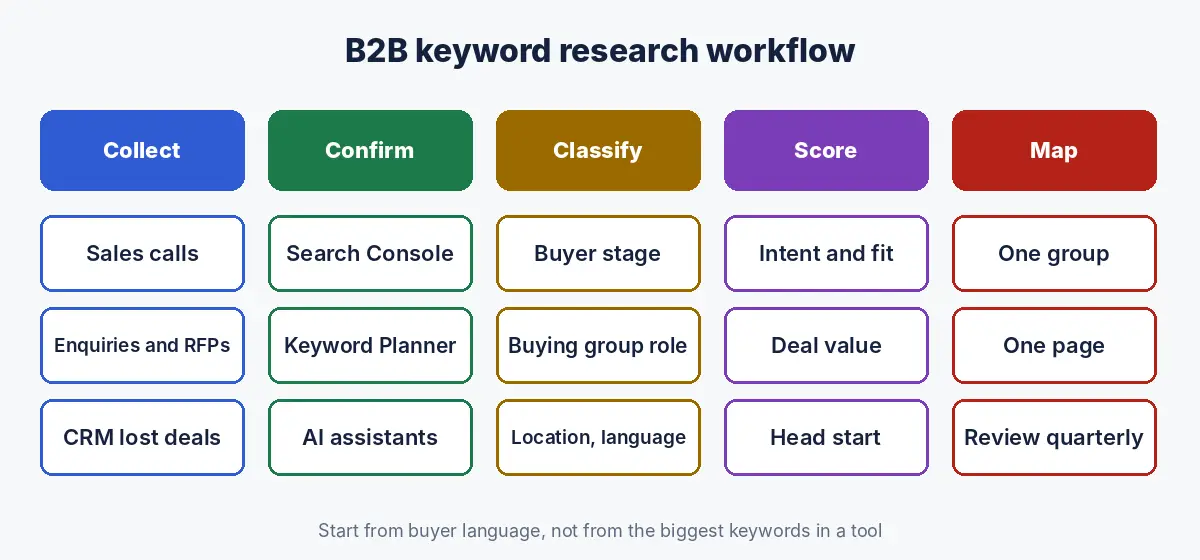
The short answer: B2B keyword research means finding the searches your buyers make in the weeks before they contact a vendor, not the biggest keywords in your category. Start from the language in sales calls, enquiries, RFPs and lost deal notes, add what Search Console shows you already appear for, check demand in Keyword Planner or an SEO tool, then sort keywords by buyer stage and buying group role and map each group to one page. Expect many of the best keywords to show low or zero volume.
Low volume is normal in B2B. A 2020 Backlinko analysis of 306 million US keywords found 91.8% get 100 or fewer searches a month (Backlinko), and B2B buying terms sit mostly in that long tail. This guide covers where to find B2B keywords, how to classify and prioritise them, worked examples for UAE businesses, a keyword map template and the mistakes to avoid. It is part of our B2B SEO guide.
How is B2B keyword research different from B2C keyword research?
B2B keyword research is different because volumes are small, several roles search for the same purchase, the most valuable searches are specific and technical, and success is measured by pipeline, so you choose keywords by buyer intent and deal value rather than by volume and difficulty alone.
| Factor | B2C keyword research | B2B keyword research |
|---|---|---|
| Starting point | Keyword tools | Sales conversations, CRM and Search Console, then tools |
| Volume | Often decides priority | Often too small to measure reliably |
| Searchers | One buyer | User, manager, finance, IT, procurement |
| Language | Everyday terms | Industry terms, acronyms, standards, job titles |
| Value of one ranking | Small per visit | One lead can be worth a large contract |
| Success measure | Traffic and sales | Qualified opportunities and pipeline |
Where do you find B2B keywords?
Find B2B keywords in your own commercial data first, because it holds the exact words buyers use, then use search data to confirm demand and fill gaps.
| Source | What to extract | Example (illustrative) |
|---|---|---|
| Sales calls and demo notes | How prospects describe the problem and the solution | “we keep missing customs filing deadlines” |
| Enquiry forms and emails | Words in the first message | “need outsourced payroll for free zone company” |
| RFPs and tender documents | Required capabilities and standards | “ISO 27001 certified managed SOC provider” |
| CRM lost deal reasons and competitor fields | Competitor names and comparison criteria | “[competitor] alternative”, “[competitor] pricing” |
| Search Console | Queries you already get impressions for | “warehouse management system UAE” |
| Keyword Planner and SEO tools | Volume ranges and related terms | “wms software”, “inventory management system Dubai” |
| Review platforms and forums | How buyers compare options | “easy to implement”, “Arabic invoices” |
| AI assistants | Questions buyers ask and vendors named | “best WMS for 3PL companies in Dubai” |
Search Console is especially useful because it shows real queries for your site, though it does not show every query: some rare queries are hidden to protect user privacy (Search Console Help). Export the last 16 months of queries and filter for terms that signal buying, such as pricing, alternatives, vs, software, provider and your locations.
How do you turn sales conversations into B2B keywords?
Collect the phrases buyers use in their first messages and calls, convert each into the search a buyer would type, and group the results by problem, solution and comparison; ten recorded sales calls usually reveal more useful keywords than a day in a keyword tool.
FROM SALES LANGUAGE TO KEYWORDS (illustrative, fictional WMS vendor)

Prospect said: "Our pickers waste time walking the whole warehouse"
  Problem search:   how to reduce picking time in a warehouse
  Solution search:  warehouse picking optimisation software

Prospect said: "We need something that works with Shopify and our 3PL"
  Integration search: wms shopify integration
  Segment search:     wms for 3pl companies UAE

Prospect said: "We are on [competitor] and the reports are too limited"
  Comparison search:  [competitor] alternatives
  Pricing search:     [competitor] pricing
Ask sales for the exact words, not a summary. Buyers rarely use your internal product language, and the gap between the two is where most B2B keyword opportunities sit.
How do you classify B2B keywords by buyer stage?
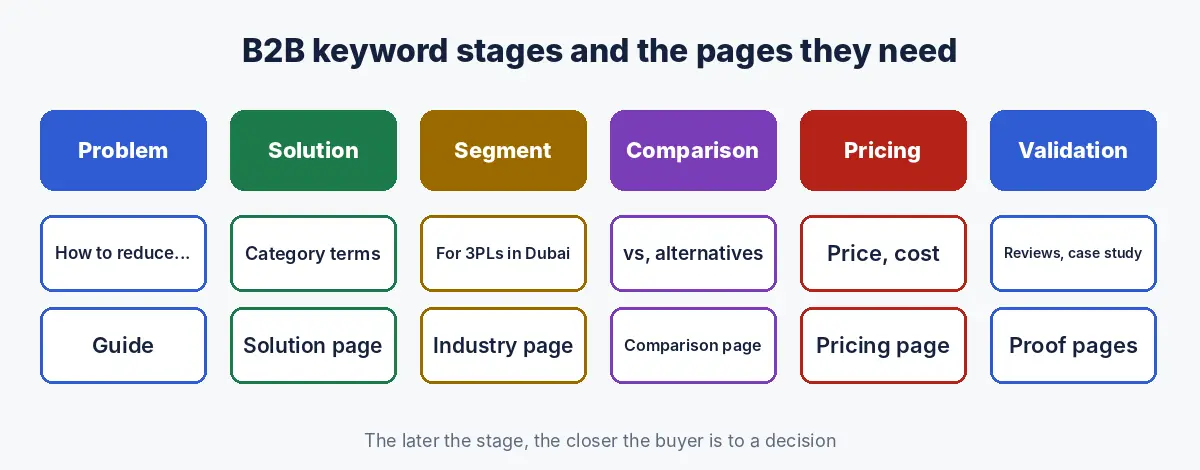
Classify each keyword as problem, solution, category, comparison, pricing or validation, because each stage needs a different page and has a different value; the later stages are closest to a buying decision.
| Stage | Example (illustrative) | Page type | Typical value |
|---|---|---|---|
| Problem | how to reduce stock errors in a warehouse | Guide | Early demand |
| Solution | warehouse management system | Solution page | High |
| Category plus segment | wms for 3pl companies Dubai | Solution or industry page | Very high |
| Comparison | [your brand] vs [competitor] | Comparison page | Very high |
| Pricing | wms pricing UAE | Pricing page | Very high |
| Validation | [your brand] reviews, [your brand] case study | Proof pages | High |
How do you find keywords for each member of the buying group?
List the roles involved in a purchase and the questions each one searches, because buyers use around seven information sources per purchase, according to Gartner (Gartner), and each role arrives with different concerns.
| Role | What they search (illustrative) | Content that answers it |
|---|---|---|
| Operations user | how to set up wave picking | How to guides, feature pages |
| Operations manager | best wms for mid size warehouse | Solution and comparison pages |
| Finance | wms implementation cost, wms ROI | Pricing page, ROI explanation |
| IT | wms api documentation, wms erp integration | Integration and technical pages |
| Procurement | [your brand] iso certification, [your brand] support hours | Trust and compliance pages |
Should B2B companies target zero volume keywords?
Yes, when the keyword clearly signals a buyer who could become a customer. Keyword tools estimate volume from samples and show ranges, so tools such as Google Keyword Planner give broad bands rather than exact counts (Google Ads Help), and very specific B2B terms often show zero even when real buyers search them.
Use three checks before dropping a low volume keyword:
- Did a real buyer use these words? If it came from a sales call or enquiry, keep it.
- Does Search Console show impressions for it or close variants? If so, demand exists.
- Would one lead from it justify the page? With a high deal value, a handful of searches a year can be enough.
Do not create a separate page for every zero volume variant. Group them under the page that answers the same need.
How do you prioritise B2B keywords?
Score each keyword group on buyer intent, fit with what you sell, deal value and your ranking head start, then work from the top; volume is a tiebreaker, not the main score. Our guide to building a revenue keyword set covers the scoring in detail.
B2B KEYWORD PRIORITY SCORE (adapt the weights)
Intent (1 to 5):        5 = pricing, comparison, segment; 1 = general learning
Fit (1 to 5):           5 = exactly what you sell to your best customers
Deal value (1 to 5):    5 = your largest typical contracts
Head start (1 to 5):    5 = you already rank 4 to 15; 1 = not ranking
Priority = Intent x 2 + Fit x 2 + Deal value + Head start   (max 30)

Example (illustrative):
wms for 3pl companies Dubai   5x2 + 5x2 + 4 + 3 = 27   Build or improve now
how to reduce picking time    2x2 + 4x2 + 3 + 1 = 16   Later, as a guide
What does B2B keyword research look like for a UAE company?
UAE B2B keyword research adds location, setup and language variations to each core keyword, then keeps only the variations that match how you actually serve buyers. The example below is for a fictional Dubai warehouse software company.
| Core keyword | UAE variations (illustrative) | Keep? |
|---|---|---|
| warehouse management system | warehouse management system UAE, wms Dubai | Yes, main solution page |
| wms for 3pl | wms for 3pl companies Dubai, 3pl software JAFZA | Yes, if you serve free zone 3PLs |
| inventory management software | inventory management software Abu Dhabi | Only if you have Abu Dhabi clients or a team there |
| wms pricing | wms price UAE, wms cost AED | Yes, pricing page |
| Arabic searches | نظام إدارة المستودعات, برنامج إدارة المخازن | Yes, if you have Arabic pages and Arabic speaking buyers |
Our guide to B2B SEO in the UAE explains when emirate, free zone and Arabic variations are worth separate pages.
How do you map B2B keywords to pages?
Map each keyword group to exactly one page, existing or new, so pages do not compete with each other, and record the page type, primary keyword, supporting keywords and priority in one sheet.
| Keyword group | Primary keyword | Supporting keywords | Target page | Status |
|---|---|---|---|---|
| WMS UAE | warehouse management system UAE | wms Dubai, warehouse software UAE | /solutions/wms/ | Optimise |
| 3PL segment | wms for 3pl companies Dubai | 3pl software UAE, 3pl inventory system | /industries/3pl/ | New |
| Pricing | wms pricing UAE | wms cost, wms price AED | /pricing/ | Optimise |
| Competitor | [competitor] alternatives | [competitor] vs [your brand] | /alternatives/[competitor]/ | New |
| Integration | wms shopify integration | shopify warehouse integration | /integrations/shopify/ | New |
The table above is illustrative. For page templates, see our guides to B2B solution and service pages and comparison and alternatives pages.
How do AI assistants change B2B keyword research?
AI assistants add a second set of queries to research: the longer, conversational questions buyers ask ChatGPT and Gemini, such as “which WMS works best for a 3PL in Dubai with Shopify clients?”. In G2’s March 2026 survey, 51% of B2B software buyers started research in an AI chatbot more often than in Google (G2).
Add these questions to your research by asking assistants the questions your buyers ask and noting which vendors and sources appear. The answers do not give volumes, but they show which pages and facts you need for buyers to find you in AI answers as well as in Google. Our guide to keyword research and clustering with Claude includes prompts for expanding and grouping keyword lists with examples.
What are the common B2B keyword research mistakes?
| Mistake | Fix |
|---|---|
| Starting in a keyword tool | Start with sales calls, enquiries and CRM data |
| Dropping every low volume keyword | Keep keywords real buyers use, grouped under the right page |
| Using internal product names | Use the words buyers use |
| Targeting only the end user | Cover finance, IT and procurement questions |
| Chasing broad educational keywords first | Start with segment, comparison and pricing searches |
| Several pages for one need | One page per keyword group |
| Researching once | Refresh quarterly with new sales and Search Console data |
How Crawl To Click does B2B keyword research
Crawl To Click is an SEO and AI visibility consultancy, and our B2B keyword research starts with the client’s sales calls, enquiries, RFPs and lost deal notes, then layers in Search Console, keyword tools and AI assistant testing. Keywords are grouped by buyer stage and buying group role, scored on intent, fit, deal value and head start, and mapped one group to one page, in English and Arabic where buyers search in both.
We do this for B2B software companies, logistics and supply chain businesses, professional services firms, healthcare technology providers, industrial suppliers and education technology companies in the UAE and India.
FAQs on B2B keyword research
How do you do keyword research for B2B?
Start with the words buyers use in sales calls, enquiries, RFPs and lost deal notes, add queries from Search Console, confirm demand in Keyword Planner or an SEO tool, classify keywords by buyer stage and role, score them on intent, fit, deal value and head start, and map each group to one page.
Why do B2B keywords have such low search volume?
B2B buying terms are specific to industries, segments and technical needs, so each one is searched by a small number of people. A Backlinko analysis of 306 million keywords found 91.8% get 100 or fewer searches a month, and B2B buying terms sit mostly in that long tail.
Should B2B companies target keywords with zero search volume?
Yes, when the keyword signals a real buyer, for example because prospects used those words or Search Console shows impressions, and when one lead would justify the page. Group zero volume variants under the page that answers the same need.
What are the best sources for B2B keywords?
The best sources are sales call notes, enquiry forms, RFPs, CRM competitor and lost deal fields and Search Console, followed by keyword tools, review platforms and the questions buyers ask AI assistants.
How do you prioritise B2B keywords?
Score keyword groups on buyer intent, fit with what you sell, deal value and your ranking head start, and use volume only as a tiebreaker. Segment, comparison and pricing searches usually rank highest.
How do you research keywords for different B2B decision makers?
List the roles in a typical purchase, such as users, managers, finance, IT and procurement, and the questions each searches, then create or assign pages that answer each role’s questions.
How often should B2B keyword research be updated?
Update it at least quarterly with new sales language, Search Console queries, competitor changes and AI assistant testing, and whenever you launch a new product, segment or market.
Need help finding the searches your buyers actually make?
Keyword lists full of volume but light on buyers? Book a B2B keyword strategy call and get a keyword map built from your sales data.
Disclaimer: Statistics are from the sources cited. Companies, keywords and scores in the examples are illustrative. Check keyword demand in Google data or an SEO tool before acting on it.