The short answer: B2B content for long sales cycles works when it answers the specific question each member of the buying group has at each stage, and when your champion can forward it internally to win agreement. Map content to roles (user, manager, finance, IT, procurement, executive) and stages (problem, requirements, shortlist, validation, approval), fill the gaps that stall deals, and make the key pages findable in search and AI assistants, because most of the journey happens before anyone talks to you.
The numbers explain why. Forrester found that on average 13 people are involved in a B2B buying decision and 89% of purchases involve two or more departments (Forrester), and 6sense found buying cycles averaged 10.1 months in 2025, with buyers 61% of the way through their journey at first contact with a seller (CustomerThink, reporting 6sense). This guide shows how to plan content for that reality, with a role and stage matrix, examples and a gap audit. It is part of our B2B SEO guide.
Why do long sales cycles and buying groups change B2B content strategy?
Long cycles and buying groups change content strategy because no single article or page persuades a whole committee over many months; you need a connected set of content that answers different people’s questions at different times and helps them agree with each other.
| Assumption | Reality in B2B | What content must do |
|---|---|---|
| One buyer reads and decides | About 13 people are involved on average | Answer several roles’ questions |
| Buyers contact sales early | Buyers are well into their journey before first contact | Answer questions without a sales call |
| A decision takes days | Cycles often last many months | Stay useful and findable throughout |
| The buyer convinces only themselves | Champions must convince colleagues | Be easy to forward and reuse internally |
Who is in a B2B buying group and what does each person need?
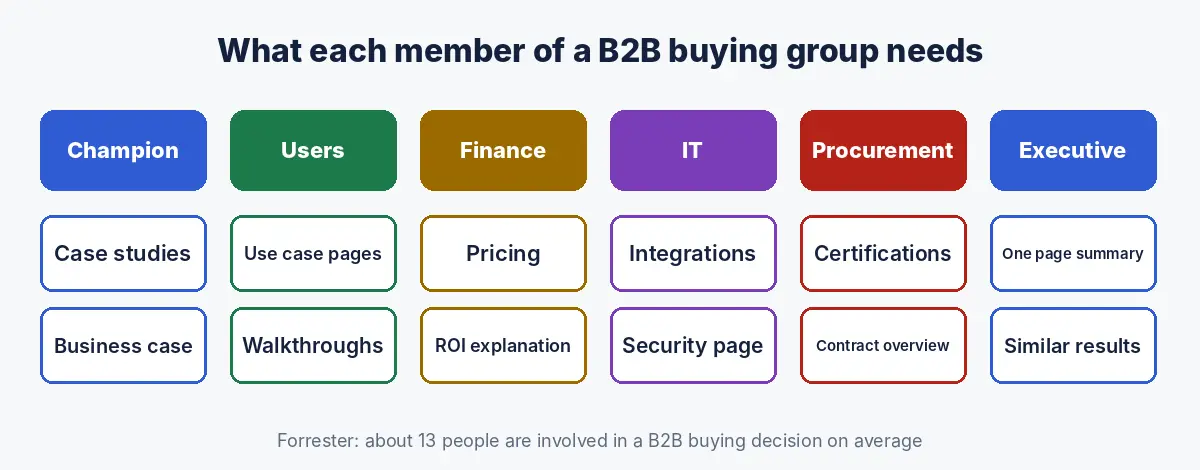
A typical B2B buying group includes a champion who leads the evaluation, the people who will use the product or service, a budget holder, IT or security, procurement and an executive sponsor, and each needs a different kind of content.
| Role | Main question | Content that helps |
|---|---|---|
| Champion | Will this solve our problem and can I get it approved? | Solution pages, case studies, business case template |
| Users | Will it make my work easier? | Use case pages, product walkthroughs, how to guides |
| Finance | What will it cost and what will we get back? | Pricing page, ROI explanation, cost comparison |
| IT and security | Will it integrate and is it secure? | Integration pages, security and data protection pages |
| Procurement and legal | Is this vendor reliable and are the terms acceptable? | Company information, certifications, contract and SLA overview |
| Executive sponsor | Is this the right strategic choice? | One page summary, results from similar companies, analyst or media mentions |
What content works at each stage of a long B2B sales cycle?
Match content to five stages: recognising the problem, defining requirements, building a shortlist, validating the choice and getting approval, because what a buyer needs in month one is different from what the committee needs in month eight.
| Stage | What buyers do | Content that works | Usually found through |
|---|---|---|---|
| Problem | Explore the problem and its cost | Guides, benchmarks, problem explainers | Search, AI assistants, LinkedIn |
| Requirements | Decide what a solution must do | Requirement checklists, buyer guides, approach comparisons | Search, AI assistants |
| Shortlist | Find and compare vendors | Solution pages, comparison and alternatives pages, pricing | Search, AI assistants, review sites |
| Validation | Check claims and fit | Case studies, reviews, demos, security and integration pages | Branded search, sales |
| Approval | Build agreement and sign off | Business case, ROI explanation, implementation plan, contract overview | Sales, champion |
The shortlist stage carries the most search intent; our guides to B2B solution pages and comparison and alternatives pages cover those pages in detail.
How do you map B2B content to roles and stages?
Build a content matrix with roles down the side and stages across the top, list the content you already have in each cell, and mark the empty cells that matter most for deals. The example below is illustrative, for a fictional Dubai payroll software company, PayDesk.
| Role | Problem | Requirements | Shortlist | Validation | Approval |
|---|---|---|---|---|---|
| Champion (HR manager) | Guide: payroll errors and their cost | Payroll software checklist for UAE companies | PayDesk vs competitor | Case study: free zone company | Business case template |
| Users (payroll team) | How to run WPS payroll | Features buyers should expect | Feature pages | Product walkthrough video | Implementation timeline |
| Finance | Cost of manual payroll | Pricing models explained | Pricing page | ROI example | Cost summary for approval |
| IT | None needed | Integration requirements guide | Integration pages | Security and data protection page | Data migration plan |
| Procurement | None needed | None needed | Company information page | Certifications page | Contract and SLA overview |
Copy this blank version and fill it in with your own content:
B2B CONTENT MATRIX (copy into a spreadsheet)
Rows:    Champion | Users | Finance | IT and security | Procurement | Executive
Columns: Problem | Requirements | Shortlist | Validation | Approval
In each cell: content title, URL, owner, last updated, status
Status: Exists and good | Exists, needs update | Missing, high priority | Not needed
What is consensus content and why does it matter in B2B?
Consensus content is material your champion can forward to colleagues to win agreement: a business case template, a one page summary, an ROI explanation, a security overview and an implementation plan. It matters because the champion, not your sales team, is in most of the internal conversations.
- Business case template: problem, options considered, recommended choice, cost, expected results and risks, with your figures filled in where possible.
- One page summary: what you do, for whom, results from similar companies, pricing model and next steps, written for an executive.
- ROI explanation: how to calculate the return with the buyer’s own numbers, not a promise of results.
- Security and compliance overview: certifications, data location, access controls and policies in one place for IT.
- Implementation plan: phases, timelines, what the client needs to provide and who is involved.
Make these easy to find on the site and easy to share as links or PDFs. Gartner found 69% of buyers turn to sales reps to validate what AI tools told them (Gartner), so the same documents also help your sales team answer consistently.
Should B2B content be gated or ungated?
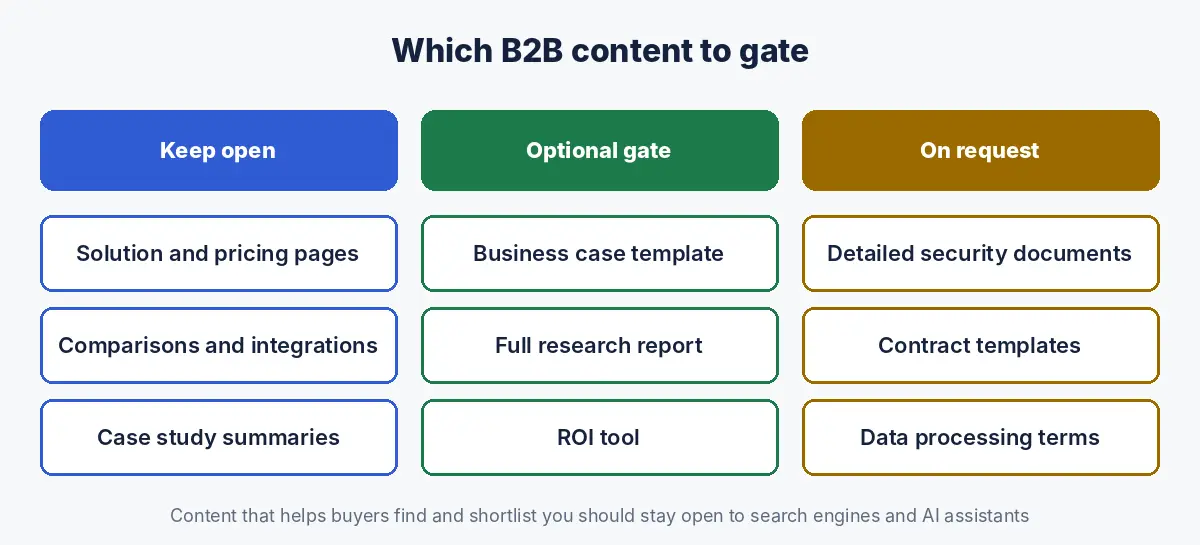
Keep content that helps buyers find and shortlist you ungated so search engines, AI assistants and buyers can read it, and gate only content that is genuinely valuable after a buyer is already interested, such as detailed templates or tools.
| Content | Gate it? | Why |
|---|---|---|
| Solution, pricing, comparison and integration pages | No | Needed for ranking, AI answers and shortlisting |
| Case study summaries with results | No | Proof should be visible to every buyer |
| Guides and checklists | Usually no | They bring search traffic and build trust |
| Detailed business case or ROI template | Optional | Valuable to buyers already in evaluation |
| Benchmark or research report | Optional | Gate the full report, publish key findings openly |
| Security documentation | Often on request | May include sensitive details; publish an overview page |
Buyers trust peer and customer evidence: TrustRadius found 74% of tech buyers use reviews to inform decisions (TrustRadius via HG Insights). Hiding all proof behind forms works against you in a self service buying journey.
How do buyers in a long cycle find your content again?
Buyers in a long cycle come back through branded searches, bookmarks, colleagues’ links and AI assistants, so make sure your key pages rank for your brand name plus common follow up terms such as pricing, reviews, integrations, security and case studies.
| Branded follow up search (illustrative) | Page that should rank |
|---|---|
| paydesk pricing | Pricing page |
| paydesk reviews | Reviews or customers page |
| paydesk WPS | Feature page for WPS payroll |
| paydesk security | Security and data protection page |
| paydesk vs [competitor] | Comparison page |
Check these in Search Console and in AI assistants. If a third party page or an outdated page answers them, the committee may read someone else’s version of your facts. Our guide to B2B AEO covers how to keep AI answers about your company accurate.
How do you find gaps in your B2B content?
Find gaps by asking where deals stall and what buyers ask that your content does not answer: review CRM stage notes and lost deal reasons, collect the questions sales hears most, and compare them with your content matrix. Our guide to B2B keyword research covers the search side.
The example below is illustrative, for the fictional PayDesk, not a real client:
| Where deals stall | Question buyers ask | Missing content | Priority |
|---|---|---|---|
| Validation | How long does migration from our current system take? | Implementation timeline page | High |
| Approval | How do we justify the cost to finance? | Business case template and ROI explanation | High |
| Validation | Where is our payroll data stored? | Security and data location page | High |
| Shortlist | How are you different from [competitor]? | Comparison page | Medium |
| Requirements | What should payroll software include for UAE rules? | Requirements checklist | Medium |
How do you measure content across a long B2B sales cycle?
Measure content by the pipeline it starts and the deals it supports: track which landing pages bring new leads, which content opportunities view before they close, and how often sales sends each consensus asset. Our guide to measuring B2B SEO shows the GA4 and CRM setup.
- Pipeline started: opportunities whose first landing page was a piece of content.
- Pipeline influenced: opportunities whose contacts viewed the content before closing, where your tools can track it.
- Sales usage: how often sales shares each asset, and whether deals that receive it move faster.
- Stage movement: whether deals stalled at a stage move faster after you publish the missing content.
What are the common mistakes with B2B content for long sales cycles?
| Mistake | Fix |
|---|---|
| Writing only for the end user | Cover finance, IT, procurement and executive questions |
| Publishing only top of funnel blog posts | Fill shortlist, validation and approval gaps first |
| Gating everything | Keep shortlist and proof content open |
| No content for the champion to forward | Business case, one page summary, implementation plan |
| Ignoring branded follow up searches | Make pricing, reviews, security and integration pages rank for your brand |
| Planning content from keyword volume alone | Plan from where deals stall and what buyers ask |
How Crawl To Click plans B2B content for buying groups
Crawl To Click is an SEO and AI visibility consultancy, and our B2B content planning starts with the client’s deals: who was involved, where deals stalled and what buyers asked. We build a role and stage content matrix, fill the gaps that block shortlisting and approval first, keep shortlist and proof content open to search engines and AI assistants, and measure each piece by the pipeline it starts and supports.
We do this for B2B software companies, logistics and supply chain businesses, professional services firms, healthcare technology providers, industrial suppliers and education technology companies in the UAE and India.
FAQs on B2B content for long sales cycles
How do you create content for a long B2B sales cycle?
Map content to the roles in the buying group and the stages of the cycle, fill the gaps where deals stall, create consensus content the champion can forward internally, and keep shortlist and proof content ungated and findable in search and AI assistants.
How many people are in a B2B buying group?
Forrester found that on average 13 people are involved in a B2B buying decision and 89% of purchases involve two or more departments, according to its State of Business Buying research published in December 2024.
What content does each member of a B2B buying group need?
Champions need case studies and a business case, users need use case pages and walkthroughs, finance needs pricing and ROI explanations, IT needs integration and security pages, procurement needs company information and certifications, and executives need a one page summary.
What is consensus content in B2B marketing?
Consensus content is material a champion can forward to colleagues to win agreement, such as a business case template, a one page summary, an ROI explanation, a security overview and an implementation plan.
Should B2B companies gate their content?
Keep solution, pricing, comparison, integration pages, case study summaries and most guides ungated so buyers, search engines and AI assistants can read them, and gate only detailed templates, tools or full research reports for buyers already in evaluation.
How long is a typical B2B sales cycle?
It varies widely by deal size and industry. 6sense found B2B buying cycles averaged 10.1 months globally in 2025, with buyers about 61% of the way through their journey before first contacting a seller.
How do you measure B2B content in a long sales cycle?
Track the pipeline each piece starts as a first landing page, the opportunities whose contacts viewed it before closing, how often sales shares it, and whether stalled deals move faster after missing content is published.
Need help planning content that moves B2B deals?
Deals stalling while your blog grows? Book a B2B content strategy call and get a content plan built around your buying groups.
Disclaimer: Survey figures are from the studies cited. The company, content and findings in the examples are fictional and illustrative.