A marketing head searches “best CRM for a 50 person sales team in Dubai with Arabic support” and switches to AI Mode. Instead of ten blue links, Google writes a three paragraph comparison, names four products, and lists the pages it used on the right. If your product is not in that answer, the buyer may never see your website. This guide explains how Google AI Mode works and what you can do to be included.
The short answer: Google AI Mode is a conversational search mode, powered by a custom version of Gemini, that answers complex questions by splitting them into subtopics and running many searches at once, a technique Google calls query fan out. To appear in AI Mode, a page must be indexed and eligible to show a snippet in Google Search; there is no separate submission. You improve your chances by ranking for the related subtopic searches, writing clear and specific passages that answer each one, keeping brand facts consistent, and being mentioned on the sources Google already trusts.
What is Google AI Mode?
Google AI Mode is a separate tab in Google Search where you ask questions in natural language and get an AI generated answer with links to sources, then continue with follow up questions. Google first tested it in Search Labs in March 2025 and opened it to all US users at Google I/O in May 2025, removing the Labs sign up (Search Engine Roundtable).
AI Mode differs from a normal results page in three ways:
- It is conversational. You can ask follow up questions and AI Mode keeps the context.
- It handles longer, harder questions. Queries in AI Mode are on average about three times longer than traditional searches (Alphabet, Q3 2026).
- It is multimodal. About one in five AI Mode searches globally use voice, images or documents (Alphabet, Q3 2026).
How does Google AI Mode work?
Google AI Mode works by breaking your question into subtopics, “issuing a multitude of queries simultaneously”, and combining what it finds into one answer, as Google described at I/O 2025 (Search Engine Roundtable). Google’s documentation confirms that AI Mode and AI Overviews may issue “multiple related searches across subtopics and data sources” to develop a response (Google Search Central).
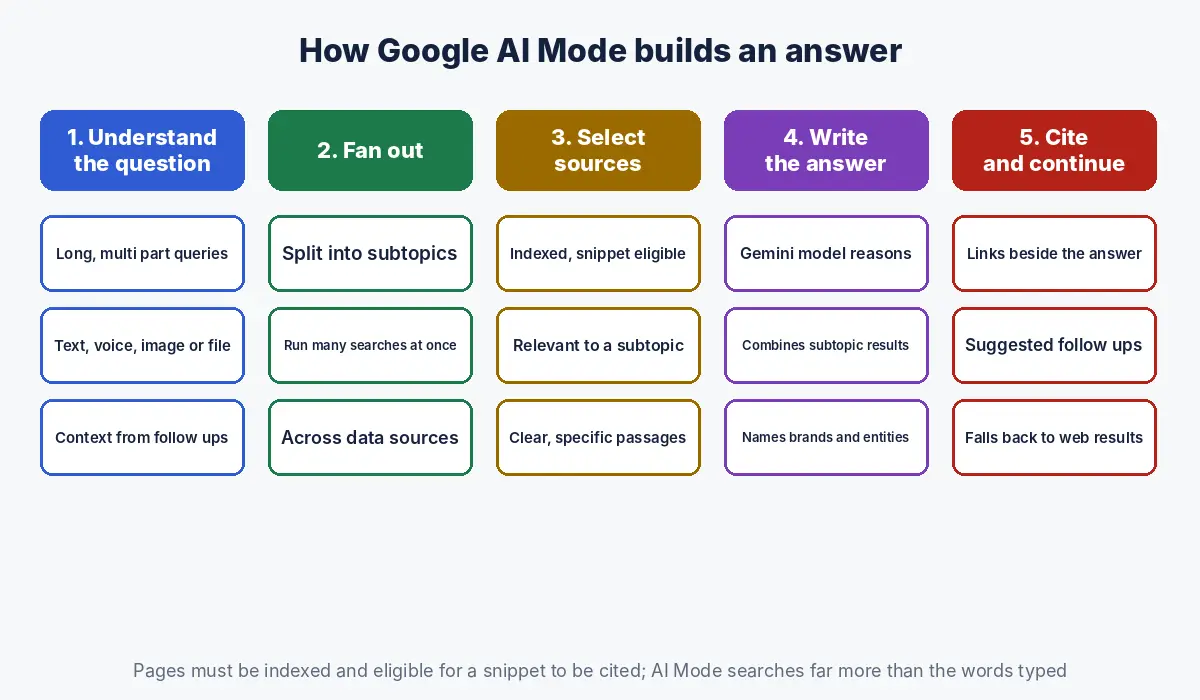
In practice, an AI Mode answer goes through five stages:
- Understand the question, including any image, voice input or earlier turns in the conversation.
- Fan out into many related searches. A question about CRMs for a Dubai sales team might trigger searches for CRM pricing in AED, Arabic interface support, integrations with WhatsApp and reviews from UAE users.
- Select sources from indexed pages that best answer each subtopic.
- Write the answer using a custom Gemini model, which reasons across the subtopic results.
- Cite and continue, showing source links beside the answer and suggesting follow ups. When confidence is low, Search falls back to standard web results (Entrepreneur India).
The key consequence for SEO: AI Mode does not just search the words a user typed. Your page can be cited because it answers one subtopic well, even if it does not rank for the original question.
AI Mode vs AI Overviews: what is the difference?
AI Overviews are short AI summaries that appear at the top of a normal results page for some searches. AI Mode is a full conversational experience in its own tab. They use similar technology but produce noticeably different answers and citations.
| AI Overviews | AI Mode | |
|---|---|---|
| Where it appears | Top of the normal results page, for some queries | Separate tab, or entered from an AI Overview |
| Answer length | Short summary | About four times longer, per Ahrefs |
| Follow ups | Limited | Conversational, keeps context |
| Brands and people named per answer | 1.3 on average | 3.3 on average |
| Answers with no citations | 11% | 3% |
| Users | Over 2.5 billion monthly | Over 1 billion monthly |
Figures in the table come from Ahrefs (540,000 US query pairs, September 2025) and, for users, Google I/O 2026.
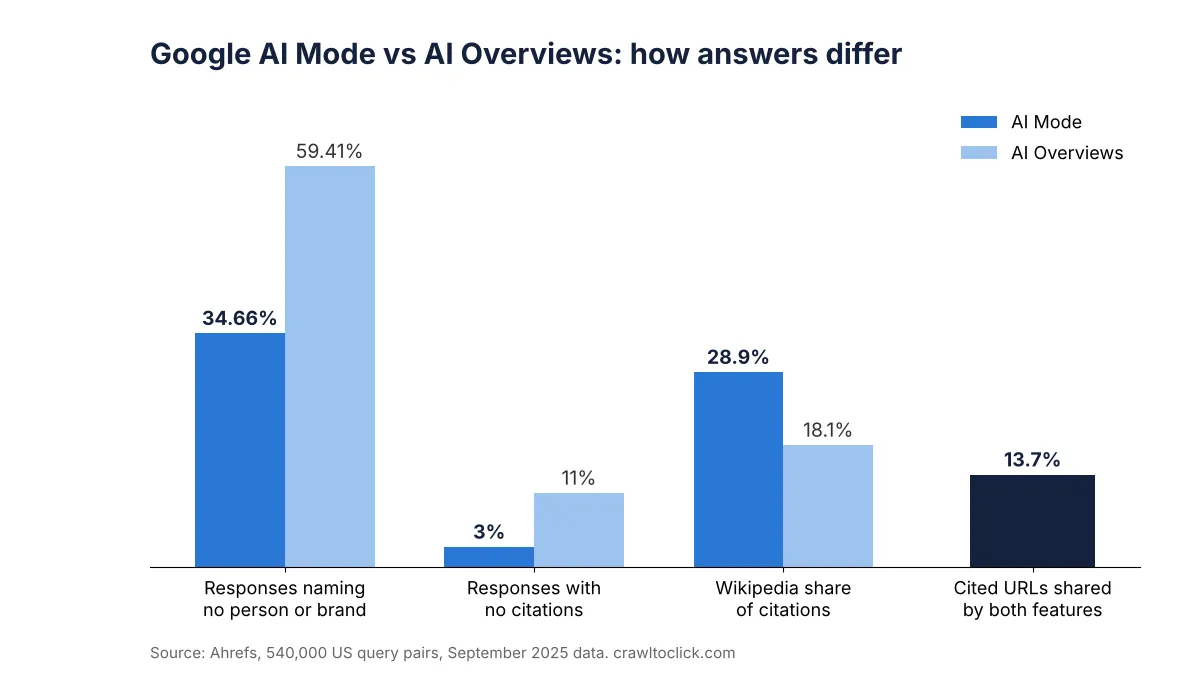
The most important finding for marketers: only 13.7% of cited URLs appeared in both AI Mode and AI Overviews for the same query (Ahrefs). Being cited in one does not mean you are cited in the other, so check both. AI Mode also leaned more on Wikipedia (28.9% of citations versus 18.1%) and cited Quora about 3.5 times more often, while AI Overviews cited videos and homepages nearly twice as often.
How many people use Google AI Mode?
Google AI Mode passed 1 billion monthly users within about a year of launch, according to Google at I/O 2026. Google also said AI Mode query volume was more than doubling each quarter (Search Engine Land).
Independent data tells a more measured story. In Similarweb clickstream data analysed by SparkToro, only 0.34% of US Google searches moved into AI Mode between January and April 2026, though that panel excludes the Google mobile app (Search Engine Land). The same study found that 68.01% of US Google searches ended without a click, up from 60.45% in 2024.
How to read both: many people try AI Mode, but most searches still happen on the normal results page. AI Mode matters most for complex, high consideration questions, which are exactly the questions buyers ask before choosing a supplier. For broader context, see our AI search statistics.
Where is Google AI Mode available?
- In October 2025, Google expanded AI Mode to more than 35 new languages, including Arabic and Hindi, and to over 200 countries and territories, with the UAE, Saudi Arabia, Qatar and Kuwait among those listed (Search Engine Roundtable).
- AI Mode first launched in English in the Middle East and North Africa in August 2025, before the Arabic expansion (Gulf Times).
- In India, AI Mode launched in English through Search Labs in June 2025 (Entrepreneur India).
For UAE and India businesses, this means buyers can now ask AI Mode in Arabic, Hindi and English. Test your important questions in each language your customers use, because answers and sources can differ.
How does AI Mode choose which websites to cite?
AI Mode cites pages that are indexed, eligible to show a snippet, and relevant to one or more of the subtopic searches it runs. Google says there are “no additional requirements to appear in AI Overviews or AI Mode, nor other special optimizations necessary” (Google Search Central).
Within that, four factors decide which pages win:
- Organic rankings for the fan out searches. For AI Overviews, Ahrefs found 76.10% of cited pages ranked in Google’s top 10 for the query. AI Mode runs more searches, so ranking for many related questions matters more than ranking for one head term.
- Passages that answer a subtopic on their own. A paragraph that states a fact, a price range or a comparison clearly is easier to cite than one that needs the rest of the page for context.
- Trusted reference and community sources. Wikipedia, Quora, Reddit and health sites feature heavily in AI Mode citations (Ahrefs), so what those sites say about your category shapes the answer.
- Entity clarity. AI Mode names more brands than AI Overviews. Brands with consistent, well documented facts across the web are easier for it to name confidently.
How to rank in Google AI Mode: an eight step plan
1. Confirm your pages are eligible
Check in Search Console that important pages are indexed, and that none carry nosnippet, a restrictive max snippet setting or noindex by mistake. A page that cannot show a snippet cannot be cited.
2. Map the fan out questions for your topics
For each commercial topic, list the subtopics a buyer would need answered: price, comparisons, suitability by company size or industry, location, integrations, risks and alternatives. People Also Ask, sales calls and AI Mode’s own suggested follow ups are good sources.
3. Cover each subtopic with a clear section or page
Give each subtopic its own heading with a direct answer in the first one or two sentences, then the detail. Where a subtopic deserves its own page, such as pricing or a comparison, create one.
4. Write passages that can stand alone
Each section should make sense if it is read on its own. Name the subject instead of writing “it” or “this”, include the specific number or fact, and add the context a reader would need. This is also good writing for people.
5. Use tables, lists and comparisons
AI Mode answers often compare options. Comparison tables, pricing tables and step lists give it structured facts to draw on.
6. Strengthen your entity signals
Keep your business name, description, services, locations and pricing consistent across your website, Google Business Profile, LinkedIn, directories and review sites. Add Organization, Product, Service or LocalBusiness structured data that matches the visible page. Google says special schema is not required for its AI features, but structured data still helps Search understand your content.
7. Earn mentions on the sources AI Mode trusts
Find the pages AI Mode cites for your category questions and work to be included on them: industry reviews, comparison articles, community discussions and reference pages. Never try to manipulate community platforms; genuine participation and accurate information last longer.
8. Keep content current and visual
Google recommends original content with first hand experience, high quality images and video, and up to date business details through Merchant Center and Google Business Profile (Google Search Central). Update prices, dates and examples at least quarterly on pages that matter commercially.
What you do not need to do for AI Mode
Google’s AI optimisation guide says you do not need to chunk content into tiny fragments, rewrite content specifically for AI, add special schema, or create AI specific files such as llms.txt to appear in its generative AI features (Google Search Central). Our guide on llms.txt covers that file in detail. Spend the time on content quality, coverage of subtopics and technical health instead.
How to track your visibility in Google AI Mode
| Method | What it shows | Notes |
|---|---|---|
| Search Console generative AI performance reports | Impressions in AI Mode and AI Overviews by page, country, device and date | Launched June 2026, rolling out to a subset of sites first; clicks not yet listed (PPC Land) |
| Search Console Performance report | Overall clicks and impressions, including AI features | AI feature data is included in the totals |
| Manual prompt testing | Whether you are named and cited, and how you are described | Run your buyer questions monthly, several times each, in each language you serve |
| Analytics | Visits and conversions from Google | AI Mode clicks arrive as Google organic traffic; compare landing pages that are cited |
Because answers vary between runs, measure how often you appear across many questions rather than relying on one screenshot. Our guide to mentions per 100 queries explains a simple method.
Do ads appear in Google AI Mode?
Yes. At Google Marketing Live in May 2026, Google announced new ad formats for AI Mode, including conversational discovery ads written for long queries and “Highlighted Answers”, sponsored entries inside AI Mode’s recommendation lists marked with a Sponsored label, alongside an expansion of Direct Offers (Technobezz). For organic visibility this means some recommendation slots may be paid, which makes earned mentions and accurate brand facts more valuable, not less.
Can you stop your content appearing in AI Mode?
You can limit it, but at a cost. Google says the nosnippet, data nosnippet and max snippet controls and noindex apply to its AI features, as they do to Search (Google Search Central). Restricting snippets also reduces how your pages appear in normal results, so for most businesses that want customers, opting out does more harm than good. Use data nosnippet selectively for content you genuinely do not want quoted, such as premium content.
What Google AI Mode means for your SEO strategy
| If you are a… | Priority | First action |
|---|---|---|
| Startup founder | Be named in answers to your category’s comparison questions | Test your top 10 buying questions in AI Mode and note who is named |
| Marketing head | Report AI Mode visibility next to organic traffic | Request access to the Search Console generative AI reports and set a baseline |
| Agency owner | Add AI Mode coverage to audits and reporting | Build a fan out question map for each client’s main service |
| SEO practitioner | Turn subtopics into clear, citable sections | Rewrite your top pages so each H2 answers one subtopic in its first two sentences |
AI Mode does not replace SEO; it raises the bar for it. The pages that win are the ones that already rank, cover the whole decision a buyer is making, and state their facts plainly. The same principles apply across assistants, as covered in what is GEO.
How Crawl To Click approaches Google AI Mode
Crawl To Click is an SEO and AI visibility consultancy, and we treat AI Mode as part of Google search rather than a separate channel. For each priority topic, we map the fan out questions buyers are likely to trigger, test them in AI Mode and AI Overviews in every language the business serves, and record which brands and sources appear. We then close the gaps in order of business value: technical eligibility, missing subtopic pages, sections that need clearer standalone answers, inconsistent brand facts and third party sources worth earning a place on. We have used this approach for software companies, healthcare providers, property developers and online retailers, reporting AI visibility alongside organic leads. Learn more about our approach.
FAQs on Google AI Mode
What is Google AI Mode?
Google AI Mode is a conversational search tab powered by a custom Gemini model. It answers complex questions by running many related searches at once, known as query fan out, and shows an AI generated answer with links to its sources.
How is AI Mode different from AI Overviews?
AI Overviews are short summaries on the normal results page. AI Mode is a separate, conversational experience with longer answers and follow ups. Ahrefs found only 13.7% of cited URLs were shared between the two for the same query.
How do I get my website cited in Google AI Mode?
Make sure pages are indexed and eligible for snippets, rank for the related subtopic questions buyers ask, give each subtopic a clear, standalone answer, keep brand facts consistent and earn mentions on trusted third party sources.
Is Google AI Mode available in the UAE and India?
Yes. AI Mode expanded to Arabic and more than 35 other languages in October 2025, with the UAE among the countries listed, and launched in English in India through Search Labs in June 2025.
Can I see AI Mode traffic in Search Console?
Google launched generative AI performance reports in Search Console in June 2026, showing impressions in AI Mode and AI Overviews. They are rolling out to a subset of sites first, and AI feature data is also included in the main Performance report totals.
Do I need llms.txt or special schema for AI Mode?
No. Google says there are no special requirements or optimisations needed to appear in AI Mode, and that it ignores llms.txt files. Standard SEO best practices apply.
Want to know how your brand appears in Google AI Mode?
We will test the questions your buyers ask in AI Mode and AI Overviews, show you who is named and cited, and give you a prioritised plan to close the gaps. Request an AI visibility baseline.
Disclaimer: This article reflects Google documentation, announcements and third party studies as of the dates stated. Google changes AI Mode frequently, and no method can guarantee inclusion in AI generated answers. Examples are illustrative.