Someone on your team read that every website now needs an llms.txt file to show up in ChatGPT and Google’s AI answers. Before you add it to the sprint, here is what the file is, what Google and the data actually say, and when it is worth the half hour it takes.
The short answer: llms.txt is a proposed Markdown file, placed at the root of a website, that gives AI systems a short summary of the site and a curated list of links to its most useful pages. Google Search ignores it, and Google says it will neither help nor hurt your visibility in Search or its AI features. A study of about 300,000 domains found no measurable link between having the file and being cited by AI. It is worth adding for documentation, developer and software sites; for most businesses, it is a low priority.
What is llms.txt?
llms.txt was proposed in 2024 by Jeremy Howard of Answer.AI (llms.txt specification). The idea: language models have small context windows and struggle with navigation menus, scripts and ads, so a site can offer a clean, Markdown summary that points to the pages that matter. It sits at the root of the domain, for example yoursite.com/llms.txt, alongside robots.txt.
It is often compared to robots.txt and XML sitemaps, but it does a different job:
| File | Purpose | Who reads it | Is it an official standard? |
|---|---|---|---|
| robots.txt | Tells crawlers what they may and may not access | Search engines and most AI crawlers | Yes, widely supported |
| XML sitemap | Lists URLs you want discovered and indexed | Search engines | Yes, widely supported |
| llms.txt | Summarises the site and points AI tools to key content in Markdown | Some AI tools and agents, on request; no major AI search engine has confirmed using it | No, a community proposal |
What goes in an llms.txt file: format and example
The specification defines a simple structure, in this order:
- An H1 heading with the name of the site or project (the only required element).
- A blockquote with a short summary.
- Optional paragraphs with more context.
- Sections headed with H2, each containing a list of links in the format [name](url), optionally followed by a short note.
- An optional section titled “Optional” for secondary links an AI tool can skip if it needs less context.
An illustrative example for an imaginary software company:
# Ledgerly

> Ledgerly is accounting software for small firms in the UAE and India. It handles invoicing, VAT returns and payroll, with plans from 49 AED a month.

Ledgerly is used by accountants and business owners. Prices are in AED and INR.

## Product
* [Features](https://ledgerly.example/features): invoicing, VAT, payroll, bank feeds
* [Pricing](https://ledgerly.example/pricing): plans, limits and annual discounts
* [Integrations](https://ledgerly.example/integrations): banks and payment gateways

## Help
* [Getting started](https://ledgerly.example/docs/start): setup in five steps
* [VAT returns](https://ledgerly.example/docs/vat): filing VAT with Ledgerly

## Optional
* [Blog](https://ledgerly.example/blog): guides on small business finance
Some sites also publish a longer companion file containing the full text of their key pages, and Markdown versions of individual pages. Those are optional extras, not part of the core proposal.
Does Google use llms.txt? What Google says
- Google’s AI optimisation guide says you do not need to create new machine readable files, AI text files, markup or Markdown to appear in Google Search, including its generative AI features (Google Search Central).
- In June 2026, Google added that creating llms.txt files for other services is fine, but “doing so won’t harm (nor help) your visibility or rankings in Google Search, as Google Search ignores them” (Search Engine Roundtable).
- Gary Illyes of Google said at a Search Central event in Asia Pacific that Google does not support llms.txt and is not planning to (Search Engine Land).
- John Mueller compared llms.txt to the keywords meta tag and noted that server logs show AI services do not even check for it (Search Engine Journal, April 2025).
One nuance: Google’s Lighthouse tool added an experimental “agentic browsing” check in 2026 that looks for an llms.txt file, describing it as an emerging convention for browser agents (Search Engine Journal). That audit is about how easily AI agents can navigate your site, not about rankings or AI citations.
Does llms.txt help with ChatGPT and AI citations? What the data shows
- SE Ranking analysed about 300,000 domains and found llms.txt on 10.13% of them, spread fairly evenly across traffic tiers (Search Engine Journal, November 2025).
- It found no measurable link between having the file and how often a domain was cited by AI. Removing llms.txt as a factor slightly improved the accuracy of its model (Search Engine Journal).
- OpenAI’s crawler documentation explains how to allow or block its search and training crawlers through robots.txt, and does not mention llms.txt (OpenAI).
In short: there is no evidence that llms.txt makes ChatGPT, Gemini or Google’s AI features cite you more. What does influence AI answers is covered in our guide on how ChatGPT chooses sources: indexing, crawler access, rankings for related queries and specific, quotable content.
Do you need an llms.txt file? A decision guide
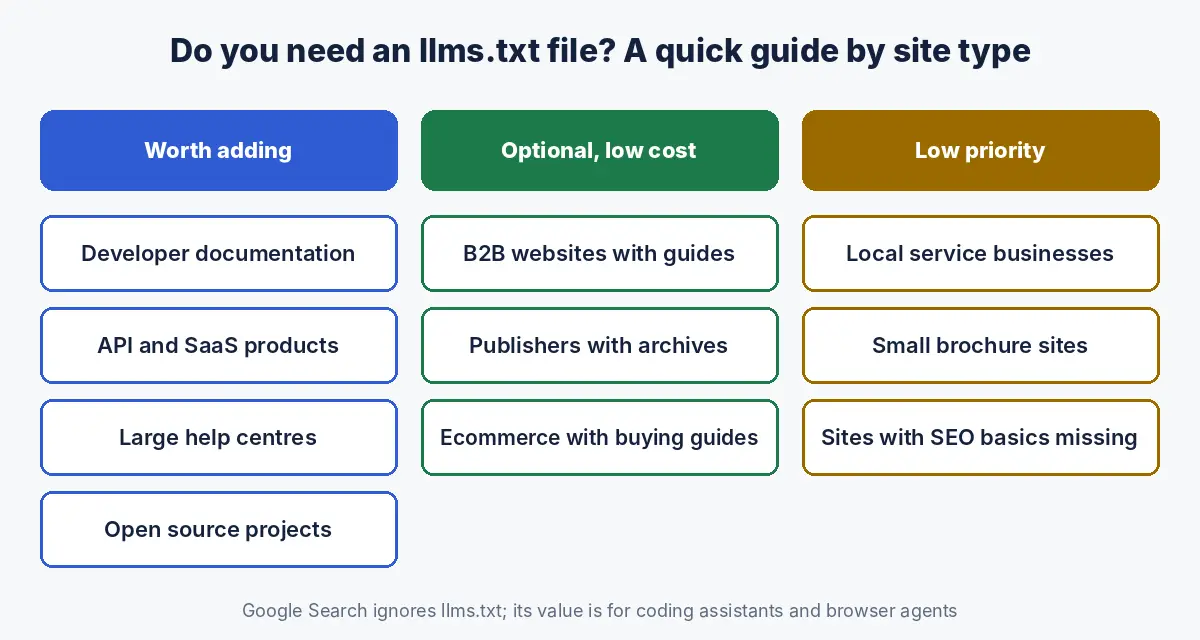
| Your situation | Recommendation | Why |
|---|---|---|
| Developer documentation, APIs, SaaS with technical docs | Add it | Developers load documentation into AI coding tools and agents; a clean index of docs pages is genuinely useful to them |
| B2B site with guides, publisher, ecommerce with buying guides | Optional | Low cost to create, but no evidence of search or citation benefit |
| Local service business or small brochure site | Low priority | Time is better spent on Google Business Profile, reviews and service pages |
| Site with indexing, speed or content problems | Fix those first | AI tools rely on the same foundations as search engines |
A useful test: if your answer to “who would read this file?” is “ChatGPT, so it ranks us higher”, skip it for now. If the answer is “developers and their AI tools, so they can find the right docs page”, add it.
How to create an llms.txt file in five steps
- Choose 10 to 30 key pages. Product, pricing, core guides, documentation and policies. Leave out tag pages, archives and thin posts.
- Write a one paragraph summary that states what you are, who you serve, where, and your pricing approach in plain sentences. Our brand fact sheet guide helps here, and the same text works on your About page.
- Group links under H2 sections with a short note after each link explaining what the page covers.
- Save it as llms.txt at the root of your domain, served as plain text. Several WordPress SEO plugins can generate one; check your plugin’s settings before installing another plugin.
- Review it every quarter so links and prices stay current. An out of date file is worse than none, because it repeats old facts.
What to do instead for AI visibility
Google’s own guidance puts the effort elsewhere: original, helpful content with first hand experience, a sound technical foundation, semantic HTML, current business details in tools such as Google Business Profile, and measuring results in Search Console (Google Search Central). For AI assistants more broadly:
- Make sure pages are indexed in Google and Bing, and that robots.txt allows the AI search crawlers you want to be found by.
- Answer buyer questions directly on dedicated pages, with specific, sourced facts.
- Keep brand facts consistent across your site, profiles, directories and review platforms.
- Earn mentions on the third party sources AI tools cite in your category.
- Use structured data that matches visible content; our schema markup examples show the common types.
- Track mentions and citations over time, as explained in what is GEO.
How Crawl To Click handles llms.txt in AI visibility work
Crawl To Click is an SEO and AI visibility consultancy, and we treat llms.txt the way the evidence suggests: as an optional extra, not a fix. In an AI visibility audit we check the things that measurably affect whether a site is retrieved and cited, including indexing in Google and Bing, crawler access in robots.txt, the pages needed for the questions buyers ask, and consistency of brand facts across the web. For software and documentation sites we add a well structured llms.txt as part of that work; for a clinic, a property developer or a local service business, we usually recommend putting the time into profiles, reviews and service pages instead. Learn more about our approach.
FAQs on llms.txt
What is llms.txt used for?
llms.txt is a proposed Markdown file at the root of a website that summarises the site and lists links to its most useful pages, so AI tools can find key content without parsing navigation, scripts and ads.
Does Google use llms.txt?
No. Google says Google Search, including its AI features, ignores llms.txt files, and that creating one will neither help nor hurt your visibility or rankings.
Does llms.txt help you rank in ChatGPT?
There is no evidence that it does. A study of about 300,000 domains by SE Ranking found no measurable link between having llms.txt and being cited by AI systems.
Is llms.txt the same as robots.txt?
No. robots.txt controls what crawlers may access and is widely supported. llms.txt is an unofficial proposal that summarises content for AI tools and does not control access.
Should I create an llms.txt file?
Create one if you run developer documentation, an API or a software product with technical docs. For most other businesses it is optional and low priority compared with indexing, content and brand consistency.
Where do I put an llms.txt file?
At the root of your domain, for example yoursite.com/llms.txt, served as plain text, in the same location as robots.txt.
Not sure which AI visibility fixes are worth your time?
Skip the guesswork on llms.txt and other AI search tactics. Get a second pair of eyes on your site and a prioritised list of what will actually move AI visibility.
Disclaimer: This article reflects Google and OpenAI documentation and published studies as of the dates stated. AI systems and their support for files such as llms.txt may change. The llms.txt example uses an imaginary company.