Ask ChatGPT with search switched off to name the best payroll software for a 40 person company in Dubai, and it answers from memory: from what it absorbed during training, months or years ago. Ask again with search on, and it reads a handful of pages live and answers from those. Two very different routes, often producing two different shortlists. LLM SEO is the work of getting your brand onto both.
The short answer: LLM SEO (large language model SEO, also called LLM optimization or LLMO) is the practice of increasing how often, and how accurately, AI assistants built on large language models mention and recommend your brand. LLMs learn about brands in two ways: from training data, which is mostly public web text collected by crawlers, and from live retrieval, where the assistant searches the web while answering. LLM SEO works on both: earning consistent mentions of your brand next to your category across the web, keeping your own facts clear and crawlable, allowing the right AI search crawlers, and ranking for the sub questions assistants search for.
What is LLM SEO?
LLM SEO is the optimisation of your brand’s presence for large language models, such as the models behind ChatGPT, Gemini, Claude, Copilot and Perplexity, so that they associate your brand with your category, describe it correctly and recommend it when users ask for options.
The term overlaps with AEO and GEO, and many teams use them interchangeably. The difference is emphasis. AEO focuses on being the cited answer to a question, as explained in our guide to what AEO is. GEO comes from research on generative search engines, covered in what GEO is. LLM SEO puts the model itself at the centre: what it learned about you, what it can retrieve about you, and how those two combine.
The stakes are scale. ChatGPT alone reached 1 billion weekly users in August 2026 (Yahoo Tech), and at Ahrefs, AI search sent about 0.5% of visitors but 12.1% of signups over 30 days (Ahrefs).
How do large language models know about brands?
Large language models know about brands through two routes: parametric knowledge learned from training data, which is fixed until the next model version, and retrieved knowledge pulled from live web searches at the moment a user asks.
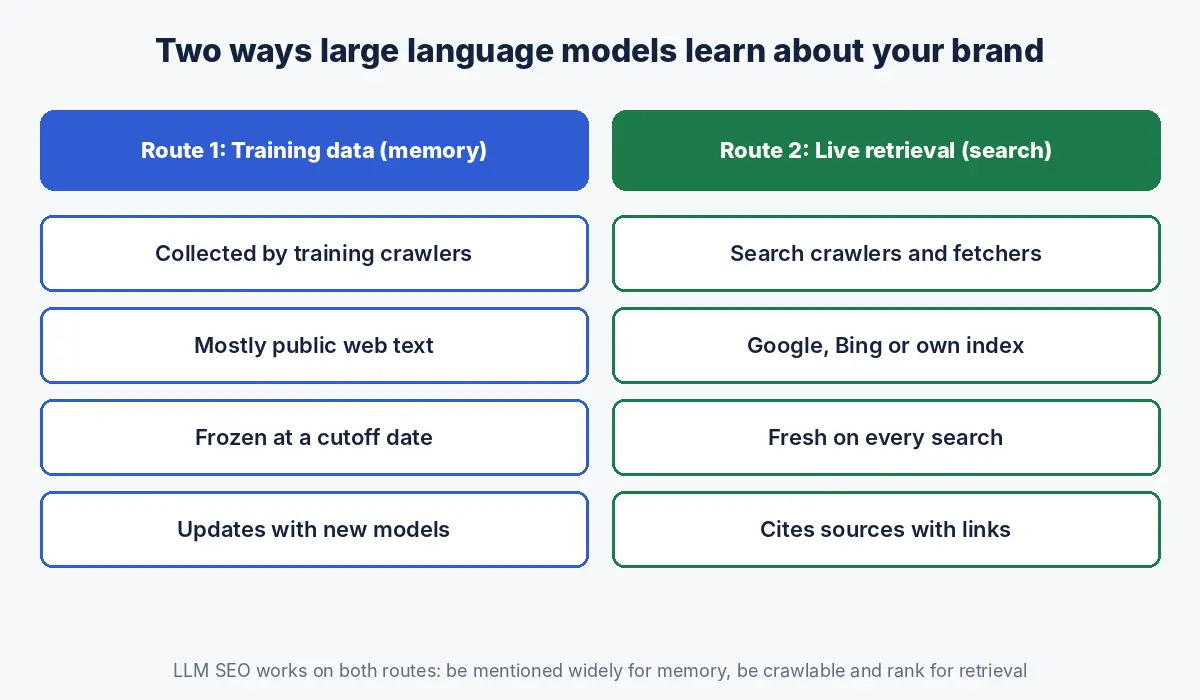
| Training data (memory) | Live retrieval (search) | |
|---|---|---|
| Where it comes from | Public web text, books, licensed data, collected before a cutoff date | Search results fetched during the conversation |
| When it updates | Only when a new model is trained and released | Every time the assistant searches |
| Shows citations? | No; the model answers from memory | Usually yes, with links |
| What influences it | How often and how consistently your brand appears with your category across the web | Rankings for the queries the assistant runs, crawler access, clear answer passages |
| Crawlers involved | Training crawlers such as GPTBot and ClaudeBot | Search crawlers such as OAI SearchBot, Claude SearchBot and PerplexityBot |
| Typical failure | Brand unknown, or described with old facts | Brand not retrieved, or a competitor’s page cited instead |
Most conversations still run on memory. Similarweb found that citations appeared in about 6.8% of US ChatGPT prompts in May 2026, up from about 1.6% a year earlier (Similarweb). When a buyer asks for recommendations without triggering a search, what the model learned in training decides the answer.
What data are LLMs trained on?
LLMs are trained mainly on large collections of public web text, plus books, encyclopaedias, code and licensed data, which means the open web, including what others write about your brand, is the largest influence on what a model remembers.
Model makers rarely publish full training mixes now, but the GPT 3 paper did. About 60% of its training mix by weight came from a filtered version of Common Crawl, a public archive of web pages, with the rest from curated web text, two book collections and English Wikipedia (Brown et al., 2020). Later models use more sources and more filtering, but web text remains the foundation.
Training is also the main reason AI companies crawl. Cloudflare reported that over the 12 months to July 2025, 80% of AI crawling on its network was for training, 18% for search and 2% for user actions (Cloudflare).
Three practical implications for brands:
- Repetition across independent sources matters. A model is more likely to associate your brand with “payroll software in the UAE” if many unrelated pages mention them together than if only your own site says so.
- Old facts persist. A pricing model you dropped two years ago may live on in a model trained on pages from that time, until a newer model is released or the assistant searches.
- Blocking training crawlers is a trade off. It keeps your future content out of training sets; it does not remove what others have written about you.
How do LLMs find brands through live search?
When an assistant decides a question needs current information, it rewrites the question into one or more search queries, retrieves pages from a search index, reads the most relevant passages and builds an answer that cites some of them.
- Assistants run variations of the question, not just the prompt. Ahrefs explains that results across several query variations are typically combined, favouring pages that appear consistently (Ahrefs). Google describes the same process for AI Overviews and AI Mode as issuing multiple related searches across subtopics (Google Search Central).
- The index differs by assistant. When ChatGPT search launched, OpenAI said it used a set of services in which Bing is an important one (Search Engine Roundtable). Gemini and AI Overviews draw on Google; Perplexity runs its own crawler.
- Rankings still feed retrieval: 76.10% of pages cited in Google AI Overviews rank in Google’s top 10 for the query (Ahrefs).
- Big platforms dominate citations. In US ChatGPT citations in early 2026, Wikipedia (13.15%) and Reddit (11.97%) led, followed by OpenAI’s own site, Walmart, YouTube, LinkedIn and Reuters (Similarweb).
For the full mechanics of one assistant, see our explainer on how ChatGPT chooses sources.
Why do LLMs recommend some brands and not others?
LLMs recommend brands that are frequently and consistently mentioned alongside the category across many independent sources, that have clear facts the model can repeat, and that rank or are cited for the sub questions the assistant searches.
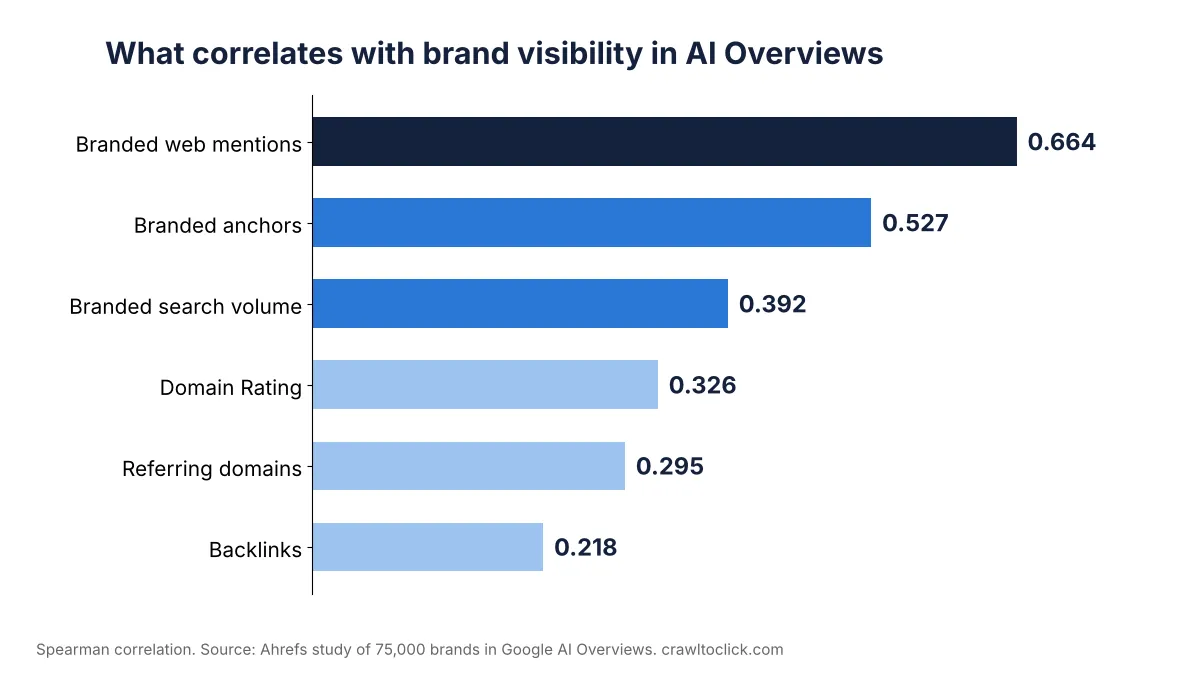
The clearest data point comes from Ahrefs’ study of 75,000 brands in Google AI Overviews. The factor most correlated with how often a brand appeared was branded web mentions (0.664), well ahead of branded anchors (0.527), branded search volume (0.392), Domain Rating (0.326) and backlinks (0.218) (Ahrefs). Correlation is not causation, and the study covers AI Overviews rather than every assistant, but it matches what practitioners see: being talked about beats being linked to.
In practice, the brands LLMs favour tend to share four traits, which our hub on entity SEO for AI search covers in more depth:
| Trait | What it looks like | What weakens it |
|---|---|---|
| Category association | The brand appears in lists, comparisons, reviews and discussions about the category | Mentioned only on its own site and press releases |
| Consistent facts | Same description, pricing model, locations and audience everywhere | Different taglines and outdated profiles across sites |
| Specific positioning | “Payroll software for UAE companies with WPS compliance” | “Innovative all in one platform for businesses” |
| Retrievable evidence | Pages that answer comparison, pricing and use case questions | Key facts in PDFs, images or behind forms |
How is LLM SEO different from SEO, AEO and GEO?
LLM SEO differs mainly in scope: SEO targets search rankings, AEO targets direct answers and citations, GEO targets generative search results, and LLM SEO also targets what models remember from training, which no ranking report shows.
| SEO | AEO | GEO | LLM SEO | |
|---|---|---|---|---|
| Primary target | Search engine rankings | Answer boxes and AI answers | Generative search engines | Large language models, memory and retrieval |
| Influences training data? | Indirectly | Indirectly | Indirectly | Directly, by building off site mentions |
| Main signals | Relevance, links, technical health | Answer passages, structured facts | Citable content, sources | Mentions with category, consistent facts, crawler access |
| Measured by | Rankings, clicks | Citations, answer share | Mention and citation share | Mention rate with and without search, accuracy |
All four share foundations. Google says that, for Google Search, optimising for generative AI is still SEO, with no special files or markup needed (Google Search Central). LLM SEO adds attention to assistants beyond Google and to the off site picture models learn from.
Which AI crawlers should you allow for LLM SEO?
For LLM SEO, allow the search and user crawlers of every assistant you want to appear in, and make a separate, deliberate decision about training crawlers, because the major AI companies now split these jobs between different bots.
| Company | Training crawler | Search crawler | User triggered fetcher |
|---|---|---|---|
| OpenAI | GPTBot (OpenAI) | OAI SearchBot | ChatGPT User |
| Anthropic | ClaudeBot (Anthropic) | Claude SearchBot | Claude User |
| Perplexity | Not used for training models, per its documentation | PerplexityBot (Perplexity) | Perplexity User |
| Google Extended token (does not affect Search) | Googlebot (Search and AI features) | Google’s user triggered fetchers |
Anthropic says blocking ClaudeBot keeps your future content out of training, while blocking Claude SearchBot may reduce your visibility in Claude’s search results (Anthropic). The same split applies at OpenAI. The commercial question is simple: if you want to be recommended, do not block the search crawlers. For training crawlers, weigh visibility in future model memory against how you feel about your content training models; for most businesses selling a product or service, allowing them helps more than it costs.
Cloudflare’s data shows why some publishers block training bots: in July 2025, Anthropic crawled about 38,000 pages for every visit it referred, and OpenAI about 1,100, against about 5 for Google (Cloudflare). For a brand, the value is not referrals from training; it is being remembered.
How do you do LLM SEO? An eight step process
Do LLM SEO by measuring how assistants describe you, fixing your own facts and crawler access, publishing pages that answer the questions assistants search, and earning consistent third party mentions next to your category.
- Baseline both routes. Run 20 to 30 buyer questions in ChatGPT, Gemini, Claude, Perplexity and Copilot, with search on and, where possible, off. Record mentions, position in lists, citations and factual errors.
- Write a one sentence positioning line naming your category, audience and market, and use it word for word on your site, profiles, directories and author bios.
- Publish a brand fact sheet: what you do, for whom, where, pricing model, founding year, key people and differentiators, in plain text. Our guide to writing a brand fact sheet LLMs repeat correctly has a template.
- Check crawler access in robots.txt and in any firewall or bot protection settings, which often block AI search crawlers without anyone deciding to.
- Get indexed in Bing as well as Google, using Bing Webmaster Tools, because several assistants retrieve from Bing.
- Build pages for the sub questions: comparisons, pricing, integrations, use cases by industry and location, each opening with a direct answer.
- Earn category mentions on independent sources: review platforms, industry lists, comparison articles, podcasts, community threads and local directories where your buyers look.
- Repeat the baseline monthly and track mention rate, accuracy and AI referred leads.
How do you get mentioned on the sources LLMs learn from?
Get mentioned where your category is already discussed: find the domains assistants cite for your buyer questions, then earn genuine inclusion on them through reviews, expert contributions, data and partnerships rather than paid placements disguised as editorial.
| Source type | Why LLMs use it | How to earn a mention |
|---|---|---|
| Review platforms (G2, Capterra, Trustpilot, Google reviews) | Structured opinions about named products | Ask real customers after successful outcomes |
| Industry “best of” lists and comparisons | Directly answer recommendation questions | Offer data, demos and accurate information to editors |
| Reddit and community forums | Heavily cited in AI answers | Answer questions helpfully with disclosure |
| Wikipedia and Wikidata | Trusted reference for entities | Only if genuinely notable; never self promote |
| YouTube | Frequently cited, especially for how to questions | Short videos answering buyer questions |
| News and trade media | Authority on companies and markets | Original research, expert comment |
A useful habit: whenever an assistant cites a page in your category, log the domain. After a month you have a citation source map showing exactly where mentions matter, and it is rarely where a generic link building plan would have pointed.
How do you measure LLM SEO?
Measure LLM SEO by mention rate across a fixed prompt set run many times, split by assistant and by search on or off, together with accuracy of descriptions, citations and AI referred traffic and leads.
| Metric | How to collect it | Why it matters |
|---|---|---|
| Mention rate | Share of runs where your brand is named, per assistant | Core visibility metric |
| Mention rate without search | Runs where no sources were cited | Shows what the model remembers |
| Position in lists | Average order when listed | First mentions get more attention |
| Accuracy | Errors per brand question | Wrong facts cost deals |
| Citations | Trackers, plus Bing Webmaster Tools AI Performance report for Copilot | Shows retrieval success |
| AI referrals and leads | Analytics sessions from chatgpt.com, perplexity.ai, gemini.google.com, claude.ai, copilot.microsoft.com | Commercial outcome |
Single answers are unreliable. In research by SparkToro and Gumshoe, the chance of an assistant returning the same brand list twice for the same prompt was under 1 in 100 (Search Engine Land). Our method for measuring LLM mentions per 100 queries explains sample sizes that survive this variability.
Which LLM SEO tactics do not work?
Tactics that try to manipulate models directly, such as hidden prompts, mass produced AI pages, fake reviews or self published “best of” lists, do not build durable visibility and can breach search engine spam policies.
| Tactic | Why it fails |
|---|---|
| Hidden text or instructions aimed at AI | Treated as manipulation; assistants increasingly filter it, and it can breach spam policies |
| Mass generated pages targeting prompts | Google lists scaled content abuse in its spam policies, whether made by AI or people |
| Fake or incentivised reviews | Platforms remove them, and regulators in many markets penalise them |
| Self published lists ranking your brand first | Low trust; assistants weigh independent sources more |
| llms.txt as the main strategy | Google says its Search ignores it (Google Search Central); no major assistant has confirmed relying on it |
| Blocking every AI bot, then asking why you are invisible | Search crawlers are how assistants retrieve you |
How long does it take for LLMs to reflect changes?
Changes reach live retrieval within days to weeks, once pages are recrawled and reranked, but reach a model’s built in memory only when a new model version trained on newer data is released, which can take many months.
| Change | Retrieval answers | Model memory |
|---|---|---|
| Fix facts on your own site | Days to weeks after recrawl | Next model trained after the change |
| New third party mentions | Weeks to months, once indexed and ranking | Next model version |
| New product or rebrand | Visible when searched | Often missing or wrong until a later model |
This is why a rebrand or pricing change needs a deliberate update campaign across profiles, directories and partner pages: the sooner the new facts dominate the web, the sooner both routes reflect them.
How Crawl To Click approaches LLM SEO
Crawl To Click is an SEO and AI visibility consultancy, and we approach LLM SEO by separating what models remember from what they retrieve. We run a prompt baseline across the major assistants with and without search, record mention rate, list position and every factual error, and map the domains cited in the category. From there we fix the brand’s own facts and crawler access, build pages for the comparison, pricing and use case questions assistants search, and plan genuine mentions on the review platforms, publications and communities that shape the category. We have applied this to B2B software, fintech, healthcare, education, property and professional services brands, adjusting the source plan to where each category’s buyers and assistants actually look.
FAQs on LLM SEO
What is LLM SEO?
LLM SEO, or large language model SEO, is the practice of increasing how often and how accurately AI assistants such as ChatGPT, Gemini, Claude, Copilot and Perplexity mention and recommend a brand, by influencing both what models learn in training and what they retrieve through live search.
Is LLM SEO the same as GEO or AEO?
LLM SEO, GEO and AEO overlap heavily and share the same foundations. AEO focuses on being the cited answer, GEO on generative search engines, and LLM SEO on large language models, including what they remember from training data as well as what they retrieve.
How do LLMs decide which brands to recommend?
LLMs tend to recommend brands that are mentioned often and consistently alongside the category across independent sources, have clear and consistent facts, and rank or are cited for the related questions the assistant searches. Ahrefs found branded web mentions were the factor most correlated with brand visibility in Google AI Overviews.
Should I block GPTBot and ClaudeBot?
Blocking GPTBot or ClaudeBot keeps your future content out of OpenAI’s or Anthropic’s training data but does not stop their search crawlers. Most businesses that want to be recommended should allow search crawlers, and decide on training crawlers based on how much they value appearing in future model memory.
How long does LLM SEO take?
Changes on your own pages can appear in AI answers that use live search within days to weeks, while changes to what a model remembers only appear when a new model version trained on newer data is released, which can take many months.
Can I pay to be recommended by ChatGPT?
Organic recommendations in ChatGPT cannot be bought. Organic mentions depend on what the model learned and what it retrieves from the web.
Want to know what LLMs say about your brand?
Find out whether ChatGPT, Gemini and Claude recommend you or your competitors, with search on and off. Book a free LLM visibility review.
Disclaimer: This article reflects published documentation and studies as of the dates stated. AI products, crawlers and training practices change frequently. Examples are illustrative, and timelines are planning guidance rather than guarantees.