A buyer in Dubai types “which accounting software handles UAE corporate tax for a small trading company” into ChatGPT. She gets a five line answer naming three products, with two sources linked underneath. She never sees a list of ten blue links, and the brands that were not named never knew she asked. That moment, the answer itself, is what answer engine optimization is about.
The short answer: AEO (answer engine optimization) is the practice of making your brand and content the source that AI assistants and search features use when they answer a question directly. It covers Google AI Overviews and AI Mode, ChatGPT, Gemini, Perplexity, Microsoft Copilot, featured snippets and voice assistants. AEO is built on SEO: Google says optimising for its generative AI features is still SEO, with no special files or markup required. What AEO adds is a focus on clear, quotable answers, consistent facts about your brand across the web, access for AI crawlers, and measuring mentions and citations rather than only rankings.
What is AEO (answer engine optimization)?
AEO, or answer engine optimization, is the work of structuring your content, brand information and technical setup so that answer engines select, quote, cite or recommend you when someone asks a question your business can answer.
The term predates ChatGPT. SEO practitioners used it in the late 2010s for winning featured snippets, the answer boxes at the top of Google, and for being read out by voice assistants such as Google Assistant, Siri and Alexa. Generative AI widened the scope. An answer engine is now any system that responds with a composed answer instead of, or before, a list of links.
Three outcomes count as AEO success:
- Mention: the answer names your brand, product or person.
- Citation: the answer links to one of your pages as a source.
- Accurate representation: what the answer says about you (prices, services, locations, who you serve) is correct and current.
Ranking in position one is no longer the only goal. A page can rank fifth and still be the source an AI Overview quotes, and a brand can be recommended by ChatGPT without its website being cited at all, because the assistant drew on reviews, directories and articles written about it.
What is an answer engine, and which ones matter?
An answer engine is a search or assistant product that replies with a direct answer built from sources, rather than only a ranked list of pages; the ones that matter most in 2026 are Google AI Overviews, Google AI Mode, ChatGPT, Gemini, Perplexity and Microsoft Copilot.
| Answer engine | How it answers | Scale (latest public figure) |
|---|---|---|
| Google AI Overviews | AI summary above normal Google results, with source links | Over 2.5 billion monthly users (Google, May 2026) |
| Google AI Mode | Separate conversational tab in Google Search with follow up questions | Over 1 billion monthly users (Google, May 2026) |
| ChatGPT | Chat assistant that searches the web for some prompts and cites sources | 1 billion weekly users (Yahoo Tech, August 2026) |
| Gemini app | Google’s chat assistant, grounded in Google Search | About 27 to 28% of generative AI web visits (Similarweb, May 2026) |
| Microsoft Copilot and Bing | Chat answers grounded in Bing’s index | Citations reported in Bing Webmaster Tools |
| Perplexity | Answer engine that cites sources for every response | Smaller audience, heavy research use |
| Featured snippets and voice assistants | Single extracted answer, often read aloud | The original AEO surface |
The mix is shifting quickly. ChatGPT’s share of generative AI web visits fell from about 76% to about 53% between June 2025 and May 2026 as Gemini and Claude grew (Similarweb). AEO that targets one assistant only is already out of date.
How do answer engines choose which sources to cite?
Answer engines choose sources by running one or more searches behind the scenes, retrieving pages that are indexed and relevant to those searches, and then citing the passages that answer the question most clearly and credibly.
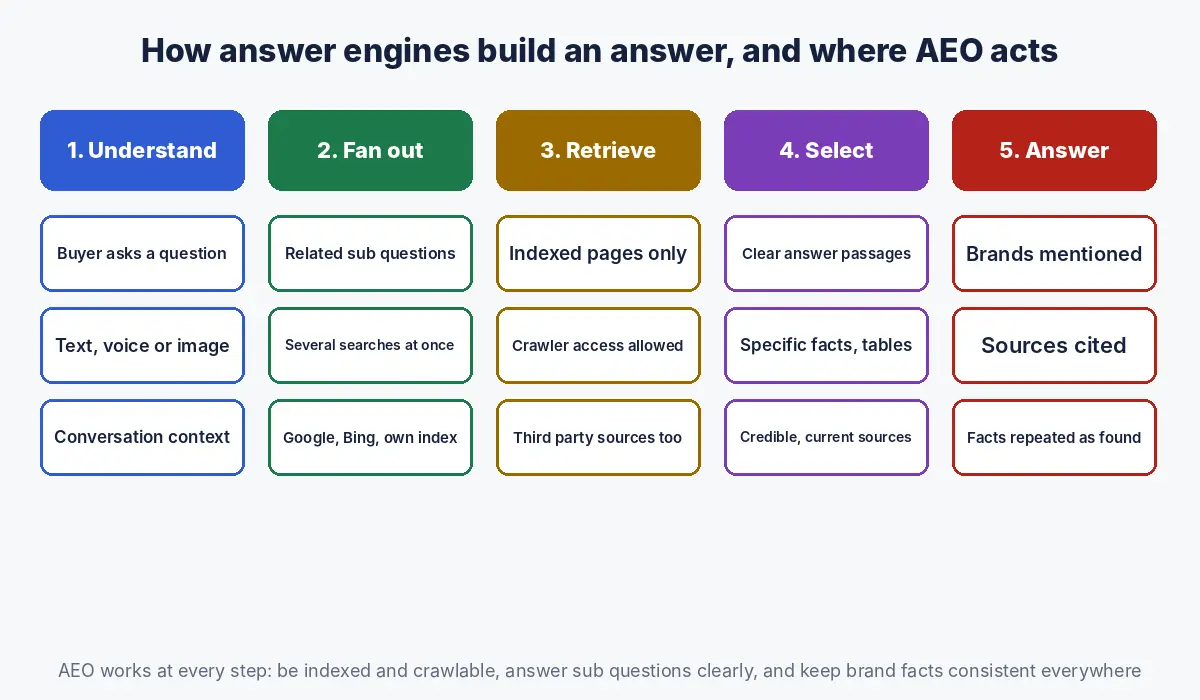
Four findings explain most of what happens:
- Ranking still feeds answers. Ahrefs found that 76.10% of pages cited in Google AI Overviews also rank in Google’s top 10 for the query, across 1.9 million citations (Ahrefs).
- Engines search more than the prompt. Google says AI Overviews and AI Mode may issue multiple related searches across subtopics and data sources to build a response (Google Search Central). This is called query fan out, and it means pages that answer specific sub questions get cited even when they do not rank for the main query.
- Different engines use different indexes. When ChatGPT search launched, OpenAI said it used a set of services in which Bing is an important one (Search Engine Roundtable). If you are invisible in Bing, you start ChatGPT and Copilot at a disadvantage.
- Third party sources carry weight. Across 30 million cited sources, Reddit, YouTube, LinkedIn and Wikipedia were among the most cited domains in AI search (Peec AI). What others publish about you shapes the answer as much as your own site.
Answers also vary from one run to the next. In research by SparkToro and Gumshoe, the chance of an AI assistant returning the same list of brand recommendations twice for the same prompt was under 1 in 100 (Search Engine Land). AEO raises the probability of being included; it does not lock in a fixed position.
What is the difference between AEO, SEO and GEO?
SEO earns rankings and clicks from search results, AEO earns direct answers and citations from answer engines, and GEO (generative engine optimization) is a near synonym for AEO that focuses specifically on generative AI systems; in practice the three overlap heavily and share the same foundations.
| SEO | AEO | GEO | |
|---|---|---|---|
| Main goal | Rank pages and earn clicks | Be the answer, quoted or cited | Be included in AI generated answers |
| Surfaces | Google and Bing organic results | AI Overviews, AI Mode, ChatGPT, Gemini, Perplexity, Copilot, featured snippets, voice | Mainly generative AI assistants and AI search |
| Unit of success | Ranking position, clicks | Mention, citation, accurate description | Mention, citation, share of voice |
| Content focus | Pages that match search intent | Self contained answer passages and clear facts | Same as AEO, plus brand presence across cited sources |
| Key metrics | Impressions, clicks, conversions | Citations, mention rate, AI referrals | Share of voice across a prompt set |
| Origin | 1990s | Late 2010s (snippets and voice) | 2023 research paper (Aggarwal et al.) |
Google’s own position is that, for Google Search, optimising for generative AI search is still SEO, and that you do not need llms.txt files, special markup or content broken into small chunks to appear in its AI features (Google Search Central). Treat AEO as a lens on SEO, not a replacement. For the full GEO explanation, read our guide to what GEO is and how it works, and for budget decisions see AEO vs SEO: where a UAE business should spend first.
Why does AEO matter for businesses in 2026?
AEO matters because a growing share of searches end with an AI answer instead of a click, so brands that are not named in those answers lose visibility, while the visitors who do click through from AI answers tend to convert well.
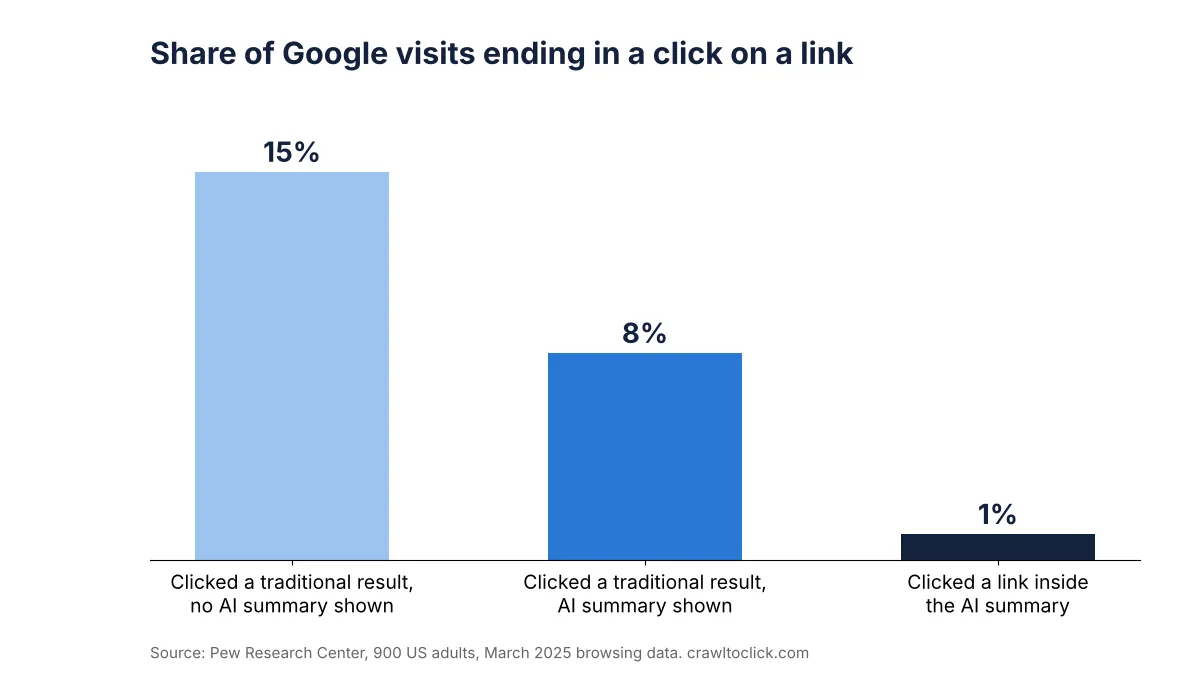
- When a Google AI summary appeared, users clicked a traditional result in 8% of visits, against 15% without a summary, and clicked a link inside the summary in about 1% (Pew Research Center).
- An AI Overview reduces the click through rate of the top ranking page by about 58%, comparing December 2023 with December 2025 across 300,000 keywords (Ahrefs).
- 68.01% of US Google searches ended without a click in early 2026, up from 60.45% in 2024 (Search Engine Land).
- AI referrals to US retail sites converted 31% better than other traffic in the 2025 holiday season (Adobe).
- At Ahrefs, AI search sent about 0.5% of visitors but 12.1% of signups over 30 days (Ahrefs).
- In the US, 45% of consumers now use ChatGPT or other AI tools for local business recommendations, up from 6% a year earlier (BrightLocal).
The pattern is fewer clicks, better clicks. The commercial risk is not that your traffic falls; it is that a competitor is named in the answer your buyer reads before they ever reach a search result.
Does AEO matter for businesses in the UAE?
Yes, and arguably more than in most markets, because the UAE has the highest AI adoption rate in the world and Google’s AI search features are available there in both English and Arabic.
- 70.1% of the UAE’s working age population used AI in the first quarter of 2026, the highest rate globally, against a global average of 17.8%, according to the Microsoft AI Diffusion Report (Khaleej Times).
- Google AI Mode launched in English across the Middle East and North Africa in August 2025 (Gulf Times) and expanded to Arabic and more than 35 other languages in October 2025, with the UAE among the countries listed (Search Engine Roundtable).
- UAE buying journeys are often research heavy and high value: property, healthcare, education, B2B services, legal and financial services. These are exactly the categories where buyers ask an assistant to shortlist providers.
A UAE specific trap is bilingual inconsistency. In audits I run, it is common to find the English site, the Arabic site and the Google Business Profile listing different phone numbers, service lists or prices. Answer engines pick up those conflicts and repeat whichever version they found, so fixing them is often the fastest AEO win in this market.
What does AEO involve? The six AEO pillars
AEO involves six areas of work: answer first content, entity clarity, technical access, structured data, third party presence, and freshness; skipping any one of them caps how often you are cited.
1. Answer first content for AEO
Each section of a page opens with a one or two sentence answer to the question in its heading, followed by the detail. Answer engines lift passages, not whole pages, so a passage that states the fact in full (who, what, how much, where) can be quoted on its own. Comparisons go in tables and processes in numbered steps.
2. Entity clarity: making sure AI knows who you are
Answer engines need to understand your brand as an entity: what it is, what it offers, where it operates and who it serves. Use the same name, description, address and service list everywhere, from your About page to directories and social profiles. Our AEO audit checklist lists the entity checks to run first.
3. Technical access for AI crawlers
Your pages must be indexed in Google and Bing, and robots.txt must allow the crawlers of the assistants you want to appear in. OpenAI separates OAI SearchBot, which powers ChatGPT search results, from GPTBot, which collects training data, so you can allow one and block the other (OpenAI). Blocking Google Extended, Google’s AI training token, does not affect inclusion in Google Search (Search Engine Roundtable). Google’s AI features follow the same snippet controls as normal results (Google Search Central).
4. Structured data that matches the page
Schema such as Organization, LocalBusiness, Product, FAQPage and Article helps machines read your facts consistently. Google says no special schema is required for its AI features, but structured data should match the visible text (Google Search Central). Its value for AEO is consistency, not a ranking trick.
5. Third party presence and reviews
Assistants often recommend brands based on what reviews, directories, comparison articles, Reddit threads, YouTube videos and industry publications say. A citation source map, built by recording which domains appear in answers for your category, shows where you need to be mentioned.
6. Freshness and accuracy
Prices, opening hours, team members, regulations and product features go out of date. Answer engines repeat old facts with confidence. Review commercially important pages at least every quarter and date your updates visibly.
How do you write content that answer engines quote?
Write content that answer engines quote by phrasing each heading as the real question a buyer asks, answering it fully in the first one or two sentences, and keeping the specific fact, number or name inside that same passage.
Use this answer block template for any section:
| Part | What to write | Example (illustrative) |
|---|---|---|
| Heading | The buyer’s question, in their words | How much does a corporate tax registration cost in the UAE? |
| Answer sentence | Direct answer with the key fact and its condition | Registering for UAE corporate tax with the Federal Tax Authority is free; costs come from adviser fees, typically quoted per entity. |
| Context sentence | Who it applies to, when it changes, or the exception | Fees vary with group structure and whether you need free zone qualifying income analysis. |
| Proof | Source link, data point or first hand example | Link to the official authority page; add your own price range table |
| Next step | What the reader should do now | Checklist of documents to prepare |
The difference this makes is easy to see. A typical service page opens with “We are a leading provider of innovative solutions with a passion for excellence.” No answer engine will quote that, because it answers nothing. Compare: “We provide bookkeeping and VAT filing for small trading companies in Dubai and Sharjah, from AED 1,200 a month, with filings submitted by Emirati tax agents.” That sentence answers who, what, where and how much, and can be lifted into an answer intact.
Things to avoid: vague headings such as “Our approach”, answers buried after three paragraphs of background, key facts locked inside images or PDFs, and the same paragraph reused across many pages.
How do you start AEO? A 30 day starter plan
Start AEO by measuring where you stand across a fixed set of buyer questions, fixing technical access and brand facts, rewriting your most important pages into answer first format, and then building third party mentions where the answers source from.
| Week | What to do | Output |
|---|---|---|
| Week 1: Baseline | Write 20 to 30 questions buyers ask before choosing a provider like you. Run each in ChatGPT, Gemini, Google AI Mode and Perplexity, three times each. Record mentions, citations and errors. | Prompt set and baseline mention rate |
| Week 2: Access and facts | Check indexing in Google and Bing, robots.txt rules for AI crawlers, and Bing Webmaster Tools setup. Fix inconsistent names, prices and addresses across your site, profiles and directories. | Technical and entity fix list, completed |
| Week 3: Answer first pages | Rewrite your five to ten most commercial pages: question headings, answer sentences, tables, FAQs, matching schema. | Pages ready to be quoted |
| Week 4: Sources and tracking | List the third party domains cited for your questions. Plan reviews, directory listings, guest articles or community answers on the top ones. Set up AI referral tracking in analytics. | Source plan and dashboard |
Here is a prompt set structure you can copy for week 1:
- Category questions: “best [service] in [city] for [type of customer]”
- Problem questions: “how do I [problem your service solves]”
- Comparison questions: “[your brand] vs [competitor]”, “[option A] or [option B] for [situation]”
- Cost questions: “how much does [service] cost in [country]”
- Brand questions: “what is [your brand]”, “is [your brand] good for [use case]”
Brand questions catch factual errors; category and comparison questions show whether you are on the shortlist. Run the full set every month, not once.
How do you measure AEO results?
Measure AEO with four layers: mention rate across a fixed prompt set, citations of your pages, accuracy of what answers say about you, and the traffic and conversions that arrive from AI sources.
| Metric | What it shows | Where to get it |
|---|---|---|
| Mention rate | Share of runs where your brand appears in answers to your prompt set | Manual sampling or an AI visibility tracker |
| Citations | How often your pages are linked as a source | Bing Webmaster Tools AI Performance report for Copilot and Bing; trackers for other assistants |
| Google AI impressions | Impressions in AI Overviews and AI Mode by page and country | Search Console generative AI performance reports, launched June 2026 and rolling out gradually (Google Search Central) |
| Accuracy | Errors in prices, services or locations in answers | Brand questions in your prompt set |
| AI referrals and conversions | Sessions and leads from chatgpt.com, perplexity.ai, gemini.google.com and copilot.microsoft.com | Google Analytics 4 with a referral channel group |
Because answers vary between runs, judge mention rate over many prompts and repeated runs, never a single screenshot. Our guide to AEO KPIs to report to your CEO shows how to turn these into a monthly report leadership will read.
How long does AEO take, and what does it cost?
Technical and factual fixes can show up in AI answers within weeks, while meaningful gains in mention rate for competitive questions usually take three to six months, because they depend on rankings and third party mentions that build over time.
| Change | Typical time to show in answers | Why |
|---|---|---|
| Correcting brand facts on your own site and profiles | 2 to 8 weeks | Depends on recrawl and how often assistants search live |
| Rewriting pages into answer first format | 1 to 3 months | Pages must be recrawled and reranked for sub questions |
| New mentions on third party sites | 2 to 6 months | Those pages must be published, indexed and start ranking |
| Category level share of voice | 6 months or more | Competitors are building the same signals |
These are planning ranges from practice, not guarantees. For a month by month view see how long AEO takes to show results, and for budgets in AED see AEO pricing in the UAE.
What are the most common AEO mistakes?
The most common AEO mistakes are treating it as separate from SEO, chasing shortcuts such as llms.txt or AI only pages, measuring with single screenshots, and ignoring what third party sites say about the brand.
| Mistake | Why it fails | Do this instead |
|---|---|---|
| Neglecting rankings because “SEO is dead” | Most AI Overview citations come from pages already in the top 10 | Keep SEO fundamentals strong |
| Publishing llms.txt and expecting results | Google says its Search ignores llms.txt (Google Search Central) | Spend the time on content and access |
| Creating separate “AI versions” of pages | Google says no special AI style rewrite is needed; duplicates dilute signals | Make the main page answer first |
| Blocking all AI bots by default | Removes you from ChatGPT search and similar products | Allow search crawlers; decide on training bots separately |
| Judging success from one answer | Recommendation lists rarely repeat between runs | Track mention rate across a prompt set |
| Ignoring the Arabic site or profiles | Answers repeat conflicting facts | Keep facts identical across languages |
Which businesses benefit most from AEO?
Businesses whose buyers research and compare before contacting anyone benefit most from AEO, such as B2B software, healthcare, property, education, professional services and high value ecommerce.
| Business type | Typical buyer question | Where AEO helps most |
|---|---|---|
| B2B SaaS | “best CRM for a 20 person sales team in the Gulf” | Comparison and integration pages, review site presence |
| Clinics and healthcare | “dermatologist in Jumeirah who treats melasma” | Doctor profiles, service pages, Google Business Profile accuracy |
| Real estate | “family friendly communities in Dubai under AED 150,000 rent” | Community guides with current data |
| Schools and education | “British curriculum schools in Abu Dhabi with fees” | Fee tables, curriculum facts, inspection ratings |
| Professional services | “how to set up a free zone company for consulting” | Step by step guides with costs and timelines |
| Ecommerce | “best running shoes for flat feet under AED 400” | Product data, Merchant Center feeds, reviews |
Businesses that sell mainly on impulse or low price, with little research before purchase, usually get more from classic SEO, marketplaces and paid media first.
Not sure where your brand stands in AI answers today? A short baseline across your top buyer questions usually answers that within a week. Request an AEO baseline.
How Crawl To Click approaches AEO
Crawl To Click is an SEO and AI visibility consultancy, and we treat AEO as an extension of search strategy tied to revenue rather than a separate channel. We begin with the questions buyers actually ask before choosing a provider, measure mention rate and citations across ChatGPT, Gemini, Google AI Mode, Perplexity and Copilot, and record every factual error. We then fix crawler access and brand facts across languages, rewrite commercial pages into answer first sections, align schema with visible content, and map the third party sources each answer engine relies on in the category. Results are reported as mention rate, citations, accuracy and AI referred leads. We have applied this to healthcare providers, property brokerages, B2B software companies, education providers, professional services firms and ecommerce brands, adjusting the prompt set and source plan to how each industry buys.
FAQs on AEO
What does AEO stand for?
AEO stands for answer engine optimization, the practice of making your content and brand the source that AI assistants and search features such as Google AI Overviews, ChatGPT, Gemini, Perplexity and Copilot use when they answer a question directly.
Is AEO different from SEO?
AEO builds on SEO rather than replacing it. SEO aims for rankings and clicks, while AEO aims for your brand to be mentioned, cited and described accurately in direct answers. Google says optimising for its AI search features is still SEO, so strong SEO fundamentals are the base of AEO.
Are AEO and GEO the same thing?
AEO and GEO are largely the same in practice. AEO, answer engine optimization, is the older term and also covers featured snippets and voice assistants, while GEO, generative engine optimization, comes from a 2023 research paper and focuses on generative AI systems.
Do I need llms.txt for AEO?
No. Google says its Search ignores llms.txt and that no special files, markup or Markdown versions are needed to appear in its AI features. Other assistants have not confirmed using it either, so content quality, crawler access and consistent brand facts matter far more.
How do I know if my brand appears in AI answers?
Write 20 to 30 questions your buyers ask, run each several times in ChatGPT, Gemini, Google AI Mode and Perplexity, and record how often your brand is mentioned or cited. Add Bing Webmaster Tools and Search Console AI reports for citation and impression data.
How long does AEO take to work?
Corrections to brand facts can appear in AI answers within a few weeks, while gains in how often you are recommended for competitive questions usually take three to six months, because they depend on rankings and third party mentions.
Can a small business do AEO without an agency?
Yes. A small business can run a prompt baseline, fix its Google Business Profile and directory facts, rewrite its main service pages into answer first format and collect reviews without outside help. An agency adds speed, tracking across many prompts and experience with competitive categories.
Need help getting your brand into AI answers?
If you want to know whether ChatGPT, Gemini and Google AI Mode recommend you or your competitors, and what to fix first, book a free AEO strategy call.
Disclaimer: This article reflects Google documentation and published studies as of the dates stated. AI search products, their data sources and usage figures change frequently. Examples are illustrative, and timelines are planning guidance rather than guarantees.