A founder asks ChatGPT about her own company and gets three wrong answers in one paragraph. It says the payroll platform was founded in 2018, not 2021. It says it serves “small retailers”, a market the company left two years ago. And it quotes a starting price from an old blog post. None of it was made up by the model out of nothing. Every wrong fact was on the web somewhere, written by the company itself, and never corrected.
The short answer: a brand fact sheet is one canonical list of the facts you want AI tools to repeat about you: what you are, who you serve, when and where you were founded, who leads you, what you sell and what it costs. Write each fact as a short, self contained sentence that names the brand, date stamp anything that changes, publish the sheet on your site, then make every other page and profile say the same thing in the same words. LLMs repeat what they see consistently; factual messaging is the work of making your facts consistent.
This guide is part of our series on entity SEO for AI search. It builds on the entity foundation in our guide to building a brand entity Google and LLMs trust, and gives you a fact sheet template, writing rules, a placement map and a test you can run monthly. Brand names in the examples are imaginary.
What factual messaging means for AI search
Positioning is for people, facts are for machines
Most brand messaging is written to persuade: “the smarter way to run payroll”. That line tells a language model nothing it can repeat with confidence. Factual messaging is the layer underneath: plain statements that are either true or false, such as “Tallyfin is payroll software for companies in the UAE with 20 to 500 employees.” Models can retrieve, compare and quote statements like that. They cannot do much with a slogan.
Why AI answers get brand facts wrong
In the audits I run, wrong facts in AI answers almost always trace back to one of four causes:
- Old content still live: launch press releases, early blog posts and old pricing pages still describe the company as it was.
- Inconsistent third party profiles: review sites, directories and startup databases each carry a different description, category or founding year.
- Vague first party copy: the website never states the fact plainly, so the model fills the gap from weaker sources or from similar companies.
- Name confusion: another entity shares the name, and its facts bleed into yours.
The fact sheet fixes the third cause directly and gives you the reference you need to fix the other three.
What to include in a brand fact sheet
The five groups of facts
| Group | Facts to include | How often it changes |
|---|---|---|
| Identity | Legal and trading name, one sentence definition, category, founding year, headquarters, markets served | Rarely |
| People | Founders, chief executive, key leaders and their titles | Occasionally |
| Offering | Products or services, who each is for, main use cases, integrations, languages supported | Each quarter |
| Commercials | Pricing model, starting price, free trial or demo, contract terms | Each quarter |
| Proof | Customer count, certifications, awards, funding, notable partnerships, each with a date | Each quarter |
Add “what we are not” statements
This is the part most brands miss. If AI tools keep putting you in the wrong category or confusing you with another company, add short disambiguation facts: “Tallyfin is not an accounting package and does not file VAT returns.” “Tallyfin Payroll is not related to Tallyfin Logistics in Oman.” These sentences give a model something explicit to retrieve when the question touches the boundary.
How to write facts LLMs repeat correctly
Seven writing rules
- Name the brand in every sentence. “Tallyfin was founded in 2021”, not “We started in 2021”. A sentence lifted out of context must still make sense.
- One fact per sentence. Long sentences with several claims get paraphrased and partly lost.
- Use the category words buyers use. If buyers say “payroll software”, do not call yourself a “people operations cloud” in the fact sheet.
- Date stamp anything that changes. “As of October 2026, Tallyfin serves more than 400 companies.” Undated numbers get repeated long after they are wrong.
- Be specific. “Supports English and Arabic payslips” beats “multilingual support”.
- Keep units and formats identical everywhere. Choose AED or USD, monthly or annual, and use it on every page.
- No superlatives without proof. “The leading payroll platform” will not be repeated as fact, and it weakens the statements around it.
Before and after: rewriting a fact
| Before | After |
|---|---|
| We help growing teams pay people on time, every time. | Tallyfin is payroll software for UAE companies with 20 to 500 employees. |
| Trusted by hundreds of businesses across the region. | As of October 2026, Tallyfin serves more than 400 companies in the UAE and Saudi Arabia. |
| Flexible plans for every budget. | Tallyfin pricing starts at AED 15 per employee per month, billed annually. |
| Built by payroll experts. | Tallyfin was founded in Dubai in 2021 by Sara Haddad, a former payroll operations lead. |
A brand fact sheet template you can copy
Fill this in, have someone outside marketing check every line, then publish it as a page on your site (we suggest a “Company facts” or “Press” page linked from your footer).
[Brand] fact sheet (last updated: [month year])

IDENTITY
[Brand] is a [category] for [audience] that [main outcome].
[Brand] was founded in [year] in [city, country].
[Brand] is headquartered in [city] and serves customers in [markets].

PEOPLE
[Brand] was founded by [name], [title], and [name], [title].
[Name] is the chief executive of [Brand].

OFFERING
[Brand] offers [product 1], which [what it does] for [who].
[Brand] integrates with [tools].
[Brand] supports [languages / regions / compliance standards].

COMMERCIALS
[Brand] pricing starts at [amount and currency] per [unit], billed [period].
[Brand] offers a [free trial of N days / demo / freemium plan].

PROOF (each with a date)
As of [month year], [Brand] serves [number] customers in [markets].
[Brand] holds [certification], awarded [year].

WHAT WE ARE NOT
[Brand] is not [common wrong category].
[Brand] is not related to [similarly named entity].
Where to publish your brand facts
On your own website
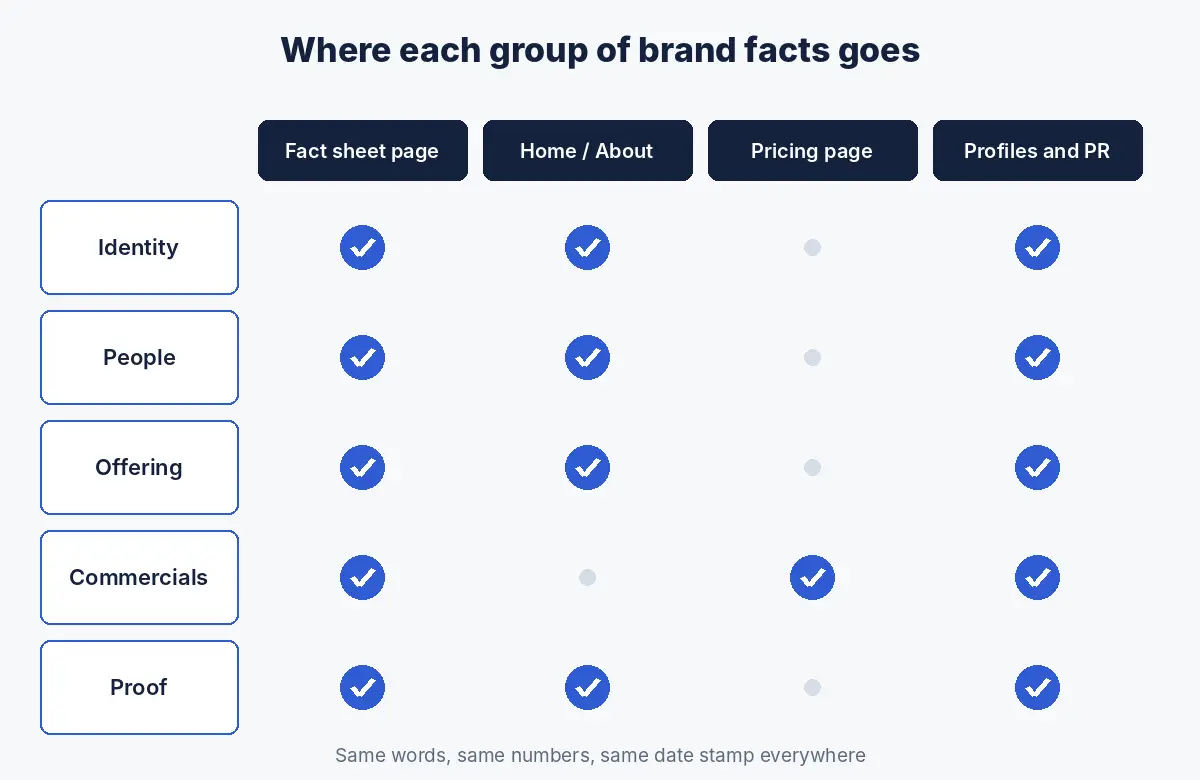
- Company facts page: the full fact sheet, in plain HTML text (not an image or PDF only).
- Home page: the one sentence definition in the first visible paragraph.
- About page: identity and people facts, matching the fact sheet word for word.
- Pricing page: commercial facts, with the same currency and billing period.
- Product pages: the offering fact for that product as the opening sentence.
- Organization markup: name, description, founding date and founders in structured data that matches the visible text. Google lists making sure structured data matches the visible text among the practices that still matter for its AI features.
On third party profiles
Copy the identity sentence and the commercial facts into every profile you control: professional networks, review sites, startup databases, app marketplaces, business directories and your Google Business Profile. Use the same boilerplate at the end of every press release, and give it to partners who write about you.
Should you add an llms.txt file?
The llms.txt proposal, first published by Jeremy Howard in September 2024, describes a Markdown file at your site root with a title, a short summary and lists of links that help AI agents use the site. It is still a proposal, not a standard, and Google states that you do not need to create new machine readable files or AI text files to appear in AI Overviews or AI Mode. My view: it costs an hour, so add one with your fact sheet summary and links to your key pages, but never treat it as a substitute for stating the facts on your normal pages.
# Tallyfin

> Tallyfin is payroll software for UAE companies with 20 to 500 employees. Founded in Dubai in 2021. Pricing starts at AED 15 per employee per month.

## Key pages

* [Company facts](https://www.example.com/facts/): official fact sheet
* [Pricing](https://www.example.com/pricing/): current plans in AED
* [Product](https://www.example.com/payroll/): features and integrations
Cleaning up conflicting brand facts
Run a fact drift audit
- Search your own site for every old figure: previous prices, old customer counts, former taglines, old market descriptions.
- Update, redirect or add a dated note to each page. A two year old press release can stay, but it should not be the clearest statement of your pricing.
- Check every third party profile against the fact sheet and fix each difference.
- Ask partners and directories you do not control to update their copy, and send them the boilerplate.
Illustrative example: one fact, five versions
Tallyfin’s audit finds its customer count stated five different ways: “200+ companies” on an old landing page, “300 businesses” in a 2024 press release, “hundreds of teams” on the home page, “400 customers” in a sales deck shared publicly, and no figure at all on review sites. AI answers quoted whichever version they happened to retrieve. After the cleanup, one dated sentence appears on the fact sheet, the About page and every profile, and the old landing page is redirected. Within a couple of months, the dated figure is what most answers repeat.
How to test whether LLMs repeat your facts
A monthly fact accuracy test
Build a set of 15 to 20 prompts, each targeting one fact: “When was Tallyfin founded?”, “How much does Tallyfin cost?”, “Who founded Tallyfin?”, “Is Tallyfin an accounting tool?”. Run each in ChatGPT, Gemini, Perplexity and Copilot, and score every answer:
| Score | Meaning |
|---|---|
| 2 | Correct and matches the fact sheet |
| 1 | Partly correct, vague or out of date |
| 0 | Wrong, or attributed to another entity |
| Blank | The tool declined to answer or said it did not know |
Track the share of answers scoring 2 over time, by fact group. AI answers vary from one run to the next, so run each prompt more than once and look at the trend, not single answers. Our sampling method for measuring LLM mentions explains how many runs you need. Our guide to AEO KPIs explains how to fit this alongside mention and citation tracking.
What to do when a fact stays wrong
- Look at the citations in Perplexity, ChatGPT search and Google AI Overviews to find which page the wrong fact comes from.
- Fix or update that source first; if you do not control it, contact the publisher with the correct fact and a link to your fact sheet.
- Strengthen the correct version: state it on more of your own pages and in fresh, independent coverage.
- Use the feedback options inside each AI tool to report wrong answers about your brand.
For a broader review of how ready your site is for AI search, work through our AEO audit checklist.
Common factual messaging mistakes
- Publishing the fact sheet only as a PDF. Put the text on an HTML page that can be crawled and quoted.
- Letting marketing rewrite facts every campaign. The fact sheet changes only when the fact changes.
- Forgetting the Arabic version. If you serve Arabic speaking buyers, publish the same facts in Arabic with the same numbers.
- Hiding prices to “start a conversation”. If you never state a price, AI answers will state one for you from wherever they can find it.
- No owner. Give one person the job of updating the sheet each quarter and pushing changes to every profile.
How Crawl To Click builds factual messaging
Our approach
Crawl To Click is the SEO and AI visibility practice of Indu Priya, with more than 15 years of experience across the US, MENA and India and more than 30 clients across healthcare, ecommerce, fintech, B2B software and lifestyle brands. Factual messaging is one of the five layers we build in every AI visibility programme, alongside entity, authority, community and answer engine work. We start by testing what AI tools currently say about the brand, trace each wrong fact to its source, write the fact sheet with the founding team, and then roll the same statements out across the site and every profile. Read more about us.
What it delivered for a B2B software platform
For a B2B marketing software platform, factual messaging was one of the five layers that moved it from rarely mentioned to regularly recommended by AI assistants. Brand mentions grew from 3 to 22 per 100 tracked queries, the share of demos driven by AI assistants rose from 2% to 10%, and visitors from AI assistants converted to demos at 14%, up from 8%.
FAQs on brand fact sheets for LLMs
What is a brand fact sheet for AI search?
It is a single, canonical list of plain, verifiable statements about your brand, covering identity, people, offering, pricing and proof, written so AI tools can retrieve and repeat each fact accurately.
Where should I publish my brand fact sheet?
On a crawlable HTML page on your website, such as a company facts or press page linked from the footer. Then repeat the same statements on your home, about and pricing pages and on every third party profile.
Do I need an llms.txt file?
No. llms.txt is a proposal, not a standard, and Google says no special AI text files are needed for its AI features. It is cheap to add, but the facts must also appear on your normal pages.
How long before ChatGPT repeats my updated facts?
It varies by tool. Tools that search the web can pick up changes once the updated pages are crawled, while facts the model learned in training change more slowly. Track the trend monthly rather than expecting an instant change.
Why does AI quote an old price for my product?
Usually because an older page, review profile or article still states that price more clearly than your current pages. Find the source through the citations in AI answers, update it, and state the current price plainly on your pricing page.
Need help with your brand fact sheet?
AI tools quoting old prices, wrong founders or the wrong category for your brand? Request a brand fact audit and we will trace every wrong fact to its source and fix it.
Disclaimer: Tallyfin, Sara Haddad and all example figures and URLs are imaginary. Platform guidance summarised here comes from the linked documentation and may change. Client results come from work led by our founder and depend on market, product and execution.