A patient asks an AI assistant for a dental clinic near Jumeirah that takes her insurance. The answer names a clinic chain, then adds that its Jumeirah branch has closed and that it does not accept her insurer. Both statements are wrong. The branch moved two streets away in March, and the insurer was added in June. The patient books elsewhere, and the clinic never learns why.
The short answer: you cannot edit an AI model directly, so you fix wrong facts about your brand by fixing what the model reads. Capture the wrong answer, trace it to its source (an old page of yours, a third party profile, an article, or the model’s training data), correct or update that source, publish the correct fact clearly on your own site, report the answer through each platform’s feedback tools, then test again on a schedule. Answers that come from live web search usually change once the sources are updated and crawled again; answers from training data change more slowly.
This guide is part of our series on entity SEO for AI search. It is a step by step correction playbook with a triage table, a diagnosis process, platform reporting steps and an incident log template. Brand names in the examples are imaginary.
Why you cannot simply ask AI tools to correct a fact
Two places wrong facts come from
A wrong fact in an AI answer comes either from live retrieval, where the assistant searched the web and repeated a page it found, or from training data, where the model learned the fact from older web content. Retrieval errors are fixable by changing the source. Training errors are much harder to change directly. When the privacy group noyb filed a complaint in 2024 about false information ChatGPT gave about a person, it reported that OpenAI argued it was not possible to correct the data, offering instead to filter or block responses to certain prompts. For brands, the practical lesson is clear: work on the sources, not on the model.
| Where the fact comes from | How to tell | How fast it can change | Main fix |
|---|---|---|---|
| Live retrieval of your own page | Your URL appears in the citations | Fast, once the page is updated and crawled again | Update or redirect the page |
| Live retrieval of a third party page | Another site appears in the citations | Depends on the publisher | Ask for a correction, outweigh with better sources |
| Training data | The wrong fact appears with web search off and no citations | Slow, often months | Make the correct fact dominant across the web |
| Entity confusion | The fact belongs to a similarly named company | Medium | Strengthen your entity and add disambiguation |
Step 1: capture and triage the wrong fact
Capture everything before it changes
- A screenshot of the full answer, with the date visible
- The exact prompt, the platform, the mode (web search on or off) and the location
- Every cited URL
- A note of how many times out of five runs the wrong fact appears
Decide how urgent it is
| Severity | Examples | Response time |
|---|---|---|
| Critical | Safety, legal or regulatory claims; says you closed; wrong licensing status; defamatory statements | Same day; involve legal or compliance |
| High | Wrong prices, locations, insurers accepted, product availability | Within a week |
| Medium | Old positioning, wrong category, former leadership | Within a month |
| Low | Minor details such as founding month or old office size | Next quarterly review |
Step 2: diagnose where the wrong fact comes from
A five check diagnosis
- Read the citations. Open every cited page and search it for the wrong fact. Our guide to citation source mapping explains how to log and group these sources.
- Search the exact wrong phrase in quotes on Google and Bing, for example “Lumen Dental” “Jumeirah branch closed”.
- Search your own site for old prices, addresses, names and claims, including blog posts, careers pages, PDFs and press releases.
- Check your third party profiles: Business Profile, directories, review sites, insurer and partner listings, social bios.
- Turn web search off where the tool allows it and ask again. If the wrong fact still appears with no citations, it is likely to come from training data.
Illustrative example: a clinic chain’s diagnosis
Lumen Dental, an imaginary clinic group in Dubai, runs the checks. The “branch closed” claim traces to a local directory that marked the old address as permanently closed when the clinic moved, and to the clinic’s own news post titled “Our Jumeirah clinic is closing” with no mention of the new address. The insurance error traces to a 2025 page on its own site listing accepted insurers, which was never updated. Two of the three sources are the clinic’s own content.
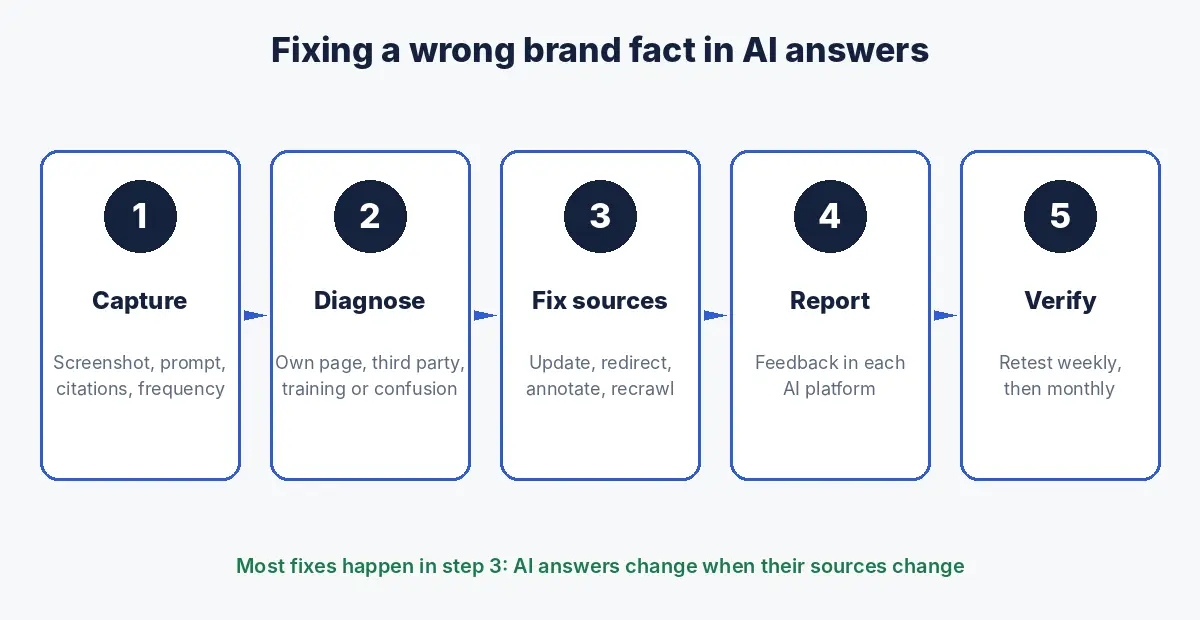
Step 3: fix the sources you control
Update, redirect or annotate old pages
- Update pages that should state the current fact, such as pricing, locations and insurers.
- Redirect pages that only exist to state an outdated fact, such as an old branch page, to the current equivalent.
- Annotate historical posts that should stay live, with a dated note at the top: “Update, March 2026: our Jumeirah clinic has moved to [new address].”
- Rename misleading titles. “Our Jumeirah clinic is closing” becomes “Our Jumeirah clinic is moving”.
Publish an explicit correction statement
AI tools retrieve sentences, so give them one that states the correct fact plainly and names the brand: “Lumen Dental’s Jumeirah clinic moved to [new address] in March 2026 and remains open.” “As of June 2026, Lumen Dental accepts [insurer] at all branches.” Put these on the relevant page, on your company facts page and in your brand fact sheet, and make sure any structured data on the page matches.
Get the updated pages crawled again
Request indexing for the updated URLs through URL Inspection in Google Search Console, and submit them in Bing Webmaster Tools, since Copilot and other assistants draw on Bing results. Update the page’s modified date and your XML sitemap so crawlers see the change.
Step 4: fix the sources you do not control
Profiles, directories and publishers
- Claim and correct directory and review listings. Most have a “suggest an edit” or owner verification route.
- For local businesses, update your Google Business Profile first, because many directories and AI answers draw on it.
- Email publishers with the specific sentence that is wrong, the correct fact, and a link to your company facts page as proof. Short, specific requests get fixed; vague complaints do not.
Use Google’s Refresh Outdated Content tool
If a third party has already updated or removed a page but Google still shows the old version, Google’s Refresh Outdated Content tool lets anyone who does not own the page ask Google to update its results. It only works when the page has been removed or changed significantly; disagreeing with content that is still live is not a valid reason, and approved requests expire after 180 days.
Correct your knowledge panel
If the wrong fact also appears in your knowledge panel, use Google’s process to submit feedback on content about you, or suggest changes directly if you have claimed the panel. Our guide to building a brand entity covers claiming and maintaining the panel.
Step 5: report the wrong answer to each AI platform
Google AI Overviews and AI Mode
Google’s help page on AI Overviews in Search explains the route: click the thumbs down at the bottom of the overview, select “Report a problem”, choose the closest category and add details. You can also use the three dot menu at the top right of the overview. Include the correct fact and the URL that proves it.
ChatGPT, Gemini, Perplexity and Copilot
Each assistant has a thumbs down or feedback control on every answer. Use it, select the inaccurate option where offered, and write the correct fact in the comment. If the wrong information is about a named person, such as a founder, the platforms’ privacy request routes may also apply. Treat feedback as a supporting step: it helps, but it is not a guaranteed correction, which is why steps 3 and 4 matter most.
Step 6: outweigh the wrong fact across the web
For facts that come from training data or from sources you cannot change, make the correct version more common and more authoritative than the wrong one:
- Announce significant changes (moves, rebrands, new pricing models, acquisitions) through a press release and your own news page.
- Update every profile in the same week so the correct fact appears in many places at once.
- Brief partners, associations and insurers that list you, and ask them to update their pages.
- Answer the question directly in a short FAQ on your site: “Is Lumen Dental Jumeirah still open? Yes. It moved to [new address] in March 2026.”
Step 7: verify the fix and keep monitoring
- Run the original prompt five times on each platform a week after the sources are updated, then monthly.
- Record how many runs still show the wrong fact. A fall from five out of five to one out of five is progress; zero for two months in a row is resolved.
- Add the prompt to your standing fact accuracy checks so the error cannot quietly return.
An incident log template for brand fact errors
| Field | Example |
|---|---|
| Wrong fact | “Jumeirah branch has closed” |
| Correct fact | Moved to [new address], March 2026 |
| Severity | High |
| Platforms and frequency | ChatGPT 3 of 5, AI Overviews 2 of 5 |
| Source type | Directory listing, own news post |
| Actions taken | Post retitled and annotated, directory corrected, feedback sent |
| Retest dates | Weekly for a month, then monthly |
| Status | Open, improving, resolved |
| Owner | Marketing lead |
Special cases when fixing brand facts in AI answers
Defamatory or harmful claims
If an AI answer makes a damaging claim, such as fraud, safety failures or regulatory action that never happened, preserve the evidence and speak to legal counsel before engaging publicly. Use the platforms’ legal and safety reporting routes alongside the steps above.
Regulated industries
Healthcare and financial brands should involve compliance in every correction, because the corrected statements on your site must themselves meet advertising and licensing rules. Our guide to clinic SEO in Dubai covers how this works for healthcare providers.
Rebrands, mergers and closures
Expect AI answers to lag behind big changes. Publish a single clear page explaining the change (“[Old name] is now [New name]”), keep the old name as an alias in your markup for a transition period, and redirect every old URL to its new equivalent.
Preventing outdated brand facts in AI answers
Most errors start when something changes inside the business and nobody updates the web. Add a short checklist to every change in price, location, leadership, product or partnership: update the fact sheet, the relevant pages, structured data, Business Profile, top directories and review profiles, then test the main prompts a week later.
How Crawl To Click fixes brand facts in AI answers
Our approach
Crawl To Click is the SEO and AI visibility practice of Indu Priya, with more than 15 years of experience and more than 30 clients across the US, MENA and India, in healthcare, ecommerce, BFSI and fintech, beauty, fashion and lifestyle, and B2B software. For brand fact errors, we test what each AI platform says, trace every wrong fact to its source, fix the client’s own pages and structured data, work through third party corrections, and set up monthly checks so errors do not return. Read more about us.
How this work shows up across industries
- Healthcare: we implement schema layers, including Organization and MedicalEntity markup, with expert authorship and quarterly refreshes, so clinical and service facts stay accurate and interpretable for AI tools.
- Ecommerce (online furniture and home retail): technical fixes, Core Web Vitals improvements and content that answered real buyer questions helped the site recover from core updates, lift coverage of its top 100 revenue keywords from 35% to 75% and grow revenue 6x between 2019 and 2022.
- B2B marketing software: a factual messaging layer was one of five layers that took AI assistant mentions from 3 to 22 per 100 tracked queries and the share of demos from AI assistants from 2% to 10%.
- Fintech and lifestyle brands: we refresh content every quarter so pricing, offers and product facts stay current across pages, and AI tools are not left quoting old terms.
FAQs on fixing wrong facts in AI answers
Can I ask ChatGPT to correct wrong information about my company?
Not directly. You can send feedback on the answer, but the reliable fix is to correct the sources the assistant relies on: your own pages, third party profiles and articles. Answers based on live web search usually change once those sources are updated and crawled again.
How long does it take for AI answers to show corrected facts?
It depends on the source. Answers from live retrieval can update within days or weeks of the source page being recrawled. Facts learned in training change more slowly, often over months, so make the correct fact dominant across the web.
How do I report an incorrect Google AI Overview?
Click the thumbs down at the bottom of the AI Overview, select Report a problem, choose the closest category and add details, including the correct fact and a link that proves it.
Why does AI say my business is closed?
Usually because a directory or map listing marked an old address as permanently closed after a move, or your own site announced a closure without stating the new location. Fix those sources and publish a clear statement that you are open.
What should I do if an AI tool makes defamatory claims about my brand?
Preserve screenshots and prompts, speak to legal counsel, use the platform’s legal or safety reporting routes, and correct or outweigh any source that the claim appears to come from.
Need help fixing what AI says about your brand?
AI assistants telling buyers you are closed, overpriced or something you are not? Get a brand fact correction plan and we will trace each error to its source and fix it.
Disclaimer: Lumen Dental and all example details are imaginary. Platform features and policies summarised here come from the linked documentation and may change. This article is not legal advice. Client results come from work led by our founder and depend on market, product and execution.