Search for “Northwind” and Google shows a knowledge panel for a different company. Ask ChatGPT about Northwind Analytics, the B2B software firm, and it describes the brand partly correctly and partly with details belonging to the other Northwind. The software company has a good website and strong rankings. What it lacks is a clearly defined entity that search engines and language models can tell apart from everything else with a similar name.
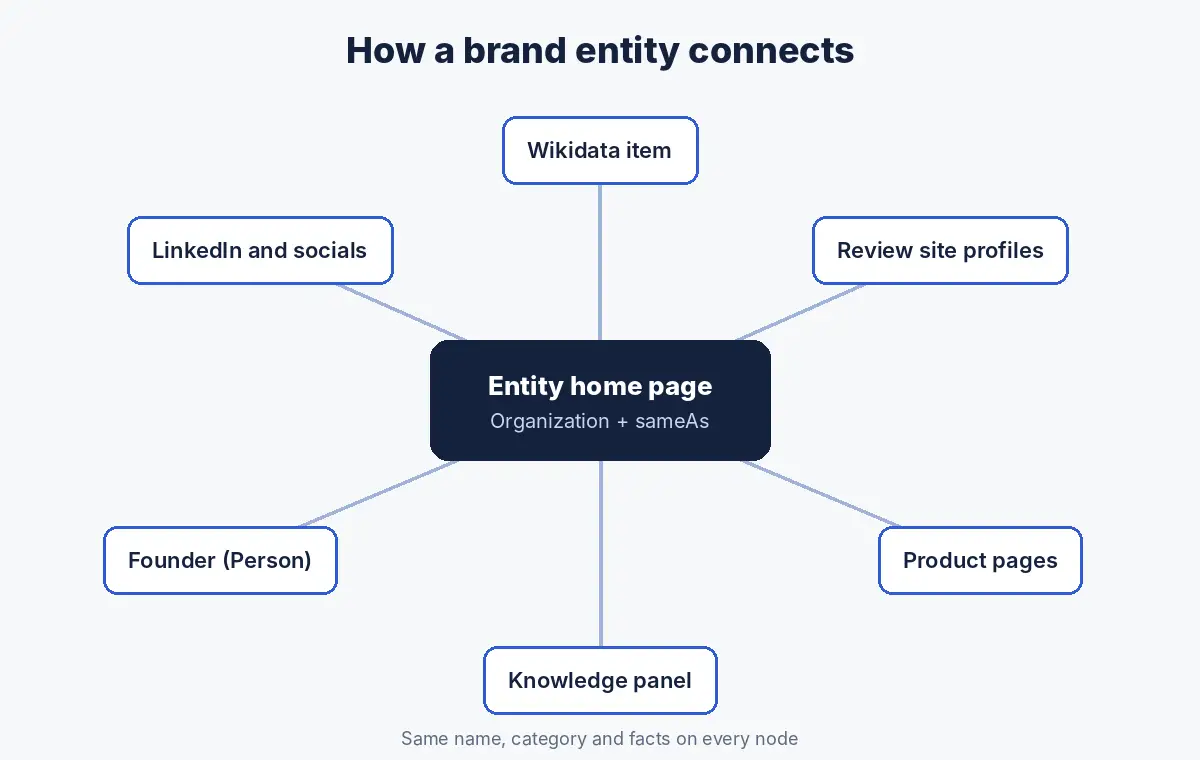
The short answer: to build a brand entity that Google and LLMs trust, choose one page on your site as the entity home, describe the brand there with Organization structured data, link it with sameAs to every official profile, make every profile describe the brand identically, create a Wikidata item if you meet its notability rules, claim your knowledge panel when one appears, and connect your founders and products as related entities. Consistency across all of these is what turns a name into an entity.
This is part of our series on entity SEO for AI search. It covers the foundation layer in practical detail, with a markup template, a consistency audit and step by step instructions. Brand names in examples are imaginary.
What makes a brand a trusted entity
How Google’s Knowledge Graph gathers facts
Google explains in its help centre on how the Knowledge Graph works that its facts come from a variety of sources that compile factual information, including public sources, licensed data and content owners who suggest changes to panels they have claimed. In other words, the Knowledge Graph builds its view of your brand from many places, not just your website.
Why LLMs need the same clarity
Language models learn and retrieve from the same web. When sources disagree on your name, category or facts, models either blend you with a similar entity or avoid naming you. A clear entity has three properties:
- Unambiguous: it cannot be confused with another company, product or person.
- Consistent: every source describes it with the same name, category and core facts.
- Connected: it is linked to its founders, products, locations and the topics it is known for.
Step 1: choose your entity home page
What an entity home is
The entity home is the one page on your site that is the definitive description of your brand. For most companies it is the About page or the home page. Google’s Organization structured data guidance recommends placing organisation details on your home page or a single page that describes your organisation, and says you do not need to include them on every page.
What the entity home page should say
- A one sentence definition in the first paragraph: “[Brand] is a [category] for [audience] that [main outcome].”
- Founding year, headquarters and markets served.
- Founders and leadership, each linked to their own profile page.
- Products or services, each linked to its own page.
- Links to every official profile (the same list you will use for sameAs).
- Contact details matching your Business Profile and directories exactly.
Step 2: Organization markup and sameAs
What sameAs does
In schema.org, sameAs is the URL of a reference page that unambiguously identifies the item, such as its Wikipedia page, Wikidata entry or official website. Google lists sameAs as a recommended Organization property for links to pages on other sites with more information about your organisation, such as social media or review site profiles. It is how you tell machines “all of these profiles are the same entity”.
An Organization markup template
Adapt this for your entity home page. Remove any property you cannot fill accurately.
<script type="application/ld+json">
{
  "@context": "https://schema.org",
  "@type": "Organization",
  "@id": "https://www.example.com/#organization",
  "name": "Northwind Analytics",
  "alternateName": "Northwind",
  "url": "https://www.example.com/",
  "logo": "https://www.example.com/logo.png",
  "description": "Northwind Analytics is a revenue analytics platform for B2B SaaS finance teams.",
  "foundingDate": "2019",
  "founder": {
    "@type": "Person",
    "@id": "https://www.example.com/team/janedoe/#person",
    "name": "Jane Doe"
  },
  "address": {
    "@type": "PostalAddress",
    "addressLocality": "Dubai",
    "addressCountry": "AE"
  },
  "sameAs": [
    "https://www.linkedin.com/company/example",
    "https://www.youtube.com/@example",
    "https://x.com/example",
    "https://www.crunchbase.com/organization/example",
    "https://www.wikidata.org/wiki/Q000000"
  ]
}
</script>
sameAs rules that matter
- Only list profiles you own or that are definitively about you. Never list a competitor comparison page or a news article.
- Use the same stable @id everywhere you reference the organisation in other markup, so all pages point to one entity.
- Keep the list current. A dead profile in sameAs is a broken claim.
- Make the links reciprocal: each profile should link back to your website.
Step 3: a profile consistency audit
Where to check
List every place your brand has a profile. For most B2B brands that includes professional networks, video and social platforms, software review sites, startup databases, business directories, app stores, Google Business Profile and industry association listings.
What to compare
| Field | Must match | Common problem |
|---|---|---|
| Name | Exactly, including spacing and capitals | “Northwind”, “NorthWind Analytics”, “Northwind Inc” used interchangeably |
| One line description | Same category and audience | Old positioning left on review sites |
| Category | Same primary category on every platform | “Accounting software” on one, “BI tool” on another |
| Website URL | Same canonical URL | Old domain or tracking parameters |
| Founding year and location | Identical | Registration year vs launch year |
| Logo | Current version | Old logo on directories |
| Founders | Same names and titles | Former founders still listed |
Illustrative example: Northwind Analytics finds eleven profiles across the web. Four use an old tagline from when it sold to retailers, two list the wrong founding year, and its review site category puts it next to bookkeeping tools rather than revenue analytics. Fixing these takes one person about two days, and it is usually the cheapest high impact entity work a brand can do.
Step 4: Wikidata for brands
Should your brand have a Wikidata item?
Wikidata is a free, open knowledge base used widely as structured reference data. Its notability policy accepts items that have a link to a Wikimedia page, that refer to a clearly identifiable entity describable with serious, publicly available references, or that fulfil a structural need. For most companies the second criterion is the relevant one: you need independent, credible sources such as press coverage or official registries, not just your own website.
How to create a Wikidata item that lasts
- Search Wikidata first to make sure an item does not already exist, including under older names.
- Create the item with an accurate label, a short neutral description and aliases.
- Add core statements: instance of (for example business or software company), country, headquarters location, inception date, official website and founders.
- Add a reference to every statement, using independent sources where possible.
- Link identifiers you hold elsewhere, such as your official social accounts and startup database entries.
- Keep it neutral. Promotional wording and unreferenced claims are the main reasons items are challenged.
What about Wikipedia?
Wikipedia has much stricter notability standards and strong rules on conflict of interest. Do not write your own company article. If your brand has enough independent coverage, an article may be created by independent editors; your job is to earn that coverage through real news and expert commentary.
Step 5: claim and maintain your knowledge panel
How to claim a knowledge panel
Google’s guide to getting verified on Google sets out the steps: search for the entity, select “Claim this knowledge panel”, review the information, then sign in to one of the listed official sites or profiles, such as YouTube, Search Console or social accounts. Google notes that not every panel can be claimed yet, and that local businesses serving customers at a location should use a Business Profile instead.
If you have no knowledge panel yet
- Complete steps 1 to 4 first. Panels tend to appear once Google has consistent facts from several sources.
- Earn coverage in publications that describe you with your category and founders.
- For local businesses, set up a Business Profile; our guide to Business Profile verification covers the process.
Correcting wrong facts
Verified representatives can suggest changes to a claimed panel, and anyone can send feedback. Google says it may remove information that is demonstrably false or outdated. Fix the underlying sources first, or the wrong fact may return. Our guide to writing a brand fact sheet LLMs repeat correctly shows how.
Step 6: connect people and product entities
Founder and expert entities
Founders and specialists are entities too, and they strengthen the brand when connected to it. Give each a profile page with Person markup, a consistent job title and links to their own professional profiles, and reference them from the Organization markup. When they write or speak elsewhere, make sure the bio names the company consistently.
Product entities
If your product name differs from your company name, give the product its own page and markup, and state the relationship clearly: “[Product] is made by [Company]”. Products with ambiguous names especially need this, or AI answers may attribute them to the wrong company.
Handling name collisions and rebrands
When your name is shared with another entity
- Always pair the name with the category in descriptions: “Northwind Analytics, the revenue analytics platform”.
- Use alternateName in markup only for genuine variants of your own name.
- Build distinct sameAs links and a Wikidata item so machines can separate you from the other entity.
After a rebrand
- Add the old name as an alias on Wikidata and in alternateName for a transition period.
- Update every profile in the same week, not over months.
- Publish a clear page stating “[Old name] is now [New name]”, which AI tools can retrieve.
How to check whether your entity work is working
- Ask ChatGPT, Gemini, Perplexity and Copilot “What is [Brand]?” monthly and check the category, audience and facts.
- Search your brand name in Google and note whether a knowledge panel appears and what it shows.
- Track brand mentions per 100 queries for your category prompts, as described in our guide to AEO KPIs.
- Run the profile consistency audit again every quarter.
For a complete review of AI visibility beyond the entity layer, use our AEO audit checklist.
How Crawl To Click builds brand entities
Our approach
Crawl To Click is the SEO and AI visibility practice of Indu Priya, with more than 15 years of experience across the US, MENA and India. Entity work is the first layer of every AI visibility engagement we run: we audit how search engines and AI tools currently describe the brand, build the entity home and schema layers, clean up profiles, and connect founders and products, before investing in content or outreach. Read more about us.
What it delivered for a B2B software platform
For a B2B marketing software platform that ranked well on Google but was rarely named by AI assistants, optimising the brand entity was the starting point of a five layer programme. Over the engagement, brand mentions in AI answers rose from 3 to 22 per 100 tracked queries, authority citations grew from 4 to more than 15, and the share of demos driven by AI assistants rose from 2% to 10%.
FAQs on building a brand entity
What is sameAs in schema markup?
sameAs is a schema.org property that lists URLs of reference pages that unambiguously identify the same entity, such as official social profiles, review site profiles and a Wikidata entry. Google recommends it in Organization markup.
Can any company create a Wikidata item?
Only if it meets Wikidata’s notability policy. For most companies that means being a clearly identifiable entity that can be described using serious, publicly available references, such as independent press coverage or official registries.
How do I get a knowledge panel for my company?
Google decides automatically when to show a panel. Building a clear entity home, consistent profiles, Organization markup and independent coverage makes it more likely. Once a panel appears, you can claim it by signing in to an official linked profile.
Does entity SEO help with ChatGPT and Gemini?
Yes. Language models learn from and retrieve the same web sources. Consistent names, categories and facts across your site and profiles make it more likely they describe and recommend your brand correctly.
Should I write a Wikipedia article about my company?
No. Wikipedia has strict notability and conflict of interest rules. Focus on earning independent coverage; if your company is notable, independent editors may create an article.
Need help building your brand entity?
AI tools confusing your brand with someone else, or describing you with old facts? Request an entity audit and get a clean, connected brand entity Google and LLMs can trust.
Disclaimer: Northwind Analytics and all example URLs are imaginary. Platform policies summarised here come from the linked documentation and may change. Client results come from work led by our founder and depend on market, product and execution.