A Dubai fintech selling expense cards to small businesses has a keyword list of 4,000 terms from its last agency. Its top “priority” keywords are “what is a corporate card” and “expense management tips”, which bring traffic but almost no sign ups. Meanwhile “corporate card for SMEs UAE”, a search with modest volume, converts better than any paid campaign it runs. The list was built on volume. It should have been built on revenue.
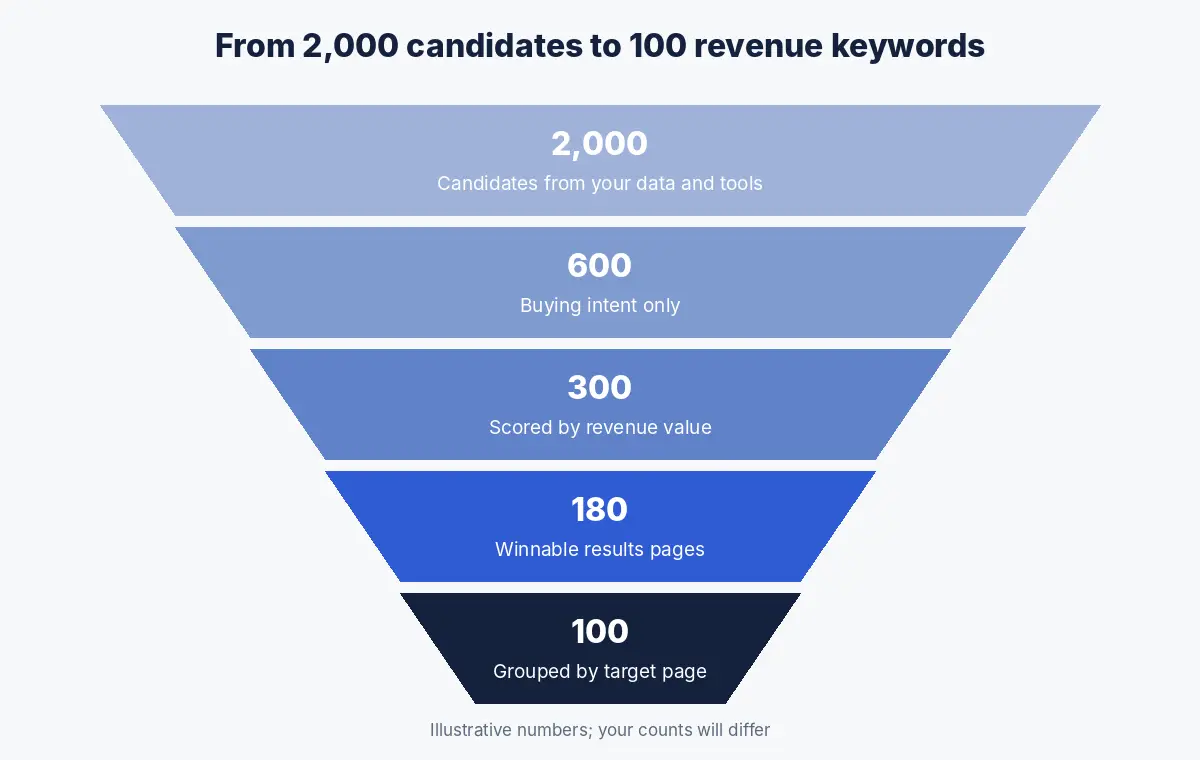
The short answer: to build a revenue keyword set, collect candidate keywords from your own conversion data (Search Console, analytics, paid search and sales conversations) as well as keyword tools, keep only searches with buying intent, score each one by its expected revenue (volume × click through rate × conversion rate × deal value), check whether you can realistically win the results page, group variants that share one target page, and keep the top 100. Then assign each keyword a target page and track it monthly as your search coverage set.
This guide is part of our series on search coverage, the SEO metric that ties rankings to revenue. It gives you the seven step process, a scoring formula, a spreadsheet template and worked examples. Brand names in the examples are imaginary.
What makes a keyword a revenue keyword
A revenue keyword passes three tests:
- Intent: the person searching could buy, book, sign up or request a demo within a few steps.
- Fit: you sell what they are looking for, in the market where they are searching.
- Evidence or logic: it has converted for you before (in organic or paid search), or it is a close variant of something that has.
Volume is not one of the tests. A keyword with 50 searches a month that brings one enterprise deal a quarter is worth more than one with 50,000 searches that brings none.
Step 1: collect candidate keywords from revenue data
Your own data sources first
| Source | What to pull | Limits to know |
|---|---|---|
| Google Search Console | Queries for landing pages that convert, last 12 months | The table shows a maximum of 1,000 rows and omits anonymised rare queries; filter by page to see more |
| Analytics (GA4) | Landing pages ranked by key events and revenue from organic search | Shows pages, not keywords; join with Search Console by page |
| Google Ads | Search terms with conversions and conversion value | The search terms report omits terms without enough query activity |
| CRM and sales calls | The words prospects use in enquiries, demos and lost deal notes | Qualitative; check search demand separately |
| Site search | What visitors search for on your site | Shows demand from people already on the site |
Then expand with keyword tools and modifiers
Take every product, service and use case you sell and combine it with commercial modifiers. Then pull competitor rankings for commercial terms from your keyword tool.
| Modifier type | Examples |
|---|---|
| Purchase | buy, price, cost, pricing, quote, order, book |
| Location | Dubai, Abu Dhabi, UAE, near me, [neighbourhood] |
| Audience | for SMEs, for startups, for clinics, for agencies |
| Comparison | best, top, vs, alternatives, compared, review |
| Attribute | online, same day, Arabic, Sharia compliant, with free delivery |
Expect a candidate list of 500 to 2,000 keywords at this stage. That is normal.
Step 2: filter revenue keywords by search intent
| Intent | Example | Keep in the set? |
|---|---|---|
| Transactional | corporate card for SMEs UAE | Yes |
| Commercial investigation | best expense card UAE | Yes |
| Local | business bank account Dubai Marina | Yes, if you serve that area |
| Competitor and alternatives | [competitor] alternatives | Yes |
| Branded | Falconpay pricing | Track separately, not in the 100 |
| Informational | what is a corporate card | No; use for content planning |
| Navigational to others | [bank] login | No |
When intent is unclear, search the keyword and look at the results. If the top results are guides and definitions, Google reads the intent as informational, whatever the words suggest.
Step 3: score each keyword by revenue value
The value formula
Monthly value = monthly searches × click through rate at your target position × conversion rate × average order or deal value.
For B2B, add your close rate: searches × click through rate × lead conversion rate × lead to customer rate × average first year contract value.
Where each input comes from
- Searches: your keyword tool, set to your target country.
- Click through rate: your own Search Console data for similar keywords at position 2 or 3, rather than an industry average.
- Conversion rate: organic conversion rate of the page type that would rank (category, product, service or comparison page); if a keyword converted in paid search, use that as a check.
- Deal value: average order value, or average first year contract value for B2B.
A spreadsheet formula you can copy
With searches in column C, click through rate in D, conversion rate in E and deal value in F, put this in G2 and fill down:
=ROUND(C2*D2*E2*F2, 0)Step 4: check the results page and winnability
What to look for
- Page type: what kind of page ranks (category pages, product pages, comparison articles, local listings). You need a page of the same type.
- Who ranks: if the top 10 is all marketplaces, government portals or global giants, the keyword is hard to win.
- Features: ads, map packs, shopping results and AI Overviews push organic results down and reduce clicks.
- Your current position: keywords where you already rank 4 to 20 are the fastest to move.
Score winnability from 1 to 3
| Score | Meaning |
|---|---|
| 3 | You rank 4 to 20 already, or the top 10 includes sites of similar authority to yours |
| 2 | You do not rank yet, but the results include specialist sites you can compete with |
| 1 | The results are dominated by marketplaces, regulators or very large brands |
Step 5: group keyword variants by target page
Many keywords are variants of one need: “corporate card UAE”, “company credit card UAE” and “business expense card UAE” will usually be served by the same page. Check whether the same URLs rank for each; if most of the top 10 overlap, they belong in one group. Keep the highest value keyword as the group’s main keyword and list the rest as secondary keywords for the same page. This stops the top 100 being filled with near duplicates.
Step 6: select the top 100 revenue keywords
The priority score
Priority = monthly value × winnability score. Sort by priority and take the top 100 groups. Then check the balance:
- Every product line or service you want to grow is represented.
- Around 10 to 15 “stretch” keywords with high value and low winnability are included, so the set shows long term ambition.
- Each main market and language has its own keywords. For the UAE, include Arabic keywords where buyers search in Arabic.
Step 7: map each keyword to a page and track it
Revenue keyword set template
| Column | What to record |
|---|---|
| Main keyword | Highest value keyword in the group |
| Secondary keywords | Variants served by the same page |
| Product line | Which part of the business it serves |
| Intent | Transactional, commercial, local or competitor |
| Market and language | For example UAE, English |
| Monthly value | From the value formula |
| Winnability | 1 to 3 |
| Priority | Value × winnability |
| Target URL | The page that should rank; “to create” if none |
| Current position and ranking URL | Updated monthly |
| Action | Create, improve, consolidate, build links, improve conversion |
Illustrative example: a fintech’s top revenue keywords
| Main keyword | Searches | Monthly value (AED) | Win | Priority | Action |
|---|---|---|---|---|---|
| corporate card for SMEs UAE | 320 | 14,400 | 3 | 43,200 | Improve page, currently position 6 |
| expense management software UAE | 880 | 19,800 | 2 | 39,600 | Create dedicated page |
| [competitor] alternatives | 210 | 9,500 | 3 | 28,500 | Create comparison page |
| business prepaid card Dubai | 590 | 8,900 | 2 | 17,800 | Consolidate two thin pages |
| best business credit card UAE | 1,900 | 12,800 | 1 | 12,800 | Stretch: banks dominate |
| بطاقة شركات الإمارات | 260 | 5,900 | 2 | 11,800 | Create Arabic page |
Notice that the keyword with the most searches ranks only fifth on priority, because banks dominate its results page, while a 210 search competitor keyword makes the top three because the fintech can realistically win it and it converts well.
Revenue keywords for different business types
B2B software and services
Volumes are low and deal values are high, so a keyword with 30 searches a month can earn a place. Keywords that come up repeatedly in sales calls deserve a place even when tools show little or no volume, because tools often undercount niche B2B searches.
Ecommerce
Category keywords (“sofa beds”, “dining tables online”) usually carry more value than individual product keywords, because they match the pages that convert browsers into buyers. Use category level conversion rates and average order values.
Clinics and local services
Treatment plus location keywords (“dental implants cost Dubai”, “dermatologist Jumeirah”) dominate. Include neighbourhood variants for every branch, and treat “near me” searches as one group per service.
Keeping your revenue keyword set current
- Quarterly: update values with fresh conversion data, add new products and remove discontinued ones.
- Seasonally: add seasonal keywords before the season starts, such as back to school, Ramadan offers or summer travel.
- After pricing or product changes: recalculate deal values.
- Never monthly: changing the set every month breaks the coverage trend.
Once the set is built, the values make forecasting straightforward; our guide to calculating SEO ROI shows how to turn them into a business case, and our SEO audit guide covers the technical checks for the pages that will carry these keywords.
Common mistakes when building a revenue keyword set
- Sorting by volume. It puts informational keywords at the top every time.
- Using tool difficulty scores alone. Look at who actually ranks.
- Ignoring paid search data. It is the best evidence of which searches convert.
- Leaving out zero volume keywords from sales calls. In B2B these are often the most valuable.
- No target page. A keyword without an assigned URL will not move.
How Crawl To Click builds revenue keyword sets
Our approach
Crawl To Click is the SEO and AI visibility practice of Indu Priya, with more than 15 years of experience and more than 30 clients across the US, MENA and India. Building the revenue keyword set is the first deliverable in almost every engagement, and it comes from the “find what converts” stage of our method: deep market and results page research, persona and intent mapping, and analytics, paid search and AI answer data to validate which topics actually convert. Read more about us.
How it worked across industries
- Ecommerce (online furniture and home retail): a set of the top 100 revenue generating keywords became the core of the programme. Coverage of those keywords rose from 35% to 75%, and revenue grew 6x between 2019 and 2022.
- B2B marketing software: a keyword set focused on bottom of funnel searches that create qualified leads helped drive 10x growth in demos.
- Technical B2B product: in a hard to crack technical category, a revenue focused keyword set built from scratch delivered 10x growth in impressions and recurring demos from Google and ChatGPT.
- Healthcare: treatment and location keyword sets for providers, mapped to compliant service pages.
- BFSI, fintech, beauty, fashion and lifestyle: product and category keyword sets built around what each business actually sells, not around search volume.
FAQs on revenue keywords
What is a revenue keyword?
A search where the person could buy, book, sign up or request a demo within a few steps, that matches what you sell in the market you serve, and that has converted for you or is a close variant of one that has.
Why limit the set to 100 keywords?
One hundred is large enough to represent your revenue and small enough to review keyword by keyword each month. Larger businesses can track several sets of 100, one per product line or market.
How do I estimate the value of a keyword?
Multiply monthly searches by your expected click through rate at the target position, the conversion rate of the page type that would rank, and your average order or deal value. For B2B, also multiply by your lead to customer rate.
Should zero volume keywords be included?
In B2B, yes, when they come up repeatedly in sales calls. Keyword tools often undercount niche searches, and these terms tend to convert very well.
How often should I update my revenue keyword set?
Review it every quarter, and before seasonal peaks or after product and pricing changes. Avoid changing it every month, or you will lose the coverage trend.
Need help building your revenue keyword set?
Keyword list full of traffic terms that never convert? Book a keyword strategy session and get the 100 keywords that should drive your SEO roadmap.
Disclaimer: Falconpay and all example keywords, volumes and values are imaginary and for illustration only. Platform limits summarised here come from the linked documentation and may change. Client results come from work led by our founder and depend on market, product and execution.