You ask ChatGPT for the best project management tools for agencies. It searches, names five products and cites a Reddit thread, a review site and two vendor blogs. Your page ranks in Google’s top five for that topic and is nowhere in the answer. Why those sources, and not yours?
The short answer: ChatGPT chooses sources in one of two ways. For many questions it answers from what it learned in training, with no citations. When it needs current or specific information, it runs web searches, often several rewritten versions of your question, through search partners in which Bing plays an important role. It then reads the pages OpenAI’s search crawler is allowed to access and cites the passages that best support its answer. Pages are cited when they are indexed, crawlable, relevant to those rewritten searches and specific enough to quote.
How ChatGPT chooses sources: two routes to an answer
| Route | When it is used | Where information comes from | Can you influence it? |
|---|---|---|---|
| Training data | General knowledge, explanations, writing tasks | Patterns learned from data before the model’s cutoff | Slowly: through how widely and consistently your brand is described across the web over time |
| Live web search | Current events, prices, product comparisons, local results, or when the user asks for sources | Search results retrieved at the time of the question | Yes: through indexing, crawl access, rankings for related queries and quotable content |
Most prompts never trigger a search. Similarweb found that citations appeared in about 6.8% of US ChatGPT prompts in May 2026, up from about 1.6% in June 2025 (Similarweb). That is consistent with how people use ChatGPT: OpenAI’s own study found that most messages are practical guidance, seeking information and writing (NBER working paper), and much of that can be answered without a live search.
The commercial implication: you need both routes. Live search is where you can win citations quickly. Training data is where your long term reputation shows up, in answers that name brands without linking to anyone.
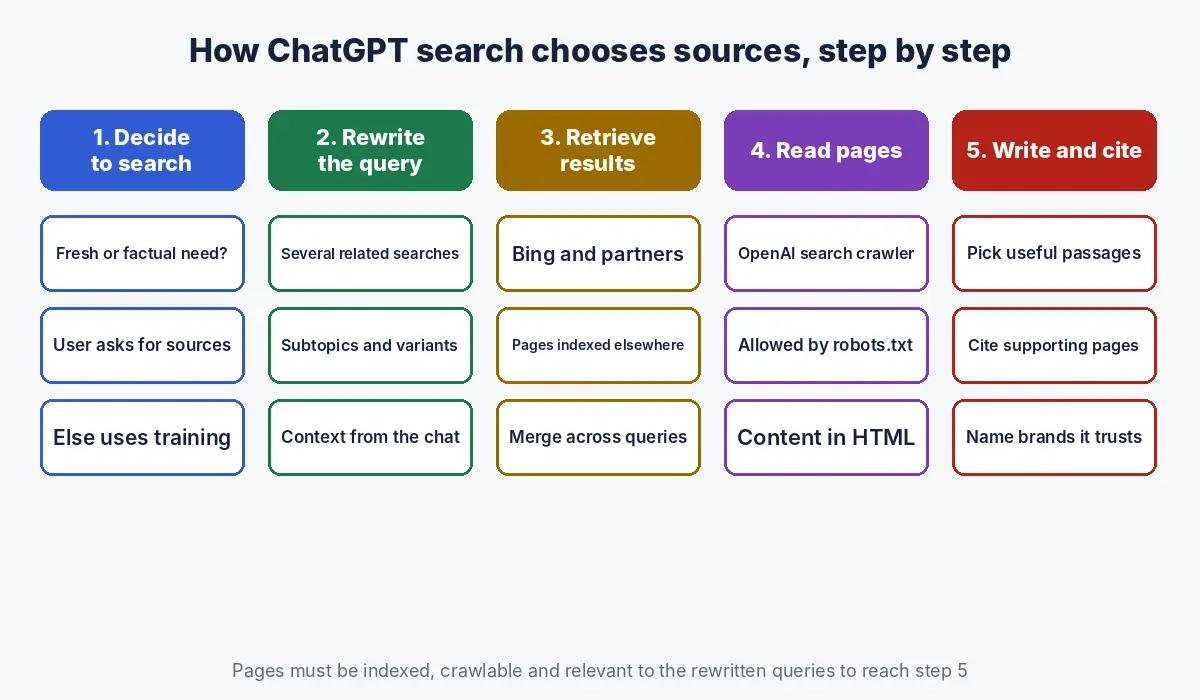
How ChatGPT search picks sources, step by step
Step 1: ChatGPT decides whether to search
ChatGPT searches when the question needs fresh, specific or verifiable information, or when the user selects search or asks for sources. Comparison, pricing, “best” and local questions are the ones most likely to trigger a search, and they are also the questions closest to a purchase.
Step 2: It rewrites your question into several searches
AI assistants rarely search the exact prompt. They issue variations covering subtopics, synonyms and context from the conversation, then merge the results, a process often called query fan out. Ahrefs explains that results are typically combined so that pages appearing consistently across several variations are favoured, even if they rank lower for any single one (Ahrefs).
Step 3: It retrieves results from search partners
When ChatGPT search launched, OpenAI said it used “a set of services and Bing is an important one” (Search Engine Roundtable). In practice, if your pages are not indexed in Bing, they have fewer chances to be retrieved. Ahrefs found little difference in how often ChatGPT’s citations ranked in Google versus Bing, about 8% for each in its sample (Ahrefs), which shows the rewritten queries matter more than any one ranking.
Step 4: It reads the pages it is allowed to access
OpenAI runs separate crawlers for separate jobs (OpenAI crawler documentation):
- The search crawler (named OAI SearchBot, written with a hyphen in robots.txt) surfaces websites in ChatGPT search. Sites that block it will not appear in ChatGPT search answers, though they can still appear as navigational links. OpenAI says robots.txt changes take about 24 hours to apply.
- The training crawler (GPTBot) collects content that may be used to train models. Blocking it does not remove you from ChatGPT search; the settings are independent.
- The user agent for live requests (named ChatGPT User) visits a page when a user’s request calls for it. It does not decide search inclusion.
A common mistake I find in audits: a site blocked every OpenAI crawler to stop model training, and in doing so removed itself from ChatGPT search. Check your robots.txt allows the search crawler even if you block the training crawler.
Step 5: It writes the answer and cites supporting pages
ChatGPT selects the passages that best support each part of its answer and links them. Pages that state a clear, specific fact in one or two sentences are easier to cite than pages that discuss a topic in general terms. Brands it names may come from the retrieved pages, from training data, or both.
Which sources ChatGPT cites most
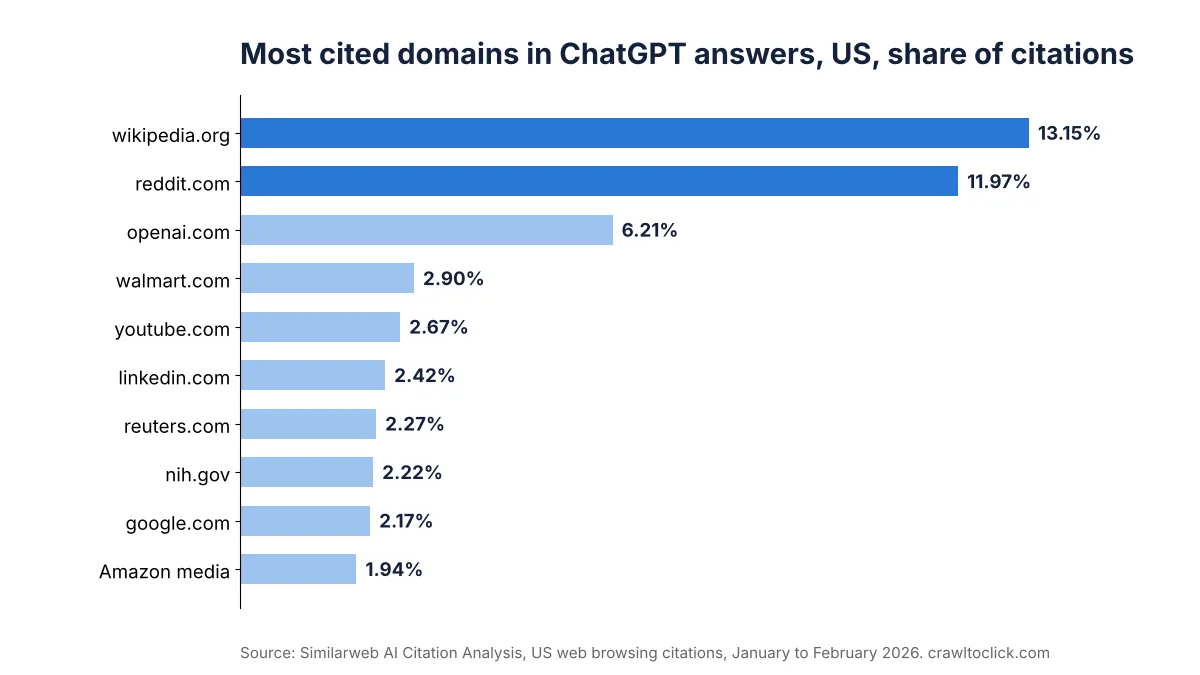
In US web browsing citations from January to February 2026, Wikipedia (13.15%) and Reddit (11.97%) led ChatGPT’s citations, followed by OpenAI’s own site, Walmart, YouTube, LinkedIn and Reuters (Similarweb). Similarweb also found that:
- AI tools rarely cite homepages; most ChatGPT citations point to pages several folders deep, such as guides, FAQs, product pages and research.
- Content that answers specific, detailed questions is more likely to be cited.
- For a given topic, AI tends to reuse a small set of trusted sources.
- Opinion and comparison prompts favour community platforms and niche publishers, while decision focused prompts lean towards major publishers, aggregators and brand sites.
ChatGPT citation factors: what makes a page more likely to be cited
| Factor | Why it matters | What to do |
|---|---|---|
| Indexed in Bing and Google | Retrieval depends on search partners | Verify in Bing Webmaster Tools and Search Console; fix indexing gaps |
| Search crawler allowed | Blocked pages cannot appear in ChatGPT search | Allow OpenAI’s search crawler in robots.txt |
| Ranks for related queries | Only about 12% of AI cited URLs rank in Google’s top 10 for the original prompt (Ahrefs) | Cover subtopics, alternatives, pricing and use cases, not just the head term |
| Specific, deep pages | Homepages are rarely cited | Create dedicated pages for each question buyers ask |
| Quotable facts | Answers need short passages to support claims | Lead with direct answers; use numbers, dates and tables |
| Presence on trusted third party sites | Community, review and reference sites are cited heavily | Earn accurate mentions where your category is discussed |
| Content in the HTML | Crawlers may not run complex scripts | Serve key text in the initial HTML |
How to see which sources ChatGPT uses for your topic
- List 20 questions your buyers ask before purchasing, including comparisons and “best for” questions.
- Ask each in ChatGPT with search on, in a fresh chat, and repeat each question three times.
- Record every cited URL and every brand named, and note whether you appear.
- Group cited sources by type: your site, competitors, review sites, community threads, publishers, directories.
- Pick the five sources cited most often for your highest value questions and decide how to earn a place on each.
- Repeat monthly. Answers vary, so track the trend, not individual answers.
Repetition matters: research by SparkToro and Gumshoe found the chance of getting the same list of brand recommendations twice was under 1 in 100 (Search Engine Land). Our guides on AI citation source mapping and tracking ChatGPT brand mentions go deeper.
How to get ChatGPT to cite your website
- Allow OpenAI’s search crawler in robots.txt, and confirm your pages are indexed in Bing.
- Build a page for each buyer question, with the answer in the first two sentences.
- Add specific, sourced facts: prices or price ranges, timelines, specifications, locations, credentials.
- Keep your brand facts identical across your site, profiles, directories and review platforms.
- Earn mentions on the community, review and comparison pages ChatGPT already cites for your topic.
- Update important pages regularly so dates, prices and examples stay current.
For a broader view of the discipline, see what is GEO, and for UAE businesses, how to rank on ChatGPT in Dubai.
What you cannot control
- Variation: the same question can produce different sources each time.
- Personalisation: conversation history and memory can change what is searched and cited.
- Model updates: OpenAI changes models and search behaviour often, so a pattern that holds today may shift.
- Scale of the audience: with 1 billion weekly users (Yahoo Tech), even small changes in how often you are cited add up, which is why measuring frequency is more useful than chasing any single answer.
How Crawl To Click works on ChatGPT visibility
Crawl To Click is an SEO and AI visibility consultancy. For ChatGPT, we start with the questions buyers ask before they purchase and test them repeatedly with search on, mapping which sources are cited and which brands are named. We then check the technical basics, including crawler access and Bing indexing, build or improve the specific pages those rewritten searches need, correct inconsistent brand facts, and pursue a place on the third party sources that keep appearing. The same method works for a software product, a clinic, a property developer or an ecommerce store, and we report progress as citation and mention rates alongside the leads ChatGPT referrals bring in. Learn more about our approach.
FAQs on how ChatGPT chooses sources
Does ChatGPT use Google or Bing?
OpenAI has said ChatGPT search uses a set of search services and that Bing is an important one. Studies find ChatGPT’s citations overlap only modestly with both Google and Bing rankings for the original prompt, because it searches rewritten variations of the question.
Why does ChatGPT cite some websites and not others?
It cites pages that its search partners retrieve for the rewritten queries, that OpenAI’s search crawler is allowed to read, and that contain a specific passage supporting the answer. Deep, specific pages and trusted third party sites are cited more often than homepages.
Does blocking GPTBot remove my site from ChatGPT?
No. GPTBot is OpenAI’s training crawler. Inclusion in ChatGPT search is controlled separately by OpenAI’s search crawler, so you can block training while allowing search.
Does ChatGPT always cite sources?
No. Most answers come from training data without citations. Similarweb found citations in about 6.8% of US ChatGPT prompts in May 2026, mainly when ChatGPT searches the web.
What websites does ChatGPT cite most?
In Similarweb’s US data for early 2026, Wikipedia and Reddit led, with about 13% and 12% of citations, followed by OpenAI, Walmart, YouTube, LinkedIn and Reuters.
How can I get my website cited by ChatGPT?
Allow OpenAI’s search crawler, make sure you are indexed in Bing, create specific pages that answer buyer questions directly with sourced facts, keep brand facts consistent, and earn mentions on the sources ChatGPT already cites in your category.
Want to know which sources ChatGPT uses in your category?
We will map the questions, citations and brands ChatGPT shows your buyers, and tell you which gaps to close first. Request an AI visibility baseline.
Disclaimer: This article describes ChatGPT behaviour based on OpenAI documentation and third party studies as of the dates stated. OpenAI changes its systems frequently, and no method can guarantee citation. ChatGPT is a trademark of OpenAI; Crawl To Click is not affiliated with OpenAI.