The short answer: Claude is very good at the thinking parts of keyword research, such as expanding seed terms, cleaning lists, labelling search intent, grouping keywords into clusters and mapping clusters to pages, but it has no search volume or ranking data of its own. Feed it exports from Search Console, Google Keyword Planner or an SEO tool, or connect a tool such as Semrush or Ahrefs, and give it three to five worked examples in every prompt, which is what Anthropic recommends for consistent output (Anthropic).
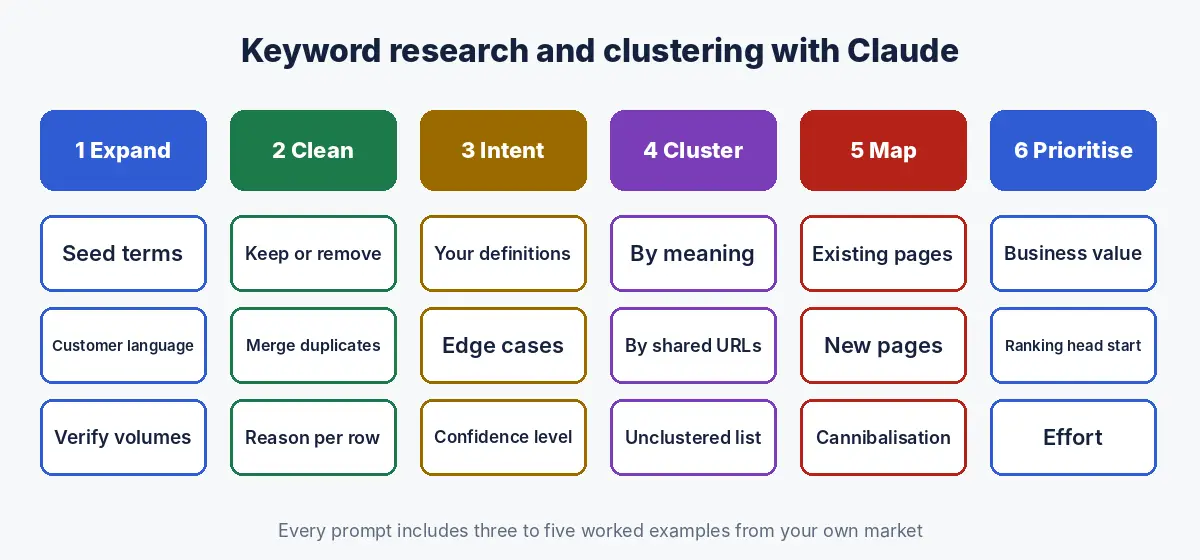
This guide sets out the six step workflow we use, with a copy ready prompt for each step. Every prompt includes worked examples, because examples are what turn Claude from a generic keyword brainstormer into a consistent analyst that labels and groups keywords the way you would. The examples use UAE businesses, but the method works for any market.
Can Claude do keyword research?
Claude can do most of the analysis in keyword research but not the measurement: it can generate, filter, classify, cluster and prioritise keywords, while search volumes, difficulty and rankings must come from Google or an SEO tool, because Claude does not have that data and will estimate badly if asked.
| Task | Claude alone | Claude with your data or a connector |
|---|---|---|
| Brainstorm seed terms and modifiers | Good | Better, grounded in real queries |
| Search volume and difficulty | No: do not ask | Yes, from the export or connector |
| Remove irrelevant keywords | Good with clear rules | Good |
| Label search intent | Good with examples | Good; check a sample against live results |
| Cluster by meaning | Good with examples | Good |
| Cluster by shared ranking URLs | No | Yes, if you supply top 10 results per keyword |
| Map clusters to existing pages | No | Yes, with your URL list or Search Console data |
| Prioritise by business value | Only with your context | Yes, with volumes, rankings and conversion data |
For the wider set of SEO tasks Claude handles well, see our hub guide to Claude for SEO.
What data do you need before using Claude for keyword research?
You need at least one source of real search data, a list of your existing pages, and a short description of what the business sells, to whom and where; without these Claude can only produce plausible guesses.
| Data | Where it comes from | What Claude uses it for |
|---|---|---|
| Queries you already rank for | Search Console performance export | Finding quick wins and existing page mapping |
| Volume ranges for new keywords | Google Keyword Planner | Prioritising clusters |
| Volume, difficulty and top ranking URLs | An SEO tool export or connector | Prioritising and clustering by shared results |
| Your page list | CMS export or sitemap | Mapping clusters to pages and spotting gaps |
| Customer language | Sales calls, enquiries, reviews, chat logs | Seed terms people actually use |
| Business context | You | Filtering out keywords you cannot convert |
Claude accepts CSV files directly, and XLSX files when code execution and file creation are turned on; in chats you can attach up to 20 files of up to 500 MB each (Claude Help Center). Semrush offers an official Claude connector that uses your Semrush API units (Semrush), and Ahrefs offers an MCP server for its data (Ahrefs), so Claude can pull volumes and rankings itself instead of you exporting them.
How do you set up Claude for keyword research?
Set up a Claude Project with your business context, page list and keyword rules saved as project knowledge, so every keyword chat starts with the same facts; Projects keep files and instructions available across all chats in that project (Claude Help Center).
Put these four things in the project knowledge before you start:
- Business brief: services, locations served, ideal customers, price level and what you do not offer.
- Page list: URL, title and primary keyword for every indexable page.
- Keyword rules: brands to exclude, locations to keep, languages, and how you define each intent label.
- Your examples: a short file of correctly labelled and clustered keywords from your own market, which Claude can reuse in every prompt.
Our guide to Claude Projects for SEO covers how to structure that project knowledge for one business or many clients.
Why do examples in the prompt matter for keyword clustering?
Examples matter because they show Claude exactly how you want keywords labelled and grouped, which instructions alone rarely achieve; Anthropic calls examples one of the most reliable ways to steer output format, tone and structure, and recommends three to five that are relevant, diverse and wrapped in example tags (Anthropic).
In keyword work, the difference is easy to see. Ask Claude to cluster a list with no examples and it groups by shared words, so “teeth whitening Dubai” and “teeth whitening kit” land together even though one is a clinic service and the other is a product. Show it three examples where you split exactly that kind of pair and explain why, and it applies the same judgement across thousands of rows.
| Make examples | What it means for keyword prompts |
|---|---|
| Relevant | Use keywords from your own industry and market, not generic ones |
| Diverse | Include edge cases: brand terms, near me queries, Arabic, questions, mixed intent |
| Structured | Wrap each in example tags, separate from your instructions and data |
| Explained | Add a one line reason, so Claude learns the rule, not just the answer |
Step 1: How do you expand a seed keyword list with Claude?
Give Claude your services, locations and customer language, and ask it to generate realistic search queries by modifier type, then check the output against Keyword Planner or your SEO tool before you rely on any of it.
<business>
Dental clinic in Jumeirah, Dubai. Services: general dentistry,
teeth whitening, aligners, implants, kids dentistry.
Patients: Dubai residents, English and Arabic speakers.
</business>

<customer_language>
[paste phrases from enquiries, reviews and sales calls]
</customer_language>

<examples>
<example>
Service: teeth whitening
Queries:
teeth whitening dubai | service + location
teeth whitening price dubai | price
how long does teeth whitening last | question
laser vs home teeth whitening | comparison
teeth whitening jumeirah | neighbourhood
Reason: real patients search by price, comparison and
neighbourhood, not only by service name.
</example>
<example>
Service: kids dentistry
Queries:
paediatric dentist dubai | service + location
kids dentist near me | near me
when should my child first see a dentist | question
does insurance cover kids dental dubai | insurance
Reason: parents use both British and plain terms, and
insurance is a common decision factor in Dubai.
</example>
<example>
Service: implants
Queries:
dental implants dubai | service + location
dental implant cost dubai | price
implants vs bridge | comparison
Not included: dental implant course | job or training,
not a patient query.
Reason: shows a query to leave out and why.
</example>
</examples>

Task: for each service in <business>, write 15 to 25 search
queries a real patient might type, in the same format:
query | modifier type. Use the customer language where it
fits. Do not add search volumes. Mark any query you are
unsure people search with (check).
Why it works: the examples teach Claude which modifiers matter in this market (price, insurance, neighbourhood) and what to leave out (training and job queries). The (check) marker stops it presenting guesses as fact. Paste the result into Keyword Planner or your SEO tool to get real volumes before the next step.
Step 2: How do you clean and filter a keyword list with Claude?
Give Claude your raw export with explicit keep and remove rules plus examples of each, and ask it to return every keyword with a decision and a reason, so you can audit what it removed instead of trusting a shorter list.
<rules>
Keep: queries a potential patient in Dubai or Abu Dhabi
might search before booking or comparing clinics.
Remove: jobs and courses, other countries, competitor
brand names, DIY or product queries we cannot serve,
duplicates that differ only in word order or spelling.
</rules>

<examples>
<example>
dentist jobs dubai | REMOVE | job query
</example>
<example>
dental clinic al barsha | KEEP | local service query in our area
</example>
<example>
teeth whitening strips | REMOVE | product, we do not sell it
</example>
<example>
[competitor clinic name] reviews | REMOVE | competitor brand
</example>
<example>
dubai teeth whitening | MERGE into teeth whitening dubai |
same query, different word order
</example>
</examples>

<keywords>
[paste export: keyword, volume]
</keywords>

Task: return every keyword in the same format:
keyword | KEEP, REMOVE or MERGE | reason.
Then give totals for each decision. Do not drop any row.
Why it works: returning every row with a reason makes the filter auditable. Spot check the REMOVE list; it is where an over strict rule costs you real opportunities.
Step 3: How do you classify search intent with Claude?
Define each intent label in your own words, give one example per label plus a tricky case, and ask Claude for a confidence level, then check the low confidence rows against the live search results.
<labels>
informational: wants to learn, not ready to choose a provider
commercial: comparing options, prices or providers
transactional: ready to book, buy or contact now
local: wants a provider in a specific place (may overlap
with transactional)
navigational: looking for a specific brand or website
</labels>

<examples>
<example>
how long do invisalign aligners take | informational | high
Reason: learning about treatment length, no provider yet.
</example>
<example>
invisalign cost dubai | commercial | high
Reason: comparing prices before choosing a clinic.
</example>
<example>
book dentist appointment jumeirah | transactional, local | high
Reason: ready to act, in a named area.
</example>
<example>
[our clinic name] location | navigational | high
Reason: looking for us specifically.
</example>
<example>
best dentist dubai | commercial, local | medium
Reason: comparing providers in a place. Google often shows
a map pack and list articles here, so check the results.
</example>
</examples>

<keywords>[paste cleaned keyword list]</keywords>

Task: return keyword | intent label(s) | confidence
(high, medium, low) | one line reason. Use more than one
label only when the query clearly carries both.
Why it works: your definitions and a borderline example (“best dentist dubai”) teach Claude where the boundaries sit. Low confidence rows are exactly the ones where the search results should decide, not the model.
Step 4: How do you cluster keywords with Claude?
Cluster by meaning with Claude when you only have a keyword list, and cluster by shared ranking URLs when you have the top 10 results for each keyword, because shared results show which keywords Google already treats as the same topic.
| Method | How it works | Best for | Limitation |
|---|---|---|---|
| Semantic clustering | Claude groups keywords one page could satisfy, based on meaning and intent | Fast first pass, new topics, small lists | Can merge keywords Google treats separately |
| SERP overlap clustering | Keywords that share several of the same top 10 URLs go in one cluster | Final page mapping, competitive topics | Needs top 10 results for every keyword |
| Hybrid | Semantic first, then split or merge using shared URLs | Most real projects | Takes two passes |
Prompt for semantic keyword clustering
<rule>
A cluster is a group of keywords that ONE page could fully
satisfy. Split keywords when the searcher needs a different
page, even if the words look similar. Merge keywords that
differ only in wording.
</rule>

<examples>
<example>
Keywords: teeth whitening dubai, teeth whitening price dubai,
laser teeth whitening dubai, teeth whitening kit
Clusters:
1. Teeth whitening Dubai (service page): teeth whitening
dubai, teeth whitening price dubai, laser teeth whitening dubai
2. Excluded: teeth whitening kit (product, not a service)
Reason: price and method questions belong on the service
page; a kit is a different need.
</example>
<example>
Keywords: invisalign dubai, invisalign cost dubai,
invisalign vs braces, are aligners painful
Clusters:
1. Invisalign Dubai (service page): invisalign dubai,
invisalign cost dubai
2. Invisalign vs braces (comparison article): invisalign
vs braces
3. Aligner questions (guide or FAQ): are aligners painful
Reason: buyers, comparers and researchers need different pages.
</example>
<example>
Keywords: dentist al barsha, dental clinic al barsha,
dentist jumeirah
Clusters:
1. Dentist Al Barsha (location page): dentist al barsha,
dental clinic al barsha
2. Dentist Jumeirah (location page): dentist jumeirah
Reason: different neighbourhoods need different pages
only if you serve both; otherwise drop the one you do not.
</example>
</examples>

<keywords>[paste keyword | volume | intent]</keywords>

Task: cluster every keyword. For each cluster return:
cluster name | page type | primary keyword (highest volume) |
supporting keywords | total volume | intent.
List any keyword you could not place under UNCLUSTERED.
Prompt for SERP overlap keyword clustering
For this method Claude needs a file with the top 10 ranking URLs for each keyword, exported from an SEO tool. With code execution turned on, Claude can write and run the comparison itself.
<file>serp_top10.csv with columns: keyword, position, url</file>

<rule>
Two keywords belong in the same cluster if they share
3 or more of the same URLs in their top 10 results.
</rule>

<examples>
<example>
"invisalign dubai" and "invisalign cost dubai" share 5 URLs
so same cluster.
</example>
<example>
"invisalign dubai" and "invisalign vs braces" share 1 URL
so separate clusters.
</example>
<example>
"dentist near me" and "dentist al barsha" share 3 URLs,
mostly directory pages so same cluster, but flag it, because
directory results suggest a local page plus Google Business
Profile is needed, not an article.
</example>
</examples>

Task: write and run Python to compare every keyword pair,
build clusters using the rule, and output a table:
cluster | primary keyword | keywords | shared URLs count |
dominant page type in the results (service page, article,
directory, marketplace, video). Then list keywords where
the semantic clusters from earlier disagree with these.
Why it works: the threshold is explicit, and the examples cover a clear match, a clear split and a borderline case with a judgement call. Three shared URLs is a common starting threshold, not a rule from Google; raise it for a stricter grouping in competitive topics.
Step 5: How do you map keyword clusters to pages with Claude?
Give Claude your clusters and your existing page list, ideally with Search Console data showing which URL already gets impressions for each keyword, and ask it to assign each cluster to an existing page, a new page, or a merge, and to flag cannibalisation.
<clusters>[paste cluster table from step 4]</clusters>
<pages>[paste URL | title | primary keyword]</pages>
<gsc>[optional: query | page | clicks | impressions | position]</gsc>

<examples>
<example>
Cluster: Teeth whitening Dubai
Existing page: /whitening/ ranks for 6 of 8 keywords
Decision: OPTIMISE /whitening/; add a price section
for "teeth whitening price dubai".
</example>
<example>
Cluster: Invisalign vs braces
Existing page: none
Decision: NEW PAGE, comparison article, link from
/invisalign/.
</example>
<example>
Cluster: Invisalign Dubai
Existing pages: /invisalign/ and /blog/invisalign-guide/
both get impressions for "invisalign dubai"
Decision: CANNIBALISATION. Keep /invisalign/ as the target;
refocus the blog post on aligner questions and link it
to /invisalign/.
</example>
</examples>

Task: for every cluster return: cluster | target URL or
NEW | decision (OPTIMISE, NEW PAGE, MERGE, CANNIBALISATION)
| action in one line.
For pulling and analysing the Search Console side of this, see our guide to analysing Search Console data with Claude.
Step 6: How do you prioritise keyword clusters with Claude?
Score each cluster on business value, current ranking position and effort, with your own weighting and examples, so the plan favours clusters that can bring enquiries soon rather than the biggest search volumes.
<scoring>
Business value 1 to 5: how close the searcher is to
becoming a customer for a service we sell.
Ranking head start 1 to 5: 5 if we already rank 4 to 15,
1 if we do not rank at all.
Effort 1 to 5: 5 = small edit, 1 = new page plus links.
Priority = business value x 2 + head start + effort.
</scoring>

<examples>
<example>
Invisalign Dubai | value 5 | ranks 9 | head start 5 |
effort 4 (optimise existing) | priority 19
</example>
<example>
Aligner questions | value 2 | not ranking | head start 1 |
effort 2 (new guide) | priority 7
</example>
<example>
Dentist Al Barsha | value 5 | not ranking | head start 1 |
effort 2 (new location page) | priority 13
Note: only worth doing if we can serve Al Barsha patients.
</example>
</examples>

<clusters>[paste mapped cluster table]</clusters>

Task: score every cluster, sort by priority, and group the
results into: do this month, next quarter, later, never.
Explain any cluster you put in "never".
Why it works: the weighting reflects what matters commercially, and the examples show Claude how to treat a high value cluster where you do not rank yet. This is the same thinking behind Search Market Fit: publish for the searches that can convert, not for volume alone.
How do you do Arabic keyword research with Claude?
Treat Arabic as its own keyword set, not a translation of the English list: ask Claude to suggest Modern Standard Arabic, Gulf dialect and transliterated variants with examples of each, then confirm every variant’s volume in Keyword Planner or your SEO tool.
<examples>
<example>
English: dentist dubai
Arabic (MSA): طبيب أسنان دبي
Arabic (common search form): دكتور اسنان دبي
Note: searchers often drop the hamza and use دكتور.
</example>
<example>
English: teeth whitening price
Arabic: سعر تبييض الاسنان
Arabic (Gulf phrasing): كم سعر تبييض الاسنان في دبي
Note: question style queries are common in Gulf searches.
</example>
<example>
English: invisalign dubai
Arabic: انفزلاين دبي
Arabic: تقويم شفاف دبي
Note: brand names are transliterated; the generic term
"clear braces" is searched too.
</example>
</examples>

<keywords>[paste English clusters]</keywords>

Task: for each English cluster, suggest 3 to 6 Arabic
queries covering MSA, common spellings without hamza,
Gulf phrasing and transliterated brand names. Mark each
as (verify volume). Do not translate word for word.
The examples teach Claude the patterns that a straight translation misses. For choosing between dialect and Modern Standard Arabic by page type, see our guide on Gulf Arabic vs MSA for SEO content.
What does a sample keyword clustering output from Claude look like?
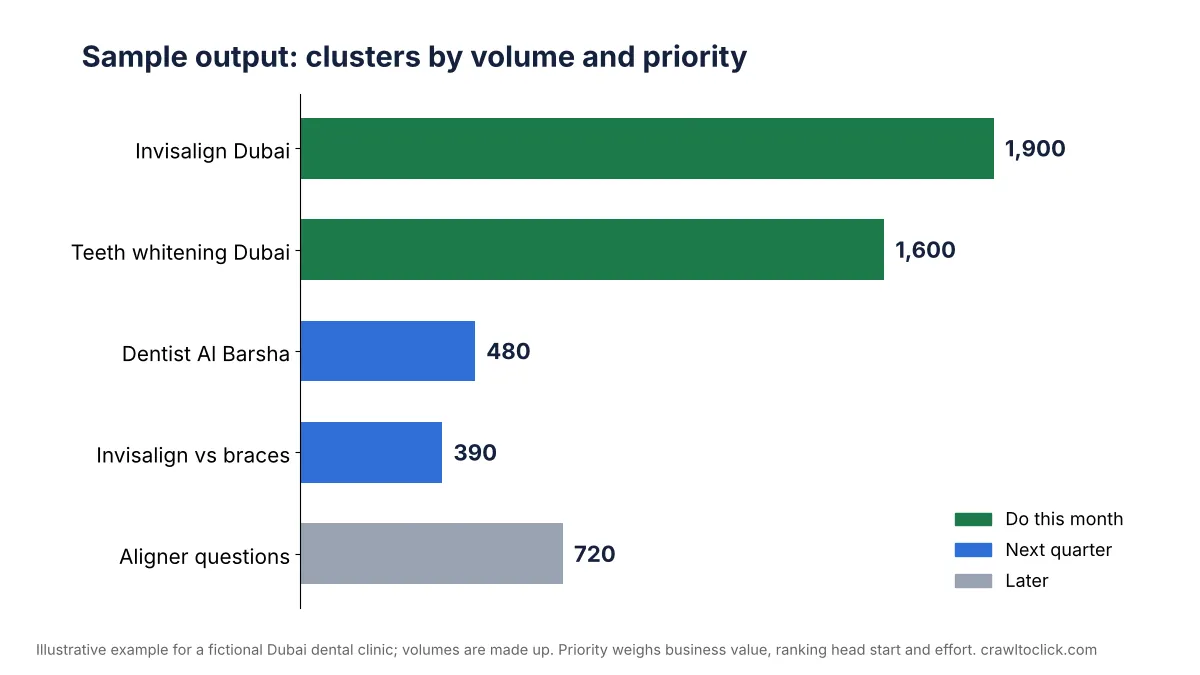
A finished output is one row per cluster with the page type, primary keyword, supporting keywords, combined volume, target URL and priority. The example below is illustrative, for a fictional Dubai dental clinic, with made up volumes.
| Cluster | Page type | Primary keyword | Supporting keywords | Volume (illustrative) | Target | Priority |
|---|---|---|---|---|---|---|
| Invisalign Dubai | Service page | invisalign dubai | invisalign cost dubai, clear aligners dubai | 1,900 | /invisalign/ (optimise) | Do this month |
| Teeth whitening Dubai | Service page | teeth whitening dubai | teeth whitening price dubai, laser teeth whitening dubai | 1,600 | /whitening/ (optimise) | Do this month |
| Dentist Al Barsha | Location page | dentist al barsha | dental clinic al barsha | 480 | New page | Next quarter |
| Invisalign vs braces | Comparison article | invisalign vs braces | aligners or braces for adults | 390 | New page | Next quarter |
| Aligner questions | Guide with FAQs | are aligners painful | how long do aligners take, can you eat with aligners | 720 | Refocused blog post | Later |
The clinic and figures above are illustrative, not a real client. Notice that the largest cluster is not automatically first: “Aligner questions” has more volume than two of the clusters above it but is further from a booking.
How is Claude different from keyword research tools?
Keyword tools measure demand and competition; Claude interprets it. You still need a tool or Google data for volumes and rankings, and most keywords are small: a 2020 Backlinko analysis of 306 million US keywords found 91.8% get 100 or fewer searches a month, yet together they make up only 3.3% of search volume (Backlinko), which is why grouping them into clusters matters more than chasing each one.
| Job | Keyword tool | Claude |
|---|---|---|
| Search volume, difficulty, ranking URLs | Yes | Only through a connector or your export |
| Keyword suggestions | From its database | From your context and examples; needs checking |
| Cleaning by business rules | Basic filters | Flexible, with reasons for each decision |
| Intent labelling | Generic labels | Your own definitions and edge cases |
| Clustering | Fixed method | Semantic, SERP overlap or both, explained |
| Mapping to your pages and prioritising | Limited | Strong, with your page list and goals |
What are the common mistakes with Claude keyword research?
| Mistake | What to do instead |
|---|---|
| Asking Claude for search volumes | Use Keyword Planner, Search Console or an SEO tool |
| Prompts with no examples | Add three to five examples from your own market |
| Examples that are all easy cases | Include brand, near me, Arabic and mixed intent edge cases |
| Accepting clusters without checking results | Check a sample of clusters against live results |
| Pasting 10,000 rows into one message | Upload a CSV and let Claude process it with code |
| Clustering before cleaning | Filter irrelevant keywords first |
| Prioritising by volume alone | Score business value and ranking head start |
| Translating English keywords into Arabic | Research Arabic variants separately and verify volumes |
Once the workflow is stable, you can save it as a reusable skill so every team member runs the same steps; our guide to Claude skills for SEO explains how. For more prompts beyond keyword research, see our Claude prompts for SEO.
How Crawl To Click does keyword research and clustering
Crawl To Click is an SEO and AI visibility consultancy, and our keyword research starts from business fit rather than search volume. We combine Search Console data, keyword tool exports and the language customers use in enquiries and sales calls, use Claude with market specific examples to clean, label and cluster the list, check clusters against live results, and map each one to a page that can convert. Every cluster gets a priority based on how close the searcher is to buying and how quickly we can rank.
We build English and Arabic keyword sets for clinics, software companies, ecommerce stores, property businesses, education providers and professional services firms in the UAE and India, and the output is a page by page plan your team can act on, not a spreadsheet of thousands of terms.
FAQs on keyword research and clustering with Claude
Can Claude give me search volumes for keywords?
No. Claude does not have search volume data and should not be asked to estimate it. Get volumes from Google Keyword Planner, Search Console or an SEO tool, either as an export you upload or through a connector such as the official Semrush app for Claude.
How many examples should I include in a Claude keyword prompt?
Include three to five examples, which is what Anthropic recommends. Make them relevant to your market, varied enough to cover edge cases such as brand, near me and Arabic queries, and wrap each one in example tags.
Is Claude good at keyword clustering?
Claude is good at clustering keywords by meaning and intent when you give it a clear rule and worked examples. For final page mapping on competitive topics, cluster by shared top 10 ranking URLs as well, which Claude can do with code if you supply the results.
What is the difference between semantic and SERP overlap keyword clustering?
Semantic clustering groups keywords that mean the same thing or that one page could satisfy. SERP overlap clustering groups keywords whose top 10 Google results share several of the same URLs, which shows how Google itself treats them.
How many keywords can Claude cluster at once?
Claude can process thousands of keywords when you upload them as a CSV file and code execution is turned on, rather than pasting them into the message. Very long lists are best clustered in batches by topic and then combined.
Can Claude do Arabic keyword research?
Claude can suggest Arabic keyword variants in Modern Standard Arabic, Gulf phrasing and transliterated brand names, especially when given examples. Every Arabic variant still needs its volume checked in Keyword Planner or an SEO tool.
Can Claude replace Ahrefs or Semrush for keyword research?
No. Claude analyses keyword data but does not measure it. It works best alongside an SEO tool or Google data, and both Semrush and Ahrefs offer ways to connect their data to Claude.
Need help turning keyword research into a content plan?
Have a keyword list but no clear plan for which pages to build first? Book a strategy call and get a prioritised, page by page plan.
Disclaimer: Claude features, limits and connectors described here reflect Anthropic, Semrush and Ahrefs documentation as of November 2026 and may change. Keyword volumes in the examples are illustrative. Always verify keyword data in Google or an SEO tool before acting on it.