The short answer: yes, AI generated content can rank on Google. Google does not penalise content because AI wrote it; its ranking systems judge whether a page is helpful, original and trustworthy, and its spam policies target pages mass produced to manipulate rankings, however they are made (Google Search Central). The data adds an important catch: in a 2026 Semrush study of 42,000 blog pages, human written content held position one about eight times more often than AI generated content (Semrush).
So the useful question is not whether AI content can rank, but what kind of AI assisted content ranks, and what gets a site into trouble. This guide sets out what Google has actually said, what the largest studies found, where AI content fails, the extra risks for Arabic and English sites in the UAE, and a workflow and review checklist you can use on every page.
Does AI generated content rank on Google?
AI generated content can and does rank on Google, but mostly when people have shaped, checked and added to it. An Ahrefs analysis of about 600,000 top 20 ranking pages found that 86.5% contained some AI generated content and that the correlation between AI share and ranking position was 0.011, effectively zero (Ahrefs).
The same study found that pages classed as purely AI made up only 4.6% of the sample, and that they rarely reached the top spot. Most ranking pages were a mix of human and AI work (81.9%). In other words, AI involvement is now normal on pages that rank; unedited AI output at the top of the results is not.
What does Google say about AI generated content?
Google’s position, unchanged since February 2023, is that it rewards quality content however it is produced, and that using automation, including AI, to generate content mainly to manipulate rankings breaks its spam policies. In its own words, “Appropriate use of AI or automation is not against our guidelines” (Google Search Central Blog).
Google has added detail over time rather than changing direction. The table below summarises the documents that matter.
| When | Google document | What it says about AI content |
|---|---|---|
| February 2023 | Guidance about AI generated content | Quality matters, not how content is produced; automation used mainly to manipulate rankings is spam |
| March 2024 | Spam policies: scaled content abuse | Generating many pages with AI or other tools without adding value for users is spam |
| April 2024 | March 2024 core update completed | Google said searchers would now see 45% less low quality, unoriginal content |
| 2025 rater guidelines | Search Quality Rater Guidelines, sections 4.6.5 and 4.6.6 | Pages where almost all main content is auto or AI generated with little effort, originality or added value should be rated Lowest |
| October 2026 | Guidance on using generative AI content | Calls it critical to manually fact check and review all AI generated content, including titles, meta descriptions, structured data and alt text, before publishing |
The October 2026 update was dated 1 October and added three sentences explaining that generative models predict likely words rather than retrieve facts, so their output can contain errors (PPC Land). Google did not announce any ranking change with it, but the message is clear: an unchecked AI draft is not ready to publish.
Does Google penalise AI content?
Google does not penalise content for being AI generated, but it does act against scaled content abuse, which its spam policies define as generating many pages for the primary purpose of manipulating search rankings, typically unoriginal content that adds little value, “no matter how it’s created” (Google spam policies).
The policy lists examples, and AI is only one of them:
- Using generative AI tools or other similar tools to generate many pages without adding value for users.
- Scraping feeds, search results or other content to generate many pages, including automated rewording or translation that adds little value.
- Stitching or combining content from different pages without adding value.
- Creating multiple sites to hide the scaled nature of the content.
- Creating many pages that make little sense to a reader but contain search keywords.
Sites caught by this can lose rankings through core updates or receive a manual action in Search Console. The practical line is volume without value: one carefully edited AI assisted guide is not the risk; five hundred templated pages with no original information are. Our guide to programmatic SEO covers how to build pages at scale without crossing that line.
Can Google detect AI generated content?
Google has not said it uses AI detection to rank or demote pages, and its documentation frames enforcement around quality and spam patterns rather than the writing method. Its rater guidelines tell human raters to give the Lowest rating to scaled, unoriginal content even when they are unsure whether generative AI was used (Search Quality Rater Guidelines).
That is a sensible approach, because detection is unreliable. In the Graphite study reported by Axios, the detector used had a 4.2% false positive rate on its test set, and researchers noted that a definitive count of AI content is not possible because people and AI now write together (Axios). For site owners this means two things: an AI detector score is not a ranking factor to optimise, and clean detector scores will not save thin pages.
Rater scores also do not directly change rankings; Google uses raters to evaluate whether its systems are working. But the guidelines show what Google wants its systems to recognise: effort, originality and added value.
What does the data show about AI content rankings?
The largest studies agree on one pattern: some AI involvement is common on ranking pages and is not punished, but mostly AI content is rarer the higher you go in the results, especially at position one.
| Study | Sample | Key finding |
|---|---|---|
| Ahrefs, July 2025 | About 600,000 top 20 ranking pages for 100,000 keywords | 86.5% of ranking pages contained some AI content; 4.6% were purely AI; correlation between AI share and position was 0.011 |
| Graphite, reported by Axios, October 2025 | 65,000 article URLs from Common Crawl | 86% of articles ranking in Google and 82% of articles cited by ChatGPT and Perplexity were human written |
| Semrush, April 2026 | 42,000 blog pages ranking in the top 10 for 20,000 keywords | Human written content was about eight times more likely to hold position one; about 80% of position one pages were human written and about 9% AI generated |
| Graphite follow up, May 2026 | More than 55,000 articles published from 2020 to March 2026 | AI generated articles have held at about half of new articles since around January 2025, and still perform worse in search |
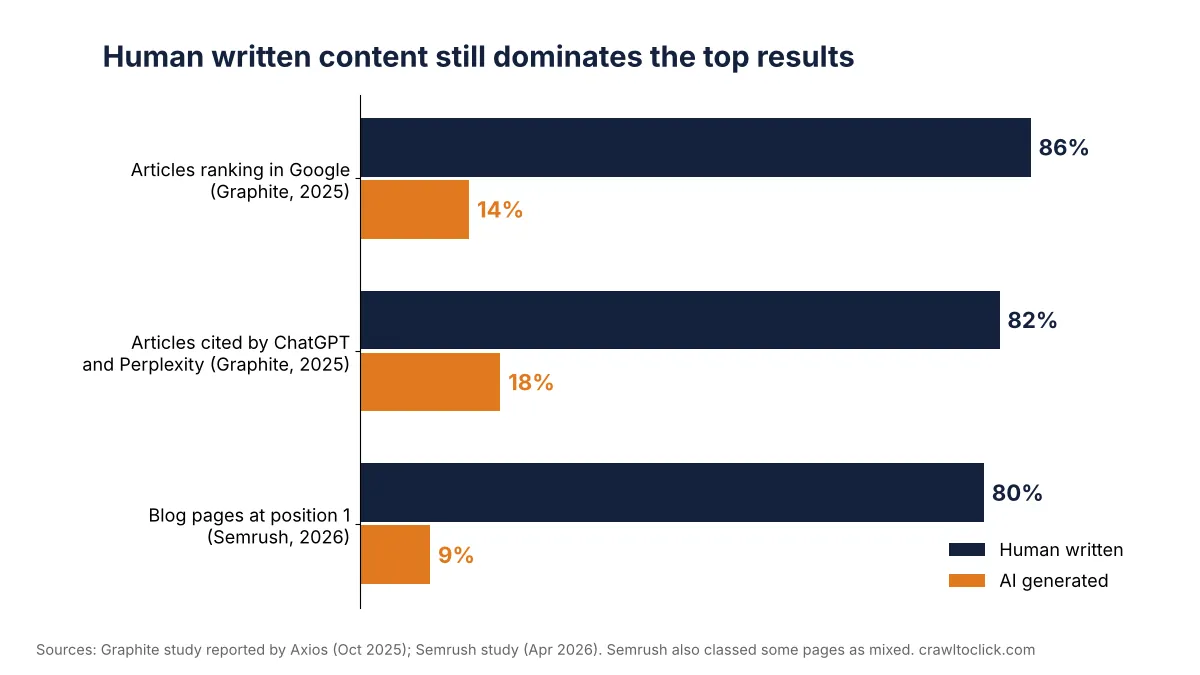
Every one of these studies classifies pages with AI detectors, which deal in probabilities, and each was run by a company that sells SEO or content services. Read them as direction rather than precise measurement. The direction is consistent across all four, though: AI can get a page into the results, but human input is what tends to win the top positions.
Why does AI generated content rank lower at the top?
Unedited AI content tends to rank lower because it repeats what already ranks: a language model predicts the most likely answer from existing text, so its default output contains little new information, no first hand experience and no original data, which are the qualities Google’s helpful content guidance asks for.
Google’s own self assessment questions ask whether content provides original information, reporting, research or analysis, and whether it adds substantial value compared with other pages in the results (Google Search Central). A generic AI draft answers no to both. Google’s Vice President of Search, Liz Reid, made a similar point in 2025: people do not want surface level AI generated content, and what they click from AI Overviews is content that is richer and deeper (Search Engine Journal).
In the audits I run, the AI pages that rank well share three traits: a brief built from real search intent, something the writer knew that the top results did not say, and an editor who removed the filler. The pages that fail usually read like an average of the first page of Google, because that is what they are.
Does AI content get cited in ChatGPT and AI Overviews?
AI generated articles are cited by AI assistants less often than human written ones: in the Graphite study, 82% of articles cited by ChatGPT and Perplexity were written by people and 18% by AI (Axios). AI search rewards the same thing Google search does, which is information an assistant cannot produce on its own.
An answer engine already has the generic explanation. What it needs from your page is a specific figure, a clear definition tied to your brand, a price range, a process or a first hand comparison. That is why entity signals and original facts matter more than word count; our guide to entity SEO for AI search explains how to make your brand the source assistants quote.
When does AI content get a site into trouble?
AI content becomes risky when it is published at volume without review, used on topics that affect health or money, or used to fill pages with nothing new; the risk comes from the pattern, not the tool.
| Use of AI | Risk level | Why |
|---|---|---|
| Research, outlines and briefs | Low | People still decide what goes on the page |
| First drafts edited by a subject expert | Low | Value and accuracy are added before publishing |
| Rewriting or summarising competitor articles | High | Adds nothing new; can fall under scaled content abuse |
| Hundreds of templated location or product pages | High | Classic scaled content pattern unless each page has unique data |
| Machine translated Arabic versions of English pages | High | Automated translation that adds little value is listed in Google’s spam policy |
| Health, finance or legal advice without expert review | High | Errors cause real harm and Google holds these topics to the highest trust standard |
| Unchecked titles, meta descriptions and schema | Medium | Google’s October 2026 guidance asks for the same review as body copy |
If an existing site already has a lot of thin AI pages, the fix is usually to improve, merge or remove them rather than add more. Our content audit guide covers how to make those keep, update, merge or remove decisions page by page.
How should UAE businesses use AI content in Arabic and English?
UAE businesses should use AI to speed up English and Arabic drafting, but never publish machine translated Arabic without a native editor, because Google’s spam policy lists automated translation that adds little value as an example of scaled content abuse (Google spam policies).
Three issues come up repeatedly on bilingual UAE sites:
- Translated, not localised, Arabic. AI translation produces formal Modern Standard Arabic that often misses the terms Gulf searchers type. Search behaviour, not the English page, should decide the Arabic keywords.
- Identical page sets in two languages. Hundreds of English service or area pages copied into Arabic with no local detail double the thin content rather than doubling the reach.
- Regulated sectors. Clinics, insurers, banks, property developers and education providers publish content where an AI error is a compliance problem as well as an SEO one. These pages need a named, qualified reviewer.
For deciding between Gulf dialect and Modern Standard Arabic by page type, see our guide on Gulf Arabic vs MSA for SEO content.
How do you use AI to write content that ranks?
Use AI for speed and people for value: build the brief from real search data, let AI produce the first draft, then add first hand experience and original information, fact check every claim and publish under a named author. The five stages below are the workflow we recommend.
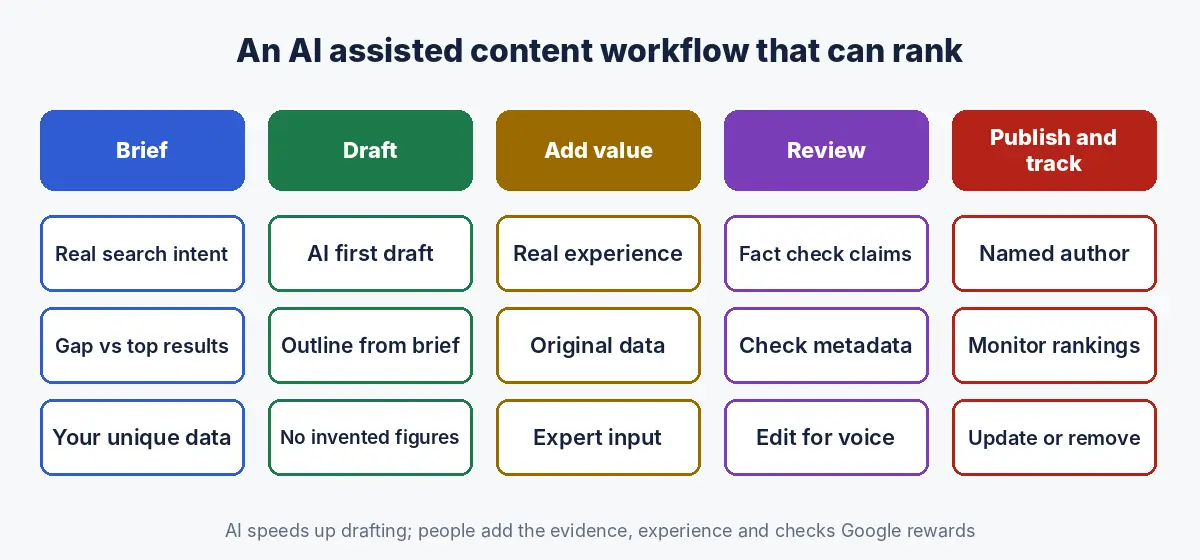
- Brief. Check what ranks and what AI answers say for the query, note what is missing, and list the information only your business has: prices, process, data, cases, local detail.
- Draft. Give the AI the brief, the outline and your source material. Instruct it not to invent statistics, quotes or examples.
- Add value. A subject expert adds experience, opinion, worked examples and original figures. This is the step that separates ranking pages from the rest.
- Review. Check every fact and figure against a primary source, review the title, meta description, schema and alt text, and edit out generic filler.
- Publish and track. Publish under a real author with relevant credentials, track rankings and AI citations, and update or remove pages that do not perform.
If your team uses Claude in this workflow, our guide to Claude for SEO shows how to set up briefs, projects and review steps, and our ChatGPT prompts for SEO include drafting prompts that ask the model to flag gaps instead of filling them.
What should you check before publishing AI assisted content?
Before publishing, confirm that the page adds something the top results do not, that every fact has been checked, and that a real person stands behind it. Copy this checklist into your editorial process:
AI CONTENT PRE PUBLISH CHECKLIST
[ ] The brief came from real search intent, not a keyword alone
[ ] The page contains at least one thing the top 5 results do not
    (original data, first hand experience, worked example, local detail)
[ ] Every statistic links to a primary source
[ ] No invented quotes, case studies, clients or results
[ ] A subject expert reviewed health, money, legal or safety claims
[ ] Title, meta description, schema and image alt text were checked
[ ] Generic filler and repeated points were removed
[ ] Arabic version edited by a native speaker, not just translated
[ ] Named author with a bio relevant to the topic
[ ] Internal links point to related pages on the site
[ ] A review date is set to update or remove the page
Should you disclose that content was written with AI?
Google does not require a disclosure on ordinary web pages, but it suggests that sites which generate content automatically consider telling readers how it was created (Google Search Central). For shopping, Google Merchant Center goes further: AI generated product images need specific image metadata, and AI generated product titles and descriptions must be labelled as such.
For most business sites, the more useful signal is accountability rather than a label: a named author, a reviewer for specialist topics and an about page that explains who is behind the content. Google’s helpful content guidance asks exactly these “who, how and why” questions about any page (Google Search Central).
What does a sample AI content review look like?
A sample AI content review lists each page or page group, the signals of low value AI content, the risk and the action. The example below is illustrative, for a fictional UAE clinic website, not a real client.
| Page group | Pages | What we found | Risk | Action |
|---|---|---|---|---|
| Treatment guides (English) | 40 | AI drafts with no doctor review; two dosage statements unsourced | High | Add qualified medical reviewer; fact check; add named author |
| Treatment guides (Arabic) | 40 | Machine translated from English; formal wording missing Gulf search terms | High | Native editor rewrites priority pages; noindex the rest until done |
| Area pages (Dubai neighbourhoods) | 85 | Same text with area name swapped; no local detail | High | Merge into 6 regional pages with real clinic information |
| Blog posts | 60 | Generic explainers; 18 pages with no clicks in 12 months | Medium | Update 10 with original data; merge or remove the rest |
| Service pages | 12 | Human written; AI used for meta descriptions, some inaccurate | Low | Rewrite metadata; check schema |
The clinic and figures above are illustrative, not a real client. If rankings dropped after an update and you are unsure whether content is the cause, our guide on why a website is not ranking walks through the other likely causes first.
How Crawl To Click approaches AI assisted content
Crawl To Click is an SEO and AI visibility consultancy, and we use AI where it saves time and people where it adds value. Every brief starts from search data and the gaps in what currently ranks and what AI assistants answer; AI helps with research, outlines and first drafts; subject experts add the experience, data and examples a model cannot know; and every figure is checked against a primary source before publishing. We filter topics by conversion potential rather than volume, so we do not publish pages just to fill a calendar.
We apply this to English and Arabic content for healthcare providers, software companies, ecommerce stores, property businesses, education providers and financial services firms in the UAE and India, with native editors for Arabic and qualified reviewers for regulated topics. For sites that already have a lot of AI content, we start with a review like the sample above and fix or remove what is holding the site back before writing anything new.
FAQs on AI generated content and Google rankings
Does Google penalise AI generated content?
No. Google does not penalise content for being AI generated. It penalises scaled content abuse, which is producing many pages mainly to manipulate rankings without adding value for users, whether AI, automation or people made them.
Can AI written content rank on the first page of Google?
Yes. AI assisted content regularly ranks on the first page, and an Ahrefs study of about 600,000 ranking pages found 86.5% contained some AI content. Pages that are purely AI generated rarely reach position one.
Is human written content better for SEO than AI content?
Human input tends to win the top positions. A 2026 Semrush study of 42,000 blog pages found human written content was about eight times more likely to hold position one than AI generated content, although the study shows correlation rather than cause.
Can Google tell if content was written by AI?
Google has not said it uses AI detection in ranking. It evaluates quality and spam patterns regardless of how content was made, and AI detectors themselves produce false positives, so detection scores are not a reliable guide to rankings.
Do I need to disclose AI generated content on my website?
Google does not require disclosure on ordinary web pages but suggests explaining how automatically generated content was created. Google Merchant Center does require AI generated product images and product data to be labelled.
Is it safe to use AI to translate English pages into Arabic for SEO?
Using AI to draft Arabic is fine, but publishing machine translated Arabic without a native editor is risky, because Google’s spam policy lists automated translation that adds little value as scaled content abuse, and translated text often misses the terms Gulf users search for.
How much AI content is too much for SEO?
There is no safe percentage. The risk depends on whether each page adds original value and has been reviewed, not on the share of words AI wrote. A fully reviewed AI draft with original data is safer than a human written page that adds nothing new.
Need help with AI content that is not ranking?
If your site has a lot of AI assisted content and rankings have stalled or dropped, an independent review shows what to fix, merge or remove first. Request an AI content review.
Disclaimer: This article reflects Google documentation and published studies as of the dates stated. Third party studies rely on AI detection tools, which are probabilistic. The sample review is illustrative and does not describe a real business. Results depend on the site, topic and implementation.