The short answer: a B2B case study ranks and converts when it is written for a search buyers actually make, such as an industry plus a problem or a service plus a result, and when it proves a specific outcome with numbers, a clear before and after, the approach taken and who the client was, even if the client cannot be named. Link it from the solution and comparison pages buyers read, and publish the key results openly so search engines and AI assistants can find them.
Case studies carry weight with buyers: 40% of B2B decision makers rated them valuable in Demand Gen Report’s Content Preferences Survey (MediaPost, reporting Demand Gen Report). But trust in vendor content is falling: in TrustRadius’s 2026 research, vendor marketing collateral ranked last among the resources buyers consult, and 47% of buyers trusted online resources less than a year earlier (HG Insights, reporting TrustRadius). Generic success stories no longer persuade. This guide shows how to write case studies that rank, convince and get cited, with a template, examples and a plan for clients who cannot be named. It is part of our B2B SEO guide.
Why do B2B case studies matter for SEO and AI search?
B2B case studies matter because they are the proof behind every claim on your solution, comparison and pricing pages, they can rank for industry and problem searches that solution pages miss, and they give AI assistants specific, quotable results to repeat when buyers ask who has solved a problem like theirs.
| Role of the case study | How it helps |
|---|---|
| Proof on commercial pages | Supports claims on solution, comparison and pricing pages |
| Search entry point | Ranks for industry, problem and result searches |
| Validation during evaluation | Answers “who else like us has done this?” |
| Consensus content | Gives champions evidence to forward internally |
| AI answers | Provides specific results assistants can cite |
Which searches can B2B case studies rank for?
B2B case studies can rank for searches that combine an industry, a problem, a service or a location with words such as case study, example, results or how a company did something, plus your brand name with case study or results.
| Search type | Example (illustrative) | What the case study needs |
|---|---|---|
| Industry plus solution | warehouse management case study 3PL | Industry named in title and opening |
| Problem plus outcome | how a logistics company reduced picking errors | The problem and result in the headline |
| Service plus location | outsourced accounting case study Dubai | Location and service stated clearly |
| Approach example | ERP migration example manufacturing | Steps of the approach, not only the result |
| Brand validation | [your brand] case study, [your brand] results | Brand and result in the title |
Volumes are usually small, so choose case study topics from what buyers ask in deals rather than from tools. The questions prospects ask on calls are the best guide to which stories to write first.
What should a B2B case study include?
A B2B case study should include a results headline, a short summary, who the client is, the situation before, why they chose you, the approach, the measurable results, a client quote, what it cost or took where possible, and a link to the relevant service.
B2B CASE STUDY TEMPLATE
Title: How [client type] [achieved result] with [service or solution]
       Example: How a Dubai 3PL cut picking errors by 38% in four months

1. Results summary (3 bullet points with numbers, above the fold)
2. About the client (industry, size, location, role of the buyer)
3. The situation before (problem, its cost, what they had tried)
4. Why they chose us (alternatives considered, deciding factors)
5. The approach (phases, timeline, who was involved)
6. The results (before and after table, time period, how measured)
7. Client quote (named person and role, or role only if anonymised)
8. What it took (timeline, team, client effort, investment range if allowed)
9. Related service and next step (link to the solution page)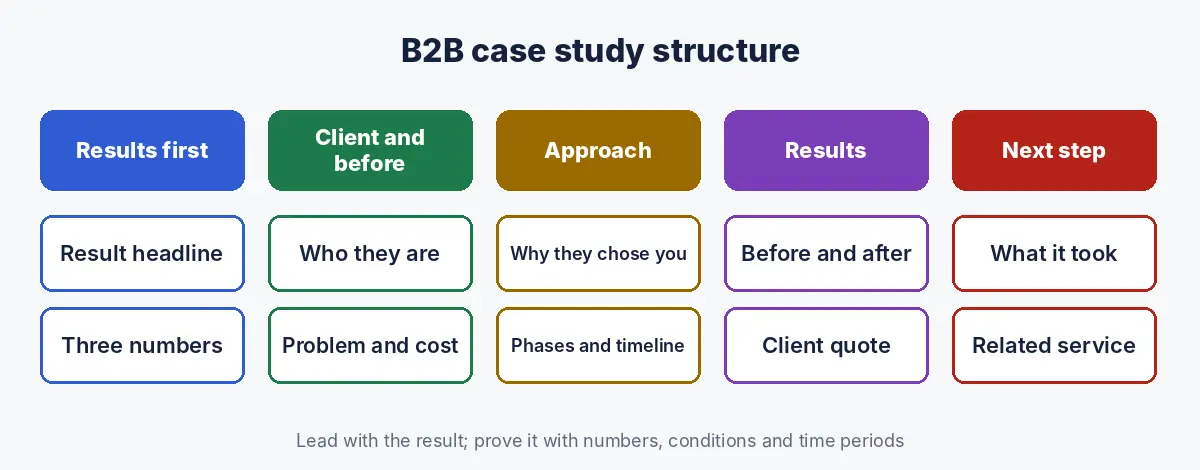
What does a strong B2B case study look like compared with a weak one?
A strong case study states specific results, conditions and time periods; a weak one uses adjectives. The example below is fictional.
| Element | Weak | Strong (fictional) |
|---|---|---|
| Title | Client success story: Logistics | How a Dubai 3PL cut picking errors by 38% in four months |
| Client | A leading logistics company | Third party logistics provider in Jebel Ali, about 120 warehouse staff, serving ecommerce brands |
| Problem | They faced operational challenges | Picking errors of about 2.1% of orders caused returns and penalty charges from two major clients |
| Results | Dramatically improved efficiency | Errors fell from 2.1% to 1.3% of orders; picking time per order down 22%; measured over four months against the previous quarter |
| Quote | “Great team, highly recommended.” | “The penalty charges stopped within two months. That paid for the project.” Operations Director |
Google’s guidance asks whether content provides original information and substantial value compared with other pages (Google Search Central). A case study with real numbers and conditions is original by definition; a vague one is interchangeable with every competitor’s.
How do you write B2B case studies when clients cannot be named?
When clients cannot be named, which is common in the UAE and in regulated sectors, describe the client precisely without identifying them: industry, size band, location, buyer role and situation, with real results and a quote attributed to a role. Specificity makes an anonymised case study credible; vagueness makes it look invented.
| Instead of | Write (illustrative) |
|---|---|
| A leading company | A family owned trading group in Dubai with five business units |
| Significant growth | Organic enquiries rose from about 20 to 55 a month over nine months |
| Our client said | Head of Marketing, the client |
| Recently | Between January and September 2026 |
| Various industries | Healthcare clinics in Abu Dhabi and Dubai |
- Ask early: agree at the start of a project whether results can be published, named or anonymised.
- Get approval in writing for the final text, numbers and quote, even when anonymised.
- Remove identifying details such as unique product names, exact locations or rare combinations that point to one company.
- Keep the numbers real: if exact figures cannot be shared, use percentages or ranges rather than inventing round numbers.
How do you collect measurable results for B2B case studies?
Collect results by recording a baseline before the work starts, agreeing the metrics with the client, measuring at fixed points and noting what else changed in the same period, so the numbers in the case study are defensible.
| Step | What to record |
|---|---|
| Baseline | Metrics before the project, with dates and source |
| Agreed metrics | Two or three outcomes the client cares about, such as cost, time, errors, leads or revenue |
| Measurement points | Same metrics at 3, 6 and 12 months |
| Context | Other changes in the period, such as seasonality, new staff or pricing changes |
| Client sign off | Approval of figures and wording before publishing |
Where should case studies sit on a B2B website?
Put case studies in their own section, filterable by industry and service, and link each one from the solution, industry and comparison pages it supports, with a short results block on those pages that links to the full story.
example.com/case-studies/                        All case studies, filter by industry and service
example.com/case-studies/3pl-picking-errors/     Individual case study
example.com/solutions/wms/                       Results block linking to relevant case studies
example.com/industries/3pl/                      Industry page linking to 3PL case studies
example.com/compare/[brand]-vs-[competitor]/     Proof section linking to switching stories
Our guides to B2B solution pages and comparison pages show where proof blocks fit on those pages.
What structured data should B2B case studies use?
Mark case studies up as articles with Article structured data, which helps Google understand the title, author, dates and images (Google Search Central). There is no special rich result for case studies, and do not add review or rating markup for your own business: Google does not show review snippets for reviews a business publishes about itself (Google Search Central).
<script type="application/ld+json">
{
  "@context": "https://schema.org",
  "@type": "Article",
  "headline": "How a Dubai 3PL cut picking errors by 38% in four months",
  "datePublished": "2026-11-12",
  "dateModified": "2026-11-12",
  "author": { "@type": "Organization", "name": "Your Company" },
  "publisher": { "@type": "Organization", "name": "Your Company" },
  "image": "https://example.com/images/3pl-case-study.jpg",
  "about": "Warehouse management for third party logistics providers"
}
</script>
How do B2B case studies get cited by AI assistants?
Case studies get cited by AI assistants when the result, the client type and the method are stated plainly near the top, when the page is publicly accessible, and when the same story appears elsewhere, such as in the client’s own announcement, an industry article or a LinkedIn post. Forrester recommends refreshing existing case studies and testimonials for AI discovery (Forrester).
- Put the result and client type in the first two sentences.
- Use a before and after table that an assistant can quote.
- Keep the full case study ungated; gate only extras such as a detailed report.
- Encourage the client to share the result on their own channels where they agree.
Our guide to B2B AEO covers the wider steps for appearing in AI shortlists.
How do you get more value from each B2B case study?
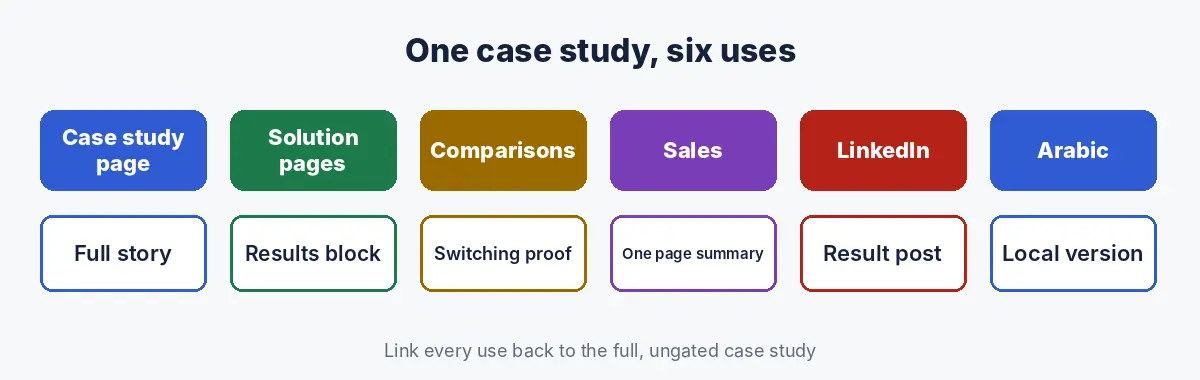
Turn each case study into several assets: a results block on solution and industry pages, proof on comparison pages, a one page summary for sales and champions, a LinkedIn post, a talk or webinar example and, for UAE buyers who read Arabic, an Arabic version. Champions forward these during approval; our guide to content for buying groups covers how.
What does a B2B case study plan look like?
Plan case studies to cover your most important industries, services and buyer objections first. The plan below is illustrative, for a fictional Dubai warehouse software company.
| Priority | Case study | Gap it fills | Target search (illustrative) |
|---|---|---|---|
| 1 | 3PL picking errors | No proof for the main industry | wms case study 3PL |
| 2 | Ecommerce brand peak season | Buyers doubt it handles volume peaks | warehouse software peak season example |
| 3 | Switch from competitor | Comparison pages lack switching proof | [competitor] migration case study |
| 4 | Free zone distributor | No UAE free zone example | inventory system free zone case study |
| 5 | Arabic version of case study 1 | No Arabic proof for local buyers | Arabic industry and solution terms |
Track which case studies are viewed before deals close and which bring new leads; our guide to measuring B2B SEO shows the setup.
What are the common mistakes with B2B case studies?
| Mistake | Fix |
|---|---|
| Vague results without numbers | Before and after figures with time periods |
| Generic titles such as client success story | Put the client type and result in the title |
| Every case study gated behind a form | Publish results openly; gate only extras |
| No link from solution and comparison pages | Add results blocks with links |
| Self serving review markup | Use Article structured data instead |
| Waiting until the end of a project to ask | Agree on publishing and record baselines at the start |
| Inventing round numbers for anonymised clients | Use real percentages or ranges |
How Crawl To Click builds B2B case studies
Crawl To Click is an SEO and AI visibility consultancy, and we plan case studies from the gaps in our clients’ proof: the industries, services and objections where buyers need evidence. We help agree publishing permissions and baselines at the start of projects, write anonymised case studies with precise client descriptions where names cannot be shared, target the industry and problem searches buyers make, and link each case study from the pages it supports.
We do this for B2B software companies, logistics and supply chain businesses, professional services firms, healthcare technology providers, industrial suppliers and education technology companies in the UAE and India.
FAQs on B2B case studies and SEO
Do B2B case studies help SEO?
Yes. Case studies can rank for industry, problem and result searches, support claims on solution and comparison pages, and give AI assistants specific results to cite when buyers ask who has solved a problem like theirs.
What should a B2B case study include?
A results headline, a short summary with numbers, a description of the client, the situation before, why they chose you, the approach, measurable before and after results, a client quote, what the project took and a link to the related service.
How do you write a case study without naming the client?
Describe the client precisely without identifying them, using industry, size, location and buyer role, share real results as figures, percentages or ranges, attribute the quote to a role, remove identifying details and get written approval for the final text.
Should B2B case studies be gated?
No, not the main story. Keep the case study and its results ungated so buyers, search engines and AI assistants can read them, and gate only extras such as a detailed report or template.
What schema should I use for case studies?
Use Article structured data for case studies. There is no special rich result for case studies, and review or rating markup about your own business is not eligible for review snippets in Google.
How long should a B2B case study be?
Long enough to cover the situation, approach and results with evidence, which is often 600 to 1,200 words, with the key results summarised in the first few lines for readers who skim.
How many case studies does a B2B company need?
Start with one case study for each priority industry or service and one for the most common buyer objection, such as switching from a competitor, then add more where deals still lack proof.
Need help turning client results into proof that ranks?
Great client results but case studies nobody finds or believes? Book a strategy call and get a case study plan built around the proof your buyers need.
Disclaimer: Survey figures are from the sources cited. Companies, results and plans in the examples are fictional and illustrative. Always get client approval before publishing results.