A mother in Abu Dhabi asks Gemini, in Arabic, which paediatric clinics near Khalifa City accept her Daman plan and have a female doctor on weekends. Gemini names two clinics and links one of them. A third clinic, five minutes closer, with three female paediatricians and Daman on its insurance page, is not mentioned. Its insurance list is a JPEG, its doctors are listed without specialities, and its Arabic pages say something different from its English ones.
The short answer: AEO for healthcare providers is the work of making your clinic, doctors and services the source that AI assistants such as Google AI Overviews, AI Mode, ChatGPT, Gemini and Perplexity name and cite when patients ask where to get care. In the UAE that means three things together: clear, licence backed facts about each doctor and service, answer first pages in English and Arabic that comply with DHA, DOH and MOHAP advertising rules, and consistent information on Google Business Profile, insurer directories and booking platforms. Clinics rarely win symptom questions, which AI answers from health authorities; they win provider choice questions, such as which clinic, which doctor, what it costs and which insurance is accepted.
What is healthcare AEO?
Healthcare AEO, or answer engine optimization for medical practices, is the application of AEO to clinics, hospitals, diagnostic centres and individual doctors, so that AI generated answers about care in their area mention them accurately and link to their pages.
The principles are the same as in any industry, explained in our guide to what AEO is and how answer engines choose sources. Healthcare adds three constraints. Medical topics are held to a higher standard of trust by Google. Advertising regulators restrict what clinics may claim. And patients act on what they read, so an AI answer that repeats an outdated fee, a doctor who has left or an insurer you no longer accept costs you appointments and trust at the same time.
Why does AEO matter for healthcare providers in the UAE?
AEO matters for UAE healthcare providers because patients increasingly ask AI assistants health and provider questions before they search or call, and the UAE has the highest AI adoption rate in the world.
- More than 230 million people ask ChatGPT health and wellness questions every week, according to OpenAI’s figures at the launch of ChatGPT Health in January 2026 (Becker’s Hospital Review).
- In a study of over 50,000 German language health searches in December 2025, more than 82% triggered a Google AI Overview (eWeek, reporting SE Ranking data). Google said the findings cannot be extrapolated to other regions, but they show how far AI answers already reach into health search.
- 70.1% of the UAE’s working age population used AI in the first quarter of 2026, against a global average of 17.8%, according to the Microsoft AI Diffusion Report (Khaleej Times).
- Google AI Mode is available in Arabic, with the UAE among the countries included in its October 2025 language expansion (Search Engine Roundtable).
- In the US, 45% of consumers now use ChatGPT or other AI tools for local business recommendations, up from 6% a year earlier (BrightLocal).
For a clinic, the patient who asks an assistant for a shortlist and then books is the highest intent patient there is. If you are not on the shortlist, you never see that patient in your analytics.
Which patient questions can a clinic realistically win in AI answers?
Clinics realistically win provider choice questions, such as which clinic or doctor to see, costs, insurance and availability, while general symptom and condition questions are usually answered from health authorities, large medical publishers and video.
This is the single most useful distinction in healthcare AEO, and the one most clinic content plans ignore. Writing a 2,000 word article on “symptoms of thyroid disorder” to compete with national health services and global hospital brands rarely earns a citation. Writing a clear page on “thyroid ultrasound in Dubai: cost, preparation and same day results” often does.
| Question type | Example patient question | Who AI usually cites | Clinic’s chance |
|---|---|---|---|
| Symptom or condition | what causes recurring migraines | Health authorities, large publishers, YouTube | Low |
| Treatment explanation | how does laser treatment for melasma work | Publishers, specialist clinics with detailed pages | Medium |
| Provider choice | dermatologist in Jumeirah who treats melasma | Clinic pages, Google Business Profile, directories, reviews | High |
| Cost | how much is an MRI scan in Dubai without insurance | Clinic and hospital price pages, directories | High if prices are published |
| Insurance | clinics in Al Ain that accept Thiqa for physiotherapy | Clinic insurance pages, insurer directories | High |
| Doctor | female gynaecologist in Sharjah who speaks Malayalam | Doctor profiles, booking platforms | High |
| Logistics | walk in paediatric clinic open Friday evening Abu Dhabi | Google Business Profile, clinic pages | High |
Start your prompt set with the bottom five rows. They are the questions closest to a booking and the ones where accurate facts on your own properties make the biggest difference.
How do AI assistants choose healthcare sources?
AI assistants choose healthcare sources from pages they can retrieve for the question and its related sub questions, weighted towards sources that appear trustworthy on medical topics, which is why named doctors, licences, accurate facts and consistency across sites matter more in healthcare than in most categories.
- Google says its systems give even more weight to experience, expertise, authoritativeness and trust on topics that can affect health, and that such content must be highly accurate and consistent with established expert consensus (Google Search Central).
- Google’s AI features use the same index and eligibility as Search, with no special requirements beyond being indexed and eligible for a snippet, and they may run multiple related searches across subtopics to build an answer (Google Search Central).
- Across industries, 76.10% of pages cited in AI Overviews rank in Google’s top 10 for the query (Ahrefs). In the German health study, only 36% of cited pages appeared in the top 10, and YouTube was the most cited domain at 4.43% of references (eWeek). Health answers draw on a wider and less predictable set of sources, including video.
- Google has pulled AI Overviews from some medical queries after a Guardian investigation in January 2026 found misleading health summaries, including liver test reference ranges shown without context (Euronews). Expect health answers to keep changing as safeguards tighten.
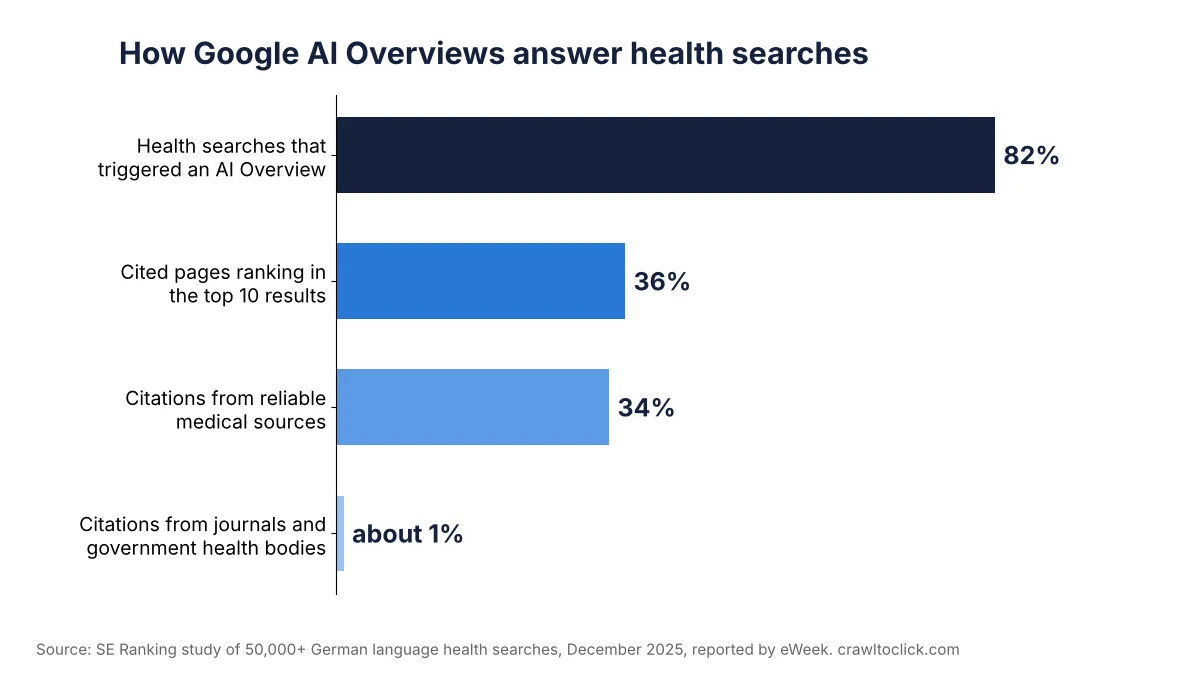
The practical conclusion: build the trust signals into the page itself, publish the provider facts AI cannot find anywhere else, and add video for the treatments patients research most.
How do UAE medical advertising rules affect AEO content?
UAE medical advertising rules affect AEO because the claims on your website and profiles are what AI assistants repeat, so content must avoid the superlatives, guarantees and comparisons regulators ban, and clinics advertising on social media may need a licence.
- The Dubai Health Authority’s Medical Advertising Content Standards for Social Media, reported in September 2026, apply to healthcare facilities, licensed professionals and influencers who promote healthcare content (Gulf Business).
- They ban absolute or exaggerated words including “the best”, “unique”, “the only”, “safest”, “100%”, and promises of guaranteed results such as “assured success”, “miraculous”, “has no side effects” and “immediate results”, and claims that one provider is better or safer than another (Khaleej Times).
- Information must be truthful, accurate, up to date and based on accepted medical practice, and ads for surgical or invasive procedures must show the risks clearly (Khaleej Times).
- Federally, MOHAP issues licences for healthcare advertising on social media accounts, with an application fee of AED 100 and a licence of AED 1,000 a month or AED 3,000 a year, processed in one to three working days (MOHAP).
- Abu Dhabi facilities fall under the Department of Health’s own standards. Check the current version with the regulator or your compliance lead before publishing.
Compliance and AEO pull in the same direction. A sentence such as “the best fertility clinic in Dubai with guaranteed results” is banned and also useless to an answer engine, because it contains no checkable fact. Here is how to rewrite common claims:
| Banned or risky claim | Why AI will not use it well | Compliant, quotable version (illustrative) |
|---|---|---|
| “The best dermatology clinic in Dubai” | Unverifiable superlative | “A DHA licensed dermatology clinic in Jumeirah with four consultant dermatologists, treating acne, melasma and psoriasis.” |
| “Guaranteed results in one session” | Promise regulators prohibit | “Most patients need three to six sessions, four weeks apart; your doctor confirms a plan after assessment.” |
| “Painless, no side effects” | Banned absolute claim | “Common side effects include redness for up to 48 hours. Your doctor explains the risks before treatment.” |
| “Safer than other clinics” | Banned comparison | “Accredited by [named accreditation body], renewed in [year].” |
| “Affordable prices” | No fact to quote | “Consultation from AED [amount]; we accept [named insurers].” |
Our article on SEO and AEO for Dubai clinics under the new DHA advertising standards walks through a full compliant content framework. This article is not legal advice; confirm current rules with your regulator.
How should clinic and doctor information be structured for AI?
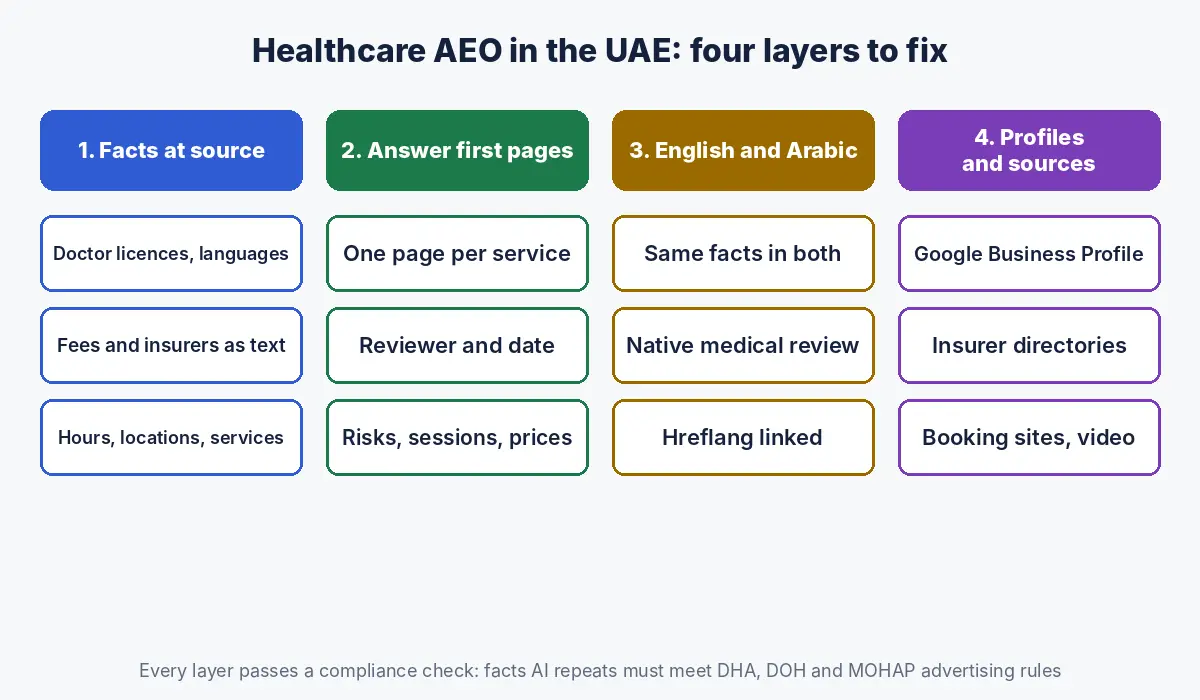
Structure clinic and doctor information as clear entities: one page per doctor and per service, each stating licence, speciality, languages, locations, insurers and fees in plain text, matched by structured data and repeated identically on every profile the clinic controls.
Doctor profile pages for healthcare AEO
Each doctor page should state, in text rather than images: full name and title as licensed, speciality and sub speciality, licensing authority and licence number, qualifications, languages spoken, clinic locations and days, conditions and procedures treated, gender if patients filter on it, and a booking link. Link the licence to the regulator’s public lookup where one exists. This is the information patients ask assistants to filter by, and the information assistants cannot invent.
Service and treatment pages
One page per service, not one page listing twenty. Each page answers, near the top: what it is, who it suits, how many sessions, preparation, recovery, risks, price range, insurers that cover it, and which doctors perform it. Every treatment page should carry a named medical reviewer and a visible last reviewed date.
Structured data for healthcare
Mark up the clinic as a MedicalClinic or MedicalOrganization with address, opening hours and telephone, doctors with Physician or ProfilePage markup, and pages with breadcrumbs. Google lists local business, organisation and profile page among its supported features (Google Search Central), and says structured data should match visible content. Our guide to schema layers for AI search covers MedicalEntity and the other types in detail.
How do you write condition and treatment pages that AI assistants quote?
Write treatment pages that AI quotes by opening every section with a direct, factual answer to the patient’s question, keeping numbers and conditions in the same sentence, and adding the medical reviewer, date and risks on the page itself.
| Section heading (patient question) | Answer first sentence (illustrative) |
|---|---|
| How much does a thyroid ultrasound cost in Dubai? | At our Al Barsha clinic, a thyroid ultrasound costs AED [amount] without insurance, and is covered by [named insurers] with a referral. |
| Do I need to prepare for a thyroid ultrasound? | No fasting or preparation is needed; wear a top that leaves your neck clear, and the scan takes about 15 to 20 minutes. |
| When will I get the results? | A consultant radiologist reports the scan the same day, and your referring doctor receives it by email. |
| Who performs the scan? | Scans are performed by DHA licensed sonographers and reported by [named consultant radiologist]. |
Notice what these sentences have in common: a fact, a condition, a named person or insurer, and nothing an AI would need to guess. Keep FAQs to questions patients really ask your reception team; that list is better research than any keyword tool.
Avoid the patterns that keep clinics out of answers: insurance lists published as images, prices only available by WhatsApp, doctor names without specialities, treatment pages written for search engines with no reviewer, and PDFs as the only source of key information.
How do you handle English and Arabic for healthcare AEO?
Handle English and Arabic as one set of facts in two languages: every fee, insurer, doctor and service must match across both versions, pages should be linked with hreflang, and Arabic content should be written or reviewed by native medical writers rather than machine translated.
Google describes how to signal language versions with hreflang in its localised versions guidance. The AEO risk in the UAE is not missing Arabic pages; it is conflicting ones. In audits I run, the most common healthcare finding is an Arabic site that was translated once and never updated, still listing doctors who left and insurers the clinic dropped. Assistants answering in Arabic draw on those pages and repeat the old facts. Run part of your prompt set in Arabic every month and compare answers with the English results.
How do Google Business Profile, directories and reviews affect AI answers for clinics?
Google Business Profile, insurer directories, booking platforms and reviews strongly affect AI answers for clinics, because provider choice answers draw on these sources to confirm location, hours, services and reputation.
- Keep one Google Business Profile per location, with the correct primary category, services, hours including Ramadan and public holiday hours, and insurers in the description where allowed.
- Check your listing in each insurer’s provider directory. Patients ask assistants which clinics accept their plan, and insurer directories are a natural source for that answer.
- Align names, addresses and phone numbers across booking platforms and health directories with your website exactly.
- Respond to reviews factually and without sharing patient information. Before using reviews or testimonials in your own advertising, check your regulator’s current rules.
When assistants get your facts wrong, correct the source rather than the symptom. Our guide to fixing wrong or outdated facts about your brand in AI answers shows how to trace an error back to the page it came from.
What does a 90 day healthcare AEO plan look like?
A 90 day healthcare AEO plan moves from a baseline of patient questions, through fixing facts and access, to rewriting priority service and doctor pages and building third party presence, with compliance review at each step.
| Phase | Weeks | Work | Output |
|---|---|---|---|
| Baseline | 1 to 2 | Write 30 provider choice questions in English and Arabic; run each three times in ChatGPT, Gemini, Google AI Mode and Perplexity; record mentions, citations and errors | Mention rate and error log |
| Facts and access | 3 to 5 | Fix Google Business Profile, insurer and directory listings; check indexing in Google and Bing; allow AI search crawlers in robots.txt | Consistent facts everywhere |
| Doctor and service pages | 5 to 9 | Rewrite top ten services and all doctor pages into answer first format; add reviewer, dates, prices, insurers, schema; compliance review | Pages ready to be cited |
| Arabic alignment | 8 to 10 | Update Arabic versions to match; hreflang check | Bilingual consistency |
| Third party and video | 9 to 12 | Short explainer videos for top treatments; profiles on the directories AI cites in your category | Wider citation base |
| Measure | 12 | Rerun the baseline; compare mention rate, citations and AI referred bookings | Quarter one report |
OpenAI separates OAI SearchBot, which powers ChatGPT search, from GPTBot, which collects training data (OpenAI), so you can stay visible in ChatGPT answers while opting out of training. Our AEO audit checklist lists every check for the baseline and access phases.
How do you measure AEO results for a clinic?
Measure clinic AEO by mention rate across your patient question set, citations of your pages, accuracy of facts in answers, and bookings and calls that arrive from AI sources.
| Metric | How to measure |
|---|---|
| Mention rate | Share of runs where your clinic or doctors are named, across your fixed question set, in English and Arabic |
| Citations | Bing Webmaster Tools AI Performance report for Copilot; trackers for other assistants |
| Google AI impressions | Search Console generative AI performance reports, rolling out since June 2026 (Google Search Central) |
| Accuracy | Number of factual errors (fees, insurers, doctors, hours) found per month |
| AI referred bookings | Sessions from chatgpt.com, gemini.google.com, perplexity.ai and copilot.microsoft.com in analytics, plus a “how did you hear about us” option that includes AI assistants at reception and in booking forms |
Answers vary from run to run; in research by SparkToro and Gumshoe the same brand list repeated for the same prompt less than once in 100 runs (Search Engine Land). Judge trends over many runs. Our guide to AEO KPIs to report to your CEO shows how to present these to a medical director or board.
What are the most common healthcare AEO mistakes?
| Mistake | Fix |
|---|---|
| Chasing symptom articles to compete with health authorities | Prioritise provider choice, cost, insurance and doctor questions |
| Superlatives and guarantees on service pages | Replace with licences, numbers, sessions, risks and named insurers |
| Insurance lists and prices as images or PDFs | Publish them as text on each service page |
| Doctor pages without speciality, languages or licence | Complete every doctor profile in text, in both languages |
| Arabic pages translated once and never updated | One fact sheet that drives both languages, reviewed quarterly |
| No medical reviewer or date on treatment pages | Named reviewer and last reviewed date on every page |
| Blocking all AI crawlers by default | Allow search crawlers; decide on training crawlers separately |
How Crawl To Click approaches healthcare AEO
Crawl To Click is an SEO and AI visibility consultancy, and in healthcare we treat AEO as an accuracy and compliance project first and a visibility project second. We start with the provider choice questions patients ask in English and Arabic, measure where the clinic and its doctors appear across ChatGPT, Gemini, Google AI Mode, Perplexity and Copilot, and log every wrong fee, insurer, doctor or opening hour. We then fix facts at the source, rebuild doctor and service pages in answer first format with medical review and compliance checks, align structured data and profiles, and add the third party and video sources each specialty relies on. We have worked this way with dermatology and aesthetic clinics, dental practices, fertility centres, physiotherapy and rehabilitation clinics, diagnostic laboratories and multi specialty hospitals, adjusting the question set to how patients choose in each specialty.
FAQs on AEO for healthcare providers
What is healthcare AEO?
Healthcare AEO is answer engine optimization for clinics, hospitals, diagnostic centres and doctors: making sure AI assistants such as Google AI Overviews, ChatGPT, Gemini and Perplexity mention them accurately and cite their pages when patients ask where to get care.
Can a clinic appear in ChatGPT and Google AI Overviews?
Yes. Clinics most often appear in answers to provider choice questions, such as which clinic or doctor to see, costs, insurance and opening hours, when that information is published clearly in text on their website and matches their Google Business Profile and directory listings.
Do UAE medical advertising rules apply to website content used for AEO?
UAE regulators restrict misleading and exaggerated healthcare claims, and the Dubai Health Authority’s 2026 social media standards ban words such as the best and unique, and promises of guaranteed results. Clinics should apply the same standard to website and profile content, and confirm current rules with their regulator or compliance lead.
Which schema should a UAE clinic use for AEO?
A UAE clinic should use MedicalClinic or MedicalOrganization markup for each location, Physician or ProfilePage markup for each doctor, and breadcrumb markup, with every value matching the visible page. Structured data supports consistency; it does not replace clear text.
Should healthcare providers block AI crawlers?
Most clinics should not block AI search crawlers, because that removes them from assistants patients use to choose providers. OpenAI separates its search crawler from its training crawler, so a clinic can allow ChatGPT search while opting out of training.
How long does healthcare AEO take to show results?
Corrected facts on a clinic’s own site and profiles can appear in AI answers within a few weeks, while consistent mentions for competitive provider questions usually take three to six months, depending on rankings, reviews and third party listings.
Does a clinic need Arabic content for AEO in the UAE?
Yes, for most UAE clinics. Assistants answer Arabic questions from Arabic sources, and Google AI Mode is available in Arabic. The Arabic pages must match the English facts exactly, or assistants will repeat outdated information.
Need help with AEO for your clinic?
Want to know what ChatGPT and Google tell patients about your clinic and your doctors, in English and Arabic? Request a healthcare AEO baseline and see where you stand before your competitors do.
Disclaimer: This article is for marketing guidance only and is not legal, regulatory or medical advice. UAE healthcare advertising rules differ by emirate and change over time; confirm current requirements with the relevant regulator. Figures reflect published sources as of the dates stated, and examples are illustrative.