Short answer: AEO usually shows its first measurable changes within 4 to 8 weeks, once fixed pages are recrawled and AI systems start retrieving them. Meaningful gains in how often you are mentioned across your prompt set typically take 3 to 6 months, because off site citations depend on third parties publishing. These timelines are indicative and vary by competition, language and how healthy your site is at the start.
The more useful question for a founder or marketing head is not “how long” but “what should I see, and by when, to know it is working”. This guide gives you the phase by phase timeline, what speeds it up, what slows it down, and a 30, 60 and 90 day checklist you can hold any provider to.
Why AEO results arrive on a different clock than SEO
AI answers come from two places. Some of what a model says about your category is learned during training, which you cannot change on any short timeline. The rest comes from retrieval: when ChatGPT search, Google AI Mode, AI Overviews, Perplexity or Copilot look up live web pages to build an answer. AEO work mostly targets retrieval, which is why it can move faster than people expect.
Retrieval still depends on search indexes being refreshed. Google says that after you request a recrawl, crawling can take anywhere from a few days to a few weeks. So even a perfect page rewrite has a built in delay before any AI system can use it.
The other difference is volatility. A large study by SparkToro and Gumshoe found that when the same prompt was run repeatedly, AI tools returned the same list of brands less than 1 time in 100. That means you cannot judge AEO progress from one screenshot. You judge it from a trend across many prompts over months.
AEO timeline: what happens in each phase
| Phase | Timing | Work done | What you should see |
|---|---|---|---|
| Audit and baseline | Weeks 1 to 3 | Prompt set built, crawler access checked, entity and content gaps listed | A scored baseline and a prioritised fix list |
| Quick technical fixes | Weeks 2 to 4 | AI crawlers unblocked, schema fixed, business details made consistent | Pages accessible to AI systems; no visibility change yet |
| Content restructuring | Weeks 3 to 8 | Key pages rewritten to answer first, FAQs added, gap pages created | First new citations on easier, specific prompts |
| Off site citation work | Months 2 to 4 | Listings, comparison pages, community and press mentions | Brand mentions start appearing in broader shortlist prompts |
| Compounding | Months 4 to 6 and beyond | Ongoing content, citations and monthly prompt reruns | Steadier share of AI answers and AI sourced leads in GA4 |
Notice the pattern: specific, long tail prompts move first, broad “best provider in Dubai” prompts move last. That matches how AI systems work, since narrow questions have fewer strong sources to choose from. For the full scope of each phase, see our guide to AEO services in Dubai.
How long AEO takes by situation
| Your situation | Indicative time to first gains | Why |
|---|---|---|
| AI crawlers were blocked and are now allowed | 2 to 6 weeks | Removing the block unlocks existing content quickly |
| Strong SEO, weak answer formatting | 4 to 8 weeks | Restructured pages are already trusted and indexed |
| Niche B2B or specialist service | 1 to 3 months | Fewer competing sources, so answers are more stable |
| Crowded category such as real estate or healthcare | 4 to 9 months | Many established sources already cited |
| Adding Arabic visibility from scratch | 3 to 6 months | New content, new sources and separate testing |
| New brand with little coverage | 6 months or more | AI systems need third party evidence that you exist |
The niche versus crowded difference is backed by data, not just experience: the same SparkToro study found that smaller markets produced more consistent AI answers than large, crowded categories.
What speeds up AEO results
- Fix crawler access first. If your CDN or robots.txt blocks AI search crawlers, nothing else matters. Our AEO audit checklist covers exactly what to check.
- Request recrawls after every major rewrite. Use the URL Inspection tool in Search Console for your most important pages.
- Use IndexNow for Bing. IndexNow lets you notify Bing and other supporting search engines the moment a page changes, which matters because Bing’s index feeds Microsoft Copilot answers. Many WordPress SEO plugins can switch it on.
- Start with prompts where you are close. If you already appear in one answer out of five, a single strong page can tip it. Start there, not with the most competitive prompt.
- Target sources that are already cited. Getting listed on a page AI systems already use is faster than waiting for a new page to earn trust.
- Keep Google Business Profile current. Corrected hours, services and locations there are one of the quickest fixes for wrong details in AI answers.
What slows AEO down
- Waiting for development. In audits I run, the biggest delay is rarely the AEO work itself. It is schema and template changes sitting in a developer queue for weeks.
- Inconsistent business details. Conflicting names, addresses or services across sources keep you out of answers until they are fixed everywhere.
- Thin or generic content. Pages that say what every competitor says give AI systems no reason to cite you.
- Translated rather than native Arabic. Arabic prompts surface different sources, and machine translated pages rarely become one of them.
- Changing the prompt set. If the tracked prompts change every month, you can never see a trend.
Want a realistic AEO timeline for your category before you commit budget? Book a free strategy call and get one based on your baseline, not a generic promise.
How to measure AEO progress without being misled
Because AI answers shift on every run, the SparkToro researchers recommend measuring how often your brand appears across many prompts and many runs rather than tracking a position. In practice that means:
- Keep the same prompt set for at least six months.
- Run each prompt several times per platform each month, not once.
- Report share of answers, the percentage of runs that mention you, rather than “rank”.
- Separate English and Arabic results.
- Track leading and lagging indicators together, as below.
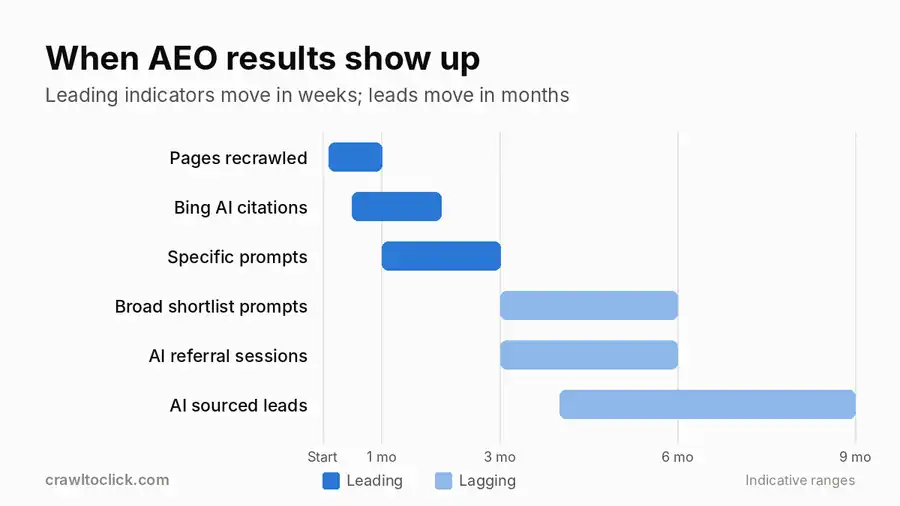
| Indicator type | Metric | When it moves |
|---|---|---|
| Leading | Pages recrawled after fixes | Days to weeks |
| Leading | Citations in Bing Webmaster Tools AI Performance | Weeks |
| Leading | Share of answers on specific prompts | 1 to 3 months |
| Lagging | Share of answers on broad shortlist prompts | 3 to 6 months |
| Lagging | AI referral sessions in GA4 | 3 to 6 months |
| Lagging | AI assisted leads and revenue | 4 to 9 months |
For the tracking setup, see our guide on how to track ChatGPT brand mentions in the UAE.
Your 30, 60 and 90 day AEO checklist
Use this to check whether an AEO programme, in house or outsourced, is on track.
By day 30
- Baseline prompt set agreed and first results recorded in English and Arabic
- AI crawler access confirmed in robots.txt and the CDN
- Business details consistent across site, Google Business Profile and main directories
- Bing Webmaster Tools and IndexNow set up
By day 60
- Top commercial pages rewritten to answer first, with FAQs and valid schema
- Citation gap list built and outreach started
- First movement on specific, long tail prompts
By day 90
- Measurable increase in share of answers across the full prompt set
- First new third party citations live
- AI referral sessions visible and tracked in GA4
- A clear plan for months four to six based on what moved
When slow AEO results are a warning sign
Slow is normal in crowded categories. These are not:
- No baseline after 30 days
- No page changes shipped after 60 days
- Reports that show screenshots instead of share of answers across a fixed prompt set
- A provider that cannot say which prompts moved and why
- Results promised in days, or guaranteed placements
If you are weighing whether the timeline justifies the spend, our guide to AEO pricing in the UAE includes a simple budget method tied to lead value.
How long does AEO take: frequently asked questions
How long does AEO take to show results?
First measurable changes usually appear within 4 to 8 weeks, once fixed pages are recrawled and AI systems retrieve them. Meaningful gains across a full prompt set typically take 3 to 6 months, and longer in crowded categories.
Is AEO faster than SEO?
Parts of it can be. Fixing AI crawler access or restructuring already trusted pages can show results within weeks. Off site citation building and broad shortlist prompts move on a similar timescale to SEO, often several months.
Why do my AI visibility results change every week?
AI answers vary between runs even for the same prompt. Research by SparkToro and Gumshoe found the same brand list repeated less than 1 time in 100. Measure how often you appear across many prompts and runs, not your position in a single answer.
Can I speed up AEO results?
Yes. Fix crawler access first, request recrawls after major rewrites, enable IndexNow for Bing, start with prompts where you already appear sometimes, and target third party pages that AI systems already cite.
When should I expect leads from AEO?
AI referral sessions and leads are lagging indicators. Most businesses see them become measurable in GA4 between months three and six, after share of answers has started to rise.
Need a realistic AEO timeline for your business?
Get an AEO baseline and a 90 day plan with clear milestones, so you know what to expect and when. Request your AEO audit.
Disclaimer: This article is for general information only. Timelines are indicative and vary by industry, competition, language, site health and how quickly changes are implemented. AI platforms change how they retrieve and present answers frequently, and no provider can guarantee placement or timing in AI generated results. Study findings are taken from the third party sources linked above. Information is current as of October 2026. Crawl To Click is not affiliated with Google, Microsoft, OpenAI, SparkToro or any other company mentioned.