A wealth app in Dubai asks ChatGPT, Gemini and Perplexity “what is the best investing app in the UAE?” fifty times. Its competitors appear again and again. When the team opens the cited sources, the pattern is obvious: the same three comparison articles, two Reddit threads, one YouTube review and a regional finance portal feed almost every answer. The app is missing from all seven. It does not have an AI visibility problem in general. It has a seven source problem, and now it knows exactly where to work.
The short answer: citation source mapping means collecting the sources AI assistants cite when they answer your category’s questions, counting which domains and pages appear most often on each platform, and checking which of them mention you and which mention only competitors. Run a fixed prompt set across ChatGPT, Gemini, Perplexity and Google AI Overviews, log every cited URL, classify each by type, then rank the gaps by how often they are cited and how realistic they are to win.
This guide is part of our series on entity SEO for AI search. It gives you the full process, a classification table, a priority score and a playbook for each type of source. Brand names in the examples are imaginary.
Why citation sources decide AI answers
AI answers lean on pages that already rank
When AI assistants search the web before answering, they build the answer from the pages they retrieve. An Ahrefs analysis of 1.9 million citations from 1 million Google AI Overviews found that 76.10% of cited pages ranked in Google’s top 10 for the query. If the pages that rank for your category do not mention you, AI answers built from them will not either.
The most cited domains differ by category
Research by Peec AI on 30 million cited sources across ChatGPT, Google AI Mode, Gemini, Perplexity and AI Overviews in the US (March 2026) found Reddit, YouTube, LinkedIn and Wikipedia at the top of the overall list. The same research notes that rankings differ meaningfully by platform and by industry; in hotels, for example, booking platforms often outrank Reddit. That is why generic “get on Reddit” advice is not enough. You need the map for your own category, market and platforms.
Step 1: choose the prompts to map
Start from buying intents
Use the same prompt set you use to track visibility: around 10 buying intents with three phrasing variants each, covering category, problem and comparison questions. Our guide to measuring LLM mentions per 100 queries explains how to build and freeze that set. Using one set for both jobs means every gap you find links directly to the visibility metric you report.
Match the market you sell in
Citation sources change with location and language. A UAE buyer asking about investing apps will see regional finance portals and Arabic news sites that a US buyer never sees. Run the prompts from your target market and, if you sell to Arabic speakers, add Arabic versions of your top intents.
Step 2: collect citations from each AI platform
Where each platform shows its sources
| Platform | Where to find citations | What to watch for |
|---|---|---|
| ChatGPT | Inline source links and the sources list when web search is used | Answers without search show no sources; log the mode |
| Perplexity | Numbered citations under and inside every answer | Usually the richest citation data per answer |
| Google AI Overviews and AI Mode | Linked cards and inline links in the AI answer | Only appears for some queries; record when it does not |
| Gemini | Source links where the answer draws on web results | Citation coverage varies; note answers with no sources |
| Copilot | Numbered references below the answer | Often overlaps with Bing results |
What to log for every citation
- Date, platform and mode
- Prompt ID
- Full cited URL and its domain
- Whether the cited page mentions your brand
- Which competitors the cited page mentions
- Whether your brand appears in the answer itself
Run each prompt at least three times per platform. Citations vary between runs just like recommendations do, and a source that appears once may be noise, while one that appears in a third of answers is a pillar of your category.
Step 3: classify every cited source
Seven source types
| Source type | Examples | How hard to influence |
|---|---|---|
| Your own site | Product, pricing, comparison and guide pages | Fully in your control |
| Competitor sites | Their comparison and “best tools” pages | Not directly; outrank them instead |
| Editorial lists and reviews | “Best X in the UAE” articles, independent reviews | Medium: outreach, briefings, product access |
| Review and directory platforms | Software review sites, app stores, local directories | Medium: complete profiles, earn reviews |
| Community and forums | Reddit threads, Quora, niche forums | Slow: genuine participation only |
| Video | YouTube reviews and tutorials | Medium: own channel, creator partnerships |
| Reference and news | Wikipedia, regulators, news sites, industry bodies | Hard: needs real news and notability |
A script to group citations by domain
If you log citations in a CSV with a column called url, this short Python script counts how often each domain is cited:
import csv
from collections import Counter
from urllib.parse import urlparse

counts = Counter()
with open("citations.csv", newline="", encoding="utf8") as f:
    for row in csv.DictReader(f):
        host = urlparse(row["url"]).netloc.lower()
        if host.startswith("www."):
            host = host[4:]
        counts[host] += 1

total = sum(counts.values())
for domain, n in counts.most_common(30):
    print(f"{domain}\t{n}\t{n / total:.1%}")
Step 4: build your citation source map
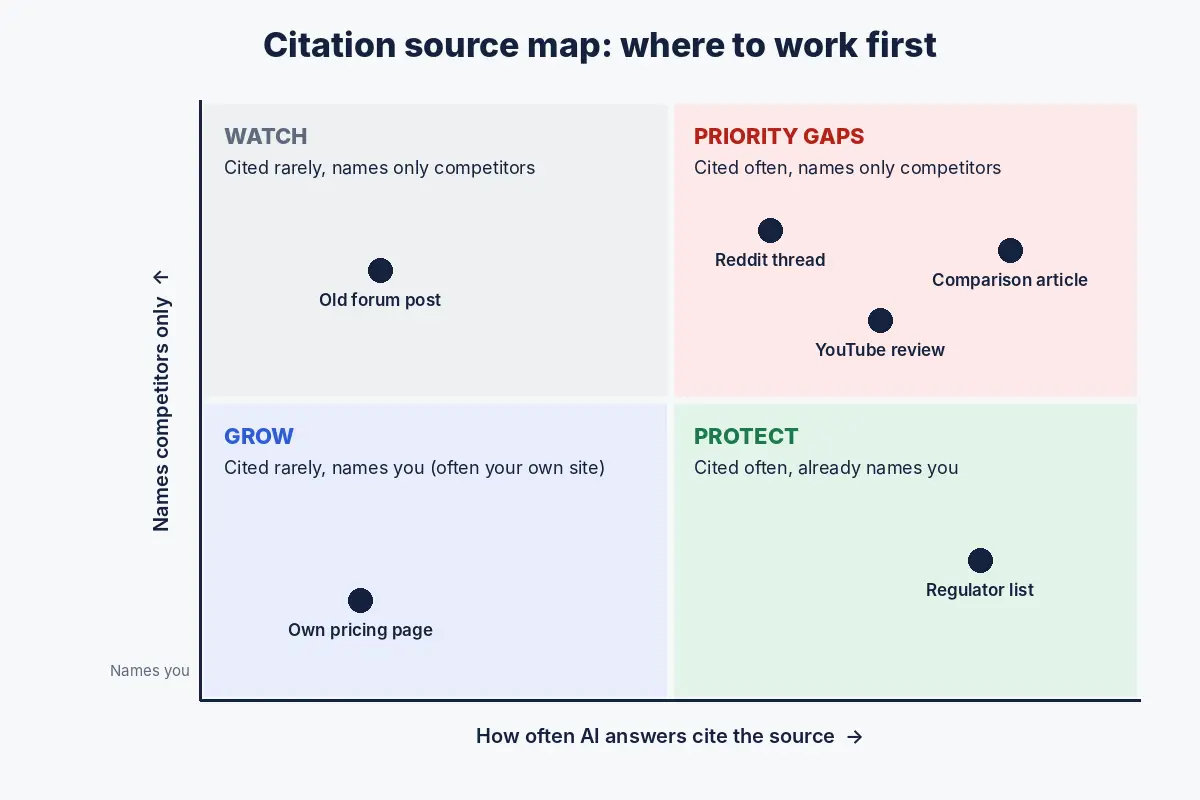
Illustrative example: a wealth app’s map
Marinavest, an imaginary investing app in Dubai, runs 30 prompts three times on four platforms and logs 1,040 citations. The top of its map looks like this:
| Cited source | Type | Share of citations | Platforms | Mentions Marinavest? |
|---|---|---|---|---|
| Regional finance comparison article A | Editorial list | 9% | 4 of 4 | No |
| Reddit thread on UAE investing apps | Community | 7% | 3 of 4 | Once, negatively |
| Competitor’s “best apps” page | Competitor | 6% | 3 of 4 | No |
| YouTube review of five apps | Video | 5% | 2 of 4 | No |
| Regulator’s licensed firms list | Reference | 4% | 4 of 4 | Yes |
| Marinavest pricing page | Own site | 2% | 1 of 4 | Yes |
The map shows three things at once: the comparison article and YouTube review are the biggest gaps, the Reddit thread is actively hurting, and the brand’s own site is barely cited because it has no comparison or guide content for these questions.
Step 5: prioritise the citation gaps
A simple priority score
Score each source that cites competitors but not you on three factors from 1 to 3, then multiply:
- Frequency: 3 if it appears in 5% or more of citations, 2 for 2% to 5%, 1 below 2%.
- Reach: 3 if cited on three or more platforms, 2 for two, 1 for one.
- Winnability: 3 if you can realistically get included within a quarter (an editorial list that updates often, your own content), 2 if it takes longer, 1 if it is unlikely.
Work on sources scoring 18 or above first. In the Marinavest example, the comparison article scores 3 × 3 × 2 = 18, the YouTube review 3 × 2 × 3 = 18, and a new comparison page on its own site scores 1 × 1 × 3 = 3 today but has the most room to grow, so it goes on the roadmap alongside the outreach.
Step 6: act on each type of citation source
Editorial lists and reviews
Find the author and the update cycle. Offer a briefing, product access and a clear fact sheet with current pricing and differentiators. Lists updated quarterly are the easiest wins. Never pay for inclusion without disclosure; it puts both of you at risk with search engines and readers.
Review platforms and directories
Complete every field with the same facts as your brand fact sheet, choose the right category, and run a steady process to ask happy customers for reviews.
Community threads
Answer questions as a named team member, disclose who you work for, and add useful detail rather than promotion. Fix the cause of any negative thread before replying to it. Community presence builds over months, not weeks.
Video
Publish your own walkthroughs and comparisons with clear titles and descriptions that state what the product is, and work with independent reviewers who already cover the category.
Your own site
Look at which of your pages are cited and which questions cite nobody useful. Those questions are your content gaps: honest comparison pages, pricing explained in full, and guides that answer the exact prompts buyers use.
How often to refresh your citation map
- Full map: every quarter, using the same prompt set.
- Top 20 sources: check monthly for new entries and changes in whether they mention you.
- After major model or search updates: run a quick check of your top intents, as cited sources can shift.
For a full review of AI search readiness beyond citations, use our AEO audit checklist.
Common citation mapping mistakes
- Mapping one platform only. Each platform leans on different sources.
- Relying on global “most cited domains” lists. Your category and market will look different.
- Counting domains but not pages. One article on a large publisher matters; the rest of that domain may not.
- Ignoring negative mentions. A cited thread that criticises you is a priority, not a footnote. If it states something false, follow our playbook for fixing wrong brand facts in AI answers.
- Chasing every source. Use the priority score and focus on the few that feed most answers.
How Crawl To Click maps and wins AI citations
Our approach
Crawl To Click is the SEO and AI visibility practice of Indu Priya, with more than 15 years of experience and more than 30 clients across the US, MENA and India. We work across healthcare, ecommerce, BFSI and fintech, beauty, fashion and lifestyle, and B2B software. AI citation insights and targeted outreach are core parts of our AEO work: we map the sources for each client’s category and market, score the gaps, then combine content, outreach, community and entity work to close them. Read more about us.
Results across industries
- B2B marketing software: by combining citation insights with targeted outreach to the sources AI assistants cited, authority citations grew from 4 to more than 15 and community mentions on Reddit doubled from 45 to more than 90. AI assistant mentions rose from 3 to 22 per 100 tracked queries.
- Ecommerce (online furniture and home retail): by prioritising the 100 keywords that drive the most revenue and answering the questions buyers actually ask, search coverage for those keywords grew from 35% to 75%, alongside 6x revenue growth between 2019 and 2022.
- Technical B2B product built from scratch: in a category that is hard to crack, the programme delivered 10x growth in impressions and recurring demos from both Google and ChatGPT.
- Healthcare: for healthcare clients, we add medical schema layers and expert authorship so AI tools can interpret and trust clinical content.
FAQs on citation source mapping
What is citation source mapping?
It is the process of collecting the sources AI assistants cite when answering your category’s questions, counting which domains and pages appear most, and identifying which ones mention competitors but not you.
Which websites do ChatGPT and Perplexity cite most?
Large studies put Reddit, YouTube, LinkedIn and Wikipedia near the top overall, but the mix changes a lot by platform, industry and country. Map your own category to see which sources matter for you.
How many prompts do I need to map citations?
Around 30 prompts covering your main buying intents, each run at least three times per platform, usually gives a clear picture of the sources that feed most answers.
Can I pay to be included in sources AI cites?
Paid placements must be clearly disclosed, and undisclosed paid links can breach search engine policies. Briefings, product access, genuine reviews and useful content are safer and last longer.
How often should I update my citation map?
Run the full map every quarter and check your top 20 sources monthly. Run a quick check after major model or search updates, as cited sources can change.
Need help mapping your AI citation sources?
Want to know exactly which sources feed AI answers in your category, and which ones leave you out? Request a citation source map and get a prioritised list of where to work first.
Disclaimer: Marinavest and all example figures are imaginary. Study findings are summarised from the linked research and may change as AI platforms evolve. Client results come from work led by our founder and depend on market, product and execution.