A Dubai skincare brand runs a dermatology clinic and sells its own product range online. Its website has schema markup, but each page’s markup was added by a different plugin: the home page says it is a “Store”, the clinic page says “LocalBusiness” with a different name, product pages have Product markup with no link to the brand, and the doctors have no markup at all. To a machine, that is four unconnected things. To an AI assistant answering “which Dubai clinics make their own skincare products?”, the brand is hard to describe with confidence.
The short answer: schema layers for AI interpretability means building your structured data as one connected graph rather than isolated snippets. Start with an identity layer (Organization or LocalBusiness), add people (Person), then what you offer (Product, Service, SoftwareApplication), then your content (Article with authors), then industry specific types such as MedicalEntity or FinancialProduct, and connect them all with stable @id references. Schema will not make an AI tool recommend you on its own, but it removes ambiguity about who you are and what you offer, which is what the rest of your AI visibility work depends on.
This is the final guide in our series on entity SEO for AI search. It covers the layer model, a connected JSON LD example, industry layers, validation and a 90 day rollout plan. Brand names in the examples are imaginary.
What schema markup can and cannot do for AI search
What the search engines say
- Google says structured data provides explicit clues about the meaning of a page and recommends JSON LD where your setup allows it.
- Google also says there is no special schema.org structured data you need to add to appear in AI Overviews or AI Mode, while listing structured data that matches visible text among the practices that still matter.
- Microsoft: Fabrice Canel of Bing confirmed that schema markup helps Microsoft’s LLMs understand your content.
The honest position
Schema is not a ranking shortcut for AI answers. It is a clarity layer. It tells search engines, in a format they parse reliably, which entity a page is about, who wrote it, what is being sold and how things relate. When your visible content, your markup and your profiles all say the same thing, AI systems have fewer chances to get you wrong. When they disagree, markup can add confusion rather than remove it.
The six schema layers
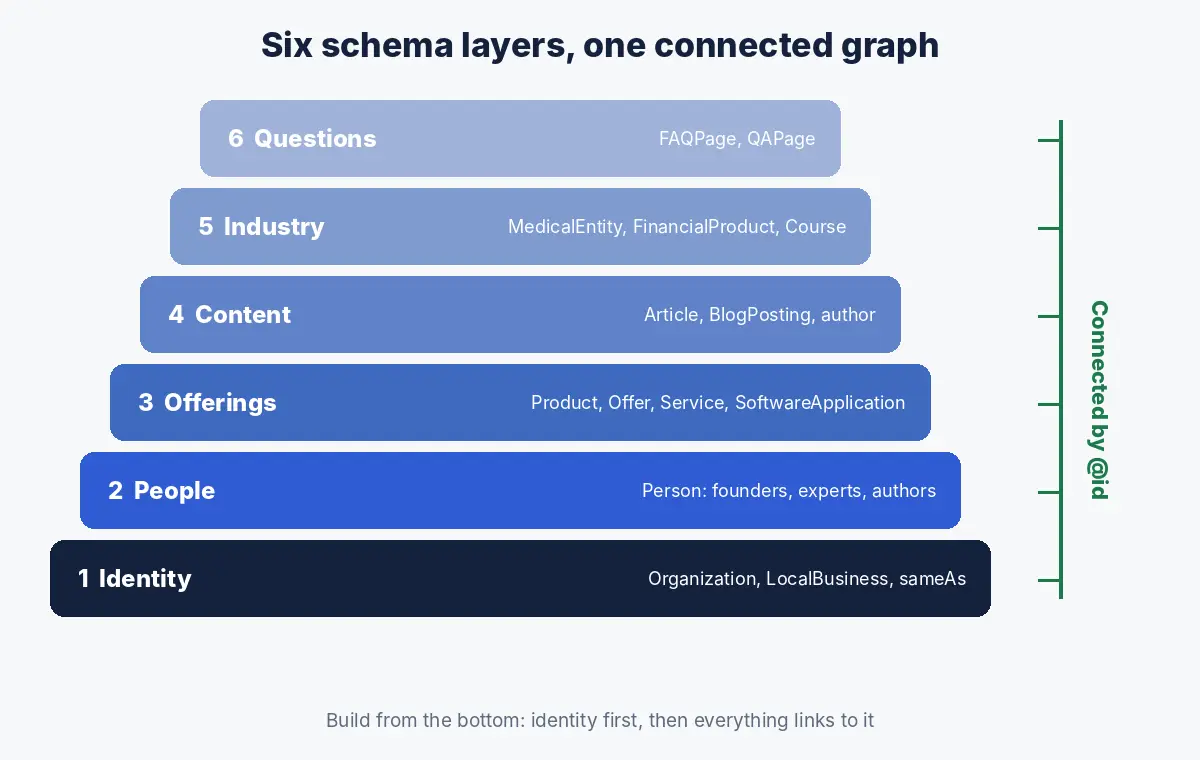
| Layer | Main types | Where it goes | What it clarifies |
|---|---|---|---|
| 1. Identity | Organization, LocalBusiness subtypes, WebSite | Home or About page | Who you are, official profiles, contact details |
| 2. People | Person | Team, author and doctor pages | Founders, experts and authors, linked to the brand |
| 3. Offerings | Product, Offer, Service, SoftwareApplication | Product, service and pricing pages | What you sell, prices, availability |
| 4. Content | Article, BlogPosting, WebPage | Articles and guides | Who wrote it, who publishes it, what it is about |
| 5. Industry | MedicalEntity, FinancialProduct, Course and others | Specialist pages | Domain specific meaning: conditions, procedures, financial products |
| 6. Questions | FAQPage, QAPage | Pages with real FAQs | Direct answers to common questions |
Layer 1: Organization schema as your identity layer
Choose the most specific type
Use the most specific type that is accurate: a clinic is a MedicalClinic or Dentist, a shop with premises is a Store, a software company is an Organization. If you are both, such as a brand with a clinic and an online store, describe the brand as an Organization and each location as its own LocalBusiness that names the Organization as its parentOrganization.
Properties that matter most
name, url, logo, description, sameAs (your official profiles), founder, address and contactPoint. Our guide to building a brand entity with sameAs covers this layer in depth.
Connecting schema layers with @id
Why @id matters
An @id is a stable identifier, usually your URL plus a fragment such as #organization. When every page refers to the same @id, all your markup describes one entity instead of many lookalikes. This is the single most common gap in the audits I run: sites with plenty of markup and no connections between it.
A connected graph example
<script type="application/ld+json">
{
  "@context": "https://schema.org",
  "@graph": [
    {
      "@type": "Organization",
      "@id": "https://www.example.com/#organization",
      "name": "Saffa Skin",
      "url": "https://www.example.com/",
      "logo": "https://www.example.com/logo.png",
      "description": "Saffa Skin is a Dubai dermatology clinic and skincare brand.",
      "founder": { "@id": "https://www.example.com/team/drlina/#person" },
      "sameAs": ["https://www.linkedin.com/company/example"]
    },
    {
      "@type": "MedicalClinic",
      "@id": "https://www.example.com/clinic/#clinic",
      "name": "Saffa Skin Clinic Jumeirah",
      "parentOrganization": { "@id": "https://www.example.com/#organization" },
      "medicalSpecialty": "Dermatology",
      "address": {
        "@type": "PostalAddress",
        "addressLocality": "Dubai",
        "addressCountry": "AE"
      }
    },
    {
      "@type": "Person",
      "@id": "https://www.example.com/team/drlina/#person",
      "name": "Dr Lina Haddad",
      "jobTitle": "Consultant Dermatologist",
      "worksFor": { "@id": "https://www.example.com/#organization" }
    },
    {
      "@type": "Product",
      "@id": "https://www.example.com/serum/#product",
      "name": "Saffa Barrier Repair Serum",
      "brand": { "@id": "https://www.example.com/#organization" },
      "offers": {
        "@type": "Offer",
        "price": "189",
        "priceCurrency": "AED",
        "availability": "https://schema.org/InStock"
      }
    }
  ]
}
</script>
In practice, each node lives on its own page (the clinic on the clinic page, the product on the product page), and each page references the others by @id. The example puts them together only to show the connections.
Layer 2: Person schema for experts and authors
Give every founder, author and practitioner a profile page with Person markup: name, jobTitle, worksFor (pointing to your organisation @id), sameAs (their professional profiles), and for regulated professionals, their qualifications in visible text. Reference that Person @id as the author of every article they write. This is how expertise becomes machine readable.
Layer 3: Product, Service and SoftwareApplication schema
Products
Google’s Product structured data documentation covers name, image, description, brand, offers (price, currency, availability) and reviews. Always connect brand to your Organization @id, and keep prices identical to the visible price on the page.
Services and software
Service businesses can use Service with provider, areaServed and serviceType. Software companies can use SoftwareApplication with applicationCategory, operatingSystem and offers. Either way, the description should match the one sentence definition in your brand fact sheet.
Layer 4: Article schema for your content
Mark up guides and blog posts with Article or BlogPosting, including headline, author (your Person @id), publisher (your Organization @id), datePublished and dateModified. Accurate modified dates matter: they help search engines and AI tools see when content was last refreshed.
Layer 5: MedicalEntity and other industry schema
Healthcare
Schema.org defines MedicalEntity as the most generic type of entity related to health and the practice of medicine. Its subtypes let clinics describe what they treat and how: MedicalCondition, MedicalProcedure, MedicalTest, Drug and more. Combine them with MedicalClinic or Physician for the provider and MedicalWebPage for content, using properties such as reviewedBy and lastReviewed to show clinical review. Our guide to clinic SEO in Dubai covers the compliance side.
Other industries
| Industry | Useful types | Key properties |
|---|---|---|
| Healthcare | MedicalClinic, Physician, MedicalProcedure, MedicalCondition, MedicalWebPage | medicalSpecialty, availableService, reviewedBy |
| Ecommerce | Product, Offer, AggregateRating, MerchantReturnPolicy | brand, price, availability, return policy |
| Fintech and banking | FinancialProduct, LoanOrCredit, BankAccount, FinancialService | provider, interestRate, feesAndCommissionsSpecification |
| B2B software | SoftwareApplication, Offer | applicationCategory, operatingSystem, offers |
| Education | Course, EducationalOrganization | provider, educationalCredentialAwarded |
| Real estate | RealEstateAgent, Place, Offer | areaServed, address |
Layer 6: FAQPage schema after the 2023 changes
In August 2023, Google announced that FAQ rich results would only be shown for well known, authoritative government and health websites, and limited HowTo rich results to desktop. Google also said that structured data that is not used does not cause problems and that there is no need to remove it. My view: keep FAQPage markup on pages with genuine FAQs, because it describes real question and answer content clearly, but do not add FAQs just to carry markup.
Schema rules that protect your AI visibility
- Match the visible page. Every name, price, date and claim in markup must appear on the page. Google’s general structured data guidelines require markup to represent the page’s main content.
- One plugin, one graph. Multiple plugins outputting overlapping markup create conflicting entities. Choose one source and disable the rest.
- No invented reviews or ratings. Mark up only genuine reviews that are visible on the page.
- Keep it current. Update markup in the same release as price, address or team changes.
How to validate your schema layers
- Test key templates in Google’s Rich Results Test and the Schema Markup Validator.
- Check the enhancement reports in Search Console for errors and warnings.
- Crawl the site with an SEO crawler that extracts structured data, and check that every page uses the same Organization @id.
- Compare markup values with the visible page for price, address and names on a sample of pages each quarter.
- Ask AI assistants what your brand is and what you sell, and check whether the answers reflect the facts in your markup.
Schema is one part of AI readiness; our AEO audit checklist covers the rest.
A 90 day schema rollout plan
| Period | Work |
|---|---|
| Days 1 to 30 | Audit existing markup, remove duplicates, build the identity layer with a stable @id, add Person markup for founders and authors |
| Days 31 to 60 | Add Product, Service or SoftwareApplication markup to every offering page, and Article markup with authors to all content |
| Days 61 to 90 | Add industry layers such as MedicalEntity or FinancialProduct, FAQPage on genuine FAQ pages, then validate and set up quarterly checks |
Common schema mistakes
- Different organisation names across pages (“Saffa Skin”, “Saffa Skin LLC”, “Saffa Clinic”).
- Product markup with no brand, or a brand written as plain text instead of linked to the Organization.
- Author markup pointing to a generic “Admin” user.
- Prices in markup that no longer match the page.
- Medical or financial claims in markup that are not on the page or not approved by compliance.
How Crawl To Click implements schema layers
Our approach
Crawl To Click is the SEO and AI visibility practice of Indu Priya, with more than 15 years of experience and more than 30 clients across the US, MENA and India. Schema layers are part of the “engineer the system” stage of our method: alongside topical hubs, internal linking and answer first page formats, we implement Organization, FAQ, MedicalEntity and other schema layers so AI tools can interpret each client’s content, then monitor crawl stats, index coverage and Core Web Vitals. Read more about us.
How it applies across industries
- Healthcare: MedicalEntity, clinic and physician markup with expert review, so clinical content and providers are clearly connected.
- Ecommerce (online furniture and home retail): a fast, stable site, improved product page elements and content answering real buyer questions supported coverage of the top 100 revenue keywords rising from 35% to 75%, and 6x revenue growth between 2019 and 2022.
- B2B software: entity and schema work formed the foundation of a programme that took AI assistant mentions from 3 to 22 per 100 tracked queries.
- Technical B2B product built from scratch: a scalable technical and programmatic setup supported 10x growth in impressions and recurring demos from Google and ChatGPT.
- Fintech, beauty, fashion and lifestyle: product and organisation layers tailored to each category’s offerings and compliance needs.
FAQs on schema for AI search
Does schema markup help with ChatGPT and AI Overviews?
It helps search engines understand your content clearly. Microsoft has said schema helps its LLMs understand content, while Google says no special schema is needed for AI Overviews. Treat schema as a clarity layer that supports your AI visibility, not a shortcut.
What schema should every business have?
At minimum, Organization or the right LocalBusiness subtype with sameAs links on your home or about page, Person markup for founders and authors, and Product, Service or SoftwareApplication markup on offering pages.
What is MedicalEntity schema?
MedicalEntity is the schema.org type for anything related to health and medicine. Its subtypes, such as MedicalCondition and MedicalProcedure, let healthcare providers describe what they treat and how.
Is FAQ schema still worth adding?
Since 2023, Google shows FAQ rich results mainly for authoritative government and health sites. FAQPage markup still describes genuine question and answer content clearly, so keep it where real FAQs exist, but do not add FAQs only for markup.
What does @id do in schema markup?
It gives an entity a stable identifier, so markup on different pages can refer to the same organisation, person or product. This connects your schema into one graph instead of many unconnected snippets.
Need help with schema for AI search?
Plenty of markup but no connected graph, or conflicting plugins fighting over your entity? Request a schema audit and get a layered plan your developers can implement.
Disclaimer: Saffa Skin, Dr Lina Haddad and all example URLs and prices are imaginary. Search engine guidance summarised here comes from the linked documentation and may change. Client results come from work led by our founder and depend on market, product and execution.