A buyer asks ChatGPT, “Which accounting software suits a 20 person firm in Dubai?” The answer names three products and links two sources. Your product ranks on page one of Google for that exact topic, yet it is not in the answer. Closing that gap is what GEO is about.
The short answer: GEO, or generative engine optimization, is the practice of making your brand and content more likely to be retrieved, cited and recommended in answers produced by AI systems such as ChatGPT, Google AI Overviews and AI Mode, Gemini, Perplexity and Copilot. It builds on SEO rather than replacing it: AI answers draw heavily on pages that already rank, but GEO adds work on quotable content, consistent brand facts and the third party sources AI tools rely on.
What is GEO (generative engine optimization)?
The term comes from a research paper, GEO: Generative Engine Optimization, by Pranjal Aggarwal, Vishvak Murahari and colleagues, first published in November 2023 and presented at the ACM KDD conference in 2024. The authors defined generative engines as systems that retrieve sources and then generate a single synthesised answer, and GEO as the methods content creators can use to improve their visibility in those answers.
In practice, GEO today covers three outcomes:
- Citation: your page is linked as a source in the AI answer.
- Mention: your brand is named in the answer, with or without a link.
- Accurate description: what the answer says about you (what you do, price, location, strengths) is correct.
Why GEO matters now
- ChatGPT reached 1 billion weekly active users in August 2026 (Yahoo Tech).
- Google AI Overviews passed 2.5 billion monthly users and AI Mode 1 billion (Google, I/O 2026).
- ChatGPT’s share of generative AI web visits fell from about 76% to about 53% in a year as Gemini and Claude grew (Similarweb), so visibility now has to be earned across several assistants.
- At Ahrefs, AI search sent 0.5% of visitors but 12.1% of signups over 30 days (Ahrefs).
- In the US, 45% of consumers now use ChatGPT or other AI tools for local business recommendations, up from 6% a year earlier (BrightLocal, 2026).
The commercial point: AI answers shortlist brands before the buyer ever visits a website. If you are missing from the answer, you are missing from the shortlist.
GEO vs SEO vs AEO: what is the difference?
| SEO | AEO | GEO | |
|---|---|---|---|
| Stands for | Search engine optimisation | Answer engine optimisation | Generative engine optimisation |
| Goal | Rank pages and earn clicks | Be the direct answer to a question | Be cited, mentioned and described accurately in AI generated answers |
| Main surfaces | Google and Bing results pages | Featured snippets, voice, AI answers | ChatGPT, AI Overviews, AI Mode, Gemini, Perplexity, Copilot |
| Success measure | Rankings, clicks, conversions | Answer ownership | Mention rate, citations, accuracy, AI referrals |
| Main levers | Relevance, technical health, links | Concise answers, structure | SEO plus quotable content, consistent brand facts, third party mentions |
In practice the terms overlap heavily, and many teams use AEO and GEO interchangeably. What matters is the work, not the label. We cover the overlap in more depth in AEO vs SEO and is GEO replacing SEO.
How generative engines choose what to cite
Most AI search systems work in two steps: they retrieve sources, usually through a search index, and then generate an answer from what they retrieved, alongside what the model learned in training. That has four practical consequences:
- Ranking still matters. Ahrefs found that 76.10% of pages cited in Google AI Overviews also rank in the top 10 for the query.
- The engine searches more than the user typed. Google says AI Overviews and AI Mode may use “query fan out”, issuing multiple related searches across subtopics, to build a response (Google Search Central). Pages that rank for those related questions get more chances to be cited.
- Third party sources carry weight. Across 30 million cited sources, community, video and professional platforms such as Reddit, YouTube and LinkedIn were among the most cited domains (Peec AI). What others say about you feeds the answer.
- Answers vary. In research by SparkToro and Gumshoe, the chance of an AI tool giving the same list of brand recommendations twice was under 1 in 100 (Search Engine Land). GEO is about raising the probability of being included, not owning a fixed position.
What the GEO research found
The original GEO paper tested nine content changes on a benchmark of 10,000 queries, called GEO bench. Its headline findings (Aggarwal et al., summarised by Everything PR):
- Optimising content raised a source’s visibility in generative engine answers by up to 40%.
- The most effective changes were adding citations to sources, adding quotations from relevant experts and adding statistics.
- In tests on Perplexity, a live engine, gains reached up to 37%.
Treat these as directional. The experiments ran on a 2023 benchmark, and today’s engines change often. But the lesson has held up in the audits I run: pages that state specific, sourced facts in clear sentences get quoted more often than pages that circle the topic.
GEO strategies: how to do generative engine optimization
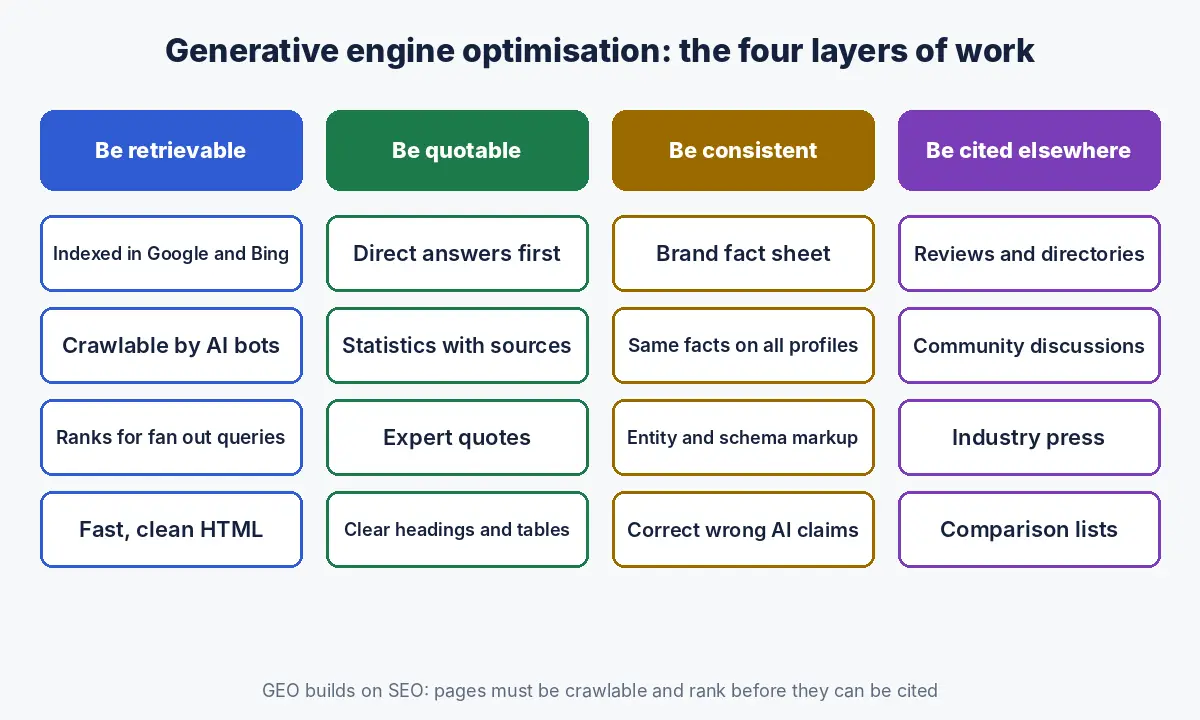
1. Make sure AI systems can retrieve your pages
- Check your pages are indexed in both Google and Bing; Bing results feed Microsoft Copilot and other assistants.
- Review robots.txt so you are not unintentionally blocking AI crawlers you want to be found by, such as the crawler OpenAI uses for ChatGPT search.
- Make sure key content is in the HTML, not only loaded by JavaScript after the page renders.
- Remember Google’s own position: there are “no additional requirements” to appear in AI Overviews or AI Mode beyond being indexed and eligible for a snippet (Google Search Central).
2. Write content that is easy to quote
- Answer the main question in the first two or three sentences.
- Use specific numbers with sources, named experts and dated facts.
- Use descriptive headings that match the questions buyers ask, and tables for comparisons.
- Cover the related questions an engine is likely to fan out to: pricing, alternatives, use cases, risks.
3. Keep your brand facts consistent everywhere
- Publish a clear fact sheet: what you do, who you serve, where, pricing approach and proof. Our guide to a brand fact sheet for LLMs has a template.
- Make your website, Google Business Profile, LinkedIn, directories and review sites say the same thing.
- Add Organization, Product or LocalBusiness schema that matches the visible page.
4. Earn mentions on the sources AI tools use
- Find which pages are cited when you ask your category questions, and work to be included on them.
- Build genuine reviews on the platforms buyers trust in your market.
- Take part in community discussions and industry press where your buyers already are.
- Get listed accurately in comparison and “best of” articles that answers draw on.
5. Measure, fix and repeat
Run the same set of buyer questions every month, several times each, and record whether you are mentioned, how you are described and which sources are cited. Then fix the gaps in order of business value.
GEO examples: what changes in practice
These illustrative examples show the kind of gap GEO work closes. The businesses are imaginary; the patterns are ones I see repeatedly.
| Business | Before | GEO fix | Expected effect |
|---|---|---|---|
| Dental clinic in Dubai | AI answers list three competitors; clinic missing despite strong reviews | Consistent name, address and services across directories; service pages with prices and doctor credentials; review replies | More frequent mentions for “best dental clinic in [area]” questions |
| B2B software company | ChatGPT describes the product with a pricing model it dropped two years ago | Updated pricing page, fact sheet, corrected profiles on review sites | Accurate descriptions in answers about pricing |
| Online fashion retailer | Category pages rank but are never cited | Buying guides with sizing data, materials and care facts in tables | Citations for “how to choose” and comparison questions |
| Property developer | AI answers rely on a forum thread with outdated handover dates | Project pages with dated milestones; updates on the portals answers cite | Answers reflect current project status |
How to measure GEO
| Metric | How to track it | Tool |
|---|---|---|
| Mention rate | Share of runs where your brand appears, across a fixed prompt set, run several times | Manual sampling or an AI visibility tracker |
| Citations | How often your pages are linked as a source | Bing Webmaster Tools AI Performance report for Copilot and Bing; trackers for other assistants |
| Accuracy | Errors in how answers describe your brand | Monthly review against your fact sheet |
| AI referrals and conversions | Sessions and key events from chatgpt.com, perplexity.ai, gemini.google.com and copilot.microsoft.com | Google Analytics 4 |
| Google AI features | Impressions in AI Overviews and AI Mode, by page, country and device, in the new generative AI performance reports (rolling out to a subset of sites since June 2026); also included in overall Performance totals | Google Search Console |
Single screenshots prove nothing, because answers vary between runs. Measure frequency across many prompts and runs, as explained in our guide to LLM mentions per 100 queries.
Common GEO myths
- “GEO replaces SEO.” Most cited pages already rank. Weak SEO usually means weak GEO.
- “You need special files or markup to appear in AI answers.” Google says no special optimisation is required for its AI features. Schema helps machines understand your content, but it does not guarantee citation.
- “Stuffing keywords or prompts into pages works.” The GEO research found the gains came from credible additions such as sources, quotations and statistics, not from manipulation.
- “One good answer means you have won.” Answers change between runs, days and assistants; track trends, not single results.
Who needs GEO, and when to start
| Situation | Priority | First step |
|---|---|---|
| Buyers research before contacting you (B2B, healthcare, property, education, high value ecommerce) | High | Audit 20 buyer questions across ChatGPT, Gemini and AI Overviews |
| Your SEO foundations are weak (pages not indexed, little ranking content) | Fix SEO first | Technical and content basics; GEO builds on them |
| Local service business | Medium to high | Consistent profiles, reviews and service pages |
| Impulse purchases or brand led categories | Lower | Monitor brand accuracy quarterly |
For small businesses in the UAE, our GEO checklist turns this into a step by step list.
How Crawl To Click approaches GEO
Crawl To Click is an SEO and AI visibility consultancy, and we run GEO and SEO as one programme rather than two. Each engagement starts with the questions buyers actually ask before they purchase, tested repeatedly across ChatGPT, Gemini, Google’s AI features, Perplexity and Copilot. We record where the brand appears, how it is described and which sources the answers rely on, then prioritise fixes by business value: the pages that need to rank for fan out questions, the facts that need correcting, and the third party sources worth earning a place on. We have applied this in software, healthcare, real estate and ecommerce, and report progress as mention rate, accuracy and AI driven conversions alongside organic search. Learn more about our approach.
FAQs on GEO
What does GEO stand for in marketing?
GEO stands for generative engine optimization: improving how often and how accurately your brand and content appear in answers generated by AI systems such as ChatGPT, Google AI Overviews, Gemini, Perplexity and Copilot.
Is GEO the same as SEO?
No, but it builds on SEO. AI answers rely heavily on pages that already rank, so SEO is the foundation. GEO adds quotable content, consistent brand facts and mentions on the third party sources AI tools cite.
What is the difference between GEO and AEO?
AEO, answer engine optimisation, focuses on being the direct answer to a question, including featured snippets and voice. GEO focuses on generative AI answers. The practices overlap and many teams use the terms interchangeably.
How long does GEO take to show results?
Fixes to brand facts and on page content can show in AI answers within weeks for systems that search the web live, while changes that depend on earning third party mentions or ranking improvements usually take months.
How do you measure GEO?
Track mention rate across a fixed set of buyer prompts run several times, citations (for example in Bing Webmaster Tools’ AI Performance report), accuracy against your brand facts, and AI referral sessions and conversions in analytics.
Who coined the term GEO?
The term was introduced in the research paper GEO: Generative Engine Optimization by Pranjal Aggarwal and colleagues, published in November 2023 and presented at ACM KDD 2024.
Want to know where you stand in AI answers?
Before investing in GEO, find out what AI assistants say about your brand today. Request an AI visibility baseline and get a prioritised list of what to fix first.
Disclaimer: Statistics are reported as published by the linked sources, for the dates stated. AI systems change frequently and no method can guarantee inclusion in AI generated answers. Examples in this article are illustrative.