The short answer: to read an SEO audit report, start with the executive summary and the prioritised action list, not the issue counts or health score. For each major finding, check four things: what the problem is, which pages and how many are affected, what evidence supports it, and what it is likely to cost in traffic or leads. Then separate issues that block search engines or revenue pages from cosmetic warnings that tools flag by default, and turn the top findings into a plan with owners and dates. A good report makes these decisions easy; a weak one hands you a long list and leaves the thinking to you.
Most founders and marketing heads receive an audit as a PDF or spreadsheet with hundreds of issues and a score out of 100, often without the time or technical background to judge it. This guide explains what each part of an audit report should contain, what scores and issue counts actually mean, which findings usually matter most and which are often overstated, how to check the evidence, which questions to ask the auditor, and how to turn the report into an action plan you can measure.
What should an SEO audit report contain?
An SEO audit report should contain an executive summary, a prioritised list of findings with evidence and fixes, baseline performance data, an action plan with owners and timing, and an appendix with the raw data, in roughly that order of importance.
| Section | What it should tell you | Where to look first |
|---|---|---|
| Executive summary | The five to ten findings that matter most, in business terms | Read this first, in full |
| Prioritised findings | Each issue with pages affected, evidence, impact and a specific fix | The top ten items |
| Baseline data | Current clicks, impressions, indexed pages, rankings, leads | Numbers you will compare against later |
| Action plan | Who fixes what, in what order, by when | Owners and dates |
| Appendix | Full crawl data, issue lists, screenshots | Only to check evidence |
If your report has no executive summary or no prioritisation, ask for them before reading further. Our guide to SEO audits in Dubai explains what a complete audit should include and how to spot padding.
How do you read the executive summary of an SEO audit?
Read the executive summary as the auditor’s answer to one question: what is stopping this website from earning more traffic and leads from search, and what should we fix first?
A useful summary does three things. It states the overall situation in a sentence or two (for example, “most service pages are indexed and ranking on page two; three technical issues and thin service content are holding them back”). It lists a small number of findings ranked by impact. And it estimates what fixing them could achieve, with the reasoning shown. If the summary only repeats the health score and the number of errors, the analysis has not been done yet.
What do SEO health scores and issue counts actually mean?
Health scores and issue counts are calculated by the crawling tool the auditor used, using that tool’s own rules; they are not Google metrics, Google does not see them, and two tools can give the same site very different scores.
- A score of 61 or 92 reflects how many pages trigger the tool’s warnings, weighted by its own severity rules. It says little about rankings or revenue.
- “2,300 issues” often means a few problems repeated across many pages, such as one template missing a tag. Ask how many distinct problems there are.
- Severity labels such as “error” and “warning” are set by the tool, not by the impact on your business.
- Improving the score is not a goal. Fixing a handful of issues on revenue pages can matter more than clearing hundreds of minor warnings.
How do you tell critical SEO issues from noise?
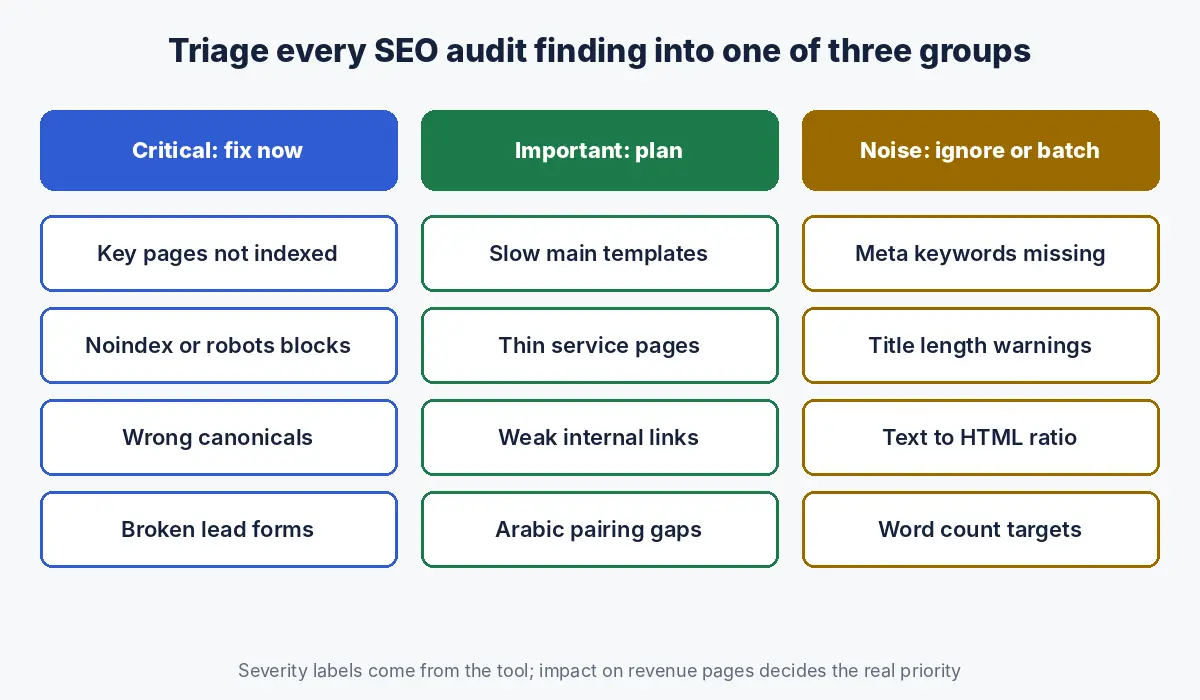
Tell critical issues from noise by asking whether the issue stops important pages being crawled, indexed or chosen by Google, or stops visitors converting; if it does neither, it is rarely urgent, however red the tool marks it.
Use these triage questions on each major finding:
- Does it affect pages that bring revenue, leads or most of the traffic?
- Does it stop those pages being crawled, indexed or shown correctly?
- How many important pages are affected, not just how many URLs?
- Is there evidence of harm in Search Console or analytics, such as dropped impressions or pages excluded from the index?
- How much effort does the fix take, and who has to do it?
| Category | Examples | Action |
|---|---|---|
| Critical | Important pages blocked by robots.txt or noindex; key pages canonicalised away; site wide redirect loops; security warnings; broken lead forms | Fix immediately |
| Important | Slow Core Web Vitals on main templates; thin or duplicate service pages; weak internal links to commercial pages; missing Arabic pairing | Plan within 30 to 60 days |
| Minor | Titles slightly long; missing alt text on decorative images; a few redirects to update | Batch with other work |
| Noise | Meta keywords missing; text to code ratio; arbitrary word count targets | Ignore |
Which SEO audit findings usually matter most?
The findings that usually matter most are those that stop important pages being indexed, send conflicting signals about which page should rank, slow down or break the pages that convert, or show that the site has a manual action or security problem.
| Finding | Why it matters | Evidence to look for |
|---|---|---|
| Important pages not indexed | A page that is not indexed cannot rank | Search Console page indexing report |
| Noindex or robots.txt blocks on key sections | Often left over from a redesign or staging site | Crawl data and robots.txt |
| Canonical tags pointing to the wrong page | Tells Google to rank a different URL | Crawl data, URL inspection |
| Redirect chains and broken internal links after a migration | Wastes crawling and loses old rankings | Crawl data, list of old URLs |
| Poor Core Web Vitals on main templates | Google recommends LCP within 2.5 seconds, INP under 200 ms, CLS under 0.1 (Google Search Central) | Search Console Core Web Vitals report |
| Thin or duplicate commercial pages | Pages compete or fail to satisfy the search | Content review, cannibalisation data |
| Weak internal links to service or product pages | Important pages look unimportant | Inlink counts per page |
| Manual actions or security issues | Can remove pages from results or trigger browser warnings | Search Console manual actions and security reports |
| Broken tracking | You cannot measure any improvement | Analytics events and goals |
Which SEO audit findings are often overstated?
Findings that tools flag by default but rarely affect rankings or revenue include missing meta keywords, title and description length warnings, text to code ratios, generic word count targets and long lists of “toxic” backlinks.
| Commonly flagged | What Google says or what usually matters |
|---|---|
| Missing meta keywords tag | Google has said since 2009 that it does not use the keywords meta tag in web ranking (Google Search Central) |
| Title too long | Google says there is no limit on title element length; title links are truncated to fit the device (Google Search Central). Rewrite only if the important words are cut off |
| Meta description length | Descriptions affect click through, not rankings; review those on high impression pages first |
| “Toxic” backlinks | Google says most sites will not need the disavow tool; it is for a considerable number of spammy links that have caused or are likely to cause a manual action (Google Search Console Help) |
| Low word count | Length is not a target; whether the page answers the search is |
| Text to HTML ratio | A tool metric with little bearing on rankings |
None of these are wrong to fix, but if they dominate the report while indexing, content and conversion issues get a line each, the audit’s priorities are upside down.
How do you check the evidence behind each finding?
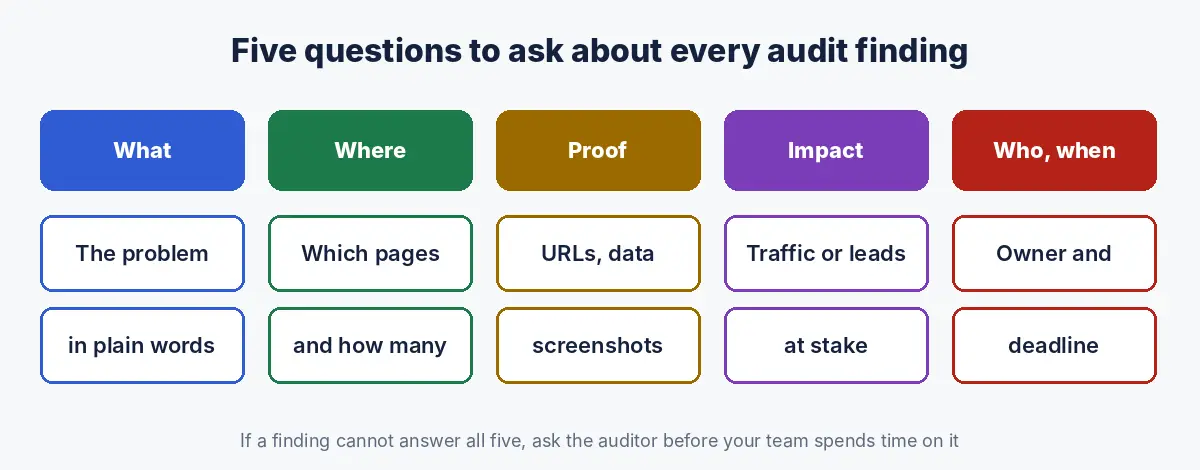
Check the evidence by asking for the specific URLs, the data source and a screenshot or export for each major finding, then confirming a few examples yourself in Search Console or in the browser.
- URLs, not counts: “412 pages have duplicate titles” should come with the list and the template they share.
- Source: is the finding from a crawler, Search Console, analytics or manual review? Search Console and analytics show real impact; crawlers show potential issues.
- Spot check: open three affected pages. Is the problem visible? Use URL inspection in Search Console for indexing claims.
- Impact estimate: how was it calculated? A good auditor shows the traffic or leads involved, even roughly.
- Dates: when was the crawl run? Sites change; an old crawl may describe problems already fixed.
How should SEO audit findings be prioritised?
Prioritise findings by impact on traffic and leads against the effort to fix them, then sequence them so that blockers come first, quick wins follow, and larger projects are planned with the right owners.
| Priority | Impact | Effort | Examples |
|---|---|---|---|
| 1. Fix now | High | Low | Remove accidental noindex, fix broken forms, correct canonicals |
| 2. Plan next | High | High | Speed rebuild of templates, consolidating duplicate pages, Arabic pairing |
| 3. Batch | Low | Low | Title rewrites on low traffic pages, alt text |
| 4. Park | Low | High | Cosmetic restructures with no measurable benefit |
For a wider view that also covers security, conversion and data protection, see our guide to a website audit in Dubai, which uses the same prioritisation matrix.
What questions should you ask the person who wrote the SEO audit?
Ask the auditor to explain the top findings in business terms, show the evidence, estimate the impact, and say what they would do first with your budget and team.
- If we could fix only three things this month, which would they be, and why?
- Which findings affect our revenue pages specifically?
- What evidence in Search Console or analytics shows this is hurting us now?
- What do you expect to change after the fixes, and how will we measure it?
- Which items can our developers ignore?
- What did the audit not cover?
- Is anything here a guarantee? (Google itself says no one can guarantee a number one ranking (Google Search Central).)
How do you turn an SEO audit report into an action plan?
Turn the report into an action plan by converting each priority finding into a task with an owner, a deadline and a way to check it is done, grouped into 30, 60 and 90 day phases.
| Phase | Typical tasks | Owner |
|---|---|---|
| First 30 days | Remove indexing blocks, fix canonicals and broken forms, repair tracking, resolve security warnings | Developer, marketing |
| Days 31 to 60 | Improve top commercial pages, internal links, Core Web Vitals on main templates | Content, developer |
| Days 61 to 90 | Consolidate duplicate content, Arabic pairing, structured data, new pages for gaps | Content, SEO |
| Ongoing | Monthly checks against the baseline | SEO or agency |
Track progress in the same format each month; our technical SEO audit checklist can serve as the checklist your developers tick off.
How do you measure whether the audit fixes worked?
Measure against the baseline in the report: indexed pages, impressions and clicks for the affected pages, rankings for the target searches, Core Web Vitals, and leads or sales from organic search, comparing equal periods after Google has recrawled the changes.
Allow time. Indexing fixes can show within weeks once pages are recrawled; content and internal linking improvements usually take longer. Judge results by the pages and searches the audit targeted, not by sitewide totals that also move with seasonality. A useful single measure is search coverage: the share of your revenue keywords where you rank on page one, explained in our guide to search coverage.
What are the red flags in an SEO audit report?
| Red flag | What it suggests |
|---|---|
| Hundreds of pages of tool screenshots | Little human analysis |
| Everything marked high priority | No real prioritisation |
| No Search Console or analytics data | Findings not linked to real performance |
| Generic advice that could apply to any site | Template report |
| Heavy focus on meta keywords, word counts or toxic links | Outdated or tool driven priorities |
| Ranking guarantees | Not credible, according to Google’s own guidance |
| No mention of Arabic pages on a bilingual site | Part of the site was not reviewed |
| Recommendations that resemble tactics in Google’s spam policies | Risk to your site |
What does a good SEO audit report excerpt look like?
A good report excerpt states each finding in plain language, shows evidence you can check, explains the business impact, gives a specific fix and assigns an owner; the annotated sample below shows what to look for.
Sample executive summary (illustrative): “Most traffic comes from 15 service pages. Eight of them are indexed but rank on page two, mainly because they overlap and have weak internal links. A redesign in March left 40 old URLs without redirects, losing links from 12 referring sites. Fixing redirects and merging overlapping pages should come first.”
| Report element | Sample text (illustrative) | Why it is good |
|---|---|---|
| Finding | 40 old service URLs return 404 after the March redesign | Specific and plain |
| Evidence | List of 40 URLs; 12 have links from other sites (backlink export attached) | Checkable |
| Impact | Lost link value and visitors from bookmarks and referrals | Tied to business outcome |
| Fix | 301 redirect each old URL to its closest new page (mapping attached) | Actionable without interpretation |
| Owner and timing | Developer, within two weeks | Clear responsibility |
| Measurement | Referring visits and rankings for the 12 linked pages, checked after 6 weeks | Shows how success will be judged |
Compare any report you receive with this structure. If findings lack evidence, impact or an owner, ask for them before work starts.
The sample above is illustrative, not a real client.
How Crawl To Click writes SEO audit reports
Crawl To Click is an SEO and AI visibility consultancy, and our audit reports are written to be acted on: a short executive summary in business language, every finding with URLs, evidence and a specific fix, priorities based on impact and effort, baseline metrics, and a 30, 60 and 90 day plan with owners. We also review audits produced by other agencies and tools, and help founders and marketing teams decide what to fix first. We work with clinics, property brokers, schools, software companies, ecommerce stores and professional services firms in the UAE. For typical audit prices by scope, see our guide to SEO audit cost in Dubai.
FAQs on reading SEO audit reports
What is the most important part of an SEO audit report?
The executive summary and the prioritised action list are the most important parts. They should tell you which few problems hold back traffic and leads, what evidence supports them, and what to fix first, without needing to read the full issue list.
Is an SEO health score important?
An SEO health score is calculated by the crawling tool using its own rules. It is not a Google metric, Google does not use it, and different tools give different scores, so it is a rough indicator at best, not a goal to optimise.
How many issues are normal in an SEO audit?
Large issue counts are normal because tools count every affected URL, so one template problem can appear as thousands of issues. What matters is the number of distinct problems and whether they affect important pages.
Should I fix every issue in an SEO audit?
No. Fix critical issues that block indexing or conversions first, then important issues on revenue pages. Many minor warnings, such as title length or meta keywords, have little or no impact and can be batched or ignored.
Do I need to disavow toxic backlinks listed in my audit?
Usually not. Google says most sites will not need the disavow tool and that it is meant for a considerable number of spammy or artificial links that have caused, or are likely to cause, a manual action.
How long after an SEO audit should I see results?
Fixes to indexing and technical blockers can show within weeks once Google recrawls the pages. Content, internal linking and speed improvements usually take two to six months to show clearly in rankings and leads.
Got an SEO audit you are not sure how to act on?
Send us the report. Request an independent review and get a clear view of what to fix first, what to ignore and what the audit missed.
Disclaimer: This article reflects Google documentation as of the dates stated. Timelines are typical ranges rather than guarantees, and examples are illustrative.