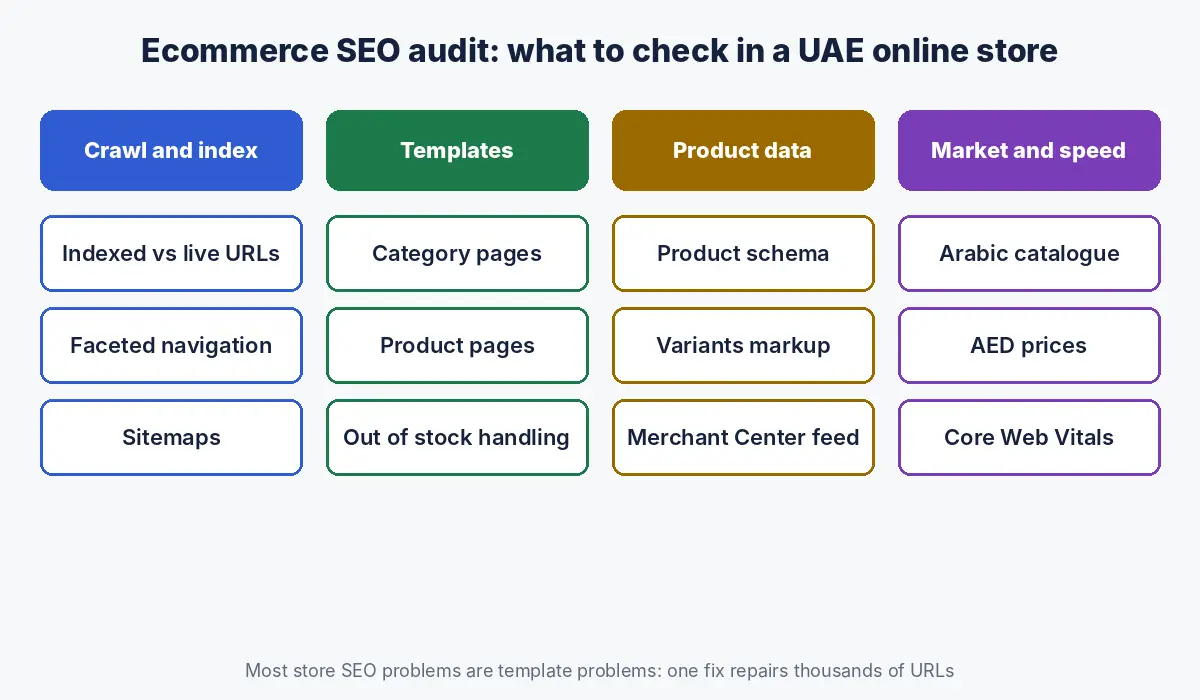
The short answer: an ecommerce SEO audit checks whether an online store’s category and product pages can be crawled, indexed and ranked efficiently at catalogue scale, and whether they convert once found. It covers crawling and indexing across thousands of URLs, faceted navigation and filters, category and product page quality, product structured data and Merchant Center feeds, out of stock and discontinued products, Arabic store pages, and page speed on the templates that sell. For UAE stores, the audit should also cover English and Arabic catalogue parity, prices in AED and the platform’s limits, whether that is Shopify, WooCommerce, Magento, Salla or Zid.
Online retail in the UAE grew about 12.9% to USD 34.63 billion in 2025, according to Research and Markets data reported by Khaleej Times, and mobile devices produce about 61% of UAE web traffic (StatCounter). Competition for category searches is intense, and most store SEO problems are template problems: one mistake in a filter, a product template or a feed repeats across thousands of pages. This guide explains what an ecommerce SEO audit covers, how to check each area, which issues are most common in UAE stores, and includes a sample audit report so you can see what the deliverable should look like.
What is an ecommerce SEO audit, and how is it different from a standard SEO audit?
An ecommerce SEO audit is an SEO audit built around templates and catalogue scale: instead of reviewing pages one by one, it checks how category, product, filter and search templates behave across thousands of URLs, and how product data reaches Google through structured data and Merchant Center.
| Area | Standard SEO audit | Ecommerce SEO audit |
|---|---|---|
| Unit of analysis | Individual pages | Templates and URL patterns |
| Crawl concerns | Broken links, redirects | Filters and parameters creating huge numbers of URLs |
| Content review | Service and blog pages | Category copy, product descriptions, duplicate supplier text |
| Structured data | Organization, FAQ, Article | Product, offers, reviews, variants, merchant listings |
| Data feeds | Not usually | Merchant Center feed quality and consistency with pages |
| Lifecycle issues | Rare | Out of stock, discontinued and seasonal products |
For what a general audit should include, see our guide to SEO audits in Dubai.
How do you audit crawling and indexing on a large product catalogue?
Compare three lists, the URLs you want indexed, the URLs crawlers find, and the URLs Google has indexed, then investigate the gaps: important categories and products missing from the index, and low value URLs such as filters, sorts and internal search results taking crawl activity instead.
- Export the list of live, indexable category and product URLs from the platform.
- Crawl the site and record status codes, canonicals and indexability for every URL found.
- Pull Search Console’s page indexing report and sitemap data.
- Find important URLs that are crawled but not indexed, or not found by the crawl at all.
- Find URL patterns, such as sort orders or session parameters, that create large numbers of crawlable duplicates.
Google’s crawl budget guidance is aimed at very large sites, those with roughly a million or more pages, or 10,000 or more pages that change daily, and at sites with many pages discovered but not indexed (Google Search Central). Many UAE stores are smaller, but faceted navigation can multiply a few thousand products into hundreds of thousands of URLs.
How do you audit faceted navigation and filters?
Audit filters by listing every parameter the store generates, deciding which filtered pages deserve to be indexed because people search for them, and checking that the rest are kept out of the crawl; Google’s December 2024 guidance warns that faceted navigation can cause overcrawling of duplicate content and slower discovery of new pages (PPC Land, summarising Google).
| Decision | When it applies | How Google suggests handling it |
|---|---|---|
| Keep out of search | Filters nobody searches for: sort order, price sliders, most colour and size combinations | Disallow the parameters in robots.txt, or use URL fragments for filters |
| Allow in search | Filters with real demand, such as “men’s running shoes size 44” or a popular brand within a category | Use the standard & separator, keep parameter order consistent, return 404 for empty results |
| Consolidate | Near duplicates that must stay crawlable | rel canonical to the main version, which takes longer to take effect |
The most valuable filtered pages are often better built as proper subcategory pages with their own copy, title and internal links, rather than left as parameter URLs.
How do you audit category pages?
Audit category pages as the store’s main ranking pages: each should target a clear search, have a unique title and H1, a short helpful introduction, sensible product sorting, crawlable links to products and subcategories, and internal links from navigation and related categories.
| Check | What good looks like | Common problem |
|---|---|---|
| Target search | One main search per category, mapped in a keyword plan | Two categories competing for the same search |
| Title and H1 | Include the category term and a differentiator | “Shop” or brand only titles |
| Introductory copy | Two to four sentences that help choose, above or below products | No copy, or long keyword stuffed text |
| Product links | Crawlable HTML links to products | Products loaded only by scripts |
| Pagination | Each page crawlable and self canonical | Page 2 onwards canonicalised to page 1 |
| Empty categories | Hidden or redirected | Indexed pages with no products |
How do you audit product pages?
Audit product pages for unique, useful descriptions, complete specifications, good images, visible price and availability in the local currency, reviews, and a single indexable URL per product, because product pages win long tail searches and feed shopping results.
- Duplicate supplier descriptions: the same text on dozens of other stores gives Google no reason to rank yours. Prioritise rewriting the top selling products.
- Specifications in text: size, material, compatibility and warranty in HTML, not only in images.
- Multiple URLs for one product: paths through different categories should canonicalise to one version.
- Variants: colour and size variants either on one page or as separate pages, consistently, with structured data that reflects the choice.
- Price and stock: visible, in AED for UAE shoppers, and matching the feed.
How do you audit product structured data and Merchant Center?
Check that every product page carries Product structured data with offers, price, currency and availability matching the visible page, that variant products use the variant markup Google added in February 2024 (Google Search Central), and that the Merchant Center feed matches the pages.
Google distinguishes product snippets, for pages where people cannot buy directly, from merchant listings, for pages that sell products and support details such as shipping and returns; it recommends providing both structured data and a Merchant Center feed to maximise eligibility for its product experiences (Google Search Central). Search Console’s merchant listings and product snippets reports show errors by template. For copy ready markup, see our schema markup examples.
How do you audit the Arabic version of an online store?
Audit the Arabic store for catalogue parity with English, correct hreflang pairing between language versions, translated titles, descriptions and filters, right to left layout on product and checkout pages, and Arabic product data in structured data and feeds.
- Each English category and product URL should be paired with its Arabic equivalent using hreflang, as Google describes in its localised versions guidance.
- Arabic pages should not canonicalise to English pages, or they will not be indexed.
- Machine translated product titles often miss the terms Arabic speakers actually search; research Arabic keywords for top categories separately.
- Filters, size guides and delivery information should be translated, not left in English.
- Check the checkout in Arabic on mobile: broken right to left forms lose orders silently.
How do you audit page speed on ecommerce templates?
Audit speed by template, category, product, search and checkout, using field data from real users against Google’s Core Web Vitals thresholds of Largest Contentful Paint within 2.5 seconds, Interaction to Next Paint under 200 milliseconds and Cumulative Layout Shift under 0.1 (Google Search Central).
Speed links directly to revenue in retail: in a Deloitte study published on web.dev, a 0.1 second improvement in mobile site speed was associated with retail consumers spending 9.2% more (web.dev). Common culprits in stores are large product images, many apps or plugins each adding scripts, review and chat widgets, and themes that load every feature on every page.
How should an audit handle out of stock and discontinued products?
An audit should check that temporarily out of stock products stay live with clear availability, that permanently discontinued products redirect to the closest equivalent or return a 404 or 410 when there is none, and that seasonal pages are kept and updated rather than deleted each year.
| Situation | Recommended handling | Common mistake |
|---|---|---|
| Temporarily out of stock | Keep the page live (200), show availability and alternatives, update structured data availability | Deleting the page, losing its rankings |
| Permanently discontinued, close replacement exists | 301 redirect to the replacement or the category | Redirecting everything to the homepage |
| Permanently discontinued, no replacement | 404 or 410, remove from sitemap and feed | Leaving thin pages indexed for years |
| Seasonal (Ramadan, Eid, White Friday, back to school) | One permanent URL updated each season | New URL every year, starting from zero |
What platform specific issues should an ecommerce audit check in the UAE?
Each ecommerce platform has typical SEO limits, so the audit should check how the store’s platform handles URLs, canonicals, filters, multilingual setups and structured data, and what can and cannot be changed.
| Platform | What to check |
|---|---|
| Shopify | Products reachable through several collection paths, fixed URL prefixes, apps adding scripts, how the language app handles hreflang |
| WooCommerce | Plugin load and speed, filter plugins creating parameter URLs, duplicate category and tag archives |
| Magento (Adobe Commerce) | Layered navigation parameters, very large numbers of URLs, store view setup for languages |
| Salla and Zid | Control over titles, canonicals and structured data, Arabic and English URL handling, sitemap coverage |
| Custom builds | Server rendering of product content, consistent canonicals, sitemap generation |
The aim is not to change platforms but to know which fixes need a setting, an app, a developer or a workaround, so the action plan is realistic.
What does a sample ecommerce SEO audit report look like?
A good ecommerce SEO audit report opens with a short summary of what is holding revenue back, lists findings by template with evidence, impact, fix and owner, and ends with a sequenced plan; the sample below shows the format for an illustrative store.
Sample summary (illustrative): “A Dubai homeware store on Shopify with about 4,200 products in English and Arabic. Category pages rank on page two for most target searches. Three issues account for most of the gap: colour and size filters create around 180,000 crawlable URLs, Arabic product pages canonicalise to English and are not indexed, and 70% of product descriptions are supplier text shared with other retailers. Fixing the first two is low effort and should be done within 30 days.”
| # | Finding | Evidence | Impact | Fix | Owner | Priority |
|---|---|---|---|---|---|---|
| 1 | Filter parameters crawlable | Crawl found about 180,000 filter URLs; Search Console shows many discovered but not indexed | Crawling wasted; new products found slowly | Disallow non search filters; build 12 subcategory pages for filters with demand | Developer, SEO | High, quick win |
| 2 | Arabic product pages canonicalised to English | Canonical tag on Arabic template points to English URL | Arabic catalogue largely absent from search | Self referencing canonical and hreflang pairs | Developer | High, quick win |
| 3 | Supplier descriptions on most products | Sample of 100 products: 70 match text on other stores | Weak product rankings | Rewrite top 300 products by revenue first | Content | High, larger project |
| 4 | Product schema missing availability | Search Console merchant listings report errors on product template | Reduced eligibility for shopping results | Add offers availability and price to template | Developer | Medium |
| 5 | Discontinued products return 200 with empty page | 84 URLs found | Thin pages, poor experience | 301 to closest product or category, else 410 | SEO, developer | Medium |
| 6 | Mobile LCP over 4 seconds on category template | Search Console Core Web Vitals report | Lower conversion, weaker page experience | Compress hero images, defer review widget | Developer | Medium |
| Phase | Actions |
|---|---|
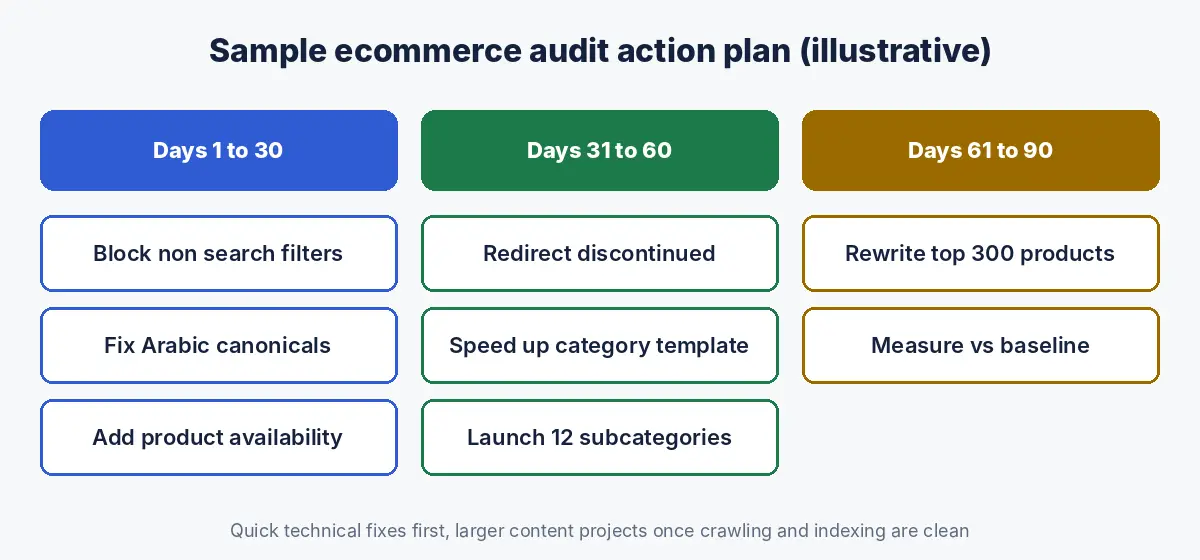
| Days 1 to 30 | Fix filters (1), Arabic canonicals and hreflang (2), product schema (4) |
| Days 31 to 60 | Discontinued products (5), speed on category template (6), launch 12 subcategory pages |
| Days 61 to 90 | Rewrite top 300 product descriptions (3), measure against baseline |
The figures in the sample are illustrative. For how to judge any audit report you receive, see our guide on how to read an SEO audit report.
How much does an ecommerce SEO audit cost, and how long does it take?
An ecommerce SEO audit usually sits in the higher audit bands because of template, filter, feed and language work: typically two to six weeks, with cost depending on catalogue size, platform, languages and whether Merchant Center and speed analysis are included. Our guide to SEO audit cost in Dubai gives typical ranges in AED by scope.
How Crawl To Click runs ecommerce SEO audits
Crawl To Click is an SEO and AI visibility consultancy, and our ecommerce audits are built around templates and revenue: we crawl the full catalogue including filters, compare it with Search Console indexing and the platform’s product list, review category and product templates, check structured data against Merchant Center, audit the Arabic store for parity and pairing, measure speed by template, and map every finding to the categories that drive sales. We work with UAE retailers in fashion, electronics, home, beauty, grocery and B2B supplies across Shopify, WooCommerce, Magento and regional platforms. For the non SEO side of a store, such as checkout, security and tracking, see our guide to a website audit.
FAQs on ecommerce SEO audits in the UAE
What is an ecommerce SEO audit?
An ecommerce SEO audit reviews how an online store’s category, product, filter and search templates are crawled, indexed and ranked at catalogue scale, along with product structured data, Merchant Center feeds, out of stock handling, language versions and page speed, ending with a prioritised plan.
How should faceted navigation be handled for SEO?
Google recommends blocking filter URLs that do not need to appear in search, through robots.txt or URL fragments, and, for filtered pages that should be indexed, using the standard & separator, a consistent parameter order and 404 responses for empty results.
Should out of stock products be removed from my store?
Temporarily out of stock products should stay live with clear availability and alternatives. Permanently discontinued products should redirect to the closest replacement or category, or return a 404 or 410 if there is no relevant alternative.
Do I need both product structured data and a Merchant Center feed?
Google recommends providing both, because together they maximise eligibility for its product experiences, including merchant listings and product snippets, as long as prices and availability match the visible page.
What should an Arabic ecommerce SEO audit check?
An Arabic ecommerce audit should check that Arabic category and product pages exist for the full catalogue, are indexable rather than canonicalised to English, are paired with English pages through hreflang, use researched Arabic search terms, and work correctly right to left on mobile, including checkout.
How long does an ecommerce SEO audit take?
An ecommerce SEO audit typically takes two to six weeks, depending on catalogue size, the number of templates and languages, the platform, and whether Merchant Center, speed and log file analysis are included.
Need an ecommerce SEO audit for your UAE store?
If your categories sit on page two, your Arabic catalogue is invisible or filters are eating your crawl, request an ecommerce SEO audit and get a template by template plan.
Disclaimer: This article reflects Google documentation and published sources as of the dates stated. The sample audit report is illustrative and does not describe a real business. Platform features change; check your platform’s current documentation.