The short answer: a website audit in Dubai is a structured review of how well a business website performs for search engines, users and the business, covering SEO and indexability, speed and Core Web Vitals, security, conversion and user experience, English and Arabic content, data protection and tracking, and increasingly AI search visibility. An SEO audit looks at one of those layers; a website audit looks at all of them, because a page that ranks but loads slowly, looks unsafe or has a broken enquiry form still loses the customer. A good audit ends with a prioritised list of fixes, not a long list of warnings.
Most UAE businesses commission an audit at a specific moment: before a redesign or migration, after a traffic drop, before hiring a new agency, or when leads fall without an obvious cause. The UAE context changes what an audit must check. Mobile devices produce about 61% of web traffic (StatCounter), Google handles over 93% of searches (StatCounter), most sites serve both English and Arabic, and federal data protection law applies outside the financial free zones. This guide sets out what a complete website audit covers, how each area is checked, what the deliverable should look like and how to judge whether an audit is worth acting on.
What is the difference between a website audit and an SEO audit?
An SEO audit checks whether search engines can find, understand and rank your pages; a website audit checks that plus whether the site is fast, secure, compliant, easy to use and able to turn visitors into enquiries.
| Area | SEO audit | Website audit |
|---|---|---|
| Crawling, indexing, technical SEO | Yes | Yes |
| Content, keywords, internal links | Yes | Yes |
| Speed and Core Web Vitals | Usually | Yes, in depth |
| Security (HTTPS, malware, plugins) | Rarely | Yes |
| Conversion paths, forms, WhatsApp, calls | Rarely | Yes |
| Accessibility | Rarely | Yes |
| Data protection and consent | No | Yes |
| Analytics and tracking accuracy | Sometimes | Yes |
| AI search visibility | Increasingly | Yes |
If your main question is “why are we not ranking”, an SEO audit is enough; our guide to SEO audits in Dubai explains what one should include. If your question is “why is the website not producing business”, you need the wider review.
What should a website audit in Dubai cover?
A complete website audit in Dubai covers seven areas: SEO and indexability, speed, security, conversion and user experience, bilingual content, data protection and tracking, and AI search visibility.
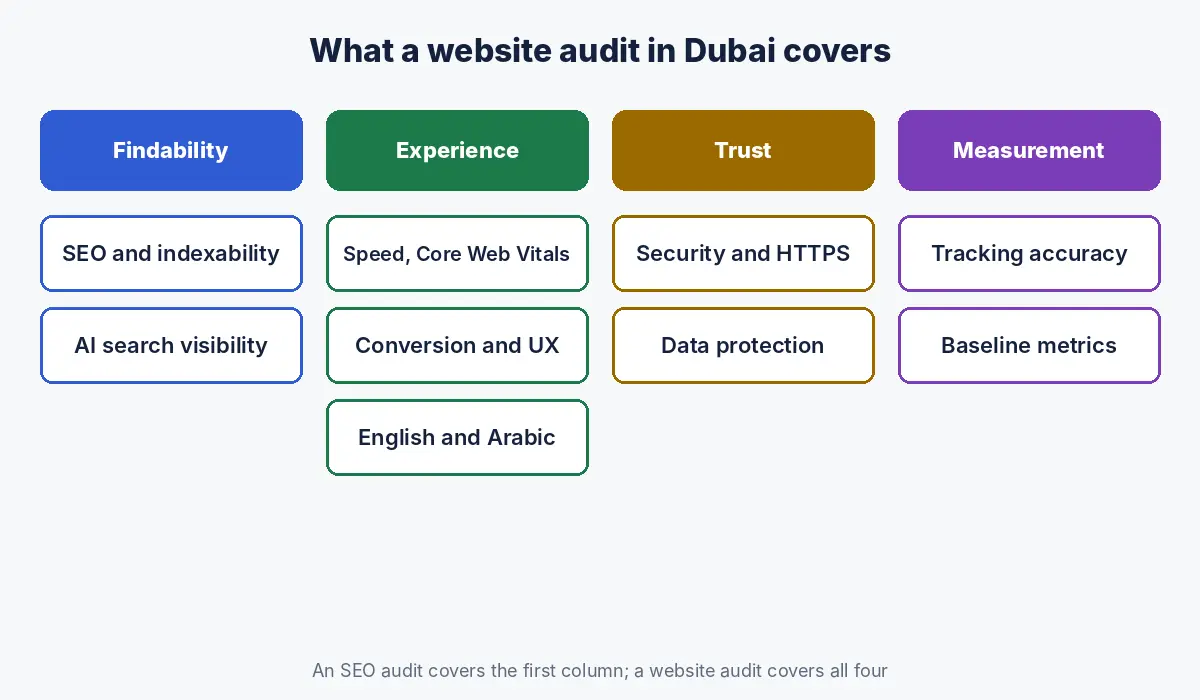
| Area | Key questions | Typical tools and data |
|---|---|---|
| SEO and indexability | Can Google crawl and index the pages that matter? Are titles, canonicals and links sound? | Crawler, Search Console page indexing and performance |
| Speed and Core Web Vitals | Do real users get fast loading, quick responses and stable layouts on mobile? | Search Console Core Web Vitals report, field data, lab tests |
| Security and trust | Is everything on HTTPS? Are plugins current? Any hacked content or warnings? | Search Console security issues, server and CMS review |
| Conversion and UX | Do forms, WhatsApp, click to call and booking flows work on every device? | Manual testing, analytics funnels, session recordings |
| English and Arabic content | Are both versions complete, consistent and correctly linked? | Crawl by language, hreflang checks, native review |
| Data protection and tracking | Is consent collected properly? Are analytics events accurate? | Consent tool review, tag audit, analytics debug |
| AI search visibility | Do ChatGPT, Gemini and Google AI describe and recommend the business correctly? | Prompt sampling, AI crawler access, citation checks |
How do you audit website speed for users in the UAE?
Audit speed with field data from real users first, using Google’s Core Web Vitals: Largest Contentful Paint within 2.5 seconds, Interaction to Next Paint under 200 milliseconds and Cumulative Layout Shift under 0.1 (Google Search Central), then use lab tests to find the causes on the slowest page templates.
The UAE has some of the fastest connections in the world: median mobile download speed reached 614.42 Mbps at the end of 2025, according to DataReportal citing Ookla. That removes the usual excuse. If a page is slow for UAE visitors, the cause is almost always the site itself: oversized images, heavy themes, too many scripts, third party chat and booking widgets, or hosting far from the region.
Speed is a revenue question, not just a ranking one. In a Deloitte study of 37 brand sites and over 30 million sessions, a 0.1 second improvement in mobile speed was associated with retail consumers spending 9.2% more and a 21.6% improvement in lead generation users reaching the form submission page (web.dev). Google also says good Core Web Vitals align with what its core ranking systems seek to reward (Google Search Central).
| Common cause in UAE sites | What the audit checks | Typical fix |
|---|---|---|
| Large hero images and sliders | Image weight and format on key templates | Compress, serve modern formats, remove sliders |
| Chat, booking and review widgets | Third party scripts loading on every page | Load on interaction or only where needed |
| Page builder themes | Unused CSS and JavaScript | Lighter theme or template clean up |
| Distant hosting without a CDN | Server response time from the region | CDN with regional edge locations |
| Arabic web fonts | Font files and loading strategy | Subset fonts, preload, limit weights |
What security checks belong in a website audit?
A website audit should confirm that every page and resource loads over HTTPS, that the CMS, themes and plugins are current, that there is no injected spam or malware, and that Search Console reports no security issues.
- HTTPS everywhere: no mixed content, correct redirects from http and non www versions, valid certificate.
- Software currency: CMS core, theme and plugins updated; unused plugins removed; admin accounts reviewed.
- Injected content: crawl for unexpected pages, hidden links and foreign language spam, a common sign of a compromised site.
- Search Console security issues report: any warning here can trigger browser warnings that stop visitors entirely.
- Forms and uploads: spam protection on forms, and uploads restricted to safe file types.
Security findings come first in the priority list. A hacked site loses rankings, visitors and trust faster than any SEO issue.
What conversion and user experience checks should a website audit include?
Conversion checks test every route a visitor can take to contact or buy, on mobile and desktop, in both languages, and confirm that each one works, is easy to find and is tracked.
| Check | Why it matters in the UAE |
|---|---|
| WhatsApp and click to call buttons work and are tracked | Many UAE enquiries start on WhatsApp or by phone, not forms |
| Forms submit, confirm and reach the right inbox | Broken forms are a common, silent cause of lost leads |
| Booking flows work on mobile | Mobile produces most traffic |
| Arabic pages have the same calls to action | Arabic visitors often get fewer contact options |
| Prices, locations and hours are visible | Buyers compare quickly; missing facts send them elsewhere |
| Trust signals: licences, reviews, team, address | Especially important in healthcare, property, finance and education |
Accessibility belongs here too. The Web Content Accessibility Guidelines (WCAG) 2.2 cover contrast, keyboard use, form labels and alternative text; fixing them helps every visitor and often improves conversion.
What data protection and tracking checks matter for UAE websites?
UAE website audits should check how personal data is collected through forms, cookies and analytics against the applicable data protection law, and confirm that analytics and conversion tracking are accurate enough to make decisions.
The UAE’s federal Personal Data Protection Law (Federal Decree Law No. 45 of 2021) generally requires consent that is specific, clear and unambiguous, has extraterritorial reach, and does not apply inside the DIFC and ADGM financial free zones, which have their own data protection regimes (Herbert Smith Freehills). An audit should therefore note which regime applies, whether the consent banner actually blocks tags before consent, and whether the privacy notice matches what the site collects. This is a marketing audit, not legal advice; confirm requirements with your legal adviser.
On tracking, check that every key event (form submission, WhatsApp click, call click, booking) fires once, carries the right labels and appears in analytics. Many “SEO is not working” conversations turn out to be tracking that stopped recording leads after a site update.
Should a website audit include Arabic and bilingual checks?
Yes. For most UAE businesses, a website audit should check that English and Arabic versions are complete, carry the same facts and calls to action, are linked with correct hreflang annotations, and display properly right to left.
- Hreflang tags pair each English page with its Arabic version and back, as Google describes in its localised versions guidance.
- Prices, services, team members and contact details match across languages.
- Arabic pages are indexable, not blocked or canonicalised to the English version.
- Right to left layouts do not break forms, tables, icons or navigation.
- Arabic content is written or reviewed by native speakers, not left as raw machine translation.
Should a website audit include AI search visibility?
It should, at least at a basic level, because AI assistants now shape how UAE buyers shortlist providers: 70.1% of the UAE’s working age population used AI in the first quarter of 2026 (Khaleej Times), and Google’s AI Overviews and AI Mode draw on the same indexed pages as Search (Google Search Central).
The basic checks are whether AI search crawlers can access the site, whether assistants describe the business accurately, and whether key pages answer buyer questions directly. Our AEO audit checklist covers the full set when AI visibility is a priority.
What should a website audit report include?
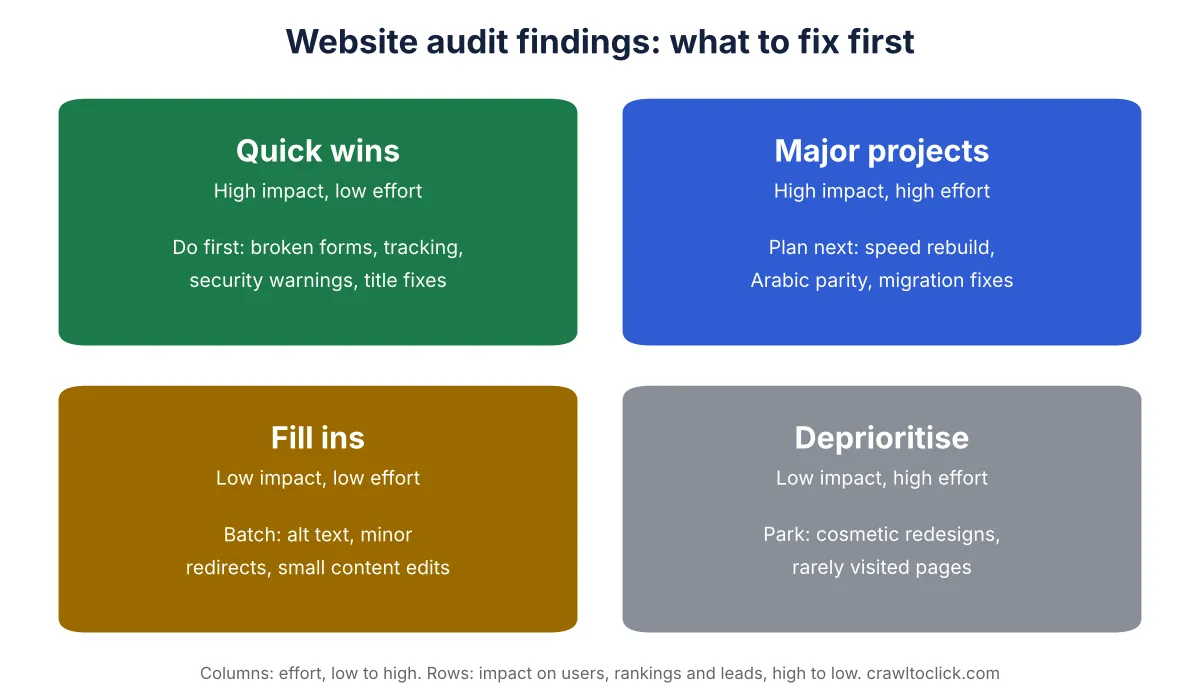
A useful website audit report includes a one page summary for decision makers, every finding with evidence and a specific fix, a priority score based on impact and effort, and a 30, 60 and 90 day action plan. Our guide on how to read an SEO audit report explains how to judge each section.
| Section | What good looks like | Warning sign |
|---|---|---|
| Executive summary | Five to ten findings that matter, in business language | Pages of scores with no conclusion |
| Findings | Issue, evidence (URLs, screenshots, data), impact, fix | Generic tool warnings copied without context |
| Prioritisation | Impact versus effort, with owner (developer, content, marketing) | Everything marked high priority |
| Action plan | Sequenced fixes for 30, 60 and 90 days | No sequence or ownership |
| Measurement | Baseline metrics to compare after fixes | No baseline |
When should a business in Dubai commission a website audit?
Commission a website audit before a redesign or platform migration, after an unexplained drop in traffic or leads, before hiring or replacing an agency, after acquiring or merging websites, and at least once a year for any site that generates significant revenue.
| Trigger | Why an audit helps |
|---|---|
| Planning a redesign or migration | Records what currently works so it is not lost |
| Traffic or leads fell | Separates technical, content, tracking and market causes |
| Changing agencies | Gives an independent baseline before handover |
| Launching an Arabic version | Catches pairing and indexing problems early |
| Annual review | Finds slow decay: outdated content, broken flows, old plugins |
If rankings are the main symptom, our guide to why a website is not ranking in Dubai covers the twelve most common causes.
Is a free automated website audit enough?
A free automated audit is a useful first scan for obvious technical errors, but it cannot judge business priorities, test conversion paths, check Arabic content quality, review data protection or explain which issues actually cost you leads.
| Automated tool scan | Expert website audit | |
|---|---|---|
| Speed | Minutes | One to four weeks, depending on site size |
| Technical errors | Good at finding them | Finds and prioritises them |
| Conversion, tracking, compliance | Not covered | Covered |
| Arabic and bilingual quality | Basic checks at most | Native review and pairing checks |
| Output | Long list of warnings and a score | Prioritised plan with owners |
| Best for | Monitoring between audits | Decisions before investment |
For the technical layer in detail, our technical SEO audit checklist for the UAE lists every check step by step. For typical prices in AED by audit scope, see our guide to SEO audit cost in Dubai.
What are the common mistakes with website audits?
| Mistake | Better approach |
|---|---|
| Judging the site by a single speed score | Use field data from real users by template |
| Auditing only the English site | Audit both languages with equal depth |
| Fixing everything flagged by a tool | Fix what affects users, rankings and leads first |
| No baseline before changes | Record metrics before fixes to measure impact |
| Ignoring tracking | Confirm every lead source is recorded before judging performance |
| Commissioning an audit with no budget to act | Plan developer and content time alongside the audit |
What does a sample website audit report look like?
A sample website audit report starts with a short summary of what is costing the business enquiries, then lists findings across SEO, speed, security, conversion, Arabic content, data protection and tracking, each with evidence, a fix, an owner and a priority.
Sample summary (illustrative): “A Dubai physiotherapy clinic with two branches and an English and Arabic website. Organic visits are stable but enquiries fell 30% in six months. The main causes are a booking form that fails on Arabic mobile pages, a WhatsApp button that is not tracked, and slow service pages on mobile. Two security and consent issues need attention within two weeks.”
| # | Finding | Evidence | Impact | Fix | Owner | Priority |
|---|---|---|---|---|---|---|
| 1 | Booking form fails on Arabic mobile pages | Manual test on iOS and Android; form submits but no email arrives | Lost bookings from Arabic speaking patients | Fix form handler for right to left fields; test weekly | Developer | High, quick win |
| 2 | WhatsApp clicks not tracked | No event in analytics for the WhatsApp button | Leads undercounted; SEO looks worse than it is | Add click event and mark as conversion | Marketing | High, quick win |
| 3 | Mobile LCP 4.2 seconds on service pages | Search Console Core Web Vitals, field data | Lower conversion and weaker page experience | Compress hero images, defer chat widget | Developer | High |
| 4 | Outdated plugins, one with a known vulnerability | CMS plugin list | Security risk | Update or replace plugins; remove unused ones | Developer | High, quick win |
| 5 | Cookie banner loads analytics before consent | Tag debug shows tags firing on page load | Data protection risk | Configure consent mode to block tags until consent | Marketing, developer | Medium |
| 6 | Arabic service pages missing two treatments listed in English | Side by side content comparison | Incomplete Arabic visibility | Translate and publish missing pages with hreflang | Content | Medium |
| Phase | Actions |
|---|---|
| Days 1 to 30 | Form fix (1), tracking (2), plugins (4) |
| Days 31 to 60 | Speed (3), consent (5) |
| Days 61 to 90 | Arabic pages (6), measure enquiries against baseline |
The clinic and figures above are illustrative, not a real client.
How Crawl To Click runs website audits
Crawl To Click is an SEO and AI visibility consultancy, and our website audits start from the business question, usually why the site is not producing enough enquiries or sales, and work back through every layer that affects it. We combine a full crawl, Search Console and analytics data, field speed data, manual testing of every contact route in both languages, a tracking and consent review and an AI visibility check, then deliver a short summary, evidence for every finding and a sequenced plan with owners. We audit sites for clinics, property brokers, schools, software companies, ecommerce stores and professional services firms across the UAE.
FAQs on website audits in Dubai
What is a website audit?
A website audit is a structured review of a business website covering SEO and indexability, speed, security, conversion and user experience, content, data protection and tracking, and AI search visibility, ending with a prioritised list of fixes.
How is a website audit different from an SEO audit?
An SEO audit focuses on whether search engines can crawl, understand and rank your pages. A website audit includes SEO but also covers speed, security, conversion paths, accessibility, data protection, tracking and bilingual content, so it explains why a site does or does not produce business.
How long does a website audit take?
A website audit typically takes one to four weeks depending on the size of the site, the number of languages, how many templates and conversion paths need testing, and whether analytics and server data are available.
What are good Core Web Vitals scores?
Google recommends Largest Contentful Paint within 2.5 seconds, Interaction to Next Paint under 200 milliseconds and Cumulative Layout Shift under 0.1, measured from real user data.
Does UAE data protection law apply to my website?
The federal Personal Data Protection Law, Federal Decree Law No. 45 of 2021, applies to most UAE businesses that collect personal data through their websites, but not to entities in the DIFC and ADGM free zones, which have their own data protection laws. Confirm your obligations with a legal adviser.
How often should a website be audited?
A full website audit once a year suits most business sites, with an additional audit before any redesign or migration, after an unexplained drop in traffic or leads, and when changing agencies. Automated monitoring can run continuously between audits.
Need an independent website audit in Dubai?
If your website gets visitors but not enough enquiries, or you are planning a redesign, request a website audit and get a prioritised plan your developers and marketers can act on.
Disclaimer: This article reflects Google documentation and published sources as of the dates stated. It is not legal advice; confirm data protection obligations with a qualified adviser. Timelines are typical ranges, not guarantees.