The short answer: to recover from a Google core update, first prove the drop was caused by the update and not by tracking, technical or seasonal problems, then find exactly which pages and queries lost visibility, compare them with what now ranks, and improve or remove the content that is less helpful than the competition. Google says core updates are not penalties, that recovery can take several months, and that improved pages can rise again without waiting for the next announced update (Google Search Central).
This matters right now: Google began rolling out its November 2026 core update on 10 November, with a rollout of up to two weeks (Search Engine Roundtable). This hub sets out a data led method: what to check in the first week, how to diagnose a drop in Search Console, which patterns point to which causes, how to assess content against Google’s own questions, what fixes work, realistic timelines and a sample diagnosis report.
What is a Google core update?
A Google core update is a broad change to Google’s ranking systems that reassesses how relevant and helpful pages are across the web; Google described its 2026 updates as “a regular update designed to better surface relevant, satisfying content for searchers from all types of sites” (Search Engine Journal).
Core updates are different from spam actions. A drop does not mean the site broke a rule; it means other pages are now judged more useful for those searches, or Google’s understanding of what searchers want has changed.
| Core update | Spam update or manual action | |
|---|---|---|
| What it does | Reassesses relevance and helpfulness broadly | Targets specific policy violations |
| Notification | Announced on the Search Status Dashboard | Manual actions appear in Search Console |
| Is it a penalty? | No | Yes, for the violating pages or site |
| Fix | Improve content and experience relative to competitors | Remove the violation and, for manual actions, request review |
Which Google core updates happened in 2026?
Google announced core updates in March, May and November 2026, each rolling out over roughly two weeks; you can confirm dates on the Google Search Status Dashboard.
| Update | Started | Completed |
|---|---|---|
| March 2026 core update | 27 March 2026 (Search Engine Journal) | 8 April 2026 |
| May 2026 core update | 21 May 2026 (Search Engine Roundtable) | 2 June 2026 |
| November 2026 core update | 10 November 2026 (Search Engine Roundtable) | Rolling out; up to two weeks expected |
Google also makes smaller core updates it does not announce, a point it added to its documentation in late 2025 (Search Engine Roundtable). So a traffic change outside announced dates can still come from ranking changes.
How do you know if a core update caused your traffic drop?
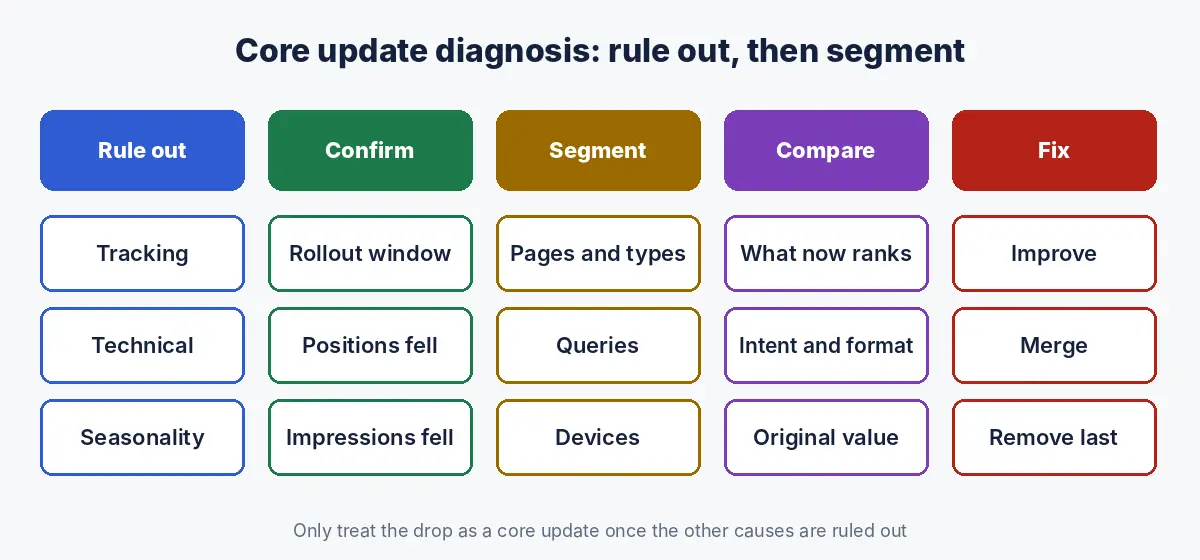
A core update is the likely cause only when the drop starts within the rollout window, appears in Search Console as lost positions or impressions rather than just lost sessions, and cannot be explained by tracking, technical, seasonal or demand changes. Rule those out first.
| Check | How | If this is the cause |
|---|---|---|
| Tracking | Compare Search Console clicks with analytics sessions | Clicks steady while sessions fall: fix tracking, not content |
| Technical | Indexing report, crawl stats, robots.txt, redirects, recent releases | Pages dropped out of the index or became uncrawlable |
| Seasonality | Compare the same weeks last year | Same dip last year: demand, not rankings |
| Demand | Impressions for your top queries in Google Trends or Search Console | Fewer people searching |
| SERP changes | Search your main queries and look at the layout | AI Overviews or new features taking clicks while positions hold |
| Core update | Positions fall across many queries during the rollout window | Continue with the diagnosis below |
Our guide to why a website is not ranking covers the non update causes in more detail, and our technical SEO audit checklist covers the technical checks.
What should you do in the first week after a core update?
In the first week, record and watch rather than change things: Google recommends waiting until the update has finished and then about a week before analysing, comparing performance before and after (Search Engine Journal, summarising Google).
FIRST WEEK CHECKLIST
[ ] Note the update start date from the Search Status Dashboard
[ ] Export Search Console data (queries and pages) for the 4 weeks
    before the start date, as a baseline
[ ] Annotate the date in analytics and reporting dashboards
[ ] Rule out tracking, technical, seasonal and demand causes
[ ] Do not rewrite, delete or redirect pages during the rollout
[ ] Brief leadership: what happened, what you are measuring, when
    you will report a diagnosis (about one week after completion)
How do you diagnose a core update drop in Search Console?
Diagnose a core update drop by comparing equal periods before and after the update in Search Console, then breaking the change down by page, page type, query type and device until you can say exactly where the loss happened.
- Compare periods: the same number of days before the start and after completion, for example 28 days each, separately for web, image, video and news search where relevant.
- Find the biggest losers: sort pages and queries by lost clicks, not by percentage change.
- Group by page type: blog posts, product or service pages, location pages, programmatic pages, category pages.
- Split position from click changes: a page that held its position but lost clicks was hit by layout changes, not rankings.
- Look at what now ranks: for the top 20 lost queries, record which pages replaced yours and what they do differently.
For larger sites, export the data and compare it in a script. This pandas example joins two exports and lists the pages that lost the most clicks:
import pandas as pd

# Exports from Search Console > Performance > Pages (equal length periods)
before = pd.read_csv('pages_before.csv')   # columns: page, clicks, impressions, position
after  = pd.read_csv('pages_after.csv')

df = before.merge(after, on='page', how='outer', suffixes=('_before', '_after')).fillna(0)
df['click_change'] = df['clicks_after'] - df['clicks_before']
df['position_change'] = df['position_after'] - df['position_before']   # positive = worse

# Simple page type from the URL path; adjust to your site
df['page_type'] = df['page'].str.extract(r'https?://[^/]+/([^/]+)/')[0].fillna('home')

print(df.sort_values('click_change').head(25)[['page','click_change','position_change']])
print(df.groupby('page_type')['click_change'].sum().sort_values())
Our guide to analysing Search Console data with Claude shows how to run this kind of analysis with prompts instead of code.
What do different core update drop patterns mean?
The pattern of the loss points to the cause: site wide drops suggest trust or overall quality issues, drops concentrated in one page type suggest a problem with that template or content type, and drops on specific queries usually mean competitors now answer the intent better.
| Pattern | Likely cause | Where to look first |
|---|---|---|
| Most pages lose positions evenly | Site wide quality, trust or reputation signals | About pages, authorship, reviews, overall content quality |
| One page type falls (for example programmatic or location pages) | Thin or repetitive pages at scale | Unique value per page, indexation of low value pages |
| Informational posts fall, commercial pages hold | Generic content that AI Overviews or stronger sources now cover | Original information, first hand experience, depth |
| Specific queries fall to different page types | Intent shift: Google now prefers guides, tools, forums or videos | What type of page ranks now |
| Positions hold but clicks fall | SERP layout changes such as AI Overviews | Click through rate by query, not content quality |
| Health, finance or legal pages fall | Trust and expertise for high stakes topics | Expert authorship, sources, review process |
For sites with many generated pages, our guide to indexation logic for programmatic SEO covers which pages deserve to stay indexed.
How do you assess content after a core update?
Assess the pages that lost the most against Google’s own self assessment questions on helpful content (Google Search Central) and against the pages that replaced them, page by page, starting with those that lost the most clicks.
CORE UPDATE CONTENT ASSESSMENT (score each page 1 to 5)
1. Original information: does it add something the top results do not?
2. First hand experience: does it show the author actually did or used this?
3. Completeness: does it fully answer the searcher's question?
4. Expertise and trust: is the author named and qualified, are claims sourced?
5. Intent match: is it the type of page that now ranks (guide, tool, list, video)?
6. Freshness: are facts, prices and examples current?
7. Experience: is the main content easy to reach, without heavy ads or pop ups?
8. Comparison: would you choose this page over the page that replaced it?
Google’s search quality rater guidelines give the same lens from the rater side: pages whose main content is copied, paraphrased or AI generated with little effort, originality or added value are rated lowest (Search Quality Rater Guidelines). If your losses are concentrated in AI assisted content, our guide on whether AI generated content ranks on Google covers what Google says and what the data shows.
What fixes help sites recover from a core update?
Fix the cause the diagnosis found, starting with the pages that lost the most: add original information and expertise to pages worth keeping, merge or remove pages that add nothing, match the intent that now ranks, and strengthen trust signals; Google advises treating content deletion as a last resort (Search Engine Journal, summarising Google).
| Finding | Fix |
|---|---|
| Generic content similar to every competitor | Add original data, examples, first hand experience and expert input |
| Many thin or repetitive pages | Merge into stronger pages; noindex or remove pages with no unique value |
| Wrong page type for the query | Rebuild the page in the format that now ranks, or target a better matched query |
| Weak authorship and trust | Named authors with relevant credentials, sources for claims, clear about and contact pages |
| Outdated information | Update facts, prices and examples; show the review date |
| Poor page experience | Reduce intrusive ads and pop ups; make the main content easy to reach |
For deciding page by page what to keep, update, merge or remove, use our content audit guide.
How long does it take to recover from a Google core update?
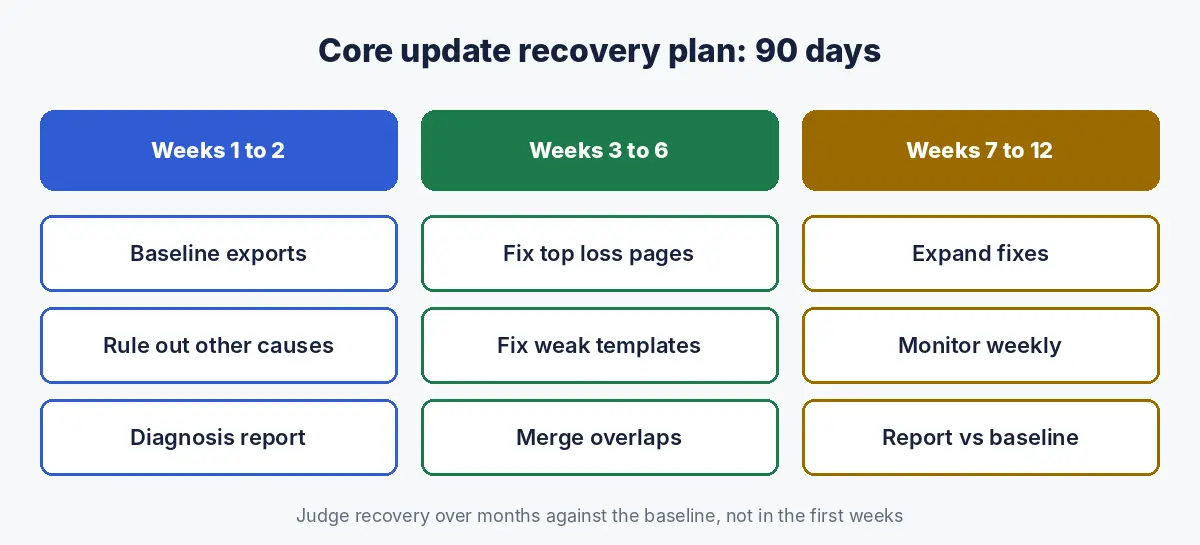
Recovery usually takes months, not weeks. Google says it can take several months for improvements to have their full effect and that some sites may need to wait until a future core update (Search Engine Journal, summarising Google), but because Google also runs smaller, unannounced core updates, improved pages can rise between announced updates (Search Engine Roundtable).
Google’s John Mueller has said sites do not need to wait for the next update to be seen differently and should keep improving in the same direction (Search Engine Land). In practice, set expectations with leadership in three horizons: diagnosis within two to three weeks, first improvements live within six weeks, and recovery judged over three to six months or the next core update.
How do AI Overviews affect core update diagnosis?
AI Overviews can make a drop look like a core update when it is not: if your average position is stable but clicks and click through rate fell on informational queries, the change is more likely a layout effect than a quality reassessment, and the fix is different.
| Signal | Likely cause | Response |
|---|---|---|
| Position stable, impressions stable, clicks down | AI Overview or other features taking clicks | Target queries with commercial intent; aim to be cited in the overview |
| Position down, impressions down | Ranking loss from the update | Content and quality diagnosis |
| Position stable, impressions down | Fewer searches or query mix change | Check demand and seasonality |
What does a core update diagnosis report look like?
A core update diagnosis report states whether the update caused the drop, where the loss is concentrated, the likely causes and the prioritised fixes. The example below is illustrative, for a fictional Dubai healthcare clinic group, not a real client.
| Section | Finding (illustrative) |
|---|---|
| Cause confirmed? | Yes: positions fell from 12 November across 340 queries; tracking, indexing and seasonality ruled out |
| Size of loss | Organic clicks down 31% (28 days after vs before); 82% of lost clicks from 45 pages |
| Where | Treatment guides lost most; service and location pages largely held |
| Pattern | Guides replaced by hospital and health authority pages with named doctors and sources |
| Likely cause | Guides lack named medical reviewers, sources and first hand clinical detail |
| Fix 1 (high) | Add named doctor reviewers, sources and clinic specific detail to the top 20 guides |
| Fix 2 (high) | Merge 18 overlapping guides into 6 stronger pages |
| Fix 3 (medium) | Update outdated treatment and price information; show review dates |
| Next review | Four weeks after fixes go live, and after the next core update |
The clinic and figures above are illustrative, not a real client. For a full site review beyond the update, see our guide to SEO audits in Dubai.
What are the common mistakes after a core update?
| Mistake | Fix |
|---|---|
| Changing pages during the rollout | Wait until the update completes and the data settles |
| Assuming every drop is the update | Rule out tracking, technical, seasonal and demand causes |
| Deleting large amounts of content in a panic | Diagnose first; deletion is a last resort |
| Rewriting pages without looking at what now ranks | Compare with the pages that replaced yours |
| Cosmetic edits such as new dates without new substance | Make substantive improvements |
| Judging recovery after two weeks | Measure over months against the baseline |
| Buying links or publishing more of the same content | Fix the quality issue the diagnosis found |
How Crawl To Click diagnoses core update drops
Crawl To Click is an SEO and AI visibility consultancy, and our core update work starts by proving the cause: we rule out tracking, technical, seasonal and SERP layout explanations, then break the loss down by page type and query in Search Console data, and compare the lost pages with the pages that replaced them. Fixes are prioritised by the clicks and revenue at stake, implemented in stages, and measured against a baseline so leadership can see whether recovery is happening.
We apply this to healthcare providers, software companies, ecommerce stores, property businesses, education providers and professional services firms in the UAE and India, including bilingual English and Arabic sites.
FAQs on Google core update recovery
What is a Google core update?
A Google core update is a broad change to Google’s ranking systems that reassesses how relevant and helpful pages are. It is not a penalty; a drop means other pages are now judged more useful for those searches.
How do I know if a core update hit my website?
A core update is the likely cause when positions and impressions fall across many queries during the rollout window, and when tracking problems, technical issues, seasonality and changes in search demand have been ruled out.
How long does it take to recover from a Google core update?
Google says improvements can take several months to have their full effect and some sites may need to wait for a future core update. Because Google also runs smaller, unannounced core updates, improved pages can recover between announced updates.
Should I make changes while a core update is rolling out?
No. Wait until the update has finished and about a week more before analysing, so you are working from settled data, then make substantive improvements based on the diagnosis.
Should I delete content after a core update?
Only as a last resort, after diagnosis. Improve pages worth keeping, merge overlapping pages, and remove or noindex pages that add no unique value.
Is a core update drop a Google penalty?
No. Core updates are not penalties. Spam updates and manual actions target policy violations, while core updates reassess helpfulness and relevance across the web.
When did the November 2026 core update start?
Google began rolling out the November 2026 core update on 10 November 2026 and said the rollout could take up to two weeks.
Need help diagnosing a core update drop?
Lost traffic during the November 2026 core update and not sure why? Request a core update diagnosis and get a clear view of the cause and the fixes that matter.
Disclaimer: Update dates and Google guidance reflect public sources as of 18 November 2026; the November 2026 core update was still rolling out at the time of writing. The diagnosis report and figures are illustrative. Recovery depends on the site, competition and the changes made.