Two project management tools have almost identical features, pricing and Google rankings. Ask ChatGPT, Gemini or Perplexity for “the best project management tool for small agencies” and one appears in most answers while the other barely shows up. The difference is not keywords or backlinks. It is how clearly and how often the wider web describes each brand as an answer to that question.
The short answer: large language models recommend brands they can identify confidently, find easily and see endorsed across many independent sources. Entity SEO is the work of making your brand that kind of entity: a clearly defined thing with a consistent name, category and set of facts, mentioned widely in the places AI systems learn from and retrieve from. In AI search, brand mentions across the web matter more than raw link counts, and consistency matters more than volume.
This is the pillar guide for our entity SEO series. It explains how LLMs choose brands, the five signals that drive those choices, a five layer framework to build them, a self audit you can run today, and how to measure progress.
What entity SEO means in AI search
Entities vs keywords
A keyword is a string of text. An entity is a thing: a company, a product, a person, a place, with attributes and relationships. “Acme CRM” as a keyword is just letters. Acme CRM as an entity is a software company, founded in a certain year, headquartered somewhere, serving a certain market, competing with certain brands and known for certain features.
Search engines have worked with entities for years; Google’s Organization structured data documentation says the markup helps “disambiguate your organization in search results”. LLMs take this further. They do not rank pages for a query; they generate an answer, and they name the entities they are most confident fit it.
Two ways LLMs learn about your brand
| Path | What it means | How you influence it |
|---|---|---|
| Model memory | What the model absorbed during training from text across the web | Consistent, widespread mentions over time; slow to change |
| Live retrieval | What the assistant finds when it searches the web while answering | Crawler access, ranking for the searches it runs, answer friendly pages; can change in weeks |
OpenAI’s crawler documentation shows the split clearly: GPTBot crawls content that may be used to train its foundation models, while a separate search crawler surfaces websites in ChatGPT’s search features, and sites that block it “will not be shown in ChatGPT search answers”. Entity SEO has to work on both paths.
How AI search expands one question into many
Google’s VP of Product for Search has described how AI Mode “fans out” a question into related searches, some on topics the user never mentioned, then combines the results, as reported by Search Engine Journal. A prompt like “best CRM for a 10 person agency” may trigger searches for pricing, reviews, integrations and comparisons. Your brand needs to be findable across that whole cluster, not just for one keyword.
How LLMs decide which brands to recommend: five signals
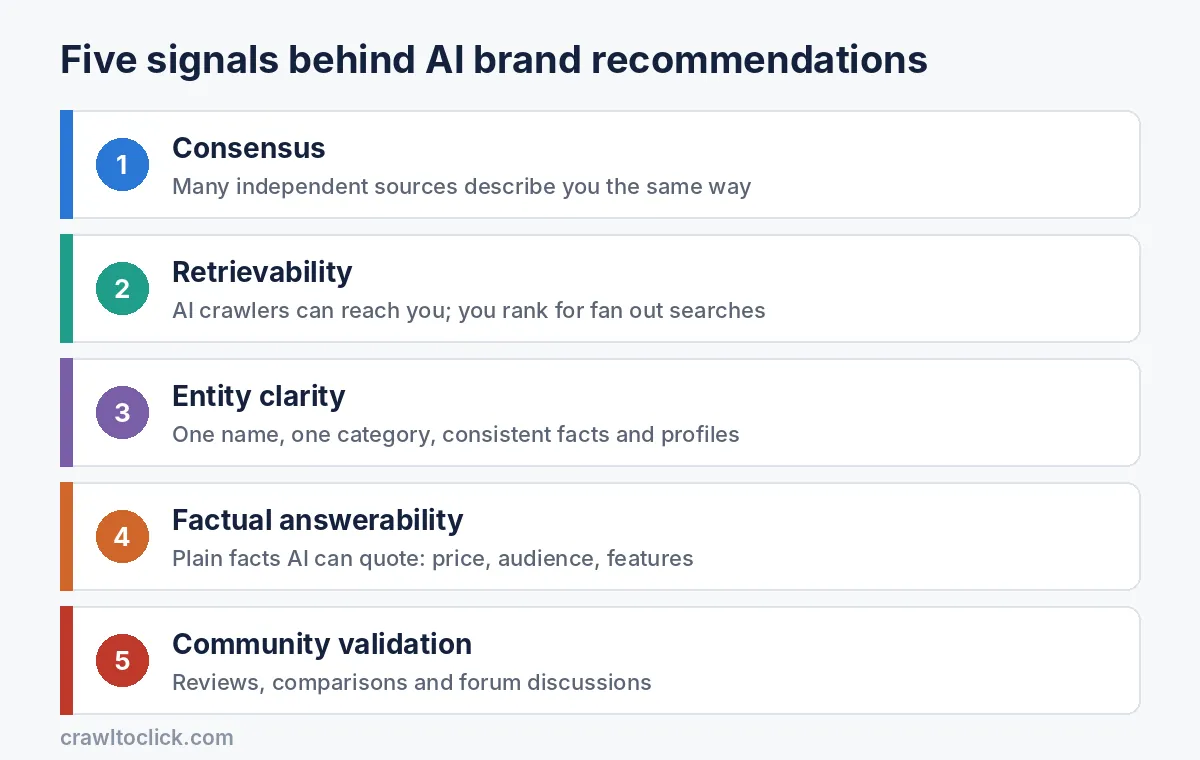
Signal 1: consensus across independent sources
LLMs are more confident naming a brand when many independent sources describe it the same way. An Ahrefs study of 75,000 brands found branded web mentions had the strongest correlation with brand visibility in Google’s AI Overviews (0.664), well ahead of domain rating (0.326), referring domains (0.295) and number of backlinks (0.218). Correlation is not causation, but the pattern matches what I see in tracking work: unlinked mentions in the right places move AI visibility more than links alone.
Signal 2: retrievability
If an assistant searches the web and cannot find or access your pages, it cannot cite them. Check that AI search crawlers are not blocked in robots.txt or by a CDN bot setting, and that your key pages rank for the follow up searches a fan out would run. In Google’s case, an Ahrefs analysis found 76.1% of AI Overview citations came from pages in the organic top 10.
Signal 3: entity clarity
An AI tool must be sure that the “Acme” in one source is the same Acme in another. Inconsistent names, a vague category (“we help businesses grow”), several different descriptions across profiles, or a name shared with another company all reduce confidence. Clear entities have one name, one category, one positioning statement and consistent facts everywhere.
Signal 4: factual answerability
Assistants prefer sources that state facts plainly: what the product does, who it is for, what it costs, how it compares. Pages that bury facts in marketing copy are harder to quote. A page that says “Pricing starts at $29 per user per month and includes unlimited projects” gives the model something it can repeat accurately.
Signal 5: community and third party validation
Comparison articles, review sites, forums and communities such as Reddit carry the “what real users think” signal that assistants lean on for recommendation questions. A brand that only talks about itself on its own site rarely gets recommended, however good the site is.
The five layer entity SEO framework
This is the framework we use to build AI visibility. Each layer feeds one or more of the signals above, and each will get its own detailed guide in this series.
Layer 1: the entity foundation
- One canonical brand name, used identically everywhere.
- A single sentence that defines what you are: “[Brand] is a [category] for [audience] that [main outcome].”
- Organization markup on your home or About page with name, URL, logo and sameAs links to your official profiles.
- Consistent profiles on the platforms that matter in your category: business directories, software review sites, professional networks, and Wikidata where you meet its notability rules.
- Founder and team pages that connect people entities to the brand.
For the full markup template, profile audit and Wikidata steps, see our guide to building a brand entity Google and LLMs trust.
Layer 2: factual messaging
- A brand fact sheet: founding year, headquarters, markets, category, key features, pricing model, integrations, notable customers you may name, and what you are not.
- The same facts repeated consistently on your About, pricing, product and comparison pages.
- Answer first page structure: the factual answer in the first two sentences of each section.
- A process to update facts everywhere when they change, because AI answers repeat outdated details for months.
Layer 3: authority and mentions
- Map which domains AI tools cite for your priority prompts, then target those: industry publications, comparison articles, review sites, podcasts and association pages.
- Aim for mentions that describe you in your own category language, not just links.
- Expert commentary from founders and specialists, which builds people entities linked to the brand.
Layer 4: community presence
- Genuine participation in the subreddits, forums and communities where your buyers ask for recommendations.
- Helpful answers from named team members, following each community’s rules on self promotion.
- Monitoring threads that rank in Google or appear in AI citations for your category.
Layer 5: AEO content and bottom of funnel pages
- Comparison pages (“[Brand] vs [competitor]”) and alternatives pages that are honest about trade offs.
- Use case and “best for” pages that match how buyers phrase recommendation prompts.
- FAQ sections built from real sales and support questions.
- Pricing pages with clear, current numbers.
Whether this work should come before or alongside classic SEO depends on your stage; see AEO vs SEO: where to spend first.
A 20 minute entity audit you can run today
Prompts to test how AI understands your brand
Run each prompt in ChatGPT, Gemini, Perplexity and Copilot in a fresh session. Copy and adapt:
1. What is [Brand]? Who is it for, and what does it cost?
2. Who are the main competitors of [Brand]?
3. What are the best [category] tools for [audience]?
4. [Brand] vs [main competitor]: which is better for [use case]?
5. What do users say about [Brand]? What are its downsides?
6. Which [category] companies are based in [country or city]?
How to score the answers
| Check | Good sign | Problem sign |
|---|---|---|
| Identity | Correct category and audience | Confused with another company, or vague |
| Facts | Current pricing, features, location | Outdated or invented details |
| Competitors | The set you actually compete with | Wrong category of competitors |
| Recommendation | Named for prompt 3 | Absent while competitors appear |
| Sources | Your site and respected third parties cited | Only old directories or nothing |
| Sentiment | Balanced, accurate downsides | Old complaints repeated as current |
For a fuller version of this audit, see our AEO audit checklist.
Entity SEO in practice: an illustrative example
Illustrative scenario (imaginary brand): a B2B invoicing tool ranks well in Google but is missing from AI recommendations. The entity audit finds four problems: the brand name is written three ways across profiles, its review site category is “accounting” while its site says “billing automation”, its pricing page has not been updated since a price change, and almost no third party comparison article mentions it.
What the team changes
- Standardises the name and one line definition across the site, schema and every profile.
- Moves all profiles into the same category and fixes the pricing page.
- Publishes honest comparison pages against its three closest competitors.
- Pitches its data on late payment trends to finance publications, earning mentions in two comparison roundups.
- Joins two finance subreddits with a named founder account, answering questions without linking.
What changes in AI answers
Over the following quarter, AI answers describe the brand correctly, quote the current price, and start including it in recommendation prompts for small agencies. This is an imaginary scenario, but each step mirrors work that moves real tracking numbers. For realistic timelines, see how long AEO takes to show results.
How to measure entity strength in AI search
Mentions per 100 queries
AI answers vary from run to run. A study reported by Search Engine Land found AI tools returned the same list of brands less than once in 100 repeated runs. So measure presence rate: run a fixed set of prompts several times per engine and report how many answers out of every 100 mention you.
Description accuracy and citation share
- Description accuracy: the share of answers that describe your category, audience and pricing correctly.
- Citation share: how often your own pages are cited as sources, and which third party domains are cited alongside you.
- Platform data: Google Search Console’s generative AI reports and Bing’s AI Performance report give first party impression and citation data where available.
Our guide to AEO KPIs shows how to turn these into a report leadership will read.
Common entity SEO mistakes
- Chasing links instead of mentions. A link from an unrelated site does less for AI visibility than a mention in a respected comparison article in your category.
- Changing positioning every quarter. Every rebrand of your one line definition resets the consensus you were building.
- Blocking AI search crawlers by accident. CDN bot protection can block crawlers you want.
- Writing only about yourself. Assistants trust what others say about you more than what you say.
- Ignoring wrong facts. Outdated pricing or features in AI answers cost deals; fix them at the source.
- Fake community activity. Undisclosed promotion on forums gets accounts banned and can turn sentiment against you.
How Crawl To Click builds entity visibility for brands
Who we are
Crawl To Click is the SEO and AI visibility practice of Indu Priya, who has more than 15 years of experience building organic growth for brands in the US, MENA and India. Our work covers AI visibility tracking, AI focused content strategy, citation insights and targeted outreach, alongside technical and editorial SEO. Read more about us and how we work.
The entity work we did for a B2B software platform
A B2B marketing software platform came to us with strong Google rankings but almost no presence in ChatGPT, Gemini or Perplexity, where its buyers had started their research. We worked through the same five layers in this guide: optimising the brand entity, tightening factual messaging, building authoritative mentions, earning citations on Reddit and structuring bottom of funnel content for AI answers. The results over the engagement:
| Metric | Before | After |
|---|---|---|
| Brand mentions per 100 tracked AI queries | 3 | 22 |
| Reddit mentions | 45 | 90+ |
| Share of demos driven by AI assistants | 2% | 10% |
| AI visitor to demo conversion rate | 8% | 14% |
| Authority citations | 4 | 15+ |
Demos grew tenfold during the engagement, and the platform now receives hundreds of demos a month from SEO and ChatGPT combined.
FAQs on entity SEO for AI search
What is entity SEO?
Entity SEO is the work of making search engines and AI systems understand your brand as a clearly defined thing, with a consistent name, category and facts, and of building the mentions and relationships that connect it to the topics and questions you want to be known for.
How do LLMs decide which brands to recommend?
They favour brands they can identify confidently and see described consistently across many independent sources, whose pages they can retrieve and quote, and that appear in comparisons, reviews and community discussions for the category.
Do backlinks matter for AI visibility?
They help, mainly through rankings and retrieval, but an Ahrefs study of 75,000 brands found branded web mentions correlated more strongly with AI Overview visibility (0.664) than backlinks (0.218) or domain rating (0.326).
Does schema markup help with AI search?
Organization markup with sameAs links helps search engines connect your brand to its official profiles and disambiguate it. It supports entity clarity but does not replace consistent facts and third party mentions.
How do I measure entity strength in AI answers?
Run a fixed prompt set several times per AI engine and measure mentions per 100 answers, the accuracy of how you are described, and how often your pages and respected third parties are cited as sources.
Need help building your brand entity for AI search?
Ranking in Google but missing from ChatGPT and Gemini answers? Request an entity and AI visibility audit and see exactly what is holding your brand back.
Disclaimer: Study figures come from the sources linked in the text; correlations do not prove causation. The invoicing tool example is imaginary. Client results come from work led by our founder and depend on market, product and execution. AI platforms change how they select sources frequently.