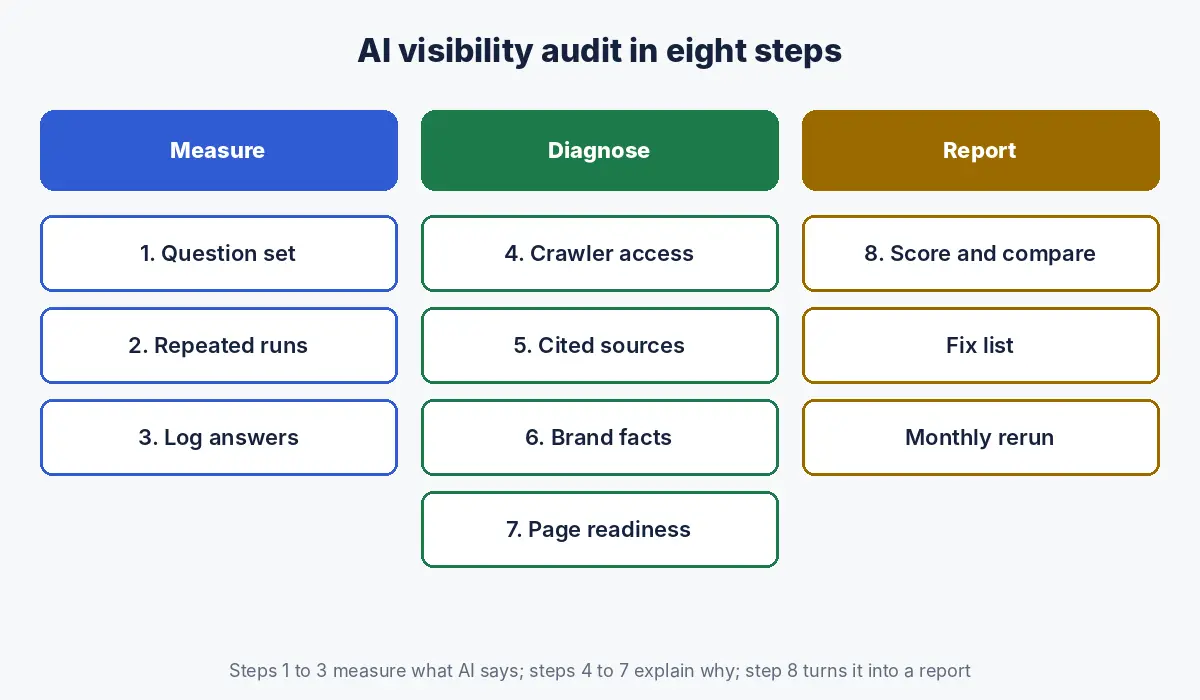
The short answer: an AI visibility audit measures how often and how accurately AI assistants such as ChatGPT, Gemini, Google AI Overviews, AI Mode, Perplexity and Copilot mention, describe and cite your brand when buyers ask questions about your category. You run it by writing 20 to 40 real buyer questions, asking each one several times on each assistant, and recording whether your brand appears, in what position, with what facts and which sources are cited. Add checks on AI crawler access, citation sources, the accuracy of your brand facts and how answer ready your key pages are, and you have a baseline you can repeat monthly.
Traditional SEO audits do not capture any of this, because AI answers do not have fixed rankings and most assistants do not report impressions. This guide sets out a step by step method a marketing team can run itself: which platforms to cover, how to build and run the question set so results are reliable, what to record, how to check crawler access, citations and facts, which data sources exist, and how to score and report the findings. A logging template is included.
What is an AI visibility audit?
An AI visibility audit is a structured check of how AI assistants represent your brand: whether they mention it, how they describe it, which competitors appear alongside it, which sources they cite, and whether anything about your website stops them from retrieving or citing your pages.
| SEO audit | AI visibility audit | |
|---|---|---|
| Main question | Can search engines crawl, index and rank our pages? | Do AI assistants mention, describe and cite us correctly? |
| Unit of measurement | Rankings, impressions, clicks | Mention rate, position in answers, citations, accuracy |
| Data source | Crawlers, Search Console, analytics | Repeated prompt sampling, AI reports, crawler logs |
| Stability of results | Rankings are fairly stable day to day | Answers vary between runs, so sampling is needed |
| Off site factors | Backlinks | Mentions, reviews, directories, communities, video |
An AI visibility audit is part of answer engine optimization; for the wider context, read what AEO is and how answer engines choose sources. It also belongs in any full audit; our guide to SEO audits in Dubai explains how the two fit together.
Why should a business run an AI visibility audit now?
Run an AI visibility audit now because a large and fast growing share of buyers ask AI assistants for recommendations before they search or contact anyone, and brands that are missing or misdescribed in those answers rarely find out from their usual reports.
- ChatGPT reached 1 billion weekly users in August 2026 (Yahoo Tech); Google AI Overviews passed 2.5 billion monthly users and AI Mode 1 billion (Google).
- 70.1% of the UAE’s working age population used AI in the first quarter of 2026, the highest rate in the world (Khaleej Times).
- Google AI Mode is available in Arabic, with the UAE among the countries in its October 2025 expansion (Search Engine Roundtable).
- Only about 6.8% of US ChatGPT prompts showed citations in May 2026 (Similarweb), so most answers come from what the model already knows about you, which no ranking report shows.
Which AI platforms should an AI visibility audit cover?
Cover the assistants your buyers actually use: for most businesses that means ChatGPT, Google AI Overviews and AI Mode, Gemini, Perplexity and Microsoft Copilot, weighted towards the ones that matter most in your market and category.
| Platform | Why include it | What it draws on |
|---|---|---|
| ChatGPT | Largest assistant by weekly users | Model knowledge, plus web search for some prompts |
| Google AI Overviews and AI Mode | Appear inside Google, which dominates search in most markets | Google’s index; pages must be indexed and snippet eligible (Google Search Central) |
| Gemini | Grows quickly through Android and Google Workspace | Google Search grounding |
| Perplexity | Research heavy users; cites sources on almost every answer | Its own index; 28.6% of its cited URLs rank in Google’s top 10 (Ahrefs) |
| Microsoft Copilot | Strong in workplaces using Microsoft 365 | Bing’s index |
Step 1: How do you build the question set for an AI visibility audit?
Build the question set from the questions real buyers ask before choosing a provider, grouped into category, problem, comparison, cost and brand questions, written in natural language and, for UAE businesses, in both English and Arabic.
| Question type | Example (illustrative) | What it reveals |
|---|---|---|
| Category | best physiotherapy clinic in Dubai Marina for sports injuries | Whether you are on the shortlist |
| Problem | how do I fix lower back pain from sitting all day | Whether your content is used for advice |
| Comparison | [your brand] vs [competitor] for small businesses | How you are positioned against rivals |
| Cost | how much does physiotherapy cost in Dubai without insurance | Whether your prices are known and correct |
| Brand | what is [your brand] and is it any good | What assistants believe about you, including errors |
Aim for 20 to 40 questions: enough to cover your main services and audiences, few enough to run repeatedly. Use your sales and support teams’ records of what prospects ask; they are better sources than keyword tools for the way people talk to assistants.
Step 2: How do you run the prompts so the results are reliable?
Run each question at least three times per assistant in fresh conversations, with consistent settings for location, language and search, and record the date, because AI answers vary between runs and change over time.
Variation is large. In research by SparkToro and Gumshoe, the chance of an AI assistant returning the same list of brand recommendations twice for the same prompt was under 1 in 100 (Search Engine Land). A single screenshot proves nothing; a mention rate across many runs does.
- Fresh conversations: start a new chat for each run, so earlier questions do not steer the answer.
- Signed out or clean accounts: personal history and memory can change answers.
- Location: run from the market you care about, or state the location in the question.
- Search setting: where the assistant allows it, note whether web search was used; answers from memory and answers from search behave differently.
- Same wording: keep the exact question text fixed between audits so results are comparable.
Our method for measuring LLM mentions per 100 queries explains sample sizes in more detail.
Step 3: What should you record for each AI answer?
For each answer, record whether your brand is mentioned, its position among the brands named, the competitors mentioned, whether your site is cited and with which URL, any factual errors about you, and the overall tone.
date | assistant | question_id | run | search_used | brand_mentioned
| position | competitors_named | our_url_cited | other_sources_cited
| factual_error (quote) | tone (positive/neutral/negative) | notes
One row per run. A spreadsheet with these columns becomes the basis for every metric in the report. Quote errors exactly; “ChatGPT says we only serve Abu Dhabi” is far more useful to the team fixing it than “some inaccuracies”.
Step 4: How do you check whether AI crawlers can access your site?
Check robots.txt, firewall and CDN settings for the search crawlers of each assistant, because a block at this level silently removes your pages from AI search results no matter how good the content is.
| Company | Crawler that affects search answers | Training only crawler |
|---|---|---|
| OpenAI | OAI SearchBot (OpenAI) | GPTBot |
| Anthropic | Claude SearchBot and Claude User (Anthropic) | ClaudeBot |
| Perplexity | PerplexityBot (Perplexity) | Not used for model training, per Perplexity |
| Googlebot (Search, AI Overviews, AI Mode) | Google Extended token, which does not affect Search (Search Engine Roundtable) | |
| Microsoft | Bingbot (Bing and Copilot) | Not applicable |
Then check your server or CDN logs to confirm the search crawlers actually reach your important pages. Some security settings block AI bots by default, without anyone choosing to.
Step 5: How do you find which sources AI assistants cite in your category?
From your logged answers, list every cited domain and count how often each appears; the result is a citation source map that shows which publications, directories, communities and competitors shape AI answers in your category.
Across 30 million cited sources, Reddit, YouTube, LinkedIn and Wikipedia were among the most cited domains in AI search (Peec AI), but every category has its own mix of specialist publishers, directories and review sites. Our guide to citation source mapping turns the list into a prioritised outreach plan.
Step 6: How do you check the accuracy of what AI says about your brand?
Compare every factual statement in the brand question answers against an approved fact sheet covering services, prices, locations, audiences, key people and credentials, and record each error with the assistant, date and, where cited, the source it came from.
Errors usually trace back to an outdated page, an old directory listing, a press article or a competitor comparison. Fixing the source, rather than complaining about the answer, is what changes future answers; our guide to fixing wrong facts about your brand in AI answers walks through the process.
Step 7: How do you check whether your pages are answer ready?
Review your most important pages for whether each section opens with a direct, factual answer to a buyer question, whether prices, locations and specifics are in plain text, and whether structured data matches the visible content.
- Headings phrased as the questions buyers ask.
- First sentence of each section answers the heading with a specific fact.
- Prices, service areas, timelines and eligibility in text, not images or PDFs.
- Comparisons in tables.
- Pages indexed and ranking: 76.10% of pages cited in Google AI Overviews rank in the top 10 for the query (Ahrefs).
- English and Arabic versions with the same facts.
Step 8: Which data sources help measure AI visibility?
Combine your prompt sampling with Search Console’s generative AI reports where available, Bing Webmaster Tools’ AI performance data, analytics referrals from AI assistants, and server logs of AI crawler activity.
| Source | What it shows | Limits |
|---|---|---|
| Search Console generative AI reports | Impressions in AI Overviews and AI Mode by page, country, device and date (Google Search Central) | Impressions only; no queries, clicks or position yet (Search Engine Journal); rolling out gradually |
| Bing Webmaster Tools AI performance | Citations in Copilot and Bing AI answers (Search Engine Land) | Microsoft surfaces only |
| Analytics referrals | Sessions and leads from chatgpt.com, perplexity.ai, gemini.google.com, copilot.microsoft.com | Some AI visits arrive without referrer data |
| Server logs | Which pages AI crawlers request | Shows access, not answers |
| Your prompt log | Mentions, position, accuracy, citations across all assistants | Manual effort; needs repeated runs |
How do you score and report an AI visibility audit?
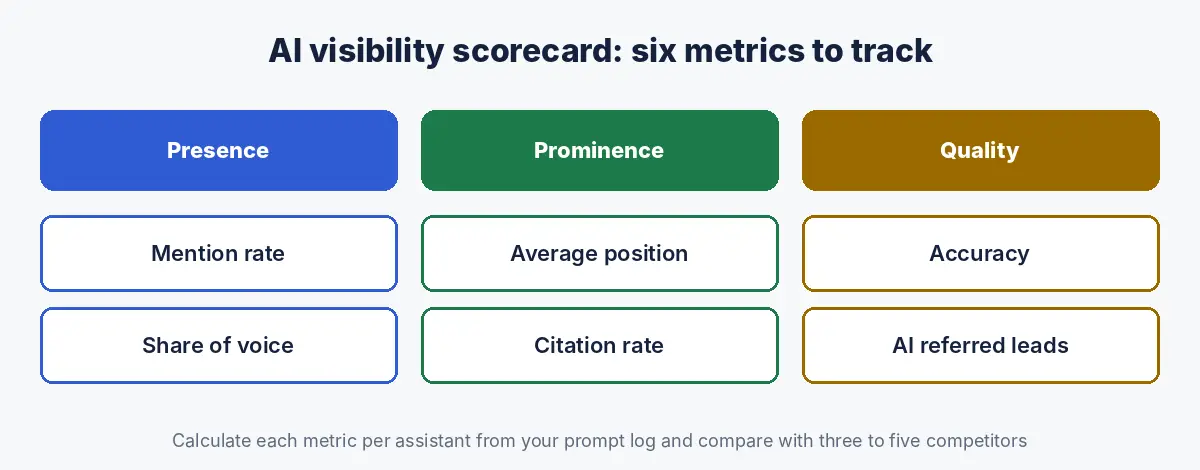
Score the audit with a small set of metrics calculated from your prompt log, compared against your main competitors, and report them with the specific errors, blocked crawlers and missing sources that explain the numbers.
| Metric | How to calculate it |
|---|---|
| Mention rate | Runs where your brand is named divided by total runs, per assistant |
| Share of voice | Your mentions divided by mentions of all tracked brands |
| Average position | Mean position when your brand appears in a list |
| Citation rate | Runs citing one of your URLs divided by runs with citations |
| Accuracy | Brand question runs with no factual error divided by brand question runs |
| AI referred leads | Leads from AI referral sessions in analytics |
Ahrefs found branded web mentions were the factor most correlated with brand visibility in AI Overviews, at 0.664, against 0.218 for backlinks (Ahrefs), so the report’s recommendations usually include off site work as well as page fixes. For what a full professional audit should deliver, compare against our AEO audit checklist.
How often should you repeat an AI visibility audit?
Repeat the core question set monthly with the same wording and settings, run a full audit including crawler, citation and accuracy checks every quarter, and rerun brand questions after any rebrand, price change or new launch.
Monthly runs show trends that single audits miss, and keeping the method fixed is what makes month to month comparisons meaningful. Add new questions in a separate group rather than changing the original set.
What are the common mistakes in AI visibility audits?
| Mistake | Better approach |
|---|---|
| Judging from one screenshot | Several runs per question, reported as a rate |
| Changing question wording every month | Fixed core set; new questions added separately |
| Testing only ChatGPT | Cover the assistants your buyers use |
| Ignoring Arabic | Run part of the set in Arabic for UAE audiences |
| Recording mentions but not errors | Quote every factual error and trace its source |
| Skipping crawler checks | Confirm search crawlers can reach key pages |
| No competitor comparison | Track three to five competitors in the same runs |
What does a sample AI visibility audit report look like?
A sample AI visibility audit report summarises how often the brand is mentioned compared with competitors on each assistant, lists factual errors and blocked crawlers, and sets out fixes on the site, in profiles and in the sources AI answers cite.
Sample summary (illustrative): “A Dubai B2B software company tested with 30 buyer questions, three runs each on five assistants (450 runs). The brand was mentioned in 18% of runs against 41% for the category leader. ChatGPT states an old pricing model in 7 of 15 brand question runs. Perplexity cannot crawl the site because the CDN blocks PerplexityBot. Two review platforms and one industry list drive most competitor citations.”
| Metric | Brand | Leading competitor |
|---|---|---|
| Mention rate (all assistants) | 18% | 41% |
| Average position when listed | 4.1 | 1.8 |
| Citation rate | 6% | 22% |
| Accuracy on brand questions | 53% | Not measured |
| # | Finding | Evidence | Impact | Fix | Owner | Priority |
|---|---|---|---|---|---|---|
| 1 | CDN blocks PerplexityBot | Server logs and firewall rules | No citations possible in Perplexity | Allow PerplexityBot in CDN rules | Developer | High, quick win |
| 2 | Old pricing model repeated by ChatGPT | 7 of 15 brand runs quote discontinued plan | Prospects misinformed | Update pricing page, review profiles and partner listings | Marketing | High |
| 3 | Missing from two review platforms cited most often | Citation source map | Not considered in shortlists | Create profiles; invite reviews from customers | Marketing | High |
| 4 | Comparison pages missing | No pages for top 3 comparison questions | Competitors define the comparison | Publish fair comparison pages | Content | Medium |
The company and figures above are illustrative, not a real client.
How Crawl To Click runs AI visibility audits
Crawl To Click is an SEO and AI visibility consultancy, and our AI visibility audits follow this method at a larger scale: a question set built from real sales conversations in English and Arabic, repeated runs across ChatGPT, Gemini, Google AI Overviews and AI Mode, Perplexity and Copilot, a full log of mentions, positions, citations and errors, crawler access and log checks, a citation source map and a page by page answer readiness review. The report compares the brand with its competitors and sets out fixes on the site, in profiles and directories, and in the sources assistants rely on. We run these audits for clinics, property brokers, schools, software companies, ecommerce stores and professional services firms in the UAE and India.
FAQs on AI visibility audits
What is an AI visibility audit?
An AI visibility audit measures how AI assistants such as ChatGPT, Gemini, Google AI Overviews, AI Mode, Perplexity and Copilot mention, describe and cite a brand, using repeated buyer questions, plus checks on AI crawler access, citation sources, factual accuracy and how answer ready the brand’s pages are.
How many prompts do I need for an AI visibility audit?
Use 20 to 40 real buyer questions and run each at least three times per assistant in fresh conversations. Because answers vary between runs, results should be reported as rates across all runs rather than from single answers.
Can I see AI Overview data in Google Search Console?
Search Console’s generative AI performance reports, introduced in June 2026 and rolling out gradually, show impressions in AI Overviews and AI Mode by page, country, device and date. They do not currently show queries, clicks or position.
Why does ChatGPT give different answers each time?
AI assistants generate answers probabilistically and may search different sources on each run, so recommendations vary. Research by SparkToro and Gumshoe found the same brand list repeated for the same prompt less than once in 100 runs.
How do I fix wrong information about my brand in AI answers?
Find where the wrong fact comes from, usually an outdated page, directory listing or article, correct it at the source, publish clear and consistent facts on your own site and profiles, and recheck the answers over the following weeks and model updates.
How often should I run an AI visibility audit?
Run the core question set monthly with fixed wording and settings, carry out a full audit including crawler, citation and accuracy checks quarterly, and recheck brand questions after any rebrand, price change or launch.
Want to know what AI assistants say about your brand?
Find out whether ChatGPT, Gemini and Google AI recommend you or your competitors, and what they get wrong. Request an AI visibility audit.
Disclaimer: This article reflects published documentation and studies as of the dates stated. AI assistants, their crawlers and reporting tools change frequently. Examples are illustrative.